Tajikistan Cargo Shipping Market Size, Share & Growth Rate
The Tajikistan Cargo Shipping Market was estimated at USD 842 Million in 2025 and is projected to reach USD 1223 Million by 2032, growing at a CAGR of 5.5% from 2026 to 2032. This anticipated growth trajectory is primarily fueled by Tajikistan's strategic positioning within Central Asia, enhancing its role as a vital trade corridor. As trade volumes with neighboring countries increase and infrastructure improvements continue, the demand for efficient cargo shipping services is set to rise significantly.
Tajikistan Cargo Shipping Market Year-wise Growth Rate and Key Drivers
This graph highlights how the Tajikistan Cargo Shipping Market has steadily grown over the years, supported by major growth factors.
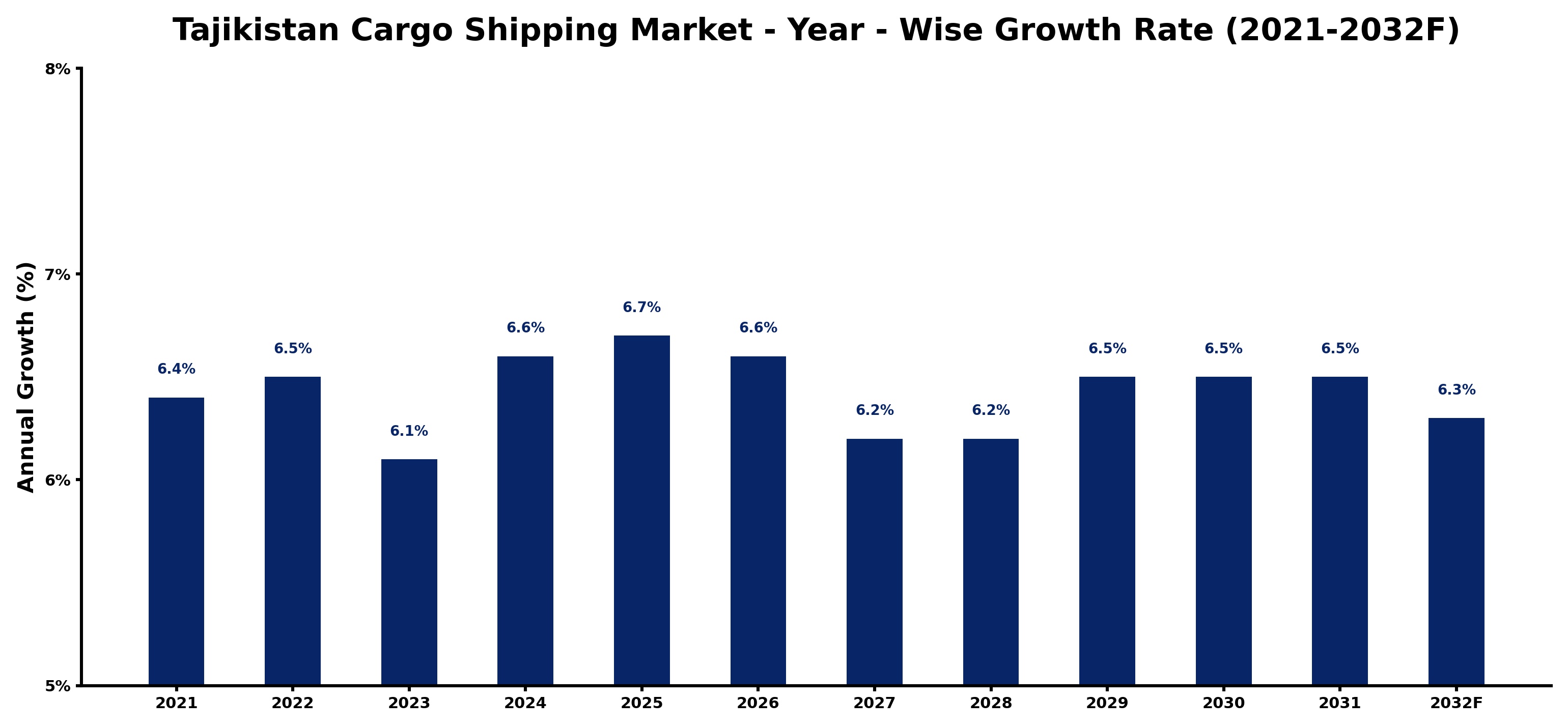
The table below presents the year‑wise growth rates along with the key drivers influencing the market
| Year | Growth Rate | Major Drivers |
| 2021 | 6.4% | Increasing industrial infrastructure investments |
| 2022 | 6.5% | Increasing industrial automation investments |
| 2023 | 6.1% | Expansion of commercial construction activities |
| 2024 | 6.6% | Government infrastructure modernization initiatives |
| 2025 | 6.7% | Growing renewable energy integration projects |
| 2026 | 6.6% | Expansion of manufacturing activities |
| 2027 | 6.2% | Expansion of commercial construction activities |
| 2028 | 6.2% | Rising electricity demand across industries |
| 2029 | 6.5% | Increasing adoption of advanced technologies |
| 2030 | 6.5% | Increasing smart city development projects |
| 2031 | 6.5% | Increasing smart city development projects |
| 2032 | 6.3% | Expansion of transportation and logistics networks |
Note - Market size estimations and growth projections presented in this report are based on 6Wresearch's advanced forecasting approach, validated with industry datasets as of June 2026.
Tajikistan Cargo Shipping Market Synopsis
The landlocked nature of Tajikistan compels businesses to rely heavily on road transport, making efficiency in this sector critical. With major routes traversing Uzbekistan and Kyrgyzstan, there's an urgent need for the modernization of logistics networks to facilitate smoother cargo movement.
Additionally, the increasing emphasis on sustainability and technological advancements within the market is reshaping operational practices. Companies are now prioritizing eco-friendly transportation solutions and adopting digital tools for better supply chain visibility, aiming for improved efficiency and reduced costs.
Tajikistan Cargo Shipping Market Key Takeaways
- The Tajikistan cargo shipping market is set for substantial growth, driven by improvements in infrastructure and trade connectivity.
- Increased adoption of technology and eco-friendly practices is revolutionizing logistics operations in the region.
- Ongoing regional trade agreements are enhancing Tajikistan's strategic importance in Central Asia.
- Investments in transportation infrastructure present significant opportunities for market entrants and existing players alike.
- Government initiatives focused on reducing regulatory burdens are expected to enhance operational efficiency for cargo shippers.
Evaluation of Restraints in Tajikistan Cargo Shipping Market
Despite the promising outlook, the Tajikistan cargo shipping market faces significant restraints. Chief among these is the inadequate infrastructure, particularly in remote areas where road conditions hinder transport efficiency. The reliance on neighboring countries for access to international ports complicates logistics, often leading to higher transit costs and delays. Moreover, limited access to modern tracking and logistics technologies creates transparency issues, further complicating operations. Additionally, bureaucratic hurdles can impede timely customs processes, presenting challenges to smooth cargo movements across borders.
Tajikistan Cargo Shipping Market Trends
Several key trends are emerging within the Tajikistan cargo shipping market. The most prominent trend is the escalating demand for efficient logistics services as trade activities flourish. This, combined with the increasing push for digital solutions like real-time cargo tracking and automated management systems, is enhancing overall operational efficacy. Sustainability is also gaining traction, with logistics firms increasingly focusing on green practices, signaling a shift in how the industry operates and aligns with global environmental goals.
Tajikistan Cargo Shipping Market Opportunities
There are numerous opportunities for growth and investment within the Tajikistan cargo shipping market. Investors could explore ventures in logistics services that emphasize efficiency and innovation, capitalizing on the burgeoning demand for improved cargo handling. Infrastructure development, particularly projects aimed at enhancing connectivity to critical international routes, presents lucrative prospects. Additionally, integrating technology in logistics management offers a pathway to improve operational transparency and cost-effectiveness.
Government Initiatives in the Tajikistan Cargo Shipping Market
The Tajik government is actively implementing policies to bolster the cargo shipping sector. A primary focus is on developing transportation infrastructure, which includes enhancing existing road and rail networks. Streamlining customs procedures and reducing bureaucratic hurdles are also on the agenda, aimed at improving logistical efficiency and reducing operational costs. Additionally, the government is fostering regional cooperation to better integrate Tajikistan into broader trade frameworks, enhancing its appeal as a strategic logistical hub.
Future Insights of the Tajikistan Cargo Shipping Market
Looking ahead to 2026-2032, the future of the Tajikistan cargo shipping market appears optimistic. Infrastructure enhancements and increasing foreign investment are anticipated to bolster demand for cargo shipping services significantly. Additionally, as regional trade networks strengthen and economic conditions improve, Tajikistan is poised to become a pivotal trade link between Europe and Asia. However, addressing existing challenges, such as bureaucratic inefficiencies and infrastructural deficits, will be crucial for realizing this potential and maintaining growth momentum.
Tajikistan Cargo Shipping Market Latest Developments (May 2025 - June 2026)
Recent developments in the Tajikistan cargo shipping market indicate a strong commitment to enhancing infrastructure and efficiency. Various initiatives are underway to modernize transportation networks, with an emphasis on improving road quality and expanding rail links to neighboring countries. Furthermore, companies are increasingly adopting advanced logistics technologies aimed at streamlining operations and improving cargo visibility. These trends reflect a growing recognition of the importance of efficient shipping solutions in fostering economic growth.
Tajikistan Cargo Shipping Market - Key Attractiveness of the Report
- 10 Years of Market Numbers
- Historical Data Starting from 2022 to 2025
- Base Year: 2025
- Forecast Data until 2032
- Key Performance Indicators Impacting the Market
- Major Upcoming Developments and Projects
Key Highlights of the Report:
- Tajikistan Cargo Shipping Market Outlook
- Market Size of Tajikistan Cargo Shipping Market, 2025
- Forecast of Tajikistan Cargo Shipping Market, 2032
- Historical Data and Forecast of Tajikistan Cargo Shipping Revenues & Volume for the Period 2022-2032F
- Tajikistan Cargo Shipping Market Trend Evolution
- Tajikistan Cargo Shipping Market Drivers and Challenges
- Tajikistan Cargo Shipping Price Trends
- Tajikistan Cargo Shipping Porter's Five Forces
- Tajikistan Cargo Shipping Industry Life Cycle
- Historical Data and Forecast of Tajikistan Cargo Shipping Market Revenues & Volume By Cargo Infrastructure for the Period 2022-2032F
- Historical Data and Forecast of Tajikistan Cargo Shipping Market Revenues & Volume By Port Developments in Asia for the Period 2022-2032F
- Historical Data and Forecast of Tajikistan Cargo Shipping Market Revenues & Volume By Port Developments in Europe for the Period 2022-2032F
- Historical Data and Forecast of Tajikistan Cargo Shipping Market Revenues & Volume By Port Developments in North America for the Period 2022-2032F
- Historical Data and Forecast of Tajikistan Cargo Shipping Market Revenues & Volume By Port Developments in South America for the Period 2022-2032F
- Historical Data and Forecast of Tajikistan Cargo Shipping Market Revenues & Volume By Port Developments in Africa for the Period 2022-2032F
- Historical Data and Forecast of Tajikistan Cargo Shipping Market Revenues & Volume By Cargo Type for the Period 2022-2032F
- Historical Data and Forecast of Tajikistan Cargo Shipping Market Revenues & Volume By Container Cargo for the Period 2022-2032F
- Historical Data and Forecast of Tajikistan Cargo Shipping Market Revenues & Volume By Bulk Cargo for the Period 2022-2032F
- Historical Data and Forecast of Tajikistan Cargo Shipping Market Revenues & Volume By General Cargo for the Period 2022-2032F
- Historical Data and Forecast of Tajikistan Cargo Shipping Market Revenues & Volume By Oil & Gas for the Period 2022-2032F
- Historical Data and Forecast of Tajikistan Cargo Shipping Market Revenues & Volume By Industry Type for the Period 2022-2032F
- Historical Data and Forecast of Tajikistan Cargo Shipping Market Revenues & Volume By Food, Manufacturing for the Period 2022-2032F
- Historical Data and Forecast of Tajikistan Cargo Shipping Market Revenues & Volume By Oil & Ores for the Period 2022-2032F
- Historical Data and Forecast of Tajikistan Cargo Shipping Market Revenues & Volume By Electrical & Electronics for the Period 2022-2032F
- Tajikistan Cargo Shipping Import Export Trade Statistics
- Market Opportunity Assessment By Cargo Infrastructure
- Market Opportunity Assessment By Cargo Type
- Market Opportunity Assessment By Industry Type
- Tajikistan Cargo Shipping Top Companies Market Share
- Tajikistan Cargo Shipping Competitive Benchmarking By Technical and Operational Parameters
- Tajikistan Cargo Shipping Company Profiles
- Tajikistan Cargo Shipping Key Strategic Recommendations






































