Tajikistan Cellulose Acetate Fiber Market Size, Share & Growth Rate
The Tajikistan Cellulose Acetate Fiber Market was estimated at USD 293 Million in 2025 and is projected to reach USD 397 Million by 2032, growing at a CAGR of 4.4% from 2026 to 2032. This growth trajectory is primarily driven by the increasing consumer preference for sustainable and biodegradable materials, particularly within the textile and apparel sectors. Furthermore, government initiatives aimed at promoting eco-friendly practices in the industry are further enhancing market prospects.
Tajikistan Cellulose Acetate Fiber Market Year-wise Growth Rate and Key Drivers
This graph highlights how the Tajikistan Cellulose Acetate Fiber Market has steadily grown over the years, supported by major growth factors.
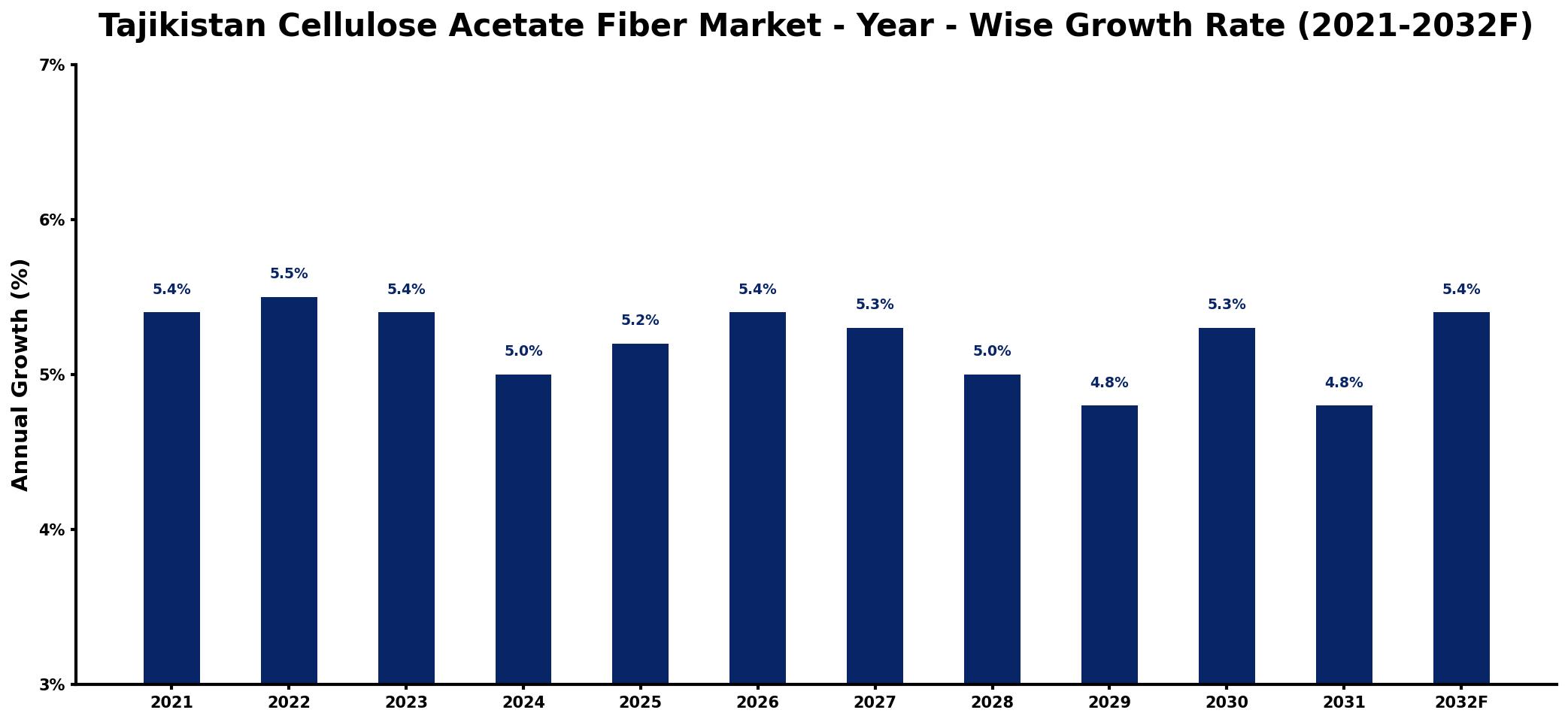
The table below presents the year‑wise growth rates along with the key drivers influencing the market
| Year | Growth Rate | Major Drivers |
| 2021 | 5.4% | Rising textile manufacturing investments |
| 2022 | 5.5% | Increased demand from apparel sector |
| 2023 | 5.4% | Growth in sustainable fashion initiatives |
| 2024 | 5.0% | Emerging markets expanding production capabilities |
| 2025 | 5.2% | Technological advancements in production processes |
| 2026 | 5.4% | Growing consumer awareness of sustainability |
| 2027 | 5.3% | Higher exports to neighboring countries |
| 2028 | 5.0% | Increased usage in automotive applications |
| 2029 | 4.8% | Expansion of local production facilities |
| 2030 | 5.3% | Rising demand for eco-friendly alternatives |
| 2031 | 4.8% | growing automotive sector requirements |
| 2032 | 5.4% | Increased investment in research innovations |
Note: Market size estimations and growth projections presented in this report are based on 6Wresearch's proprietary forecasting methodology, utilizing the latest available industry data, government publications, and primary research inputs.
Tajikistan Cellulose Acetate Fiber Market Synopsis
The demand for cellulose acetate fibers in Tajikistan is being propelled by a rising awareness of environmental issues among consumers. As the textile industry pivots towards sustainable solutions, these fibers are becoming an essential component in modern manufacturing practices. This shift not only caters to local market needs but also aligns with global trends advocating for sustainable textiles.
On the supply side, while the country faces challenges such as limited domestic production capacity, investment in research and development is fostering innovation. This evolving landscape is making cellulose acetate fibers more attractive for various applications, including apparel and home textiles, as manufacturers strive to meet the growing demand.
Tajikistan Cellulose Acetate Fiber Market Key Takeaways
- The market is projected to grow at a CAGR of 4.4% from 2026 to 2032, reflecting a shift towards sustainability.
- Government initiatives are significantly promoting sustainable practices and investments in the textile sector.
- Increased consumer awareness about the environmental impact of synthetic fibers is driving demand for biodegradable materials.
- Strategic investments in R&D are leading to improved product quality and innovation in cellulose acetate fibers.
- Investment opportunities lie in establishing local production facilities and partnerships with textile manufacturers.
Evaluation of Restraints in Tajikistan Cellulose Acetate Fiber Market
Despite its growth potential, the Tajikistan Cellulose Acetate Fiber Market faces significant constraints. The lack of domestic production capabilities means that manufacturers heavily depend on imports for raw materials, exposing them to supply chain vulnerabilities and price volatility. This reliance complicates profit margin management and pricing strategies in a competitive market environment where synthetic fibers like polyester and nylon dominate. Navigating these issues requires a strategic focus on technology investments and market diversification efforts.
Tajikistan Cellulose Acetate Fiber Market Trends
Currently, a notable trend is the increasing emphasis on product innovation within the cellulose acetate fiber segment. Manufacturers are continuously enhancing both the aesthetic appeal and functional performance of these fibers to cater to evolving consumer preferences for sustainable fashion. Additionally, collaborations between local companies and international partners are on the rise, aiming to bolster production capabilities and improve the overall market infrastructure.
Tajikistan Cellulose Acetate Fiber Market Opportunities
Opportunities for investment are abundant in the Tajikistan Cellulose Acetate Fiber Market, particularly in establishing manufacturing facilities that harness local resources. Investors can capitalize on the increasing trend toward biodegradable fibers by supporting existing textile companies in expanding their product lines. Moreover, the potential for government-backed initiatives that advocate for sustainable practices offers a promising avenue for aligning investments with national interests in environmental stewardship.
Government Initiatives in the Tajikistan Cellulose Acetate Fiber Market
The Tajikistan government is actively supporting the cellulose acetate fiber market through various initiatives aimed at fostering industry growth. Policies include providing financial incentives, such as tax breaks and subsidies, to manufacturers who focus on sustainable production. Moreover, there is a strong emphasis on promoting research and development within the sector, ensuring that the quality and competitiveness of local products align with international standards and sustainable practices.
Future Insights of the Tajikistan Cellulose Acetate Fiber Market
The outlook for the Tajikistan Cellulose Acetate Fiber Market between 2026 and 2032 is optimistic. With increasing disposable income levels among consumers, the demand for high-quality, eco-friendly textiles is anticipated to rise significantly. Coupled with government efforts to enhance the textile industry and attract foreign investments, the market is positioned for steady growth. The sustained focus on sustainability will likely remain a central theme, driving further adoption of cellulose acetate fibers across various applications.
Tajikistan Cellulose Acetate Fiber Market Latest Developments (2025 - 2026)
In recent months, the Tajikistan Cellulose Acetate Fiber Market has seen an uptick in collaborations aimed at enhancing the production capacity and quality of cellulose acetate fibers. Companies are increasingly prioritizing sustainability, with several initiatives being launched to develop more environmentally friendly production processes. Additionally, awareness campaigns to educate consumers about the benefits of cellulose acetate are gaining traction, fostering a greater appreciation for sustainable textiles within the local market.
Tajikistan Cellulose Acetate Fiber Market - Key Attractiveness of the Report
- 10 Years of Market Numbers
- Historical Data Starting from 2022 to 2025
- Base Year: 2025
- Forecast Data until 2032
- Key Performance Indicators Impacting the Market
- Major Upcoming Developments and Projects
Key Highlights of the Report:
- Tajikistan Cellulose Acetate Fiber Market Outlook
- Market Size of Tajikistan Cellulose Acetate Fiber Market, 2025
- Forecast of Tajikistan Cellulose Acetate Fiber Market, 2032
- Historical Data and Forecast of Tajikistan Cellulose Acetate Fiber Revenues & Volume for the Period 2022-2032F
- Tajikistan Cellulose Acetate Fiber Market Trend Evolution
- Tajikistan Cellulose Acetate Fiber Market Drivers and Challenges
- Tajikistan Cellulose Acetate Fiber Price Trends
- Tajikistan Cellulose Acetate Fiber Porter's Five Forces
- Tajikistan Cellulose Acetate Fiber Industry Life Cycle
- Historical Data and Forecast of Tajikistan Cellulose Acetate Fiber Market Revenues & Volume By Type for the Period 2022-2032F
- Historical Data and Forecast of Tajikistan Cellulose Acetate Fiber Market Revenues & Volume By Plastic for the Period 2022-2032F
- Historical Data and Forecast of Tajikistan Cellulose Acetate Fiber Market Revenues & Volume By Fiber for the Period 2022-2032F
- Historical Data and Forecast of Tajikistan Cellulose Acetate Fiber Market Revenues & Volume By Application for the Period 2022-2032F
- Historical Data and Forecast of Tajikistan Cellulose Acetate Fiber Market Revenues & Volume By Photographic Films for the Period 2022-2032F
- Historical Data and Forecast of Tajikistan Cellulose Acetate Fiber Market Revenues & Volume By Cigarette Filters for the Period 2022-2032F
- Historical Data and Forecast of Tajikistan Cellulose Acetate Fiber Market Revenues & Volume By Tapes & Labels for the Period 2022-2032F
- Historical Data and Forecast of Tajikistan Cellulose Acetate Fiber Market Revenues & Volume By Textiles & Apparel for the Period 2022-2032F
- Tajikistan Cellulose Acetate Fiber Import Export Trade Statistics
- Market Opportunity Assessment By Type
- Market Opportunity Assessment By Application
- Tajikistan Cellulose Acetate Fiber Top Companies Market Share
- Tajikistan Cellulose Acetate Fiber Competitive Benchmarking By Technical and Operational Parameters
- Tajikistan Cellulose Acetate Fiber Company Profiles
- Tajikistan Cellulose Acetate Fiber Key Strategic Recommendations






































