Tajikistan Chloroprene rubber Market Size, Share & Growth Rate
The Tajikistan Chloroprene rubber Market was estimated at USD 501 Million in 2025 and is projected to reach USD 727 Million by 2032, growing at a CAGR of 5.5% from 2026 to 2032. This growth trajectory is primarily fueled by the rapid expansion of the manufacturing sector in Tajikistan, coupled with infrastructure development projects that necessitate the use of durable materials like Chloroprene rubber. As industries increasingly recognize the advantages of Chloroprene rubber in applications such as automotive seals and construction adhesives, demand is set to rise significantly.
Tajikistan Chloroprene rubber Market Year-wise Growth Rate and Key Drivers
This graph highlights how the Tajikistan Chloroprene rubber Market has steadily grown over the years, supported by major growth factors.
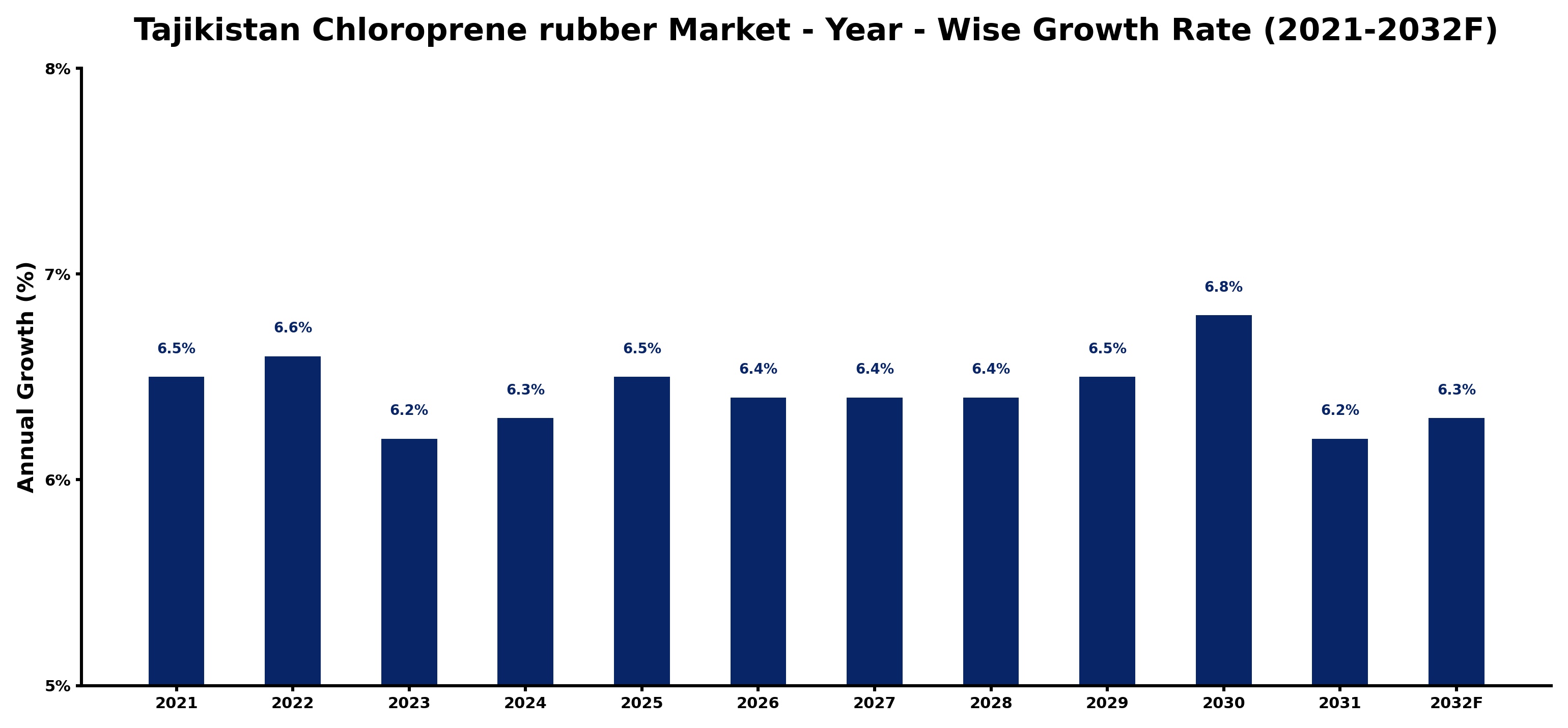
The table below presents the year‑wise growth rates along with the key drivers influencing the market
| Year | Growth Rate | Major Drivers |
| 2021 | 6.5% | Manufacturing investments in advanced processing technologies boost chloroprene output |
| 2022 | 6.6% | Chloroprene rubber production scale up drives local manufacturing investments |
| 2023 | 6.2% | Increased manufacturing investments boosted chloroprene rubber capacity utilization |
| 2024 | 6.3% | Domestic manufacturers adopt advanced technology for chloroprene rubber production |
| 2025 | 6.5% | Higher chloroprene rubber plant capacities boost regional automotive supply chain |
| 2026 | 6.4% | Construction projects stimulate demand for chloroprene rubber applications |
| 2027 | 6.4% | Local tire manufacturing plants expanded chloroprene rubber sourcing requirements |
| 2028 | 6.4% | Increased foreign investment spurs local chloroprene rubber production capacity |
| 2029 | 6.5% | Domestic infrastructure projects boosted chloroprene rubber demand in construction |
| 2030 | 6.8% | Improved chloroprene rubber processing techniques boosted production efficiency |
| 2031 | 6.2% | Domestic manufacturers adopt automation, boosting chloroprene rubber production efficiency |
| 2032 | 6.3% | Export driven investments boost chloroprene rubber manufacturing capacity expansion |
Note - Market size estimations and growth projections presented in this report are based on 6Wresearch’s advanced forecasting approach, validated with industry datasets as of June 2026.
Tajikistan Chloroprene rubber Market Synopsis
The Chloroprene rubber market in Tajikistan is on an upward trend, driven by its diverse applications across various industries, including automotive, construction, and electronics. The material's exceptional resistance to heat, oil, and ozone positions it as a material of choice for numerous industrial applications.
Increasing awareness regarding the benefits of Chloroprene rubber is evident among local manufacturers, who are investing in product innovation and supply chain optimization. This strategic focus is crucial as Tajikistan continues to enhance its manufacturing capabilities and infrastructure to meet rising domestic and regional demand.
Tajikistan Chloroprene rubber Market Key Takeaways
- The market is driven by strong demand from the automotive, construction, and electronics sectors.
- Investment in manufacturing and infrastructure development is creating new opportunities for growth.
- Strategic partnerships and product innovation are key focuses for market players.
- Challenges include reliance on imports and fluctuating raw material prices.
- The government's supportive policies are bolstering the market landscape.
Evaluation of Restraints in Tajikistan Chloroprene rubber Market
Despite its growth potential, the Tajikistan Chloroprene rubber market faces notable constraints. The heavy reliance on imports for raw materials places local manufacturers at the mercy of global price fluctuations, which can significantly affect profitability. Inconsistent quality control standards also hinder the competitiveness of domestic products. Furthermore, bureaucratic inefficiencies and inadequate infrastructure complicate the production and distribution processes, creating barriers that must be addressed to unlock the full potential of this market.
Tajikistan Chloroprene rubber Market Trends
Currently, the market is witnessing a surge in demand for eco-friendly materials, prompting manufacturers to explore sustainable alternatives to traditional Chloroprene rubber. Additionally, advancements in production technologies are enhancing product quality and efficiency, enabling local players to better compete in both domestic and international markets. The growing trend towards automation and digitalization in manufacturing processes is also reshaping operational frameworks, resulting in improved supply chain management.
Tajikistan Chloroprene rubber Market Opportunities
The outlook for investment in the Tajikistan Chloroprene rubber market is promising, particularly as the demand for synthetic rubber escalates across industries. Opportunities abound for establishing new production facilities and forming strategic alliances with local entities to meet the growing needs. Moreover, investing in R&D initiatives aimed at enhancing product performance and sustainability could lead to significant competitive advantages. As infrastructure projects expand, the demand for innovative applications of Chloroprene rubber will continue to rise.
Government Initiatives in the Tajikistan Chloroprene rubber Market
The government of Tajikistan has recognized the strategic importance of the Chloroprene rubber market and is actively implementing policies to support its growth. Initiatives include tax incentives for manufacturers and funding for R&D programs that focus on technological advancements within the industry. Furthermore, efforts to enhance infrastructure and reduce bureaucratic red tape are paving the way for improved production capabilities and increased foreign investment in the sector.
Future Insights of the Tajikistan Chloroprene rubber Market
Looking ahead, the Tajikistan Chloroprene rubber market is expected to flourish, with continued industrial expansion fueling demand across multiple sectors. The government's commitment to attracting foreign investments, along with ongoing infrastructure improvements, will likely create a robust environment for growth. However, as competition from alternative synthetic rubbers intensifies, manufacturers must remain agile and innovative to maintain their market positions and seize upcoming opportunities.
Tajikistan Chloroprene rubber Market Latest Developments (May 2025 - June 2026)
Recent developments in the Tajikistan Chloroprene rubber market indicate a shift towards increased collaboration between domestic and international companies. This trend is fostering knowledge transfer and technology-sharing initiatives, which are critical for improving production capabilities. Additionally, growing partnerships with research institutions are aimed at enhancing product quality and exploring new applications, setting a positive trajectory for future growth.
Tajikistan Chloroprene rubber Market - Key Attractiveness of the Report
- 10 Years of Market Numbers
- Historical Data Starting from 2022 to 2025
- Base Year: 2025
- Forecast Data until 2032
- Key Performance Indicators Impacting the Market
- Major Upcoming Developments and Projects
Key Highlights of the Report:
- Tajikistan Chloroprene rubber Market Outlook
- Market Size of Tajikistan Chloroprene rubber Market, 2025
- Forecast of Tajikistan Chloroprene rubber Market, 2032
- Historical Data and Forecast of Tajikistan Chloroprene rubber Revenues & Volume for the Period 2022-2032F
- Tajikistan Chloroprene rubber Market Trend Evolution
- Tajikistan Chloroprene rubber Market Drivers and Challenges
- Tajikistan Chloroprene rubber Price Trends
- Tajikistan Chloroprene rubber Porter's Five Forces
- Tajikistan Chloroprene rubber Industry Life Cycle
- Historical Data and Forecast of Tajikistan Chloroprene rubber Market Revenues & Volume By Grade for the Period 2022-2032F
- Historical Data and Forecast of Tajikistan Chloroprene rubber Market Revenues & Volume By Linear for the Period 2022-2032F
- Historical Data and Forecast of Tajikistan Chloroprene rubber Market Revenues & Volume By Cross-linked for the Period 2022-2032F
- Historical Data and Forecast of Tajikistan Chloroprene rubber Market Revenues & Volume By Sulfur Modified for the Period 2022-2032F
- Historical Data and Forecast of Tajikistan Chloroprene rubber Market Revenues & Volume By Crystallizing Resistant for the Period 2022-2032F
- Historical Data and Forecast of Tajikistan Chloroprene rubber Market Revenues & Volume By Others for the Period 2022-2032F
- Historical Data and Forecast of Tajikistan Chloroprene rubber Market Revenues & Volume By Application for the Period 2022-2032F
- Historical Data and Forecast of Tajikistan Chloroprene rubber Market Revenues & Volume By Automobile for the Period 2022-2032F
- Historical Data and Forecast of Tajikistan Chloroprene rubber Market Revenues & Volume By Construction for the Period 2022-2032F
- Historical Data and Forecast of Tajikistan Chloroprene rubber Market Revenues & Volume By Furniture for the Period 2022-2032F
- Historical Data and Forecast of Tajikistan Chloroprene rubber Market Revenues & Volume By Textiles for the Period 2022-2032F
- Historical Data and Forecast of Tajikistan Chloroprene rubber Market Revenues & Volume By Others for the Period 2022-2032F
- Tajikistan Chloroprene rubber Import Export Trade Statistics
- Market Opportunity Assessment By Grade
- Market Opportunity Assessment By Application
- Tajikistan Chloroprene rubber Top Companies Market Share
- Tajikistan Chloroprene rubber Competitive Benchmarking By Technical and Operational Parameters
- Tajikistan Chloroprene rubber Company Profiles
- Tajikistan Chloroprene rubber Key Strategic Recommendations






































