Tajikistan Cigarette Market Size, Share & Growth Rate
The Tajikistan Cigarette Market was estimated at USD 218 Million in 2025 and is projected to reach USD 289 Million by 2032, growing at a CAGR of 4.1% from 2026 to 2032. This growth trajectory can be attributed to a combination of factors, including a persistently high smoking prevalence and the expansion of disposable incomes among the young population. Furthermore, the availability of both low-cost local brands and premium international products continues to fuel market demand.
Tajikistan Cigarette Market Year-wise Growth Rate and Key Drivers
This graph highlights how the Tajikistan Cigarette Market has steadily grown over the years, supported by major growth factors.
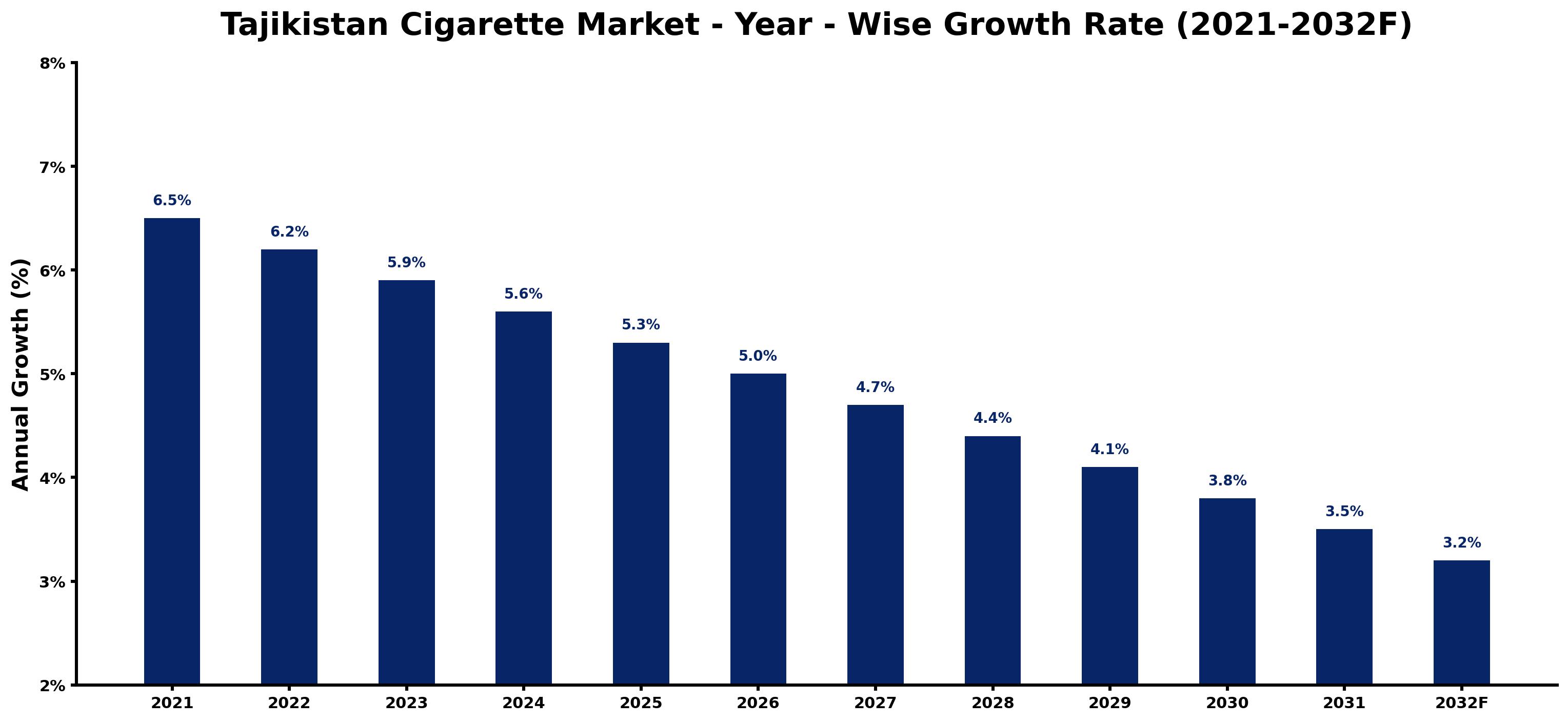
The table below presents the year‑wise growth rates along with the key drivers influencing the market
| Year | Growth Rate | Major Drivers |
| 2021 | 6.5% | Expansion of commercial construction activities |
| 2022 | 6.2% | Increasing adoption of advanced technologies |
| 2023 | 5.9% | Expansion of manufacturing activities |
| 2024 | 5.6% | Increasing smart city development projects |
| 2025 | 5.3% | Increasing industrial automation investments |
| 2026 | 5.0% | Technology transition toward sustainable alternatives |
| 2027 | 4.7% | Environmental regulations reducing traditional demand |
| 2028 | 4.4% | Environmental regulations reducing traditional demand |
| 2029 | 4.1% | Technology transition toward sustainable alternatives |
| 2030 | 3.8% | Growing adoption of energy efficient systems |
| 2031 | 3.5% | Declining investments in legacy infrastructure |
| 2032 | 3.2% | Growing adoption of energy efficient systems |
Note - Market size estimations and growth projections presented in this report are based on 6Wresearch’s advanced forecasting approach, validated with industry datasets as of June 2026.
Tajikistan Cigarette Market Synopsis
The most significant force currently shaping the Tajikistan Cigarette Market is the affordability of local cigarette brands. As economic conditions remain challenging for many consumers, these low-cost options are gaining popularity, driving consumption despite increasing awareness of health risks associated with smoking.
Additionally, government policies aimed at reducing smoking prevalence, including stricter regulations and health campaigns, are creating a complex environment for the cigarette market. While these initiatives are expected to dampen long-term consumption rates, they also present opportunities for innovation in product offerings and marketing strategies tailored to evolving consumer preferences.
Tajikistan Cigarette Market Key Takeaways
- The market is characterized by a strong presence of both local and multinational brands, reflecting diverse consumer preferences.
- Population growth and increasing disposable income levels are driving demand for cigarettes among the younger demographic.
- Local brands are seeing a surge in popularity due to their affordability in a challenging economic environment.
- Government regulations and health awareness campaigns pose ongoing challenges to cigarette consumption.
- Investment opportunities exist in developing innovative tobacco products and targeting specific consumer segments.
Evaluation of Restraints in Tajikistan Cigarette Market
The Tajikistan Cigarette Market grapples with significant restraints that hinder its growth potential. Chief among these is the increasing regulatory landscape aimed at reducing tobacco consumption. Policies that impose higher taxes and restrict advertising can lead to decreased demand, as consumers become more health-conscious. Moreover, illicit trade in tobacco products undermines the efforts of legitimate businesses and distorts market dynamics, making it imperative for the government to enhance enforcement of existing regulations. Additionally, widespread poverty limits purchasing power, restricting market growth despite the high prevalence of smoking.
Tajikistan Cigarette Market Trends
Current trends within the Tajikistan Cigarette Market indicate a shifting consumer focus towards more affordable products. The preference for local brands reflects economic realities, as consumers seek value amidst financial constraints. Furthermore, there is a growing awareness of health risks, leading to an increased interest in alternatives to traditional smoking, such as e-cigarettes and heated tobacco products. These trends signal a pivotal change in the market landscape, with potential for continued evolution in consumer preferences.
Tajikistan Cigarette Market Opportunities
Investment opportunities in the Tajikistan Cigarette Market are promising, particularly given the substantial population of young smokers. The focus could be on enhancing production capabilities and exploring innovative tobacco product lines that cater to evolving consumer demands. Additionally, companies that effectively implement targeted marketing strategies aimed at niche segments, such as youth and premium consumers, may find success in capitalizing on the prevailing market dynamics.
Government Initiatives in the Tajikistan Cigarette Market
The government of Tajikistan has undertaken various initiatives to regulate the cigarette market. Key measures include increasing taxes on tobacco products to deter consumption and imposing advertising restrictions to limit promotion. Additionally, health warning labels on packaging are mandatory to enhance public awareness of smoking risks. Smoke-free laws in public spaces further support the aim to protect non-smokers from the effects of secondhand smoke, aligning public health objectives with regulatory measures.
Future Insights of the Tajikistan Cigarette Market
The outlook for the Tajikistan Cigarette Market between 2026 and 2032 presents both challenges and opportunities. While regulatory pressures and health consciousness may result in a decline in traditional cigarette consumption, the market's growth is likely to be fueled by the young population's continued smoking prevalence and rising disposable incomes. Companies will need to adapt their strategies, focusing on innovation and consumer engagement to navigate the complex landscape effectively.
Tajikistan Cigarette Market Latest Developments (May 2025 - June 2026)
Recent developments in the Tajikistan Cigarette Market have reflected a notable shift towards public health initiatives aimed at reducing tobacco consumption. Increased public awareness campaigns have been launched, encouraging healthier lifestyle choices. Simultaneously, there has been a rise in the introduction of alternative smoking products as consumer preferences begin to evolve. The interplay between local production and foreign investment continues to shape the competitive landscape, particularly as companies adjust to changing regulations and consumer demands.
Tajikistan Cigarette Market - Key Attractiveness of the Report
- 10 Years of Market Numbers
- Historical Data Starting from 2022 to 2025
- Base Year: 2025
- Forecast Data until 2032
- Key Performance Indicators Impacting the Market
- Major Upcoming Developments and Projects
Key Highlights of the Report:
- Tajikistan Cigarette? Market Outlook
- Market Size of Tajikistan Cigarette? Market, 2025
- Forecast of Tajikistan Cigarette? Market, 2032
- Historical Data and Forecast of Tajikistan Cigarette? Revenues & Volume for the Period 2022-2032F
- Tajikistan Cigarette? Market Trend Evolution
- Tajikistan Cigarette? Market Drivers and Challenges
- Tajikistan Cigarette? Price Trends
- Tajikistan Cigarette? Porter's Five Forces
- Tajikistan Cigarette? Industry Life Cycle
- Historical Data and Forecast of Tajikistan Cigarette? Market Revenues & Volume By Type for the Period 2022-2032F
- Historical Data and Forecast of Tajikistan Cigarette? Market Revenues & Volume By Light for the Period 2022-2032F
- Historical Data and Forecast of Tajikistan Cigarette? Market Revenues & Volume By Medium for the Period 2022-2032F
- Historical Data and Forecast of Tajikistan Cigarette? Market Revenues & Volume By Others for the Period 2022-2032F
- Historical Data and Forecast of Tajikistan Cigarette? Market Revenues & Volume By Distribution Channel for the Period 2022-2032F
- Historical Data and Forecast of Tajikistan Cigarette? Market Revenues & Volume By Tobacco Shops for the Period 2022-2032F
- Historical Data and Forecast of Tajikistan Cigarette? Market Revenues & Volume By Supermarket and Hypermarkets for the Period 2022-2032F
- Historical Data and Forecast of Tajikistan Cigarette? Market Revenues & Volume By Convenience Stores for the Period 2022-2032F
- Historical Data and Forecast of Tajikistan Cigarette? Market Revenues & Volume By Online Stores for the Period 2022-2032F
- Historical Data and Forecast of Tajikistan Cigarette? Market Revenues & Volume By Others for the Period 2022-2032F
- Tajikistan Cigarette? Import Export Trade Statistics
- Market Opportunity Assessment By Type
- Market Opportunity Assessment By Distribution Channel
- Tajikistan Cigarette? Top Companies Market Share
- Tajikistan Cigarette? Competitive Benchmarking By Technical and Operational Parameters
- Tajikistan Cigarette? Company Profiles
- Tajikistan Cigarette? Key Strategic Recommendations






































