United Kingdom (UK) Cigarette Market Size, Share & Growth Rate
The United Kingdom (UK) Cigarette Market was estimated at USD 155 Million in 2025 and is projected to reach USD 179 Million by 2032, growing at a CAGR of 2.1% from 2026 to 2032. This growth trajectory reflects the market's complex dynamics, which are influenced by evolving consumer preferences, regulatory frameworks, and emerging competition from alternative nicotine products. As health awareness escalates, a gradual pivot towards reduced-risk products is reshaping demand within this mature market.
United Kingdom (UK) Cigarette Market Year-wise Growth Rate and Key Drivers
This graph highlights how the United Kingdom (UK) Cigarette Market has steadily grown over the years, supported by major growth factors.
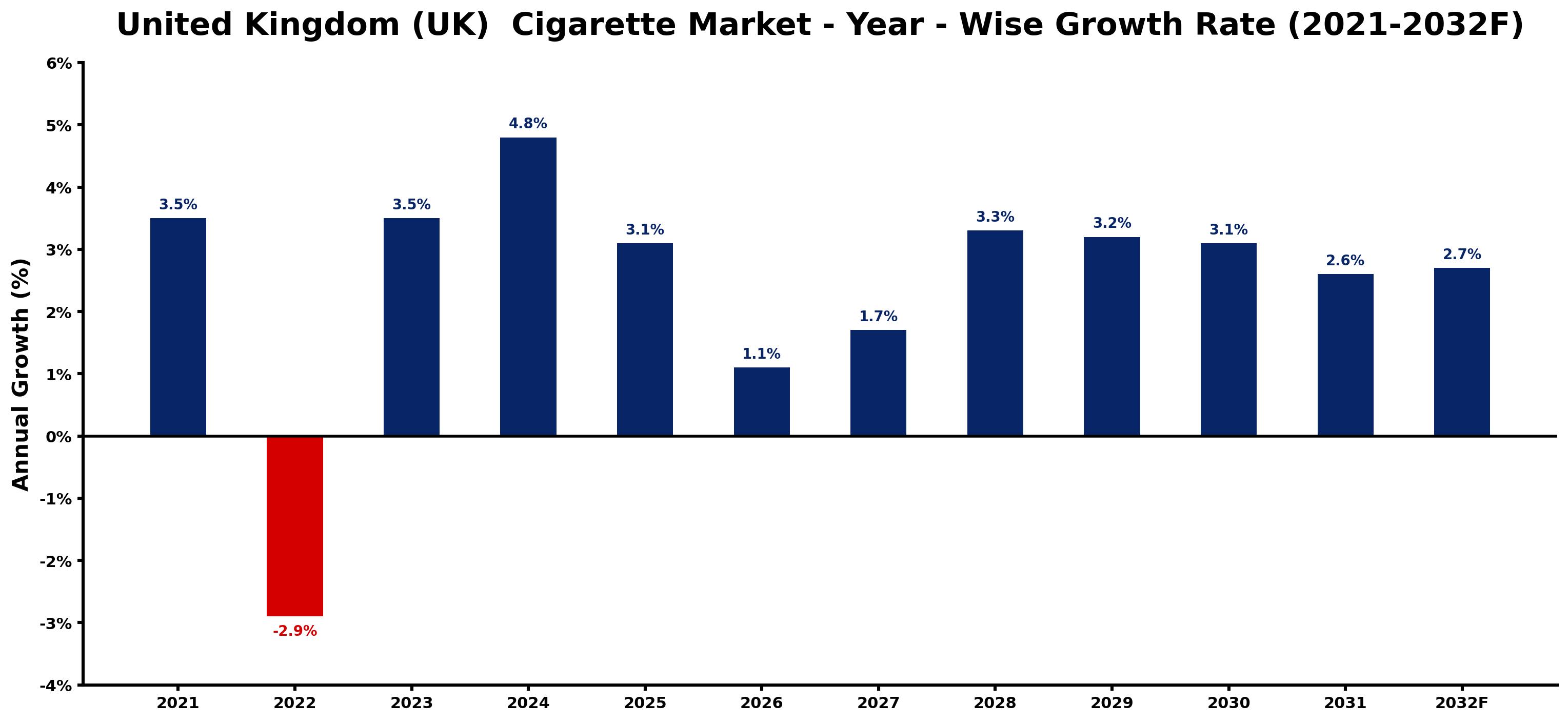
The table below presents the year‑wise growth rates along with the key drivers influencing the market
| Year | Growth Rate | Major Drivers |
| 2021 | 3.5% | Increasing industrial automation investments |
| 2022 | -2.9% | Increasing industrial infrastructure investments |
| 2023 | 3.5% | Increasing industrial automation investments |
| 2024 | 4.8% | Government infrastructure modernization initiatives |
| 2025 | 3.1% | Growing renewable energy integration projects |
| 2026 | 1.1% | Increasing shift toward cleaner alternatives |
| 2027 | 1.7% | Increasing shift toward cleaner alternatives |
| 2028 | 3.3% | Technology transition toward sustainable alternatives |
| 2029 | 3.2% | Technology transition toward sustainable alternatives |
| 2030 | 3.1% | Growing adoption of energy efficient systems |
| 2031 | 2.6% | Environmental regulations reducing traditional demand |
| 2032 | 2.7% | Declining investments in legacy infrastructure |
Note - Market size estimations and growth projections presented in this report are based on 6Wresearch's advanced forecasting approach, validated with industry datasets as of June 2026.
United Kingdom (UK) Cigarette Market Synopsis
The most significant force shaping the UK cigarette market is the stringent regulatory landscape, which aims to reduce smoking prevalence through measures like plain packaging and advertising restrictions. These regulations are pushing consumers to explore alternatives and compelling manufacturers to innovate in product offerings.
Additionally, rising health consciousness among consumers is reshaping purchasing behaviors. As more people become aware of the risks associated with traditional smoking, the market is seeing a shift towards alternative products, including e-cigarettes and heated tobacco, which are increasingly being viewed as less harmful options.
United Kingdom (UK) Cigarette Market Key Takeaways
- The UK cigarette market is navigating a landscape influenced by stringent regulations and health awareness, which are impacting traditional cigarette sales.
- Consumers are increasingly favoring reduced-risk products, driving innovation and diversification in product offerings by manufacturers.
- Ongoing government initiatives focus on reducing smoking prevalence and protecting public health, shaping the strategic direction of the market.
- The illicit trade of counterfeit cigarettes poses significant challenges, affecting both revenue and health initiatives.
- Investment opportunities are emerging in the alternative tobacco product segment, as consumer preferences shift towards less harmful options.
Evaluation of Restraints in United Kingdom (UK) Cigarette Market
The UK cigarette market is constrained by a myriad of factors, primarily stemming from the government's commitment to public health initiatives. The implementation of higher taxes on tobacco products has resulted in increased prices, deterring some consumers from purchasing traditional cigarettes. Furthermore, growing societal disapproval of smoking and the rising prevalence of smoking cessation programs have contributed to declining cigarette consumption. The market also grapples with the challenge of illegal trade, which undermines both legitimate businesses and public health efforts. These restraints necessitate a strategic adaptation for companies operating within this sector.
United Kingdom (UK) Cigarette Market Trends
Current trends in the UK cigarette market indicate a marked shift towards reduced-risk products, such as e-cigarettes and heated tobacco devices. This shift is largely driven by heightened health consciousness and evolving consumer preferences. Moreover, sustainability is becoming an integral focus, with increasing demand for environmentally friendly packaging solutions. Innovations in product formulations aimed at reducing health risks are also gaining traction, further driving the transformation of the market landscape.
United Kingdom (UK) Cigarette Market Opportunities
As the market evolves, significant opportunities lie within the development of alternative tobacco products. E-cigarettes and heated tobacco alternatives present lucrative avenues for growth, catering to consumers seeking less harmful options. Additionally, there is potential for investment in smoking cessation products and services, targeting demographics keen on quitting smoking. These strategic avenues will become increasingly important as the regulatory landscape continues to develop and shift towards health-oriented measures.
Government Initiatives in the United Kingdom (UK) Cigarette Market
The UK government has taken a proactive stance in regulating the cigarette market through various public health policies. This includes the ban on smoking in public spaces, which aims to minimize exposure to secondhand smoke, thereby promoting healthier environments. Additionally, stringent regulations on packaging have been implemented, enforcing standardized designs that feature graphic health warnings. Regular tax increases on tobacco products serve to discourage consumption and drive public health initiatives, underscoring the government's commitment to reducing smoking rates across the nation.
Future Insights of the United Kingdom (UK) Cigarette Market
Looking ahead from 2026 to 2032, the UK cigarette market is expected to face ongoing challenges from a combination of regulatory pressures and shifting consumer behavior. The trend towards reduced-risk products will likely intensify, as traditional cigarette consumption continues to decline. Manufacturers may need to re-evaluate their strategies to focus on innovation and alternative offerings to maintain market relevance. The long-term outlook suggests a gradual contraction of the traditional cigarette market, with an increasing emphasis on compliance and adaptation to evolving health-focused regulations.
United Kingdom (UK) Cigarette Market Latest Developments (May 2025 - June 2026)
In recent months, the UK cigarette market has seen a notable shift in corporate strategies, with an emphasis on diversifying product lines to include more e-cigarettes and heated tobacco products. Companies are investing in research and development to enhance product safety and appeal to health-conscious consumers. Regulatory updates continue to influence marketing practices, compelling firms to adapt their approaches in order to comply with evolving government mandates. As these trends unfold, market players are actively seeking partnerships and collaborations to enhance their innovation capacities.
United Kingdom (UK) Cigarette Market - Key Attractiveness of the Report
- 10 Years of Market Numbers
- Historical Data Starting from 2022 to 2025
- Base Year: 2025
- Forecast Data until 2032
- Key Performance Indicators Impacting the Market
- Major Upcoming Developments and Projects
Key Highlights of the Report:
- United Kingdom (UK) Cigarette? Market Outlook
- Market Size of United Kingdom (UK) Cigarette? Market, 2025
- Forecast of United Kingdom (UK) Cigarette? Market, 2032
- Historical Data and Forecast of United Kingdom (UK) Cigarette? Revenues & Volume for the Period 2022-2032F
- United Kingdom (UK) Cigarette? Market Trend Evolution
- United Kingdom (UK) Cigarette? Market Drivers and Challenges
- United Kingdom (UK) Cigarette? Price Trends
- United Kingdom (UK) Cigarette? Porter's Five Forces
- United Kingdom (UK) Cigarette? Industry Life Cycle
- Historical Data and Forecast of United Kingdom (UK) Cigarette? Market Revenues & Volume By Type for the Period 2022-2032F
- Historical Data and Forecast of United Kingdom (UK) Cigarette? Market Revenues & Volume By Light for the Period 2022-2032F
- Historical Data and Forecast of United Kingdom (UK) Cigarette? Market Revenues & Volume By Medium for the Period 2022-2032F
- Historical Data and Forecast of United Kingdom (UK) Cigarette? Market Revenues & Volume By Others for the Period 2022-2032F
- Historical Data and Forecast of United Kingdom (UK) Cigarette? Market Revenues & Volume By Distribution Channel for the Period 2022-2032F
- Historical Data and Forecast of United Kingdom (UK) Cigarette? Market Revenues & Volume By Tobacco Shops for the Period 2022-2032F
- Historical Data and Forecast of United Kingdom (UK) Cigarette? Market Revenues & Volume By Supermarket and Hypermarkets for the Period 2022-2032F
- Historical Data and Forecast of United Kingdom (UK) Cigarette? Market Revenues & Volume By Convenience Stores for the Period 2022-2032F
- Historical Data and Forecast of United Kingdom (UK) Cigarette? Market Revenues & Volume By Online Stores for the Period 2022-2032F
- Historical Data and Forecast of United Kingdom (UK) Cigarette? Market Revenues & Volume By Others for the Period 2022-2032F
- United Kingdom (UK) Cigarette? Import Export Trade Statistics
- Market Opportunity Assessment By Type
- Market Opportunity Assessment By Distribution Channel
- United Kingdom (UK) Cigarette? Top Companies Market Share
- United Kingdom (UK) Cigarette? Competitive Benchmarking By Technical and Operational Parameters
- United Kingdom (UK) Cigarette? Company Profiles
- United Kingdom (UK) Cigarette? Key Strategic Recommendations






































