Tajikistan Cloud Applications Market Size & Growth Rate (2026-2032)
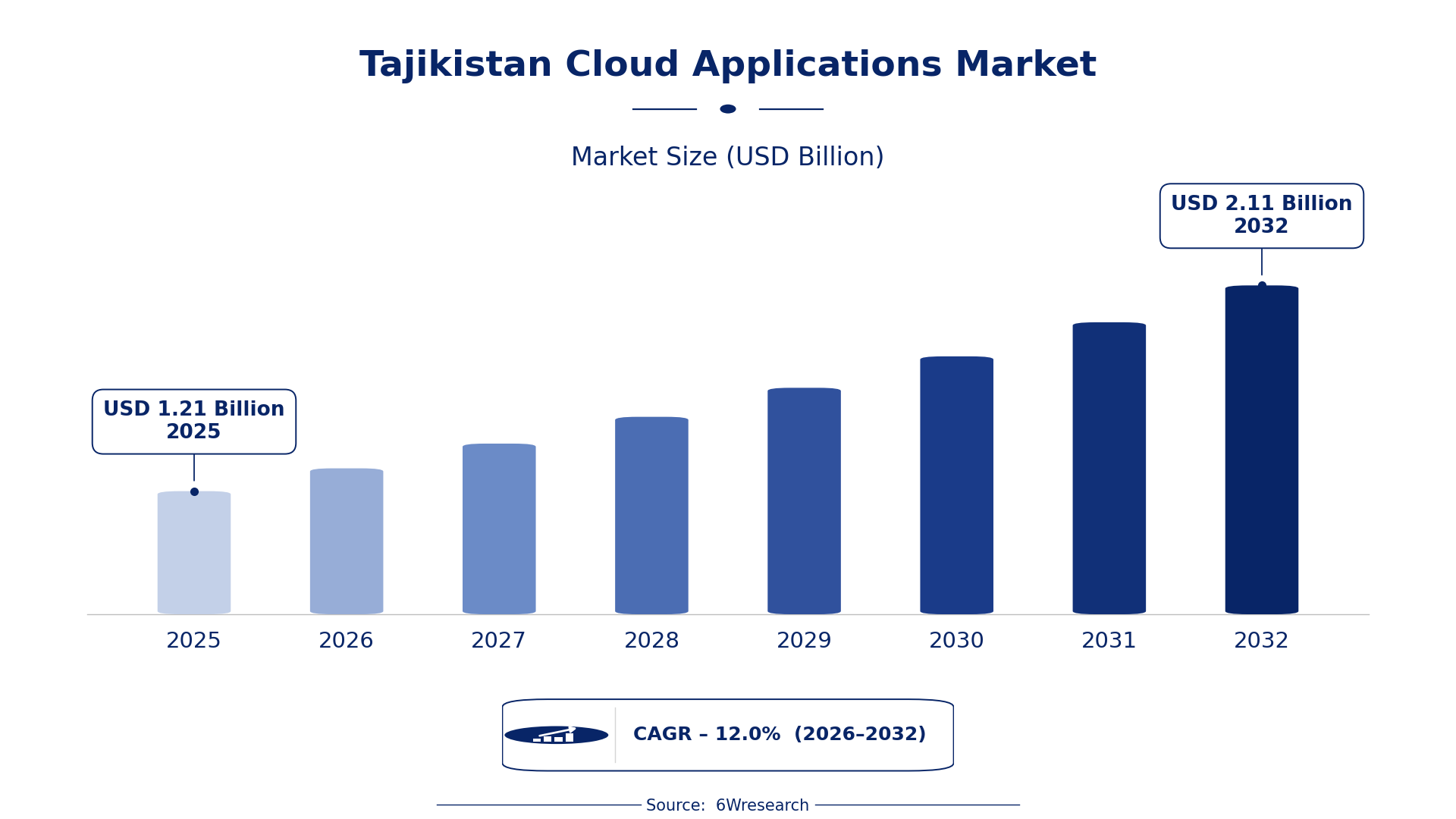
The Tajikistan Cloud Applications Market was estimated at USD 1206 Million in 2025 and is projected to reach USD 2113 Million by 2032, growing at a CAGR of 12.0% from 2026 to 2032.
Tajikistan Cloud Applications Market Synopsis
The Tajikistan cloud applications market is on a clear upward trajectory, driven by a growing appetite for cloud-based solutions across various sectors. Companies in finance, healthcare, and government are increasingly recognizing the value of cloud applications for operational efficiency and enhanced productivity.
As digital transformation takes center stage, the need for data storage, collaboration tools, and customer relationship management solutions is rising sharply. This shift is supported by a mix of global cloud service providers and local vendors, each tailoring offerings to meet the unique demands of Tajik businesses.
Tajikistan Cloud Applications Market Year-wise Growth Rate and Key Drivers
This graph illustrates the annual growth rates of the Tajikistan Cloud Applications Market from 2021 to 2032, highlighting a steady upward trajectory and projected expansion over the forecast period.
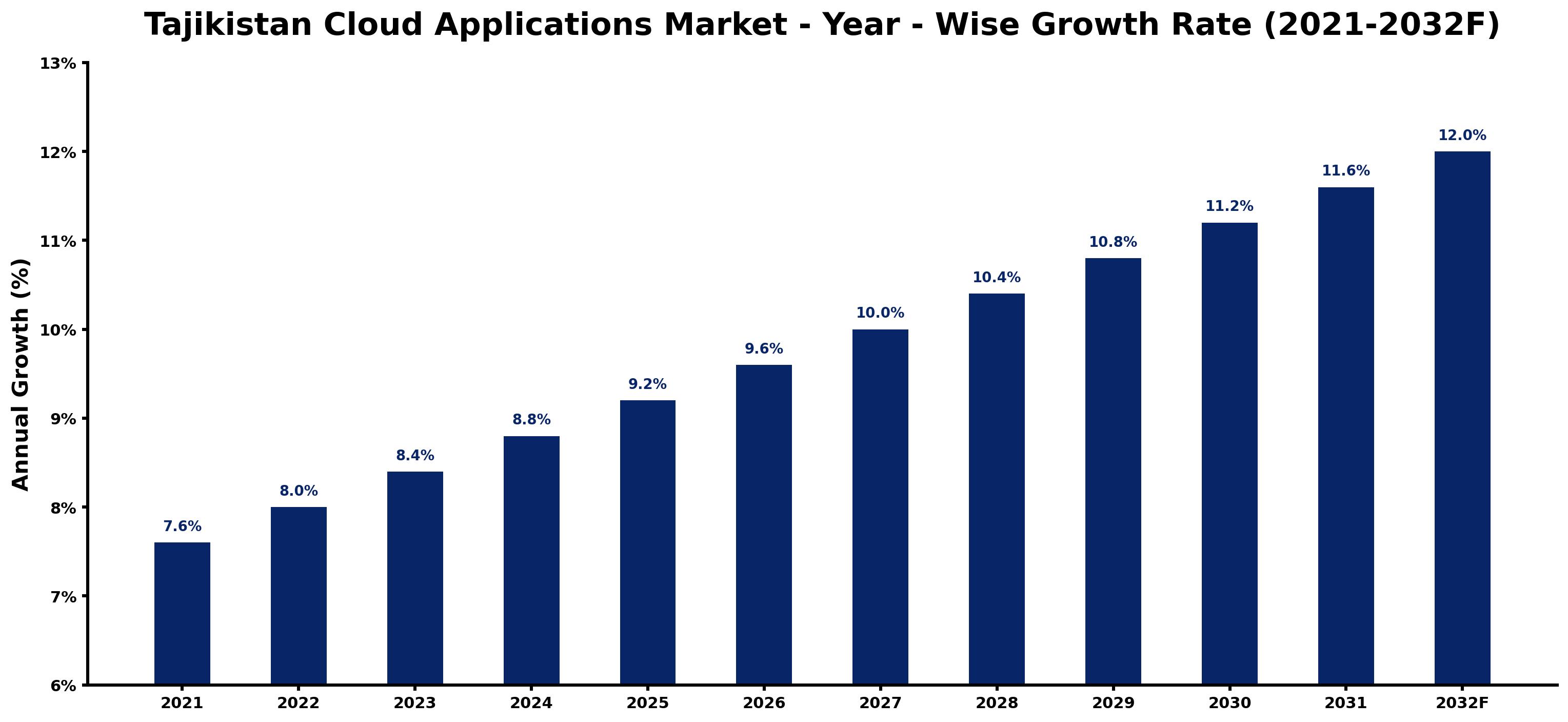
The table below presents the year‑wise growth rates along with the key drivers influencing the market
| Year | Growth Rate | Major Drivers |
| 2021 | 7.6% | Government's digital transformation initiative boosts cloud adoption |
| 2022 | 8.0% | Expanding internet infrastructure enhances cloud service accessibility |
| 2023 | 8.4% | Increased mobile penetration drives demand for cloud applications |
| 2024 | 8.8% | Growing SME sector requires scalable cloud solutions |
| 2025 | 9.2% | Local tech startups leverage cloud for innovative services |
| 2026 | 9.6% | Improved cybersecurity regulations enable trust in cloud services |
| 2027 | 10.0% | Rising digital literacy strengthens cloud user base |
| 2028 | 10.4% | Local partnerships enhance cloud service offerings and support |
| 2029 | 10.8% | E-commerce growth boosts need for cloud-based platforms |
| 2030 | 11.2% | Investment in education technology drives cloud application usage |
| 2031 | 11.6% | Government incentives promote cloud adoption in public sectors |
| 2032 | 12.0% | Regional collaborations enhance cloud ecosystem efficiency |
Note: Market size estimations and growth projections presented in this report are based on 6Wresearch's proprietary forecasting methodology, utilizing the latest available industry data, government publications, and primary research inputs.
Tajikistan Cloud Applications Market Key Takeaways
Below are some of the specific key takeaways from the market, including:
- The increasing adoption of cloud applications is fundamentally changing how businesses operate in Tajikistan.
- Key sectors, including finance and healthcare, are leading the charge toward cloud-based solutions.
- Government initiatives are paving the way for improved internet infrastructure and digitalization.
- Growing demand for SaaS, PaaS, and IaaS models is reshaping the competitive landscape.
- Concerns over data security and lack of skilled professionals present challenges to market growth.
Evaluation of Restraints in Tajikistan Cloud Applications Market
Despite its promising trajectory, the Tajikistan cloud applications market faces several real hurdles. Limited internet infrastructure continues to stifle broader adoption, especially in rural areas where connectivity remains unreliable. Additionally, businesses harbor valid concerns regarding data security and privacy, which can inhibit full-scale migration to cloud solutions.
The talent gap is another pressing issue; a shortage of skilled IT professionals restricts the ability of local firms to effectively implement and manage cloud technologies. Economic instability further complicates matters, as limited financial resources often restrict investments in necessary cloud infrastructure.
Tajikistan Cloud Applications Market Trends
Several trends are shaping the Tajikistan cloud applications market. The shift towards hybrid cloud environments is becoming increasingly prevalent, as businesses look to balance cost and flexibility. The integration of artificial intelligence and machine learning into cloud solutions is enhancing their functionality, enabling companies to derive greater insights from their data.
Data security remains at the forefront of discussions, with businesses prioritizing compliance and protective measures as they transition to cloud platforms. As more organizations recognize the benefits of cloud-based services, the market is expected to adapt rapidly to meet evolving demands.
Tajikistan Cloud Applications Market Opportunities
The prospects for growth in the Tajikistan cloud applications market are substantial. With businesses increasingly seeking cost-effective solutions, there is a ripe opportunity for cloud service providers to introduce tailored applications that cater specifically to local needs. The rising trend of digital transformation presents a fertile ground for innovative cloud solutions, particularly in sectors like education and agriculture.
on top of that, as internet penetration improves, the market will likely witness an influx of new entrants, both local and international, eager to capitalize on this growing demand. The combination of government support and a tech-savvy youth population suggests that the market is on the brink of significant expansion.
Government Initiatives in the Tajikistan Cloud Applications Market
Government policies are playing a crucial role in shaping the trajectory of the Tajikistan cloud applications market. With a focus on fostering digitalization and innovation, the government is actively supporting the IT sector through various initiatives. These efforts include improving internet infrastructure and developing digital skills among the workforce, both essential for the growth of cloud technology.
- A tax incentive program launched in 2023 aims to attract IT companies and stimulate investment in cloud technologies.
- A national digital infrastructure upgrade program is currently underway, focusing on enhancing connectivity across urban and rural areas.
- The government is promoting a digital literacy initiative to educate businesses about the benefits of cloud applications, which began implementation in early 2024.
- A regulatory framework introduced in 2025 mandates data localization, requiring cloud service providers to store data within Tajikistan.
- Upcoming plans for 2026 include a public-private partnership aimed at expanding access to cloud services in underserved regions.
Future Insights of the Tajikistan Cloud Applications Market
Looking ahead to 2026-2032, the Tajikistan cloud applications market is set for robust growth. The confluence of increasing demand for efficient, cost-effective software solutions and ongoing improvements in digital infrastructure will drive market expansion. The government’s proactive approach in promoting cloud computing will further enhance the environment for innovation and investment.
As more businesses adopt cloud technologies, there will be an increased focus on developing localized applications that address specific market needs. This evolution will not only strengthen the competitive position of local providers but will also pave the way for enhanced digital services across various sectors.
Tajikistan Cloud Applications Market Latest Developments
Recent activity in the Tajikistan cloud applications market has reflected a growing interest in digital solutions. Over the past year, various initiatives have been launched to enhance cloud adoption and technological innovation. The landscape is shifting, with both local and international players actively seeking to capitalize on emerging opportunities.
- A major technology vendor announced a partnership in Q1 2024 to deliver cloud-based CRM solutions tailored for Tajik businesses.
- In mid-2024, a local startup launched a new SaaS platform aimed at improving supply chain management for small to medium-sized enterprises.
- A technology conference held in late 2024 highlighted advancements in AI integration within cloud applications, attracting significant attention from industry stakeholders.
- An initiative that began in early 2024 focuses on developing training programs for IT professionals to enhance cloud skills and knowledge.
- Plans for a cloud service expansion by a regional provider are expected to kick off in the second half of 2025, enhancing service availability across the country.
Tajikistan Cloud Applications Market - Key Attractiveness of the Report
- 10 Years of Market Numbers
- Historical Data Starting from 2022 to 2025
- Base Year: 2025
- Forecast Data until 2032
- Key Performance Indicators Impacting the Market
- Major Upcoming Developments and Projects
Key Highlights of the Report:
- Tajikistan Cloud Applications Market Outlook
- Market Size of Tajikistan Cloud Applications Market, 2025
- Forecast of Tajikistan Cloud Applications Market, 2032
- Historical Data and Forecast of Tajikistan Cloud Applications Revenues & Volume for the Period 2022-2032F
- Tajikistan Cloud Applications Market Trend Evolution
- Tajikistan Cloud Applications Market Drivers and Challenges
- Tajikistan Cloud Applications Price Trends
- Tajikistan Cloud Applications Porter's Five Forces
- Tajikistan Cloud Applications Industry Life Cycle
- Historical Data and Forecast of Tajikistan Cloud Applications Market Revenues & Volume By Application for the Period 2022-2032F
- Historical Data and Forecast of Tajikistan Cloud Applications Market Revenues & Volume By ERP for the Period 2022-2032F
- Historical Data and Forecast of Tajikistan Cloud Applications Market Revenues & Volume By CRM for the Period 2022-2032F
- Historical Data and Forecast of Tajikistan Cloud Applications Market Revenues & Volume By HCM for the Period 2022-2032F
- Historical Data and Forecast of Tajikistan Cloud Applications Market Revenues & Volume By SCM for the Period 2022-2032F
- Historical Data and Forecast of Tajikistan Cloud Applications Market Revenues & Volume By Content Management for the Period 2022-2032F
- Historical Data and Forecast of Tajikistan Cloud Applications Market Revenues & Volume By BI for the Period 2022-2032F
- Historical Data and Forecast of Tajikistan Cloud Applications Market Revenues & Volume By Analytics for the Period 2022-2032F
- Historical Data and Forecast of Tajikistan Cloud Applications Market Revenues & Volume By Vertical for the Period 2022-2032F
- Historical Data and Forecast of Tajikistan Cloud Applications Market Revenues & Volume By Banking, Financial Services, and Insurance (BFSI) for the Period 2022-2032F
- Historical Data and Forecast of Tajikistan Cloud Applications Market Revenues & Volume By Energy and Utilities for the Period 2022-2032F
- Historical Data and Forecast of Tajikistan Cloud Applications Market Revenues & Volume By Government and Public Sector for the Period 2022-2032F
- Historical Data and Forecast of Tajikistan Cloud Applications Market Revenues & Volume By Healthcare and Life Sciences for the Period 2022-2032F
- Historical Data and Forecast of Tajikistan Cloud Applications Market Revenues & Volume By Manufacturing for the Period 2022-2032F
- Historical Data and Forecast of Tajikistan Cloud Applications Market Revenues & Volume By Retail and Consumer Goods for the Period 2022-2032F
- Historical Data and Forecast of Tajikistan Cloud Applications Market Revenues & Volume By Telecommunications for the Period 2022-2032F
- Historical Data and Forecast of Tajikistan Cloud Applications Market Revenues & Volume By Transportation and Logistics for the Period 2022-2032F
- Historical Data and Forecast of Tajikistan Cloud Applications Market Revenues & Volume By Organization Size for the Period 2022-2032F
- Historical Data and Forecast of Tajikistan Cloud Applications Market Revenues & Volume By Small and Medium-sized Enterprises (SMEs) for the Period 2022-2032F
- Historical Data and Forecast of Tajikistan Cloud Applications Market Revenues & Volume By Large Enterprises for the Period 2022-2032F
- Tajikistan Cloud Applications Import Export Trade Statistics
- Market Opportunity Assessment By Application
- Market Opportunity Assessment By Vertical
- Market Opportunity Assessment By Organization Size
- Tajikistan Cloud Applications Top Companies Market Share
- Tajikistan Cloud Applications Competitive Benchmarking By Technical and Operational Parameters
- Tajikistan Cloud Applications Company Profiles
- Tajikistan Cloud Applications Key Strategic Recommendations






































