Tajikistan Conductive Yarn Market Size, Share & Growth Rate
The Tajikistan Conductive Yarn Market was estimated at USD 492 Million in 2025 and is projected to reach USD 679 Million by 2032, growing at a CAGR of 4.7% from 2026 to 2032. This growth trajectory is predominantly fueled by the surging demand for smart textiles and wearable technology across various sectors including healthcare and fashion. As more manufacturers seek to innovate by embedding electronic functionalities into their textile products, the market's appeal continues to expand.
Tajikistan Conductive Yarn Market Growth Rate Analysis (2021-2032)
The Tajikistan conductive yarn market has shown stable growth, marked by a compound annual growth rate of 5.8% in 2021, slightly decreasing to 5.7% in 2022 and 5.5% in 2023. This decline reflects adjustments in raw material supply chains and fluctuating consumer demand. However, the market is expected to rebound, with projections of 5.9% growth in 2024, as investments in digitalization and energy transition initiatives gain momentum. Continued expansion through 2025 to 2029, with growth rates stabilizing around 5.3% to 5.6%, aligns with Tajikistan’s increasing focus on sustainable textile solutions. By 2032, the market is anticipated to maintain a growth rate of approximately 5.3%, driven by technological advancements and rising industrial applications.
Tajikistan Conductive Yarn Market Year-wise Growth Rate and Key Drivers
This graph highlights how the Tajikistan Conductive Yarn Market has steadily grown over the past five years, supported by major growth factors.
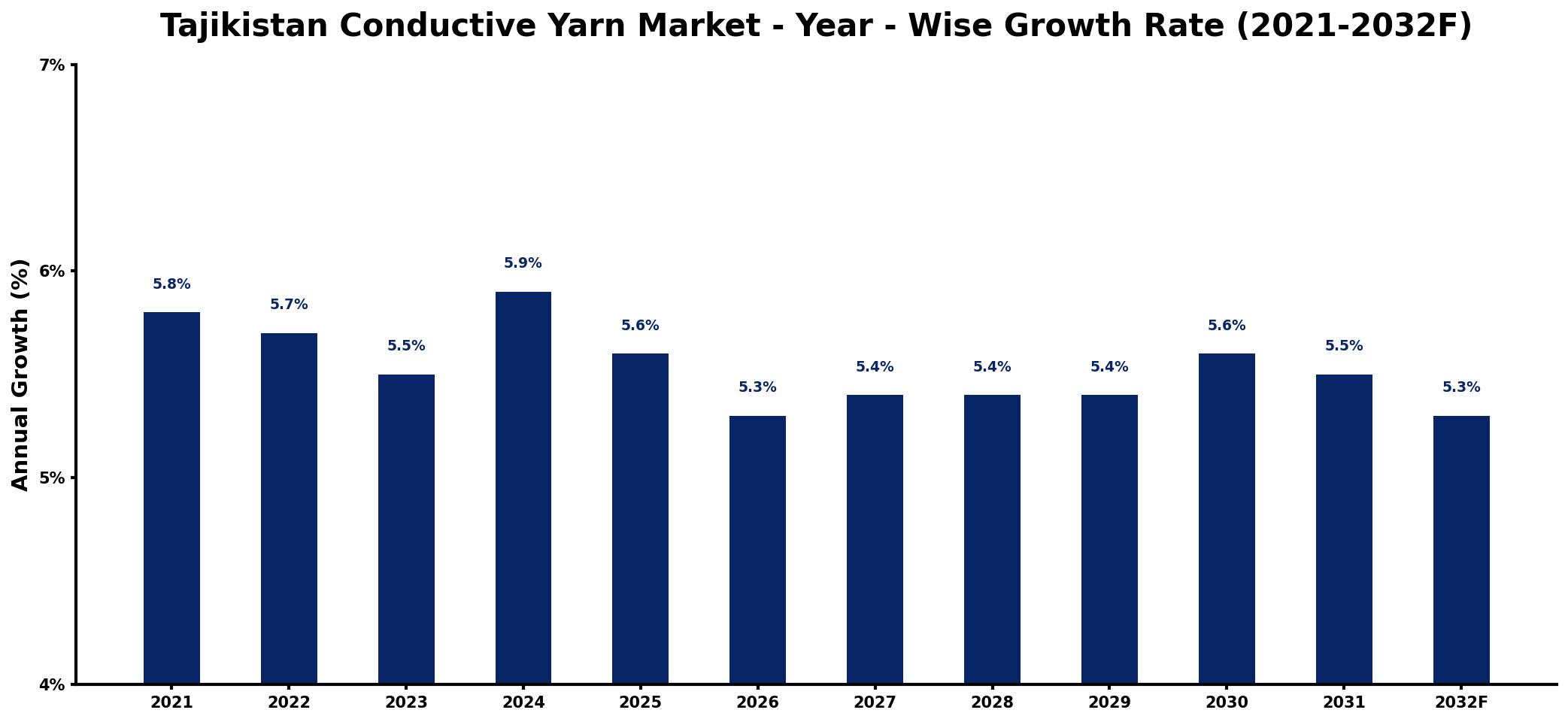
The table below presents the year‑wise growth rates along with the key drivers influencing the market
| Year | Growth Rate | Major Drivers |
| 2021 | 5.8% | Rising demand for smart textiles |
| 2022 | 5.7% | Increased investment in wearable technology |
| 2023 | 5.5% | Growth in electronic textile applications |
| 2024 | 5.9% | Expansion of e-commerce platforms |
| 2025 | 5.6% | Development of innovative textile solutions |
| 2026 | 5.3% | Emergence of eco-friendly materials |
| 2027 | 5.4% | Surge in fashion industry integration |
| 2028 | 5.4% | Growing interest in health monitoring |
| 2029 | 5.4% | Collaboration with tech startups |
| 2030 | 5.6% | Increase in research funding initiatives |
| 2031 | 5.5% | Adoption of textiles in automotive |
| 2032 | 5.3% | Integration into home automation systems |
Note: Market size estimations and growth projections presented in this report are based on 6Wresearch's proprietary forecasting methodology, utilizing the latest available industry data, government publications, and primary research inputs.
Tajikistan Conductive Yarn Market Synopsis
In recent years, the Tajikistan Conductive Yarn Market has gained momentum thanks to a growing interest in the integration of electronics with textiles. As the market evolves, it is poised for significant growth driven by advancements in material science and the increasing prevalence of wearable electronics. However, limited awareness and high production costs remain considerable hurdles.
Looking ahead, the market is expected to shift toward greater adoption of e-textiles, as manufacturers recognize the potential of conductive yarns to create innovative applications. This growth is anticipated to stimulate interest from both local producers and international players seeking to establish a foothold in this niche but promising sector.
Tajikistan Conductive Yarn Market Key Takeaways
- The market is on an upward trajectory, driven by the rising demand for smart textiles and wearable electronics.
- Technological advancements are yielding more efficient and durable conductive yarns, enhancing their appeal.
- Healthcare, sports, and fashion sectors are leading the way in the application of conductive yarns.
- High production costs and limited consumer awareness pose challenges to market penetration.
- Future growth will be significantly influenced by the development of industry standards and regulations.
Evaluation of Restraints in Tajikistan Conductive Yarn Market
Despite the promising growth trajectory of the Tajikistan Conductive Yarn Market, several key restraints impede its full potential. Limited awareness about the advantages and applications of conductive yarns presents a significant barrier, particularly for manufacturers and consumers unfamiliar with the technology. Additionally, the higher production costs associated with these specialized yarns, compared to traditional alternatives, can deter uptake in a price-sensitive market. Moreover, technical challenges in maintaining the necessary flexibility and strength while integrating conductive materials complicate manufacturing processes. Finally, the lack of standardization in the industry creates uncertainty, further limiting market growth.
Tajikistan Conductive Yarn Market Trends
Current trends in the Tajikistan Conductive Yarn Market show a noticeable shift towards the adoption of e-textiles, with a focus on integrating electronic components seamlessly into fabrics. Innovations in textile engineering are leading to the creation of conductive yarns that are not only more flexible but also more durable, catering to the rising demands of modern consumers. Furthermore, the crossover of smart textiles into sectors like healthcare and fitness is generating new applications, thereby broadening the market's scope.
Tajikistan Conductive Yarn Market Opportunities
The evolving landscape of the Tajikistan Conductive Yarn Market presents numerous growth opportunities. With an increasing demand for innovative solutions in wearable technology, there is significant potential for investment in research and development of advanced conductive yarns. Collaborations between textile manufacturers and electronics companies could lead to groundbreaking applications in various industries, particularly in healthcare, where smart textiles can enhance patient monitoring. Additionally, education and awareness campaigns aimed at both consumers and industry professionals could further stimulate market growth by showcasing the unique benefits of conductive yarns.
Government Initiatives in the Tajikistan Conductive Yarn Market
The Tajikistan government has demonstrated a commitment to enhancing the textile and electronics sectors through various initiatives and policies. Investments in technology transfer programs aim to bolster local manufacturing capabilities and encourage the adoption of innovative materials, including conductive yarns. Public spending is directed toward fostering research and development, as well as providing incentives for businesses engaged in the smart textiles domain. Such initiatives are expected to create a conducive environment for the growth of the conductive yarn market, allowing local companies to compete effectively on an international scale.
Tajikistan Conductive Yarn Market Future Insights
Looking forward to the period from 2026 to 2032, the Tajikistan Conductive Yarn Market is poised for considerable expansion. Factors such as increased awareness of smart textiles, technological innovations, and heightened focus on e-textiles will continue to drive growth. As local manufacturers invest in developing advanced materials, the market is expected to evolve in tandem with global trends, potentially positioning Tajikistan as a competitive player in the region's textile industry. Collaboration between sectors and a focus on quality standards will be essential in realizing this potential.
Tajikistan Conductive Yarn Market Latest Developments (2025 - 2026)
Recent developments in the Tajikistan Conductive Yarn Market reflect a growing interest in innovative applications of conductive textiles. Manufacturers are increasingly exploring partnerships with technology firms to enhance the functionality of their products. Additionally, there has been a noticeable rise in local initiatives aimed at educating potential customers about the benefits and applications of conductive yarns. These movements are expected to reshape market dynamics, paving the way for future advancements and applications.
Tajikistan Conductive Yarn Market - Key Attractiveness of the Report
- 10 Years of Market Numbers
- Historical Data Starting from 2022 to 2025
- Base Year: 2025
- Forecast Data until 2032
- Key Performance Indicators Impacting the Market
- Major Upcoming Developments and Projects
Key Highlights of the Report:
- Tajikistan Conductive Yarn Market Outlook
- Market Size of Tajikistan Conductive Yarn Market, 2025
- Forecast of Tajikistan Conductive Yarn Market, 2032
- Historical Data and Forecast of Tajikistan Conductive Yarn Revenues & Volume for the Period 2022-2032F
- Tajikistan Conductive Yarn Market Trend Evolution
- Tajikistan Conductive Yarn Market Drivers and Challenges
- Tajikistan Conductive Yarn Price Trends
- Tajikistan Conductive Yarn Porter's Five Forces
- Tajikistan Conductive Yarn Industry Life Cycle
- Historical Data and Forecast of Tajikistan Conductive Yarn Market Revenues & Volume By Product Type for the Period 2022-2032F
- Historical Data and Forecast of Tajikistan Conductive Yarn Market Revenues & Volume By Metallic Type for the Period 2022-2032F
- Historical Data and Forecast of Tajikistan Conductive Yarn Market Revenues & Volume By Carbon-Based Type for the Period 2022-2032F
- Historical Data and Forecast of Tajikistan Conductive Yarn Market Revenues & Volume By Metal Compound Type for the Period 2022-2032F
- Historical Data and Forecast of Tajikistan Conductive Yarn Market Revenues & Volume By Application for the Period 2022-2032F
- Historical Data and Forecast of Tajikistan Conductive Yarn Market Revenues & Volume By Anti-Static Fabric for the Period 2022-2032F
- Historical Data and Forecast of Tajikistan Conductive Yarn Market Revenues & Volume By Signal Transmission for the Period 2022-2032F
- Historical Data and Forecast of Tajikistan Conductive Yarn Market Revenues & Volume By Cellphone Protective Cover for the Period 2022-2032F
- Tajikistan Conductive Yarn Import Export Trade Statistics
- Market Opportunity Assessment By Product Type
- Market Opportunity Assessment By Application
- Tajikistan Conductive Yarn Top Companies Market Share
- Tajikistan Conductive Yarn Competitive Benchmarking By Technical and Operational Parameters
- Tajikistan Conductive Yarn Company Profiles
- Tajikistan Conductive Yarn Key Strategic Recommendations






































