Tajikistan Construction and Mining Equipment Market Size, Share & Growth Rate
The Tajikistan Construction and Mining Equipment Market was estimated at USD 176 Million in 2025 and is projected to reach USD 237 Million by 2032, growing at a CAGR of 4.3% from 2026 to 2032. This growth trajectory is fueled by significant government investments in infrastructure and the modernization of the mining sector, which are critical to supporting the nations economic development. Furthermore, the construction industry's expanding scope is increasing the demand for a diverse range of heavy machinery and specialized equipment.
Tajikistan Construction and Mining Equipment Market Year-wise Growth Rate and Key Drivers
This graph highlights how the Tajikistan Construction and Mining Equipment Market has steadily grown over the years, supported by major growth factors.
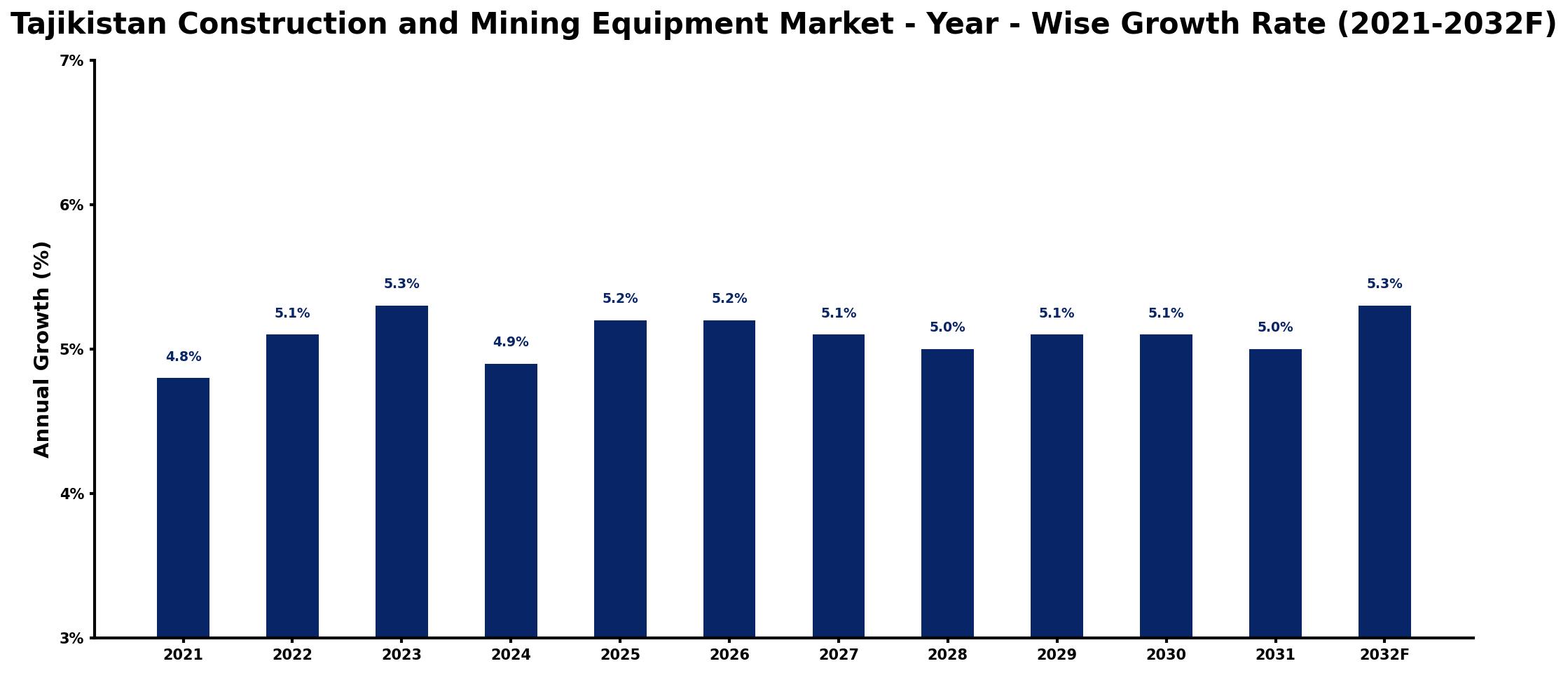
The table below presents the year‑wise growth rates along with the key drivers influencing the market
| Year | Growth Rate | Major Drivers |
| 2021 | 4.8% | Rising infrastructure development investments |
| 2022 | 5.1% | Increased urbanization and population growth |
| 2023 | 5.3% | Government initiatives for economic expansion |
| 2024 | 4.9% | Boosted private sector investments |
| 2025 | 5.2% | Growing demand for renewable energy |
| 2026 | 5.2% | Expansion of road network projects |
| 2027 | 5.1% | Increased foreign direct investments influx |
| 2028 | 5.0% | Emerging technology adoption in industries |
| 2029 | 5.1% | Strengthened regional trade partnerships |
| 2030 | 5.1% | rising demand from electronics |
| 2031 | 5.0% | Enhanced logistics and transportation networks |
| 2032 | 5.3% | Sustainable development project implementations |
Note: Market size estimations and growth projections presented in this report are based on 6Wresearch's proprietary forecasting methodology, utilizing the latest available industry data, government publications, and primary research inputs.
Tajikistan Construction and Mining Equipment Market Synopsis
In recent years, Tajikistan has witnessed a surge in infrastructure projects, including roads, bridges, and commercial facilities, driving an increasing demand for construction equipment. As the government emphasizes infrastructural upgrades, the requirement for advanced machinery, such as cranes and excavators, has escalated, reflecting a robust market opportunity.
Additionally, the mining industry is poised for modernization, creating a parallel demand for more efficient and technologically advanced mining equipment. As local and international stakeholders aim to enhance productivity and safety standards in mining operations, the market is expanding to accommodate these evolving needs.
Tajikistan Construction and Mining Equipment Market Key Takeaways
- Strong government focus on infrastructure development is a primary driver of market growth.
- Increasing adoption of advanced technologies such as IoT and automation in equipment is shaping the market landscape.
- The demand for rental equipment services is rising due to cost considerations among project developers.
- Modernization of the mining sector is creating substantial opportunities for equipment suppliers.
- Environmental sustainability is becoming a key consideration in equipment procurement and operation.
Evaluation of Restraints in Tajikistan Construction and Mining Equipment Market
Despite the growth potential, several constraints hinder the advancement of the Tajikistan Construction and Mining Equipment Market. The limited infrastructure, especially in remote areas, complicates the logistics of transporting heavy machinery, impeding project timelines. Additionally, the market's relatively small size restricts the availability of specialized equipment. Coupled with political and economic uncertainties, these challenges can adversely affect investment flows and operational efficiencies. Furthermore, a lack of skilled labor to effectively operate advanced machinery is a pressing issue that needs addressing to maximize productivity in construction and mining operations.
Tajikistan Construction and Mining Equipment Market Trends
The market is currently experiencing notable trends, including a shift towards more sustainable practices in equipment usage. Companies are increasingly seeking environmentally friendly machinery to align with global standards. Moreover, the integration of advanced technologies such as telematics is becoming essential in construction and mining operations, enhancing monitoring and operational efficiency. Another emerging trend is the rising preference for equipment rental services, which provide flexibility and cost savings for businesses navigating unpredictable market conditions.
Tajikistan Construction and Mining Equipment Market Opportunities
Investment opportunities abound in Tajikistan's construction and mining equipment sector, particularly as the government ramps up efforts to modernize infrastructure. Suppliers can capitalize on the demand for state-of-the-art machinery that supports construction initiatives, including excavators and loaders. The growth of the mining sector, particularly in precious metal extraction, presents further avenues for investment in specialized mining equipment. Establishing partnerships with local firms or government bodies will prove crucial for foreign investors aiming to navigate the market effectively.
Government Initiatives in the Tajikistan Construction and Mining Equipment Market
The Tajikistan government is actively implementing policies to bolster the construction and mining sectors. This includes providing tax incentives and subsidies that encourage investment in infrastructure development. Efforts to enhance safety regulations in the mining industry are also underway, aimed at ensuring worker safety and environmental conservation. Such initiatives are designed to foster a favorable business environment, paving the way for sustainable growth in the construction and mining equipment market.
Future Insights of the Tajikistan Construction and Mining Equipment Market
Looking ahead to 2026-2032, the Tajikistan Construction and Mining Equipment Market is on track for stable growth, supported by continuous government investment in infrastructure and mining projects. The ongoing urbanization trends are anticipated to bolster demand for construction equipment, while enhanced mining operations will require upgraded machinery. However, potential challenges such as limited access to financing and technological constraints must be navigated to realize the full growth potential of the market. With the right strategic approaches and investments, the future appears promising for this sector.
Tajikistan Construction and Mining Equipment Market Latest Developments (2025 - 2026)
Recent developments in the Tajikistan construction and mining equipment market reflect an increasing momentum towards modernization and sustainability. Government initiatives have been emphasizing infrastructure projects, leading to a spike in demand for heavy machinery. Additionally, stakeholders in the mining sector are actively engaging in technology upgrades, showcasing a commitment to improving operational efficiencies and safety standards. This evolving landscape signals a fertile environment for equipment suppliers and investors looking to make strategic inroads.
Tajikistan Construction and Mining Equipment Market - Key Attractiveness of the Report
- 10 Years of Market Numbers
- Historical Data Starting from 2022 to 2025
- Base Year: 2025
- Forecast Data until 2032
- Key Performance Indicators Impacting the Market
- Major Upcoming Developments and Projects
Key Highlights of the Report:
- Tajikistan Construction and Mining Equipment Market Outlook
- Market Size of Tajikistan Construction and Mining Equipment Market, 2025
- Forecast of Tajikistan Construction and Mining Equipment Market, 2032
- Historical Data and Forecast of Tajikistan Construction and Mining Equipment Revenues & Volume for the Period 2022-2032F
- Tajikistan Construction and Mining Equipment Market Trend Evolution
- Tajikistan Construction and Mining Equipment Market Drivers and Challenges
- Tajikistan Construction and Mining Equipment Price Trends
- Tajikistan Construction and Mining Equipment Porter's Five Forces
- Tajikistan Construction and Mining Equipment Industry Life Cycle
- Historical Data and Forecast of Tajikistan Construction and Mining Equipment Market Revenues & Volume By Product Type for the Period 2022-2032F
- Historical Data and Forecast of Tajikistan Construction and Mining Equipment Market Revenues & Volume By Loaders for the Period 2022-2032F
- Historical Data and Forecast of Tajikistan Construction and Mining Equipment Market Revenues & Volume By Dozers for the Period 2022-2032F
- Historical Data and Forecast of Tajikistan Construction and Mining Equipment Market Revenues & Volume By Excavators for the Period 2022-2032F
- Historical Data and Forecast of Tajikistan Construction and Mining Equipment Market Revenues & Volume By Crushing for the Period 2022-2032F
- Historical Data and Forecast of Tajikistan Construction and Mining Equipment Market Revenues & Volume By Pulverizing & Screening Equipment for the Period 2022-2032F
- Historical Data and Forecast of Tajikistan Construction and Mining Equipment Market Revenues & Volume By Others for the Period 2022-2032F
- Historical Data and Forecast of Tajikistan Construction and Mining Equipment Market Revenues & Volume By Application for the Period 2022-2032F
- Historical Data and Forecast of Tajikistan Construction and Mining Equipment Market Revenues & Volume By Infrastructure for the Period 2022-2032F
- Historical Data and Forecast of Tajikistan Construction and Mining Equipment Market Revenues & Volume By Mineral Mining for the Period 2022-2032F
- Historical Data and Forecast of Tajikistan Construction and Mining Equipment Market Revenues & Volume By Residential Building for the Period 2022-2032F
- Historical Data and Forecast of Tajikistan Construction and Mining Equipment Market Revenues & Volume By Metal Mining for the Period 2022-2032F
- Historical Data and Forecast of Tajikistan Construction and Mining Equipment Market Revenues & Volume By Others for the Period 2022-2032F
- Tajikistan Construction and Mining Equipment Import Export Trade Statistics
- Market Opportunity Assessment By Product Type
- Market Opportunity Assessment By Application
- Tajikistan Construction and Mining Equipment Top Companies Market Share
- Tajikistan Construction and Mining Equipment Competitive Benchmarking By Technical and Operational Parameters
- Tajikistan Construction and Mining Equipment Company Profiles
- Tajikistan Construction and Mining Equipment Key Strategic Recommendations






































