Tajikistan Decentralized Identity Market Size & Growth Rate (2026-2032)
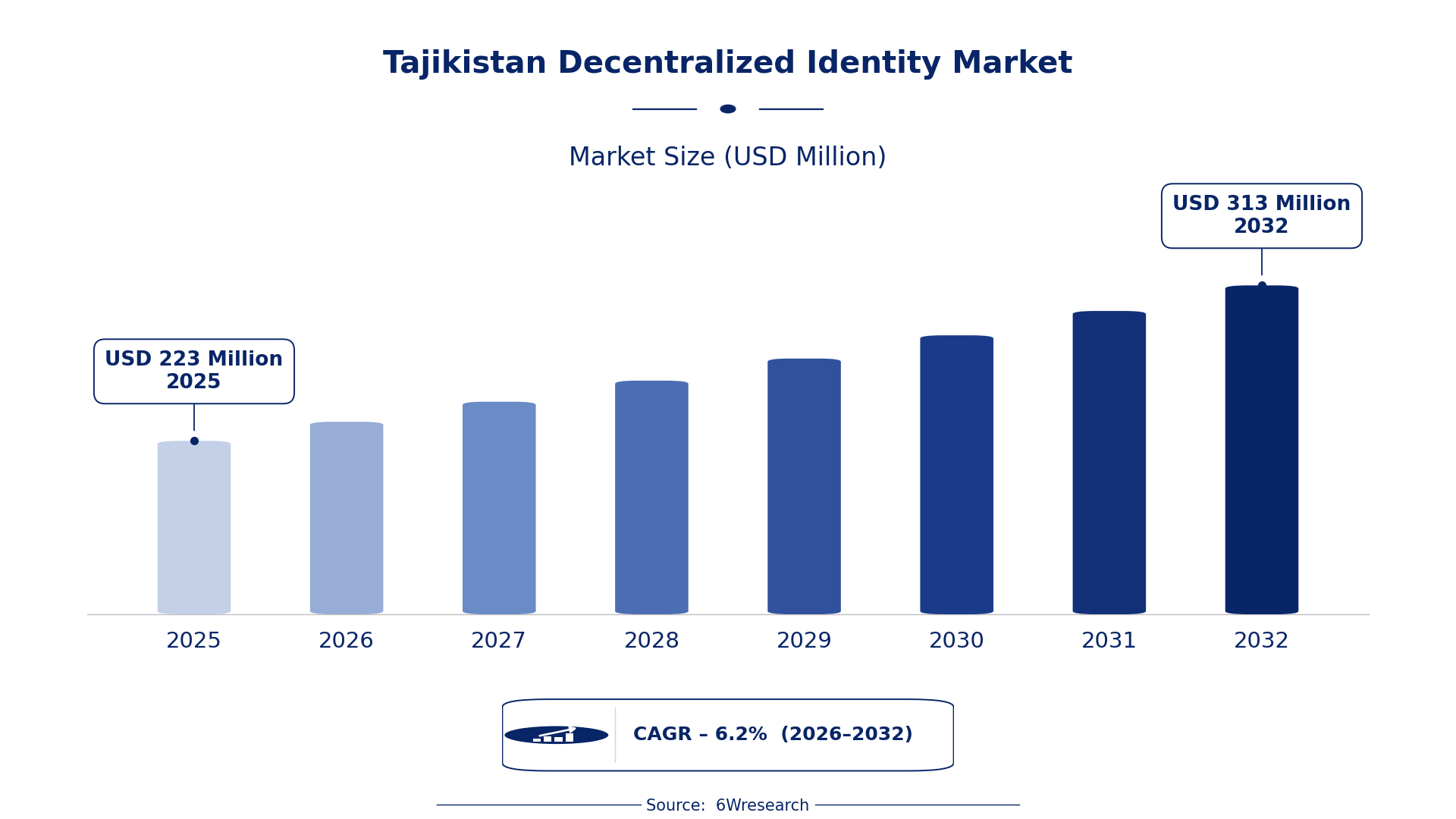
The Tajikistan Decentralized Identity Market was estimated at USD 223 Million in 2025 and is projected to reach USD 313 Million by 2032, growing at a CAGR of 6.2% from 2026 to 2032.
Tajikistan Decentralized Identity Market Synopsis
The emergence of decentralized identity solutions in Tajikistan is largely fueled by a heightened understanding of their role in enhancing security and privacy. The drive for secure identity management systems is evident as government initiatives actively promote digital transformation across various sectors.
A noteworthy trend includes collaborations between technology firms and government agencies, enabling the implementation of blockchain-based identity solutions. Sectors such as finance, healthcare, and public services stand to benefit significantly, creating a conducive environment for innovation and adoption.
Tajikistan Decentralized Identity Market Year-wise Growth Rate and Key Drivers
This graph illustrates the annual growth rates of the Tajikistan Decentralized Identity Market from 2021 to 2032, highlighting a steady upward trajectory and projected expansion over the forecast period.
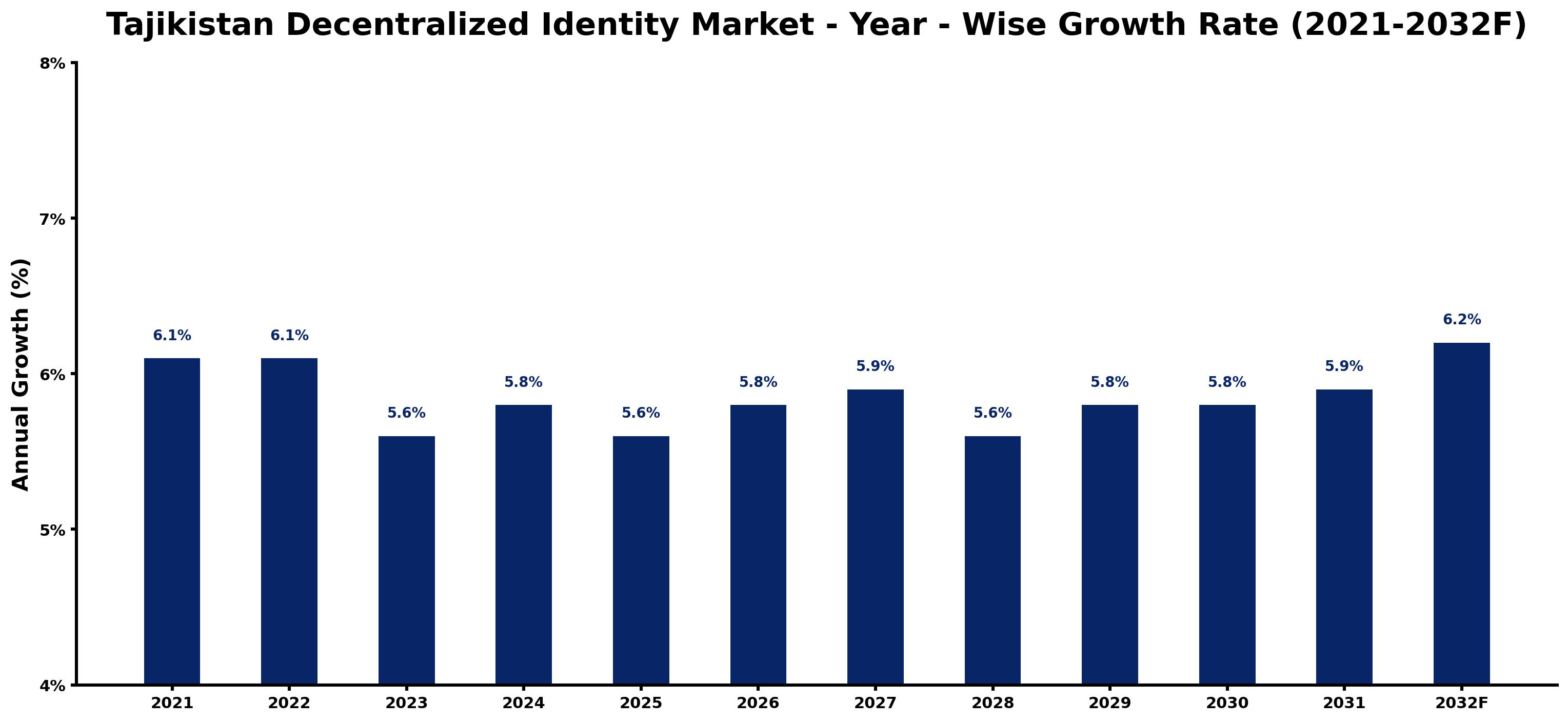
The table below presents the year‑wise growth rates along with the key drivers influencing the market
| Year | Growth Rate | Major Drivers |
| 2021 | 6.1% | Government push for digital IDs to improve governance. |
| 2022 | 6.1% | Increased investment in technology infrastructure by local startups. |
| 2023 | 5.6% | Collaboration with international NGOs on identity management standards. |
| 2024 | 5.8% | Rising youth population demanding digital access solutions. |
| 2025 | 5.6% | National strategies promoting financial inclusion through tech innovation. |
| 2026 | 5.8% | Regulatory support for biometric identification implementations. |
| 2027 | 5.9% | Growing awareness of data privacy among citizens. |
| 2028 | 5.6% | Spotlight on security improvements in public service access. |
| 2029 | 5.8% | Partnerships with tech firms enhancing digital identity platforms. |
| 2030 | 5.8% | Local demand for e-services boosting identity verification needs. |
| 2031 | 5.9% | Transitioning to blockchain solutions for secure identity systems. |
| 2032 | 6.2% | Government's aim to reduce fraud with digital identities. |
Note: Market size estimations and growth projections presented in this report are based on 6Wresearch's proprietary forecasting methodology, utilizing the latest available industry data, government publications, and primary research inputs.
Tajikistan Decentralized Identity Market Key Takeaways
Below are some of the specific key takeaways from the market, including:
- Growing demand for decentralized identity solutions driven by digital transformation initiatives.
- Increased adoption of blockchain technology for secure and verifiable identity management.
- Active collaborations between public and private sectors to set standards for decentralized identity systems.
- Investment opportunities in blockchain-based identity verification and biometric authentication technologies.
- Government policies prioritizing user data protection and interoperability among identity platforms.
Evaluation of Restraints in Tajikistan Decentralized Identity Market
Challenges persist in the Tajikistan Decentralized Identity Market, particularly due to a lack of awareness among both individuals and businesses regarding the benefits of decentralized identity solutions. This knowledge gap significantly hampers potential adoption rates. Furthermore, inadequate infrastructure and limited internet access in rural areas hinder the implementation of these technologies. Data security remains a pressing concern, with evolving regulations adding complexity to the landscape. Addressing these barriers will require a collaborative effort among stakeholders, focusing on education and infrastructural development.
Tajikistan Decentralized Identity Market Trends
The market is currently witnessing a surge in interest and adoption of decentralized identity technologies. One prominent trend involves the integration of blockchain for immutable record-keeping, which enhances trust and security. Self-sovereign identity platforms are also gaining traction, empowering individuals to manage their own data more effectively.
Biometric authentication methods are being explored as a means to provide additional layers of security. As public and private sectors collaborate more closely, the establishment of common standards for these technologies is becoming a key focus, indicating a promising direction for the market.
Tajikistan Decentralized Identity Market Opportunities
There are substantial investment opportunities in the Tajikistan Decentralized Identity Market, especially in developing secure digital identity solutions. With rising digitization efforts, there is an increasing demand for platforms that offer improved privacy and security. Companies specializing in blockchain-based identity verification and biometric solutions stand to benefit significantly. Collaborating with government agencies and financial institutions to provide comprehensive identity management services could yield lucrative returns as this sector continues to grow.
Government Initiatives in the Tajikistan Decentralized Identity Market
The Tajikistan government is actively working to foster the decentralized identity market through various policy initiatives aimed at enhancing the security and efficiency of digital identity solutions. The regulatory framework being developed emphasizes the use of blockchain technology, which is integral to supporting the adoption of decentralized identity systems. The government's commitment to data protection and interoperability is crucial for driving innovation and collaboration within the sector.
- A recently completed regulatory framework that encourages the use of blockchain technology for identity verification and authentication.
- A current initiative to upgrade national digital infrastructure, improving accessibility to decentralized identity solutions across the country.
- Ongoing partnerships with tech companies aimed at developing self-sovereign identity platforms for citizen engagement.
- A planned public-private initiative expected to enhance data security measures by 2027.
- Government-led workshops focused on raising awareness about decentralized identity technologies among businesses and the general public.
Future Insights of the Tajikistan Decentralized Identity Market
Looking ahead, the Tajikistan Decentralized Identity Market is expected to experience substantial growth through 2032. Digitalization efforts will only intensify, paired with increasing awareness regarding the importance of data privacy and security. As businesses across sectors recognize the advantages of decentralized identity technologies, there will be a shift toward broader adoption.
Regulatory support and the expanded use of blockchain will likely drive the market's evolution, fostering a climate ripe for innovation and investment. With ongoing developments, the future of decentralized identity in Tajikistan promises exciting opportunities.
Tajikistan Decentralized Identity Market Latest Developments
In the past year, the Tajikistan Decentralized Identity Market has seen noteworthy advancements as the sector gears up for transformation. Companies and government agencies have intensified their collaborations to implement blockchain solutions while addressing the need for secure identity management. As the landscape evolves, new partnerships and projects are beginning to take shape.
- An initiative that began in early 2025 focusing on the development of a blockchain-based identity verification platform is currently ongoing.
- A major technology vendor rolled out a biometric authentication pilot program in mid-2025 to assess its effectiveness across various sectors.
- Plans for an upcoming regulatory review in late 2026, aimed at streamlining the implementation of decentralized identity systems.
- A collaborative project initiated in Q2 2025 involving several stakeholders to enhance public awareness about decentralized identity technologies.
- A newly launched online portal aimed at providing resources and guidelines for businesses looking to adopt decentralized identity solutions.
Tajikistan Decentralized Identity Market - Key Attractiveness of the Report
- 10 Years of Market Numbers
- Historical Data Starting from 2022 to 2025
- Base Year: 2025
- Forecast Data until 2032
- Key Performance Indicators Impacting the Market
- Major Upcoming Developments and Projects
Key Highlights of the Report:
- Tajikistan Decentralized Identity Market Outlook
- Market Size of Tajikistan Decentralized Identity Market, 2025
- Forecast of Tajikistan Decentralized Identity Market, 2032
- Historical Data and Forecast of Tajikistan Decentralized Identity Revenues & Volume for the Period 2022-2032F
- Tajikistan Decentralized Identity Market Trend Evolution
- Tajikistan Decentralized Identity Market Drivers and Challenges
- Tajikistan Decentralized Identity Price Trends
- Tajikistan Decentralized Identity Porter's Five Forces
- Tajikistan Decentralized Identity Industry Life Cycle
- Historical Data and Forecast of Tajikistan Decentralized Identity Market Revenues & Volume By Vertical for the Period 2022-2032F
- Historical Data and Forecast of Tajikistan Decentralized Identity Market Revenues & Volume By BFSI for the Period 2022-2032F
- Historical Data and Forecast of Tajikistan Decentralized Identity Market Revenues & Volume By Government for the Period 2022-2032F
- Historical Data and Forecast of Tajikistan Decentralized Identity Market Revenues & Volume By Healthcare and Life Sciences for the Period 2022-2032F
- Historical Data and Forecast of Tajikistan Decentralized Identity Market Revenues & Volume By Retail and eCommerce for the Period 2022-2032F
- Historical Data and Forecast of Tajikistan Decentralized Identity Market Revenues & Volume By Telecom and IT for the Period 2022-2032F
- Historical Data and Forecast of Tajikistan Decentralized Identity Market Revenues & Volume By Transport and Logistics for the Period 2022-2032F
- Historical Data and Forecast of Tajikistan Decentralized Identity Market Revenues & Volume By Real Estate for the Period 2022-2032F
- Historical Data and Forecast of Tajikistan BFSI Decentralized Identity Market Revenues & Volume By Others for the Period 2022-2032F
- Historical Data and Forecast of Tajikistan Decentralized Identity Market Revenues & Volume By Identity Type for the Period 2022-2032F
- Historical Data and Forecast of Tajikistan Decentralized Identity Market Revenues & Volume By Non- biometrics for the Period 2022-2032F
- Historical Data and Forecast of Tajikistan Decentralized Identity Market Revenues & Volume By Biometrics for the Period 2022-2032F
- Historical Data and Forecast of Tajikistan Decentralized Identity Market Revenues & Volume By End User for the Period 2022-2032F
- Historical Data and Forecast of Tajikistan Decentralized Identity Market Revenues & Volume By Enterprises for the Period 2022-2032F
- Historical Data and Forecast of Tajikistan Decentralized Identity Market Revenues & Volume By Individual for the Period 2022-2032F
- Historical Data and Forecast of Tajikistan Decentralized Identity Market Revenues & Volume By Organization Size for the Period 2022-2032F
- Historical Data and Forecast of Tajikistan Decentralized Identity Market Revenues & Volume By Large Enterprises for the Period 2022-2032F
- Historical Data and Forecast of Tajikistan Decentralized Identity Market Revenues & Volume By SMEs for the Period 2022-2032F
- Tajikistan Decentralized Identity Import Export Trade Statistics
- Market Opportunity Assessment By Vertical
- Market Opportunity Assessment By Identity Type
- Market Opportunity Assessment By End User
- Market Opportunity Assessment By Organization Size
- Tajikistan Decentralized Identity Top Companies Market Share
- Tajikistan Decentralized Identity Competitive Benchmarking By Technical and Operational Parameters
- Tajikistan Decentralized Identity Company Profiles
- Tajikistan Decentralized Identity Key Strategic Recommendations






































