Tajikistan Digital Market Size & Growth Rate (2026-2032)
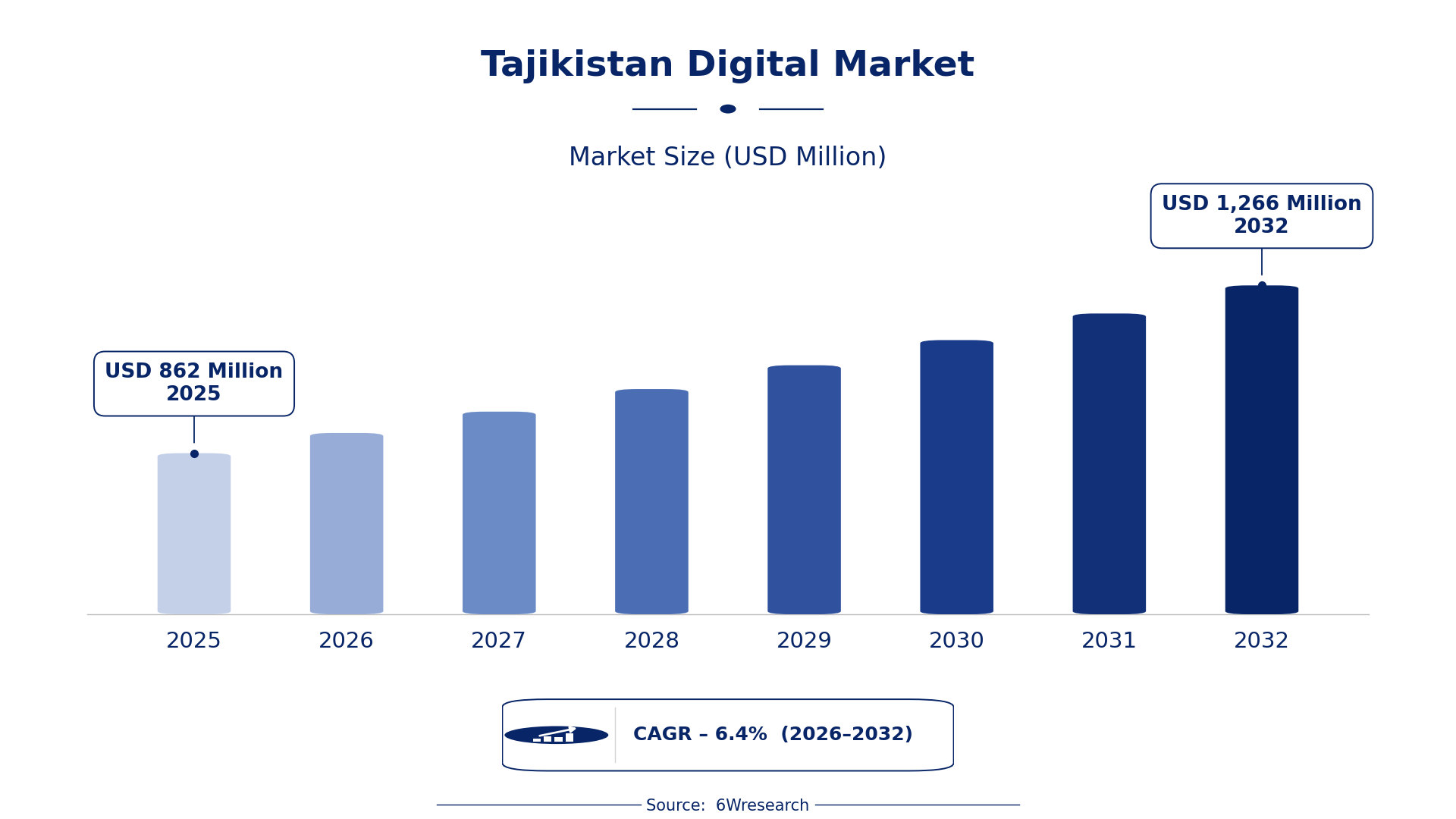
The Tajikistan Digital Market was estimated at USD 862 Million in 2025 and is projected to reach USD 1266 Million by 2032, growing at a CAGR of 6.4% from 2026 to 2032.
Tajikistan Digital Market Synopsis
The driving force behind the Tajikistan Digital Market is the rapid increase in internet penetration and smartphone usage. With a significant portion of the population now accessing the internet, businesses are finding new avenues for engagement and growth.
Social media platforms are particularly influential among the youth, presenting a fertile ground for digital marketing. The rise of e-commerce and mobile banking is reshaping consumer behavior, while ongoing challenges in infrastructure and digital literacy continue to be hurdles that need addressing.
Tajikistan Digital Market Year-wise Growth Rate and Key Drivers
This graph illustrates the annual growth rates of the Tajikistan Digital Market from 2021 to 2032, highlighting a steady upward trajectory and projected expansion over the forecast period.
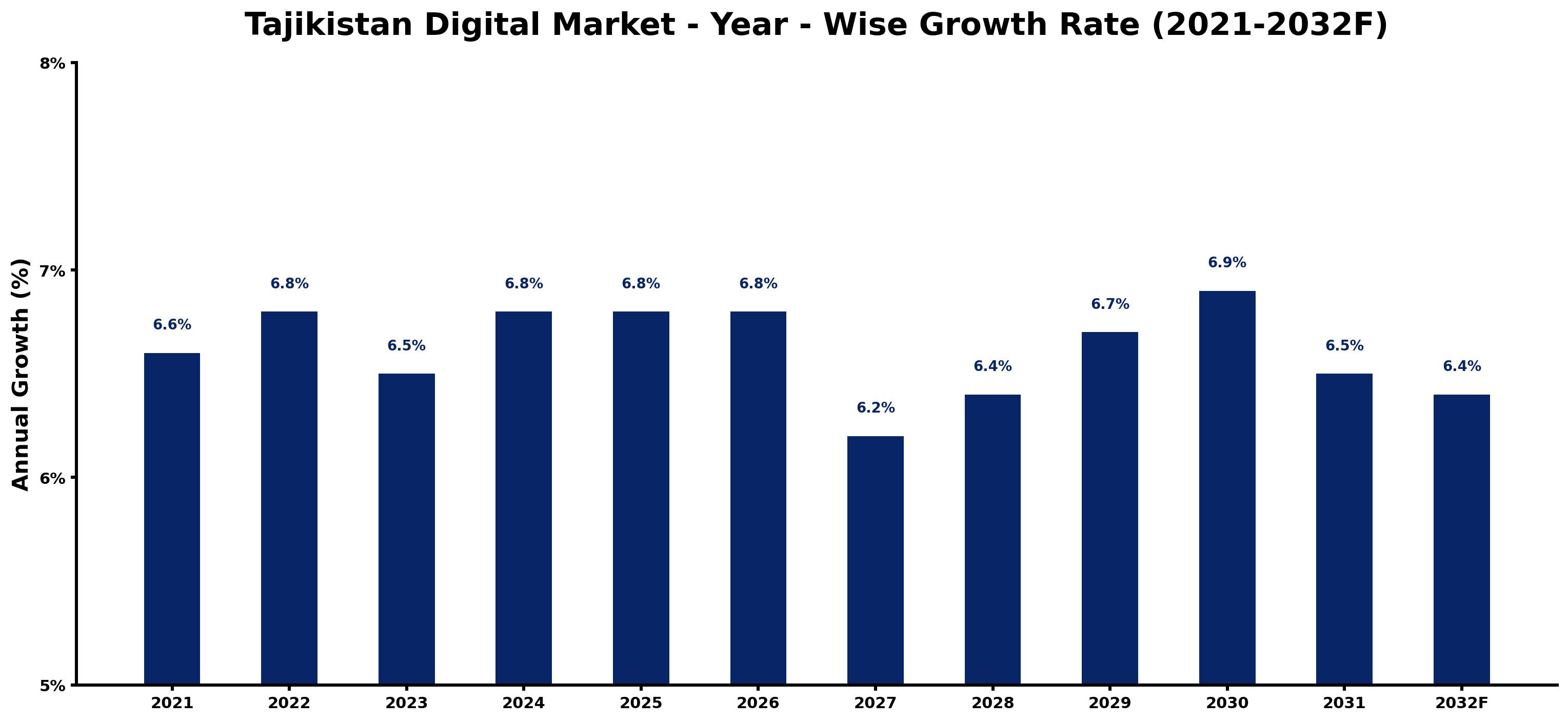
The table below presents the year‑wise growth rates along with the key drivers influencing the market
| Year | Growth Rate | Major Drivers |
| 2021 | 6.6% | Government digitalization initiatives boosting online service access. |
| 2022 | 6.8% | Growing youth population embracing mobile payment solutions. |
| 2023 | 6.5% | Rise in remote work driving demand for digital tools. |
| 2024 | 6.8% | Mobile internet coverage expansion facilitating e-business growth. |
| 2025 | 6.8% | Launch of national digital ID program enhancing transactions. |
| 2026 | 6.8% | Increased smartphone penetration fostering app development market. |
| 2027 | 6.2% | Local fintech solutions addressing unbanked population needs. |
| 2028 | 6.4% | Government partnerships with tech firms for skills training. |
| 2029 | 6.7% | Increased internet security regulations boosting consumer confidence. |
| 2030 | 6.9% | Emergence of online education platforms meeting local demand. |
| 2031 | 6.5% | Investment in ICT infrastructure improving connectivity nationwide. |
| 2032 | 6.4% | Supporting regulations for startups bolstering digital entrepreneurship. |
Note: Market size estimations and growth projections presented in this report are based on 6Wresearch's proprietary forecasting methodology, utilizing the latest available industry data, government publications, and primary research inputs.
Tajikistan Digital Market Key Takeaways
Below are some of the specific key takeaways from the market, including:
- Increased internet penetration is a major catalyst for market growth.
- Mobile banking services are gaining traction, enhancing financial accessibility.
- Social media usage is expanding, offering new marketing opportunities for businesses.
- The government's commitment to improving digital infrastructure is evident in its policies.
- E-commerce is on the rise, driven by consumer demand for online shopping options.
Evaluation of Restraints in Tajikistan Digital Market
The Tajikistan Digital Market is held back by several significant factors. Limited internet infrastructure, especially in rural areas, restricts access to digital services. This gap creates disparities in e-commerce growth and digital engagement. on top of that, the absence of a clear regulatory framework creates uncertainty for businesses and consumers alike. Cybersecurity remains a critical concern, with inadequate measures in place to protect online transactions. Lastly, the shortage of skilled professionals in digital fields hampers the sector's growth potential.
Tajikistan Digital Market Trends
The digital market is witnessing several key trends that shape its trajectory. E-commerce continues to expand as consumers increasingly favor online shopping. Additionally, the adoption of mobile payment solutions is on the rise, making transactions more convenient. Social media platforms are evolving into powerful tools for marketing, allowing businesses to connect directly with their target audiences. on top of that, the government's focus on enhancing digital literacy and infrastructure indicates a commitment to fostering long-term growth.
Tajikistan Digital Market Opportunities
As the digital landscape evolves, several opportunities for growth emerge. Companies can harness the increasing smartphone penetration to reach a broader audience through mobile applications. The e-commerce sector is ripe for investment, with potential for new platforms and services catering to local consumer needs. Additionally, fintech solutions can capitalize on the rising demand for secure digital payment methods. Overall, businesses that adapt to these trends will find numerous avenues for expansion in Tajikistan's digital market.
Government Initiatives in the Tajikistan Digital Market
Government policy is a crucial factor in shaping the Tajikistan Digital Market. The state has launched various initiatives aimed at boosting digital infrastructure and literacy, reflecting a clear commitment to fostering a conducive environment for digital growth. These initiatives not only support economic development but also enhance the technological capabilities of the nation.
- A national digital infrastructure upgrade programme now in its rollout phase aims to expand internet access across urban and rural areas.
- The Digital Economy Development Concept for Tajikistan, introduced in 2023, focuses on promoting e-commerce and improving digital literacy nationwide.
- A regulatory framework for electronic commerce was established in 2022, ensuring consumer protection and fostering trust in online transactions.
- Current initiatives include a government-led project to enhance cybersecurity measures for e-commerce platforms.
- Upcoming plans involve launching a nationwide campaign to boost digital skills among the workforce by 2025.
Future Insights of the Tajikistan Digital Market
Looking ahead to 2026-2032, the Tajikistan Digital Market appears to be on a path of sustained growth. The increasing accessibility of the internet and smartphones is expected to drive demand for digital services further. E-commerce will likely continue to flourish as both businesses and consumers increasingly turn to online platforms. With the government's ongoing initiatives to enhance infrastructure and promote digital literacy, the market is well-positioned for innovative developments in sectors such as fintech and digital marketing.
Tajikistan Digital Market Latest Developments
Over the past year, the Tajikistan Digital Market has seen a range of developments that reflect its growth trajectory. Companies are increasingly adopting digital technologies, and government initiatives are paving the way for enhanced connectivity and service delivery.
- A leading telecommunications provider launched a new mobile banking app in early 2023, aimed at simplifying financial transactions for users.
- A major technology vendor is currently implementing a nationwide training programme for digital marketing professionals, which began in mid-2023 and remains underway.
- New e-commerce platforms have been introduced in the past year, catering specifically to local consumer demands and preferences.
- An upcoming initiative expected to begin in Q4 2023 aims to expand internet access in remote regions, addressing the digital divide.
- A recent partnership between local banks and fintech startups has successfully rolled out enhanced payment solutions, completed by early 2023.
Tajikistan Digital Market - Key Attractiveness of the Report
- 10 Years of Market Numbers
- Historical Data Starting from 2022 to 2025
- Base Year: 2025
- Forecast Data until 2032
- Key Performance Indicators Impacting the Market
- Major Upcoming Developments and Projects
Key Highlights of the Report:
- Tajikistan Digital Market Outlook
- Market Size of Tajikistan Digital Market, 2025
- Forecast of Tajikistan Digital Market, 2032
- Historical Data and Forecast of Tajikistan Digital Revenues & Volume for the Period 2022-2032F
- Tajikistan Digital Market Trend Evolution
- Tajikistan Digital Market Drivers and Challenges
- Tajikistan Digital Price Trends
- Tajikistan Digital Porter's Five Forces
- Tajikistan Digital Industry Life Cycle
- Historical Data and Forecast of Tajikistan Digital Market Revenues & Volume By Software for the Period 2022-2032F
- Historical Data and Forecast of Tajikistan Digital Market Revenues & Volume By CRM Software for the Period 2022-2032F
- Historical Data and Forecast of Tajikistan Digital Market Revenues & Volume By Email Marketing Software for the Period 2022-2032F
- Historical Data and Forecast of Tajikistan Digital Market Revenues & Volume By Social Media Advertising for the Period 2022-2032F
- Tajikistan Digital Import Export Trade Statistics
- Market Opportunity Assessment By Software
- Tajikistan Digital Top Companies Market Share
- Tajikistan Digital Competitive Benchmarking By Technical and Operational Parameters
- Tajikistan Digital Company Profiles
- Tajikistan Digital Key Strategic Recommendations






































