Tajikistan Dyestuff For Cotton Market Size, Share & Growth Rate
The Tajikistan Dyestuff For Cotton Market was estimated at USD 215 Million in 2025 and is projected to reach USD 294 Million by 2032, growing at a CAGR of 4.6% from 2026 to 2032. This growth trajectory is primarily driven by the surging demand for vibrant cotton textiles, spurred by both local consumption and export opportunities. Additionally, the increasing shift towards sustainable dyeing practices is encouraging textile manufacturers to seek high-quality, eco-friendly dye solutions, further propelling market expansion.
Tajikistan Dyestuff For Cotton Market Year-wise Growth Rate and Key Drivers
This graph highlights how the Tajikistan Dyestuff For Cotton Market has steadily grown over the years, supported by major growth factors.
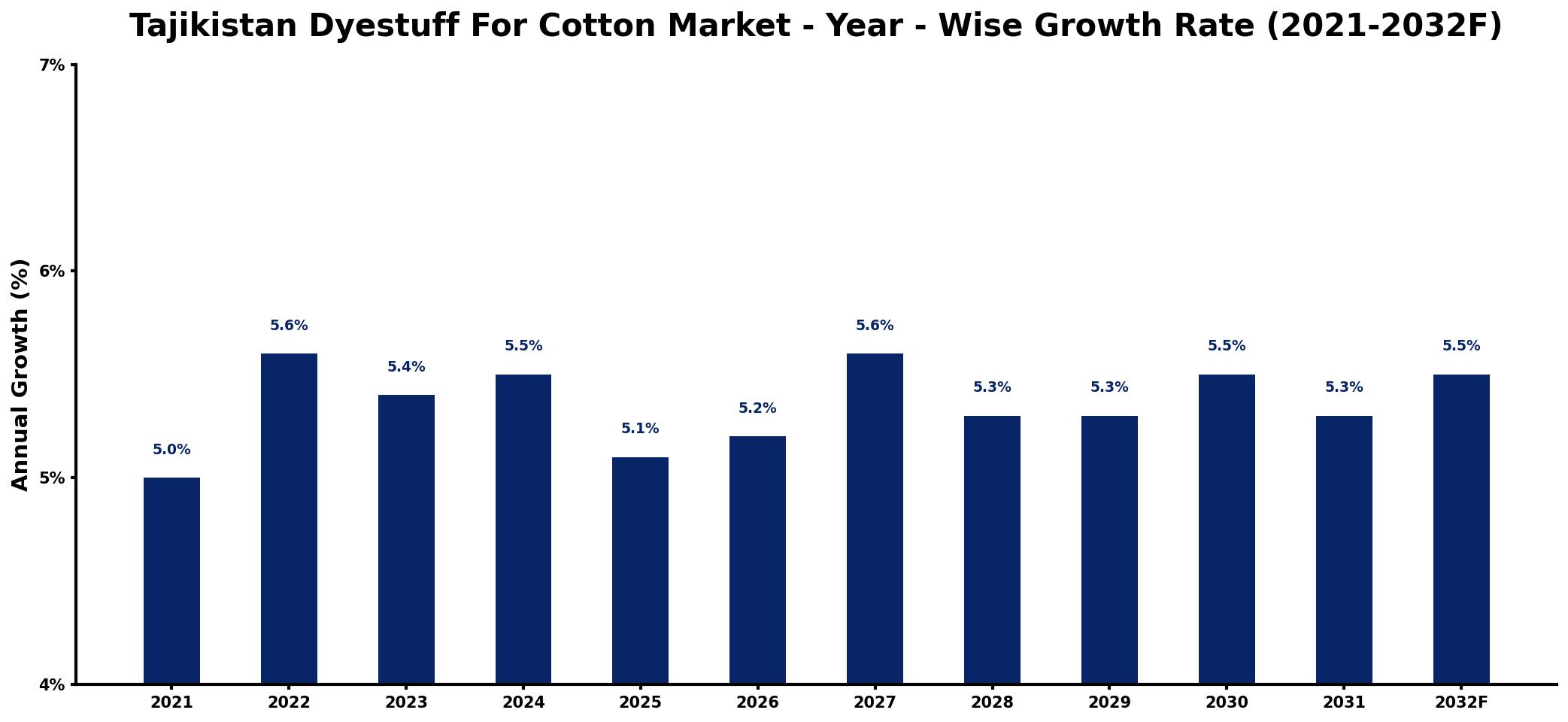
The table below presents the year‑wise growth rates along with the key drivers influencing the market
| Year | Growth Rate | Major Drivers |
| 2021 | 5.0% | Rising textile production capacity |
| 2022 | 5.6% | Growing demand for sustainable materials |
| 2023 | 5.4% | Increased exports to neighboring markets |
| 2024 | 5.5% | Expansion of local manufacturing facilities |
| 2025 | 5.1% | Investments in research and development |
| 2026 | 5.2% | Strengthening of supply chain networks |
| 2027 | 5.6% | Higher consumer awareness on colors |
| 2028 | 5.3% | Adoption of advanced dyeing technologies |
| 2029 | 5.3% | Increase in fashion industry collaborations |
| 2030 | 5.5% | Growing trend of eco-friendly products |
| 2031 | 5.3% | Stronger regulatory support for innovation |
| 2032 | 5.5% | Enhanced marketing strategies for products |
Note: Market size estimations and growth projections presented in this report are based on 6Wresearch's proprietary forecasting methodology, utilizing the latest available industry data, government publications, and primary research inputs.
Tajikistan Dyestuff For Cotton Market Synopsis
The strongest force shaping the Tajikistan dyestuff for cotton market is the rising consumer preference for eco-friendly dyeing solutions. As environmental awareness grows, local manufacturers are increasingly focused on adopting sustainable practices, driving demand for natural and organic dyes tailored for cotton textiles.
Moreover, the textile industry in Tajikistan is gaining momentum, with significant investments aimed at enhancing production capabilities. This expansion not only presents opportunities for local dyestuff manufacturers but also necessitates the development of innovative dyeing technologies that can meet both quality and sustainability standards.
Tajikistan Dyestuff For Cotton Market Key Takeaways
- The market is benefiting from a rising trend towards sustainable and eco-friendly dyeing practices.
- Government initiatives aimed at promoting domestic production are enhancing the competitive landscape.
- Investment opportunities are emerging in research and development for innovative dye solutions.
- Challenges related to high-quality dye availability and reliance on imports still need to be addressed.
- The increasing demand for colored textiles supports a robust growth trajectory for the market.
Evaluation of Restraints in Tajikistan Dyestuff For Cotton Market
Despite its promising growth, the Tajikistan dyestuff for cotton market faces significant restraints. One of the most pressing issues is the limited availability of high-quality, environmentally friendly dyes, which restricts manufacturers from fully meeting international colorfastness and sustainability standards. Moreover, many local textile facilities lack modern dyeing technologies, hindering efficient production processes. The heavy reliance on imported dyes also presents challenges, leading to potential supply chain disruptions and rising costs influenced by currency fluctuations. This scenario, coupled with insufficient local research and development efforts, poses a significant hurdle for the market's competitiveness on a global scale.
Tajikistan Dyestuff For Cotton Market Trends
A notable trend in the Tajikistan dyestuff for cotton market is the increasing demand for sustainable dyeing solutions. As consumers become more environmentally conscious, there's a palpable shift toward natural and plant-based dyes, as well as eco-friendly synthetic options. Manufacturers are responding to this demand by expanding their product lines to include dyes that comply with both environmental regulations and consumer preferences. Furthermore, theres a growing emphasis on transparency within the supply chain to ensure ethically sourced materials, reinforcing the commitment to sustainability.
Tajikistan Dyestuff For Cotton Market Opportunities
The expanding textile industry in Tajikistan offers significant investment opportunities in the dyestuff for cotton sector. Companies looking to manufacture dyes specifically tailored for local textile needs can capture a segment of this growing market. Additionally, by investing in research and development, businesses can explore innovative dyeing solutions that meet the increasing consumer demand for sustainability. Collaborating with local textile manufacturers to understand their specific needs can create strategic advantages for investors aiming to enter or expand within this market.
Government Initiatives in the Tajikistan Dyestuff For Cotton Market
The Tajikistan government is actively promoting the dyestuff for cotton market through various initiatives aimed at bolstering domestic production. Policies such as import tariffs and trade restrictions are designed to safeguard local manufacturers and encourage the development of the national dyestuff industry. Furthermore, the government has introduced subsidies and technical assistance programs to stimulate investment and enhance competitiveness among local dyestuff producers, fostering a self-sufficient supply chain for the cotton sector.
Future Insights of the Tajikistan Dyestuff For Cotton Market
Looking ahead, the Tajikistan dyestuff for cotton market is poised for steady growth from 2026 to 2032, largely fueled by the rising demand for colored textiles and the government's commitment to advancing the textile sector. As sustainability continues to take center stage, the adoption of organic and eco-friendly dye solutions is expected to rise. However, fluctuations in raw material costs and competition from imported dyes could pose challenges. Overall, with ongoing government support and a growing emphasis on sustainable practices, this market is well-positioned for gradual yet robust expansion.
Tajikistan Dyestuff For Cotton Market Latest Developments (2025 - 2026)
In recent months, the Tajikistan dyestuff for cotton market has witnessed a series of developments that underscore its potential for growth. Local manufacturers have started introducing a broader range of eco-friendly dyes to meet increasing consumer demands for sustainable products. Additionally, partnerships between textile producers and dyestuff manufacturers are emerging, aimed at fostering innovation in dyeing technologies. The government's ongoing efforts to enhance the competitive landscape have also led to increased investments in the textile industry, paving the way for future advancements.
Tajikistan Dyestuff For Cotton Market - Key Attractiveness of the Report
- 10 Years of Market Numbers
- Historical Data Starting from 2022 to 2025
- Base Year: 2025
- Forecast Data until 2032
- Key Performance Indicators Impacting the Market
- Major Upcoming Developments and Projects
Key Highlights of the Report:
- Tajikistan Dyestuff For Cotton Market Outlook
- Market Size of Tajikistan Dyestuff For Cotton Market, 2025
- Forecast of Tajikistan Dyestuff For Cotton Market, 2032
- Historical Data and Forecast of Tajikistan Dyestuff For Cotton Revenues & Volume for the Period 2022-2032F
- Tajikistan Dyestuff For Cotton Market Trend Evolution
- Tajikistan Dyestuff For Cotton Market Drivers and Challenges
- Tajikistan Dyestuff For Cotton Price Trends
- Tajikistan Dyestuff For Cotton Porter's Five Forces
- Tajikistan Dyestuff For Cotton Industry Life Cycle
- Historical Data and Forecast of Tajikistan Dyestuff For Cotton Market Revenues & Volume By Types for the Period 2022-2032F
- Historical Data and Forecast of Tajikistan Dyestuff For Cotton Market Revenues & Volume By Reactive Dyes for the Period 2022-2032F
- Historical Data and Forecast of Tajikistan Dyestuff For Cotton Market Revenues & Volume By Disperse Dyes for the Period 2022-2032F
- Historical Data and Forecast of Tajikistan Dyestuff For Cotton Market Revenues & Volume By Direct Dyes for the Period 2022-2032F
- Historical Data and Forecast of Tajikistan Dyestuff For Cotton Market Revenues & Volume By Sulfur Dyes for the Period 2022-2032F
- Historical Data and Forecast of Tajikistan Dyestuff For Cotton Market Revenues & Volume By Optical Brighteners for the Period 2022-2032F
- Historical Data and Forecast of Tajikistan Dyestuff For Cotton Market Revenues & Volume By Applications for the Period 2022-2032F
- Historical Data and Forecast of Tajikistan Dyestuff For Cotton Market Revenues & Volume By Non-Woven for the Period 2022-2032F
- Historical Data and Forecast of Tajikistan Dyestuff For Cotton Market Revenues & Volume By Health Care for the Period 2022-2032F
- Historical Data and Forecast of Tajikistan Dyestuff For Cotton Market Revenues & Volume By Personal Care for the Period 2022-2032F
- Historical Data and Forecast of Tajikistan Dyestuff For Cotton Market Revenues & Volume By Others for the Period 2022-2032F
- Tajikistan Dyestuff For Cotton Import Export Trade Statistics
- Market Opportunity Assessment By Types
- Market Opportunity Assessment By Applications
- Tajikistan Dyestuff For Cotton Top Companies Market Share
- Tajikistan Dyestuff For Cotton Competitive Benchmarking By Technical and Operational Parameters
- Tajikistan Dyestuff For Cotton Company Profiles
- Tajikistan Dyestuff For Cotton Key Strategic Recommendations






































