Vietnam Dyestuff For Cotton Market Size, Share & Growth Rate
The Vietnam Dyestuff For Cotton Market was estimated at USD 266 Million in 2025 and is projected to reach USD 375 Million by 2032, growing at a CAGR of 5.0% from 2026 to 2032. This growth trajectory reflects an increasing demand for sustainable and eco-friendly dyeing solutions within the textile industry. As manufacturers pivot towards more responsible practices, the shift towards innovative dyestuffs that ensure superior color fastness while minimizing environmental impact will further fuel market expansion.
Vietnam Dyestuff For Cotton Market Year-wise Growth Rate and Key Drivers
This graph highlights how the Vietnam Dyestuff For Cotton Market has steadily grown over the years, supported by major growth factors.
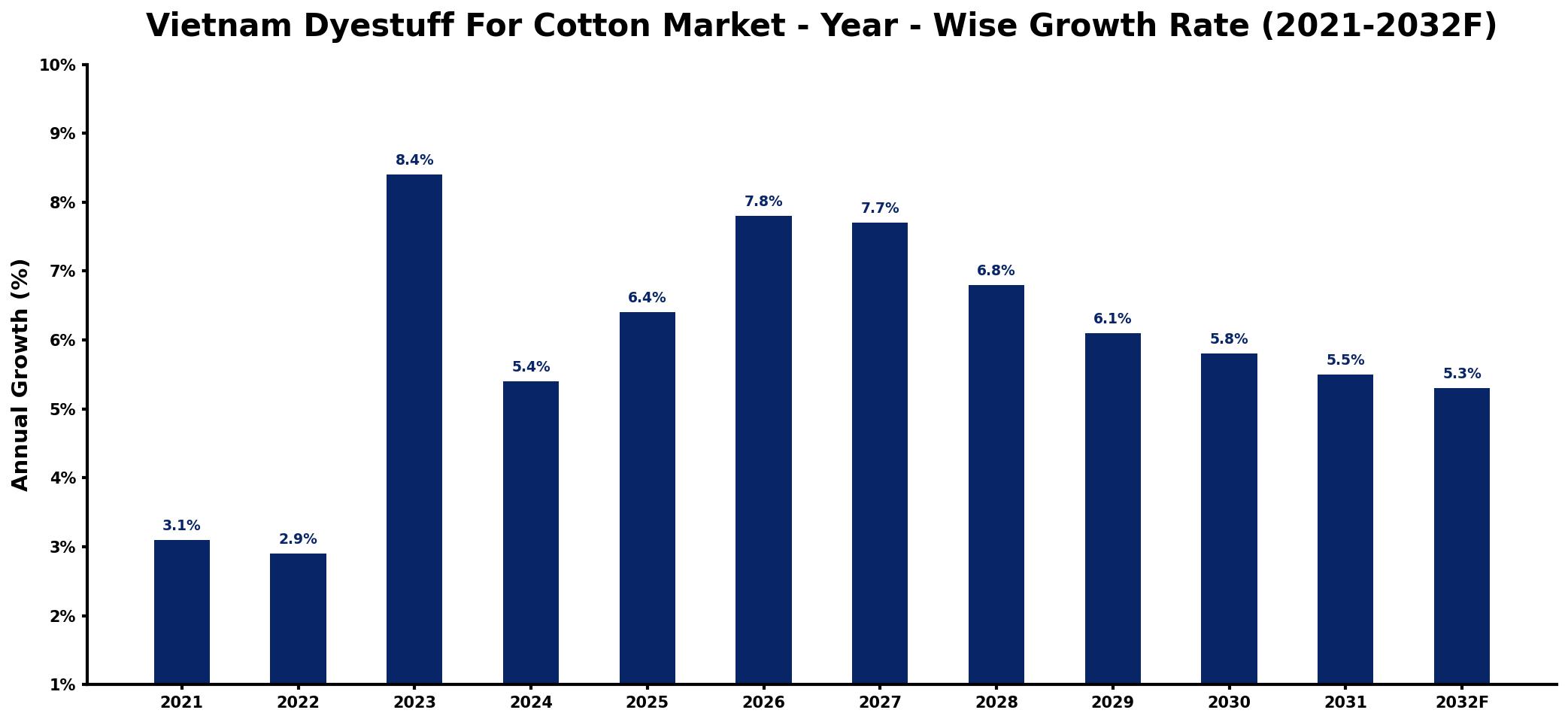
The table below presents the year‑wise growth rates along with the key drivers influencing the market
| Year | Growth Rate | Major Drivers |
| 2021 | 3.1% | Rising textile production capacity |
| 2022 | 2.9% | Increased consumer fashion trends |
| 2023 | 8.4% | improved processing technologies adoption |
| 2024 | 5.4% | Expansion of export markets |
| 2025 | 6.4% | Technological advancements in production |
| 2026 | 7.8% | Higher demand for sustainable materials |
| 2027 | 7.7% | Investment in manufacturing infrastructure |
| 2028 | 6.8% | Emerging markets driving consumption |
| 2029 | 6.1% | Collaborations with fashion brands |
| 2030 | 5.8% | Regulatory support for innovation |
| 2031 | 5.5% | Focus on quality and performance |
| 2032 | 5.3% | Advancements in color technology |
Note: Market size estimations and growth projections presented in this report are based on 6Wresearch's proprietary forecasting methodology, utilizing the latest available industry data, government publications, and primary research inputs.
Vietnam Dyestuff For Cotton Market Synopsis
The Vietnam dyestuff for cotton market has experienced robust momentum recently, driven by the rising popularity of cotton textiles among consumers. However, as the market evolves, a significant focus on sustainability is steering manufacturers to adopt greener practices and innovative dyestuffs. This transition signifies not just a change in product offerings, but a broader commitment to meet the environmental and ethical demands of a discerning consumer base.
In this dynamic landscape, textile producers must navigate a dual focus: maintaining color quality while responding to regulatory pressures and consumer preferences for non-toxic, environmentally friendly alternatives. The market's evolution is characterized by a need for agility and forward-thinking strategies to leverage emerging opportunities in eco-conscious dyestuff formulations.
Vietnam Dyestuff For Cotton Market Key Takeaways
- Rapid growth is anticipated due to increasing consumer demand for sustainable textile solutions.
- Innovations in dyestuffs that focus on environmental impact are becoming essential for market players.
- The shift towards efficient dyeing processes is reshaping the operational strategies of textile manufacturers.
- Regulatory standards are influencing the adoption of eco-friendly dyestuffs in the industry.
- Emerging trends highlight a greater emphasis on color fastness and performance without compromising sustainability.
Evaluation of Restraints in Vietnam Dyestuff For Cotton Market
Despite the growth potential, the Vietnam dyestuff for cotton market faces several restraints that could impede its expansion. One primary concern is the pressure on manufacturers to innovate rapidly in response to shifting consumer preferences. This necessitates significant investment in research and development to create non-toxic and environmentally friendly dyestuff solutions that maintain competitive pricing. Additionally, supply chain disruptions, particularly those experienced during the COVID-19 pandemic, continue to challenge manufacturers' ability to meet market demands effectively. As such, balancing sustainability with cost-effectiveness remains a critical hurdle for the industry.
Vietnam Dyestuff For Cotton Market Trends
The Vietnam dyestuff for cotton market is currently experiencing a surge in interest toward sustainable practices. More manufacturers are adopting natural and bio-based dyes in response to growing consumer awareness regarding environmental impacts. Additionally, advancements in dyeing technologies are enabling more efficient processes, minimizing water usage, and reducing waste. The trend of customization in textile design is also influencing the demand for more versatile dyestuff offerings, further highlighting the importance of innovation in product development.
Vietnam Dyestuff For Cotton Market Opportunities
There are significant growth opportunities in the Vietnam dyestuff for cotton market, especially for companies that prioritize sustainable practices and product innovation. As eco-conscious consumers drive demand for responsibly produced textiles, manufacturers who can offer superior dyeing solutions will stand to benefit. Additionally, partnerships with research institutions to develop new formulations that cater to sustainability criteria can enhance a companys market position. Exploring export markets can also provide avenues for growth as global demand for eco-friendly textiles rises.
Government Initiatives in the Vietnam Dyestuff For Cotton Market
The Vietnamese government is actively promoting sustainability within the textile sector through various policies and incentives. Programs aimed at improving environmental standards in production processes are facilitating the transition toward eco-friendly practices. Moreover, public funding for research and development initiatives in sustainable dye technologies is encouraging manufacturers to adopt greener alternatives. This proactive stance not only aids local companies in enhancing competitiveness but also aligns with broader global sustainability goals.
Future Insights of the Vietnam Dyestuff For Cotton Market
Looking ahead to 2026-2032, the Vietnam dyestuff for cotton market is expected to continue evolving as sustainability takes center stage. Innovations in dye technology, particularly those emphasizing minimal environmental impact, will be key drivers of market growth. As consumer preferences for eco-friendly textiles solidify, companies that prioritize these attributes will gain a distinct competitive advantage. Additionally, as regulatory frameworks tighten, adherence to sustainable practices will no longer be an option but a necessity for survival in this dynamic market.
Vietnam Dyestuff For Cotton Market Latest Developments (2025 - 2026)
In recent months, the Vietnam dyestuff for cotton market has seen several notable developments aimed at enhancing sustainability. Companies are increasingly focusing on R&D to create dyes with lower environmental footprints. Additionally, initiatives promoting collaboration among manufacturers and environmental organizations are gaining traction, fostering innovation in dye formulations. The emphasis on improved dyeing processes to reduce waste and water consumption is becoming a common goal among market participants, reflecting a collective move towards a more sustainable future.
Vietnam Dyestuff For Cotton Market - Key Attractiveness of the Report
- 10 Years of Market Numbers
- Historical Data Starting from 2022 to 2025
- Base Year: 2025
- Forecast Data until 2032
- Key Performance Indicators Impacting the Market
- Major Upcoming Developments and Projects
Key Highlights of the Report:
- Vietnam Dyestuff For Cotton Market Outlook
- Market Size of Vietnam Dyestuff For Cotton Market, 2025
- Forecast of Vietnam Dyestuff For Cotton Market, 2032
- Historical Data and Forecast of Vietnam Dyestuff For Cotton Revenues & Volume for the Period 2022-2032F
- Vietnam Dyestuff For Cotton Market Trend Evolution
- Vietnam Dyestuff For Cotton Market Drivers and Challenges
- Vietnam Dyestuff For Cotton Price Trends
- Vietnam Dyestuff For Cotton Porter's Five Forces
- Vietnam Dyestuff For Cotton Industry Life Cycle
- Historical Data and Forecast of Vietnam Dyestuff For Cotton Market Revenues & Volume By Types for the Period 2022-2032F
- Historical Data and Forecast of Vietnam Dyestuff For Cotton Market Revenues & Volume By Reactive Dyes for the Period 2022-2032F
- Historical Data and Forecast of Vietnam Dyestuff For Cotton Market Revenues & Volume By Disperse Dyes for the Period 2022-2032F
- Historical Data and Forecast of Vietnam Dyestuff For Cotton Market Revenues & Volume By Direct Dyes for the Period 2022-2032F
- Historical Data and Forecast of Vietnam Dyestuff For Cotton Market Revenues & Volume By Sulfur Dyes for the Period 2022-2032F
- Historical Data and Forecast of Vietnam Dyestuff For Cotton Market Revenues & Volume By Optical Brighteners for the Period 2022-2032F
- Historical Data and Forecast of Vietnam Dyestuff For Cotton Market Revenues & Volume By Applications for the Period 2022-2032F
- Historical Data and Forecast of Vietnam Dyestuff For Cotton Market Revenues & Volume By Non-Woven for the Period 2022-2032F
- Historical Data and Forecast of Vietnam Dyestuff For Cotton Market Revenues & Volume By Health Care for the Period 2022-2032F
- Historical Data and Forecast of Vietnam Dyestuff For Cotton Market Revenues & Volume By Personal Care for the Period 2022-2032F
- Historical Data and Forecast of Vietnam Dyestuff For Cotton Market Revenues & Volume By Others for the Period 2022-2032F
- Vietnam Dyestuff For Cotton Import Export Trade Statistics
- Market Opportunity Assessment By Types
- Market Opportunity Assessment By Applications
- Vietnam Dyestuff For Cotton Top Companies Market Share
- Vietnam Dyestuff For Cotton Competitive Benchmarking By Technical and Operational Parameters
- Vietnam Dyestuff For Cotton Company Profiles
- Vietnam Dyestuff For Cotton Key Strategic Recommendations






































