Tajikistan Electric Hair Clipper & Trimmer Market Size, Share & Growth Rate
The Tajikistan Electric Hair Clipper & Trimmer Market was estimated at USD 397 Million in 2025 and is projected to reach USD 746 Million by 2032, growing at a CAGR of 9.4% from 2026 to 2032. This impressive growth trajectory is driven by increasing urbanization, rising disposable incomes, and a notable shift in consumer preference towards personal grooming. As residents become more style-conscious and explore grooming solutions that offer convenience and efficiency, electric hair clippers and trimmers are becoming essential items in both homes and professional settings.
Tajikistan Electric Hair Clipper & Trimmer Market Year-wise Growth Rate and Key Drivers
This graph highlights how the Tajikistan Electric Hair Clipper & Trimmer Market has steadily grown over the years, supported by major growth factors.
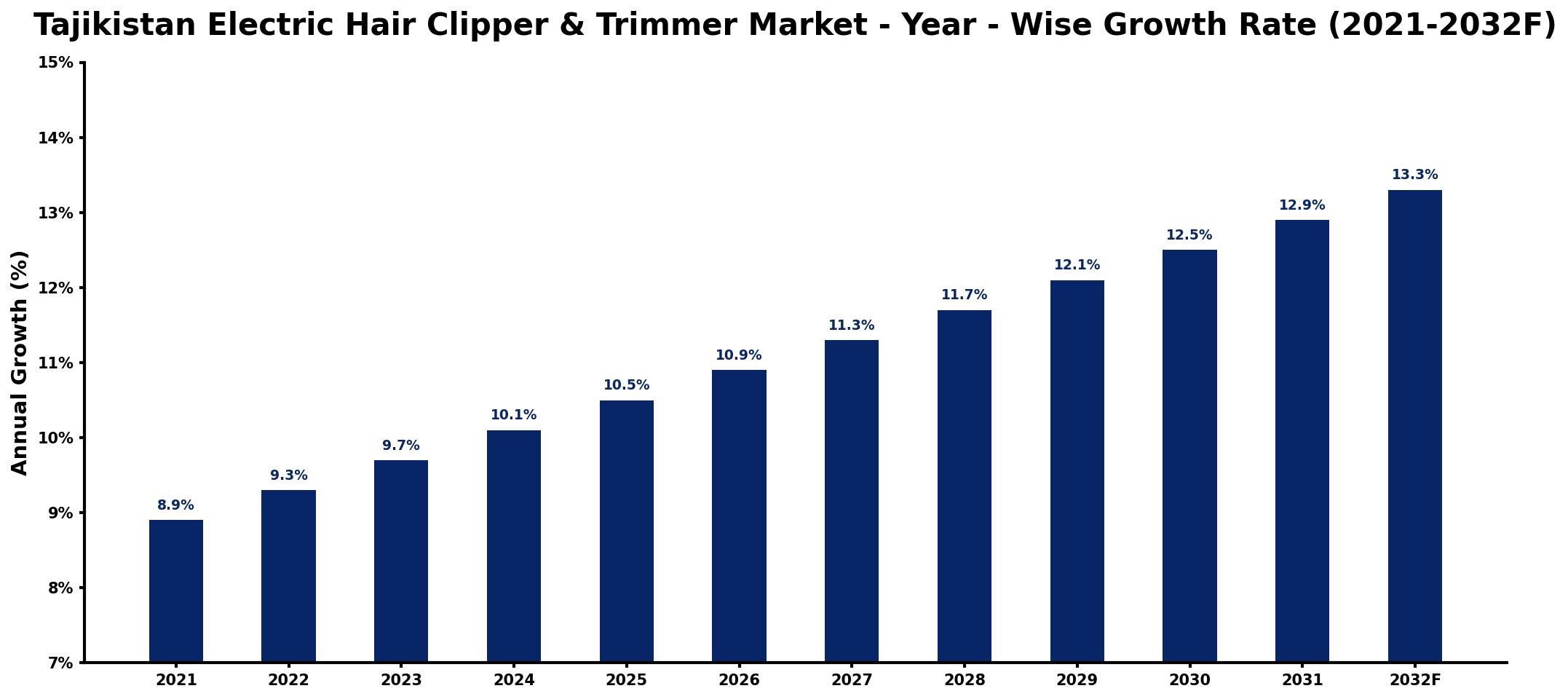
The table below presents the year‑wise growth rates along with the key drivers influencing the market
| Year | Growth Rate | Major Drivers |
| 2021 | 8.9% | Rising consumer grooming awareness |
| 2022 | 9.3% | Increased disposable income levels |
| 2023 | 9.7% | Expansion of retail distribution channels |
| 2024 | 10.1% | Growing trend of home grooming |
| 2025 | 10.5% | Surge in online shopping platforms |
| 2026 | 10.9% | Advancements in grooming technology |
| 2027 | 11.3% | Higher demand for personal care |
| 2028 | 11.7% | Emergence of new market players |
| 2029 | 12.1% | Increased focus on personal hygiene |
| 2030 | 12.5% | rising end-use demand growth |
| 2031 | 12.9% | Rising popularity of grooming subscriptions |
| 2032 | 13.3% | increased pharmaceutical industry usage |
Note: Market size estimations and growth projections presented in this report are based on 6Wresearch's proprietary forecasting methodology, utilizing the latest available industry data, government publications, and primary research inputs.
Tajikistan Electric Hair Clipper & Trimmer Market Synopsis
In Tajikistan, the electric hair clipper and trimmer market is witnessing a notable transformation, characterized by a growing demand for innovative grooming solutions. Urban dwellers, especially men, are increasingly opting for these devices to maintain their grooming standards amidst busy lifestyles.
The market not only benefits from international brands but is also seeing the rise of local manufacturers offering cost-effective alternatives. This blend of options allows consumers to select products that best fit their financial capacities while ensuring quality and variety.
- The market is primarily driven by changing grooming trends and rising disposable incomes.
- Technological advancements in electric hair clippers and trimmers are fostering consumer interest.
- Local manufacturers are providing affordable alternatives, enhancing market competition.
- The government's supportive policies are helping to stimulate market growth.
- Growing urbanization contributes to increasing consumer awareness regarding personal grooming.
Despite the promising growth potential, the Tajikistan Electric Hair Clipper & Trimmer Market faces significant restraints. Chief among these is the limited disposable income of many consumers, which can hinder their willingness to invest in grooming products. Traditional barbershops remain popular, often providing manual tools that compete with electric alternatives, thereby creating a challenge for market adoption. Furthermore, the lack of consumer awareness about the benefits of electric grooming devices can slow the transition from traditional grooming methods to modern alternatives.
A prominent trend shaping the Tajikistan Electric Hair Clipper & Trimmer Market is the rising demand for cordless devices featuring extended battery life and rapid charging options. These innovations cater to a consumer base that values convenience and portability. Additionally, multi-functional products that can perform various grooming tasks, such as hair clipping and beard trimming, are becoming increasingly popular among consumers seeking value in their purchases.
Another critical trend is the emphasis on precision with adjustable settings and high-quality cutting blades, enabling users to achieve their desired styles with ease. This shift towards technologically advanced and user-friendly products is redefining the grooming experience in Tajikistan.
The opportunities for growth in the Tajikistan Electric Hair Clipper & Trimmer Market are robust. Investors looking to tap into this burgeoning sector can do so by establishing local distribution networks, collaborating with salons and barbershops, and introducing innovative products that resonate with local consumers. The evolving grooming culture and increasing disposable incomes make this market ripe for investment, particularly as it presents potential for expansion into neighboring Central Asian countries, leveraging Tajikistan's geographic advantage.
The Tajikistan government has taken proactive measures to foster growth in the Electric Hair Clipper & Trimmer Market. By reducing import tariffs on grooming devices, the government aims to make these products more accessible to consumers. Initiatives aimed at enhancing the skills of local barbers and hairdressers in using electric grooming tools further support market expansion. These government policies are part of a broader strategy to stimulate economic growth in the beauty and personal care sectors, ultimately aiming to create job opportunities for the local workforce.
Looking ahead to 2026-2032, the Tajikistan Electric Hair Clipper & Trimmer Market is expected to continue on its growth trajectory fueled by an increasing emphasis on personal grooming among urban males. With rising disposable incomes and greater awareness of grooming benefits, consumers are likely to embrace electric grooming solutions even more. Moreover, the introduction of advanced technologies and diverse product offerings will likely entice a broader range of consumers. Nonetheless, careful navigation of challenges related to market saturation and traditional barbering practices will be essential for sustained growth.
In recent months, the Tajikistan Electric Hair Clipper & Trimmer Market has seen a surge in the introduction of advanced grooming technologies. Consumer interest is notably shifting toward products featuring smart technology that facilitates more personalized grooming experiences. Additionally, marketing campaigns emphasizing the convenience and affordability of electric grooming tools have started to gain traction, particularly in urban areas where lifestyle changes are most pronounced. Overall, the market is evolving, as both local and international brands strategize to capture the growing interest in personal grooming solutions.
- 10 Years of Market Numbers
- Historical Data Starting from 2022 to 2025
- Base Year: 2025
- Forecast Data until 2032
- Key Performance Indicators Impacting the Market
- Major Upcoming Developments and Projects
Key Highlights of the Report:
- Tajikistan Electric Hair Clipper & Trimmer Market Outlook
- Market Size of Tajikistan Electric Hair Clipper & Trimmer Market, 2025
- Forecast of Tajikistan Electric Hair Clipper & Trimmer Market, 2032
- Historical Data and Forecast of Tajikistan Electric Hair Clipper & Trimmer Revenues & Volume for the Period 2022-2032F
- Tajikistan Electric Hair Clipper & Trimmer Market Trend Evolution
- Tajikistan Electric Hair Clipper & Trimmer Market Drivers and Challenges
- Tajikistan Electric Hair Clipper & Trimmer Price Trends
- Tajikistan Electric Hair Clipper & Trimmer Porter's Five Forces
- Tajikistan Electric Hair Clipper & Trimmer Industry Life Cycle
- Historical Data and Forecast of Tajikistan Electric Hair Clipper & Trimmer Market Revenues & Volume By Product for the Period 2022-2032F
- Historical Data and Forecast of Tajikistan Electric Hair Clipper & Trimmer Market Revenues & Volume By Corded for the Period 2022-2032F
- Historical Data and Forecast of Tajikistan Electric Hair Clipper & Trimmer Market Revenues & Volume By Cordless for the Period 2022-2032F
- Historical Data and Forecast of Tajikistan Electric Hair Clipper & Trimmer Market Revenues & Volume By Distribution Channel for the Period 2022-2032F
- Historical Data and Forecast of Tajikistan Electric Hair Clipper & Trimmer Market Revenues & Volume By Offline for the Period 2022-2032F
- Historical Data and Forecast of Tajikistan Electric Hair Clipper & Trimmer Market Revenues & Volume By Online for the Period 2022-2032F
- Tajikistan Electric Hair Clipper & Trimmer Import Export Trade Statistics
- Market Opportunity Assessment By Product
- Market Opportunity Assessment By Distribution Channel
- Tajikistan Electric Hair Clipper & Trimmer Top Companies Market Share
- Tajikistan Electric Hair Clipper & Trimmer Competitive Benchmarking By Technical and Operational Parameters
- Tajikistan Electric Hair Clipper & Trimmer Company Profiles
- Tajikistan Electric Hair Clipper & Trimmer Key Strategic Recommendations






































