Tajikistan Electrical Steel Market Size, Share & Growth Rate
The Tajikistan Electrical Steel Market was estimated at USD 300 Million in 2025 and is projected to reach USD 397 Million by 2032, growing at a CAGR of 4.1% from 2026 to 2032. This positive trajectory is primarily fueled by the nation's ambitious infrastructure projects and the pressing need for modernization within the power sector. Furthermore, the growing emphasis on renewable energy sources is prompting investments that will inevitably increase the demand for high-quality electrical steel products.
Tajikistan Electrical Steel Market Year-wise Growth Rate and Key Drivers
This graph highlights how the Tajikistan Electrical Steel Market has steadily grown over the years, supported by major growth factors.
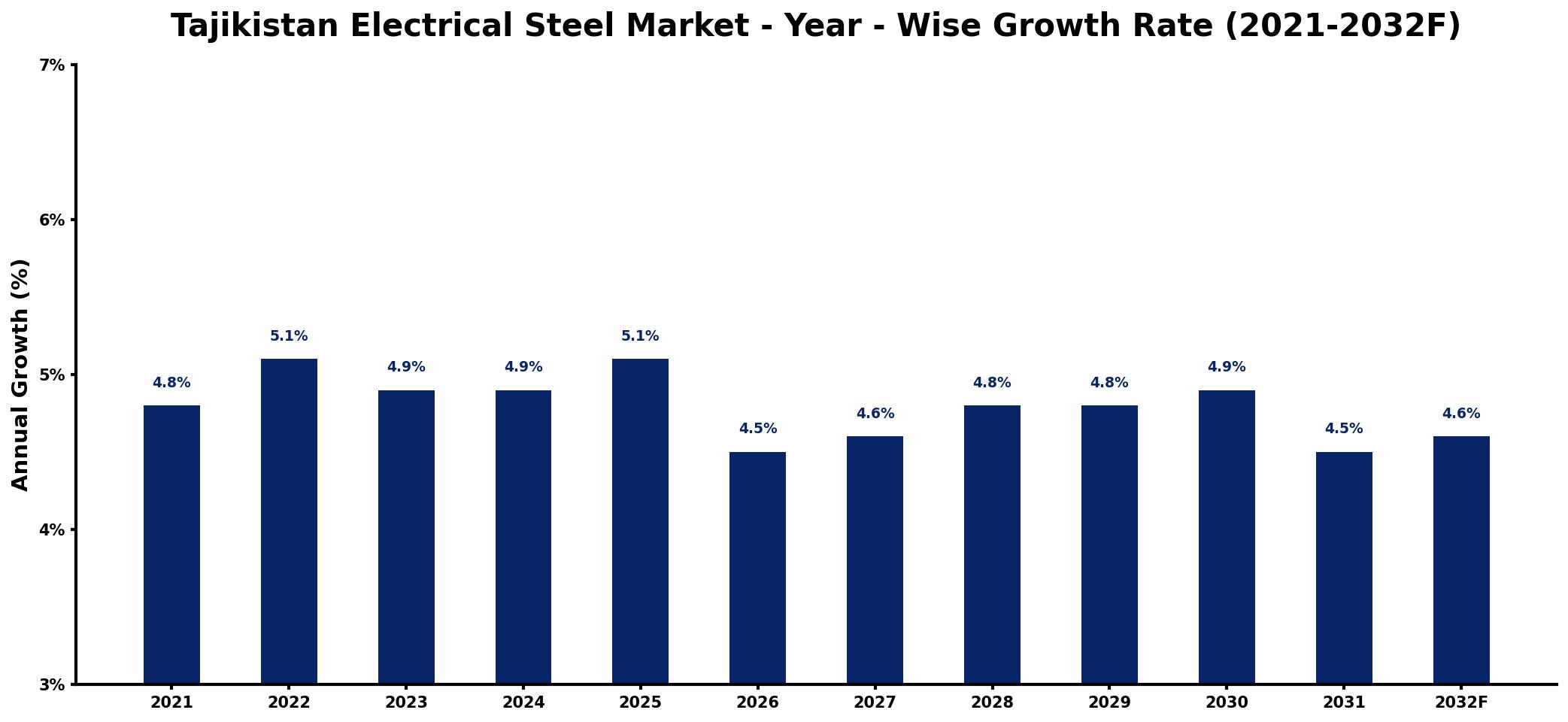
The table below presents the year‑wise growth rates along with the key drivers influencing the market
| Year | Growth Rate | Major Drivers |
| 2021 | 4.8% | Increased demand from manufacturing sector |
| 2022 | 5.1% | Growth in renewable energy projects |
| 2023 | 4.9% | Expansion of automotive industry needs |
| 2024 | 4.9% | Rise in construction industry activities |
| 2025 | 5.1% | Investment in infrastructure development |
| 2026 | 4.5% | Manufacturing sector adaptation strategies |
| 2027 | 4.6% | Technological advancements in production |
| 2028 | 4.8% | Rising consumer electronics demand |
| 2029 | 4.8% | Increased exports to neighboring countries |
| 2030 | 4.9% | Sustainable energy initiatives gaining traction |
| 2031 | 4.5% | Emerging markets driving industrial growth |
| 2032 | 4.6% | Innovations in energy-efficient applications |
Note: Market size estimations and growth projections presented in this report are based on 6Wresearch's proprietary forecasting methodology, utilizing the latest available industry data, government publications, and primary research inputs.
Tajikistan Electrical Steel Market Synopsis
A notable demand surge for electrical steel in Tajikistan stems from the ongoing construction of new power plants, driven by government initiatives aimed at enhancing energy security. As the industrial sector expands, the requirement for high-performance electrical steel to facilitate efficient power transmission is becoming increasingly critical.
Currently, domestic manufacturers are focusing on enhancing production capacities to accommodate the growing market needs. Concurrently, technological advancements in manufacturing processes are not only improving product quality but also contributing to sustainability within the industry.
Tajikistan Electrical Steel Market Key Takeaways
- The market is driven by significant investments in infrastructure and energy sector modernization.
- Technological innovations are enhancing the efficiency and sustainability of electrical steel production.
- Government initiatives to boost renewable energy are creating new avenues for growth.
- Limited local production capacity presents challenges for meeting rising demand.
- Opportunities exist for both domestic and international players to expand their footprint in this market.
Evaluation of Restraints in Tajikistan Electrical Steel Market
One of the significant limitations impacting the Tajikistan Electrical Steel Market is the heavy reliance on imports to satisfy local demand. This dependency exposes the market to supply chain vulnerabilities and fluctuating prices, hampering long-term planning for local producers. Additionally, the country's infrastructural inadequacies complicate distribution logistics, making it difficult for manufacturers to deliver products efficiently. To foster sustainable growth, addressing these limitations through increased domestic production capacity and improved supply chain management will be crucial.
Tajikistan Electrical Steel Market Trends
The market is currently witnessing a pronounced shift towards high-quality electrical steel, which enhances the performance and reliability of electrical equipment. As urbanization and industrialization intensify, the demand for efficient power transmission solutions continues to rise. Additionally, the adoption of renewable energy technologies, particularly hydropower, is becoming a strong trend, prompting manufacturers to innovate and produce electrical steel suited for these applications. In response to market demand, players are actively investing in cutting-edge production technologies.
Tajikistan Electrical Steel Market Opportunities
Investment opportunities in the Tajikistan Electrical Steel Market are robust, largely due to the government's focus on energy infrastructure and modernization. Potential investors can explore avenues in manufacturing various electrical steel products, including transformers and generators, which are essential for upgrading the energy network. There is also significant potential for export to neighboring countries, provided that the quality of products meets international standards. Moreover, investing in technological advancements and sustainable production processes will allow stakeholders to align with market trends and create a competitive advantage.
Government Initiatives in the Tajikistan Electrical Steel Market
The Tajik government is actively implementing policies to bolster domestic production within the electrical steel sector. Initiatives include the introduction of import tariffs to protect local manufacturers and subsidies aimed at encouraging investment in new production facilities. Regulations are also in place to ensure the quality of electrical steel products, thereby enhancing competitiveness and consumer confidence. By prioritizing improvements in infrastructure and providing incentives for local production, the government aims to cultivate a more sustainable and self-reliant electrical steel industry.
Future Insights of the Tajikistan Electrical Steel Market
Looking ahead to 2026-2032, the Tajikistan Electrical Steel Market is set for steady growth, underpinned by ongoing urbanization and industrial expansion. The government's commitment to increasing power generation capacity, coupled with a growing trend towards electric vehicles, will further elevate demand for electrical steel. However, market participants should remain vigilant regarding fluctuating raw material prices and heightened competition from global players. Overall, with supportive policies and increasing investments in sustainable energy, the market appears poised for a promising future.
Tajikistan Electrical Steel Market Latest Developments (2025 - 2026)
Recent developments in the Tajikistan Electrical Steel Market highlight a concerted effort towards enhancing production capabilities through investments in state-of-the-art manufacturing technologies. As the government continues to roll out infrastructure projects, discussions about potential joint ventures and partnerships among stakeholders are becoming more prominent, aimed at sharing resources and expertise. Moreover, initiatives to foster local talent and improve workforce skills are gaining traction, ensuring that the industry can meet the evolving demands of a growing market.
Tajikistan Electrical Steel Market - Key Attractiveness of the Report
- 10 Years of Market Numbers
- Historical Data Starting from 2022 to 2025
- Base Year: 2025
- Forecast Data until 2032
- Key Performance Indicators Impacting the Market
- Major Upcoming Developments and Projects
Key Highlights of the Report:
- Tajikistan Electrical Steel Market Outlook
- Market Size of Tajikistan Electrical Steel Market, 2025
- Forecast of Tajikistan Electrical Steel Market, 2032
- Historical Data and Forecast of Tajikistan Electrical Steel Revenues & Volume for the Period 2022-2032F
- Tajikistan Electrical Steel Market Trend Evolution
- Tajikistan Electrical Steel Market Drivers and Challenges
- Tajikistan Electrical Steel Price Trends
- Tajikistan Electrical Steel Porter's Five Forces
- Tajikistan Electrical Steel Industry Life Cycle
- Historical Data and Forecast of Tajikistan Electrical Steel Market Revenues & Volume By Type for the Period 2022-2032F
- Historical Data and Forecast of Tajikistan Electrical Steel Market Revenues & Volume By Grain-oriented for the Period 2022-2032F
- Historical Data and Forecast of Tajikistan Electrical Steel Market Revenues & Volume By Non-grain-oriented for the Period 2022-2032F
- Historical Data and Forecast of Tajikistan Electrical Steel Market Revenues & Volume By End Use for the Period 2022-2032F
- Historical Data and Forecast of Tajikistan Electrical Steel Market Revenues & Volume By Energy for the Period 2022-2032F
- Historical Data and Forecast of Tajikistan Electrical Steel Market Revenues & Volume By Automotive for the Period 2022-2032F
- Historical Data and Forecast of Tajikistan Electrical Steel Market Revenues & Volume By Household Appliances for the Period 2022-2032F
- Historical Data and Forecast of Tajikistan Electrical Steel Market Revenues & Volume By Manufacturing for the Period 2022-2032F
- Historical Data and Forecast of Tajikistan Electrical Steel Market Revenues & Volume By Others for the Period 2022-2032F
- Historical Data and Forecast of Tajikistan Electrical Steel Market Revenues & Volume By Application for the Period 2022-2032F
- Historical Data and Forecast of Tajikistan Electrical Steel Market Revenues & Volume By Transformers for the Period 2022-2032F
- Historical Data and Forecast of Tajikistan Electrical Steel Market Revenues & Volume By Motors for the Period 2022-2032F
- Historical Data and Forecast of Tajikistan Electrical Steel Market Revenues & Volume By Inductors for the Period 2022-2032F
- Historical Data and Forecast of Tajikistan Electrical Steel Market Revenues & Volume By Others for the Period 2022-2032F
- Tajikistan Electrical Steel Import Export Trade Statistics
- Market Opportunity Assessment By Type
- Market Opportunity Assessment By End Use
- Market Opportunity Assessment By Application
- Tajikistan Electrical Steel Top Companies Market Share
- Tajikistan Electrical Steel Competitive Benchmarking By Technical and Operational Parameters
- Tajikistan Electrical Steel Company Profiles
- Tajikistan Electrical Steel Key Strategic Recommendations






































