Tajikistan Electronic Dictionary Market Size, Share & Growth Rate
The Tajikistan Electronic Dictionary Market was estimated at USD 1305 Million in 2025 and is projected to reach USD 1916 Million by 2032, growing at a CAGR of 5.6% from 2026 to 2032. This growth trajectory is primarily driven by rising internet penetration, an increasing emphasis on language education, and a shift toward digital learning platforms. With a significant portion of the population eager to learn foreign languages, the demand for innovative electronic dictionaries tailored to specific linguistic needs is expected to surge.
Tajikistan Electronic Dictionary Market Year-wise Growth Rate and Key Drivers
This graph highlights how the Tajikistan Electronic Dictionary Market has steadily grown over the years, supported by major growth factors.
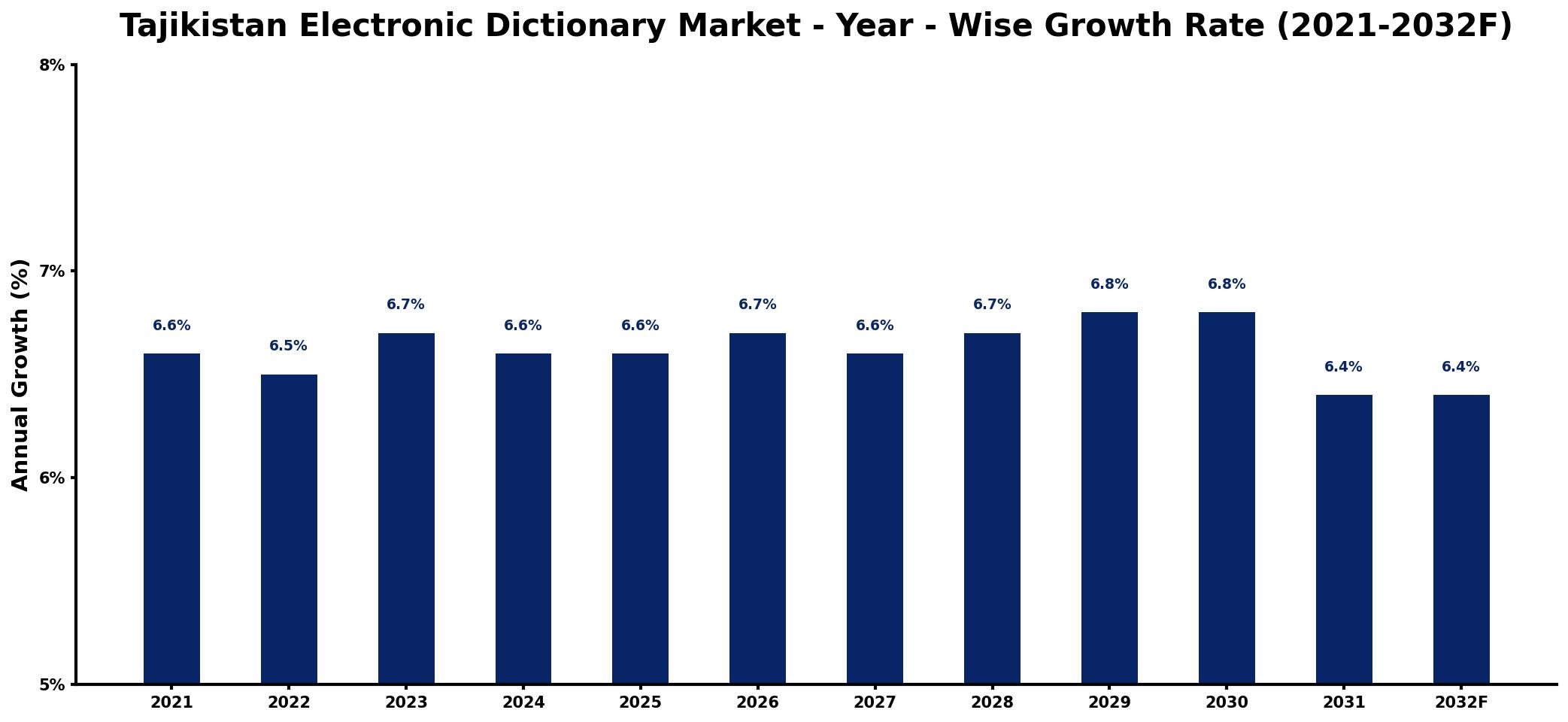
The table below presents the year‑wise growth rates along with the key drivers influencing the market
| Year | Growth Rate | Major Drivers |
| 2021 | 6.6% | Rising demand for language tools |
| 2022 | 6.5% | Increased investments in education |
| 2023 | 6.7% | Expansion of digital learning platforms |
| 2024 | 6.6% | Growing interest in bilingualism |
| 2025 | 6.6% | Enhanced mobile technology accessibility |
| 2026 | 6.7% | Surge in online learning initiatives |
| 2027 | 6.6% | Development of new language apps |
| 2028 | 6.7% | Increase in cross-border communication |
| 2029 | 6.8% | Growth of international business relations |
| 2030 | 6.8% | Strengthening of cultural exchange programs |
| 2031 | 6.4% | Emergence of new educational policies |
| 2032 | 6.4% | Rising popularity of self-study tools |
Note: Market size estimations and growth projections presented in this report are based on 6Wresearch's proprietary forecasting methodology, utilizing the latest available industry data, government publications, and primary research inputs.
Tajikistan Electronic Dictionary Market Synopsis
The Tajikistan Electronic Dictionary Market has seen a notable rise in interest and adoption, fueled by a growing population of tech-savvy learners and the increasing need for educational resources. However, while current momentum is strong, there remains considerable potential for expansion as digital literacy improves and more robust educational frameworks are established.
As the market evolves, there is a clear shift towards electronic dictionaries that not only accommodate the Tajik language but also support various foreign languages, including English, Russian, and Chinese. This diversification is indicative of a broader trend towards comprehensive language tools that meet the diverse needs of the educational sector.
Tajikistan Electronic Dictionary Market Key Takeaways
- The market is characterized by increasing demand for multifunctional electronic dictionaries that enhance language learning.
- Mobile applications and online platforms are becoming critical for accessibility and convenience in language acquisition.
- Government policies are promoting the development of digital resources to foster the use of the Tajik language in educational settings.
- Challenges related to digital access and traditional preferences may temper market growth, necessitating targeted solutions.
- Investment in localized content and innovative features will be key to capturing the expanding market segment.
Evaluation of Restraints in Tajikistan Electronic Dictionary Market
Despite the promising outlook, the Tajikistan Electronic Dictionary Market faces several restraints that could inhibit its potential. Low internet penetration rates in certain rural areas hamper access to digital dictionaries, while a preference for traditional paper dictionaries persists among older demographics. Additionally, the current lack of standardized content in the Tajik language limits the appeal of available electronic options. Economic constraints, coupled with relatively low purchasing power among segments of the population, further complicate the landscape. Addressing these challenges will be essential for market players aiming to achieve widespread adoption.
Tajikistan Electronic Dictionary Market Trends
The demand for user-friendly electronic dictionaries is on the rise, with consumers showing a preference for products featuring voice recognition, real-time translation capabilities, and interactive learning tools. Notably, mobile applications are gaining traction, making language learning resources more accessible to users on-the-go. Furthermore, there is a notable increase in interest in electronic dictionaries that cater to lesser-known local dialects and languages, reflecting the diverse linguistic landscape of Tajikistan. As educational institutions continue to integrate technology into their curriculums, these trends are expected to significantly shape the markets future.
Tajikistan Electronic Dictionary Market Opportunities
Investors should note the substantial opportunities within the Tajikistan Electronic Dictionary Market, particularly given the countrys emphasis on improving educational outcomes and digital literacy. Developing comprehensive electronic dictionaries tailored to the unique needs of Tajik students and professionals presents a lucrative avenue. Forming partnerships with educational institutions can further enhance market reach and credibility. The increasing smartphone penetration and the growing trend of online learning platforms indicate a ripe environment for innovative solutions that leverage technology to meet the evolving demands of learners.
Government Initiatives in the Tajikistan Electronic Dictionary Market
The Tajikistan government has undertaken various initiatives aimed at bolstering the development and adoption of electronic dictionaries. Policies focused on the promotion of the Tajik language through digital means underscore the importance of preserving cultural heritage. Additionally, there are incentives for local developers and businesses to innovate in this sector, fostering a supportive environment for the growth of electronic educational resources. These government efforts reflect a commitment to enhancing digital literacy and access to language learning tools across the country.
Future Insights of the Tajikistan Electronic Dictionary Market
Looking ahead to the period between 2026 and 2032, the Tajikistan Electronic Dictionary Market is anticipated to witness sustained growth, driven by heightened awareness of the benefits of digital learning. As educational institutions increasingly recognize the importance of integrating technology into their curricula, electronic dictionaries will play a crucial role in facilitating effective language learning. Additionally, as digital literacy improves among the general populace, a shift towards electronic resources is likely, ensuring a flourishing market landscape.
Tajikistan Electronic Dictionary Market Latest Developments (2025 - 2026)
Recent developments in the Tajikistan Electronic Dictionary Market have highlighted a growing emphasis on mobile platform development, reflecting the needs of an increasingly on-the-go user base. Innovations focused on enhancing user engagement through interactive features and social sharing capabilities are emerging trends. Furthermore, there has been a noticeable increase in collaborations between tech firms and educational institutions, aimed at creating tailored electronic dictionary solutions that meet local educational standards.
Tajikistan Electronic Dictionary Market - Key Attractiveness of the Report
- 10 Years of Market Numbers
- Historical Data Starting from 2022 to 2025
- Base Year: 2025
- Forecast Data until 2032
- Key Performance Indicators Impacting the Market
- Major Upcoming Developments and Projects
Key Highlights of the Report:
- Tajikistan Electronic Dictionary Market Outlook
- Market Size of Tajikistan Electronic Dictionary Market, 2025
- Forecast of Tajikistan Electronic Dictionary Market, 2032
- Historical Data and Forecast of Tajikistan Electronic Dictionary Revenues & Volume for the Period 2022-2032F
- Tajikistan Electronic Dictionary Market Trend Evolution
- Tajikistan Electronic Dictionary Market Drivers and Challenges
- Tajikistan Electronic Dictionary Price Trends
- Tajikistan Electronic Dictionary Porter's Five Forces
- Tajikistan Electronic Dictionary Industry Life Cycle
- Historical Data and Forecast of Tajikistan Electronic Dictionary Market Revenues & Volume By Application for the Period 2022-2032F
- Historical Data and Forecast of Tajikistan Electronic Dictionary Market Revenues & Volume By Educational Institutions for the Period 2022-2032F
- Historical Data and Forecast of Tajikistan Electronic Dictionary Market Revenues & Volume By Corporate for the Period 2022-2032F
- Historical Data and Forecast of Tajikistan Electronic Dictionary Market Revenues & Volume By Government for the Period 2022-2032F
- Historical Data and Forecast of Tajikistan Electronic Dictionary Market Revenues & Volume By Household for the Period 2022-2032F
- Historical Data and Forecast of Tajikistan Electronic Dictionary Market Revenues & Volume By Others for the Period 2022-2032F
- Tajikistan Electronic Dictionary Import Export Trade Statistics
- Market Opportunity Assessment By Application
- Tajikistan Electronic Dictionary Top Companies Market Share
- Tajikistan Electronic Dictionary Competitive Benchmarking By Technical and Operational Parameters
- Tajikistan Electronic Dictionary Company Profiles
- Tajikistan Electronic Dictionary Key Strategic Recommendations






































