Tajikistan Ergonomic Chair Market Size, Share & Growth Rate
The Tajikistan Ergonomic Chair Market was estimated at USD 349 Million in 2025 and is projected to reach USD 582 Million by 2032, growing at a CAGR of 7.6% from 2026 to 2032. This remarkable growth is primarily fueled by a growing awareness among businesses and individuals regarding the importance of ergonomics and proper posture in the workplace. Moreover, as the workforce shifts towards remote working arrangements, the demand for comfortable and health-oriented seating solutions is rapidly increasing.
Tajikistan Ergonomic Chair Market Year-wise Growth Rate and Key Drivers
This graph highlights how the Tajikistan Ergonomic Chair Market has steadily grown over the years, supported by major growth factors.
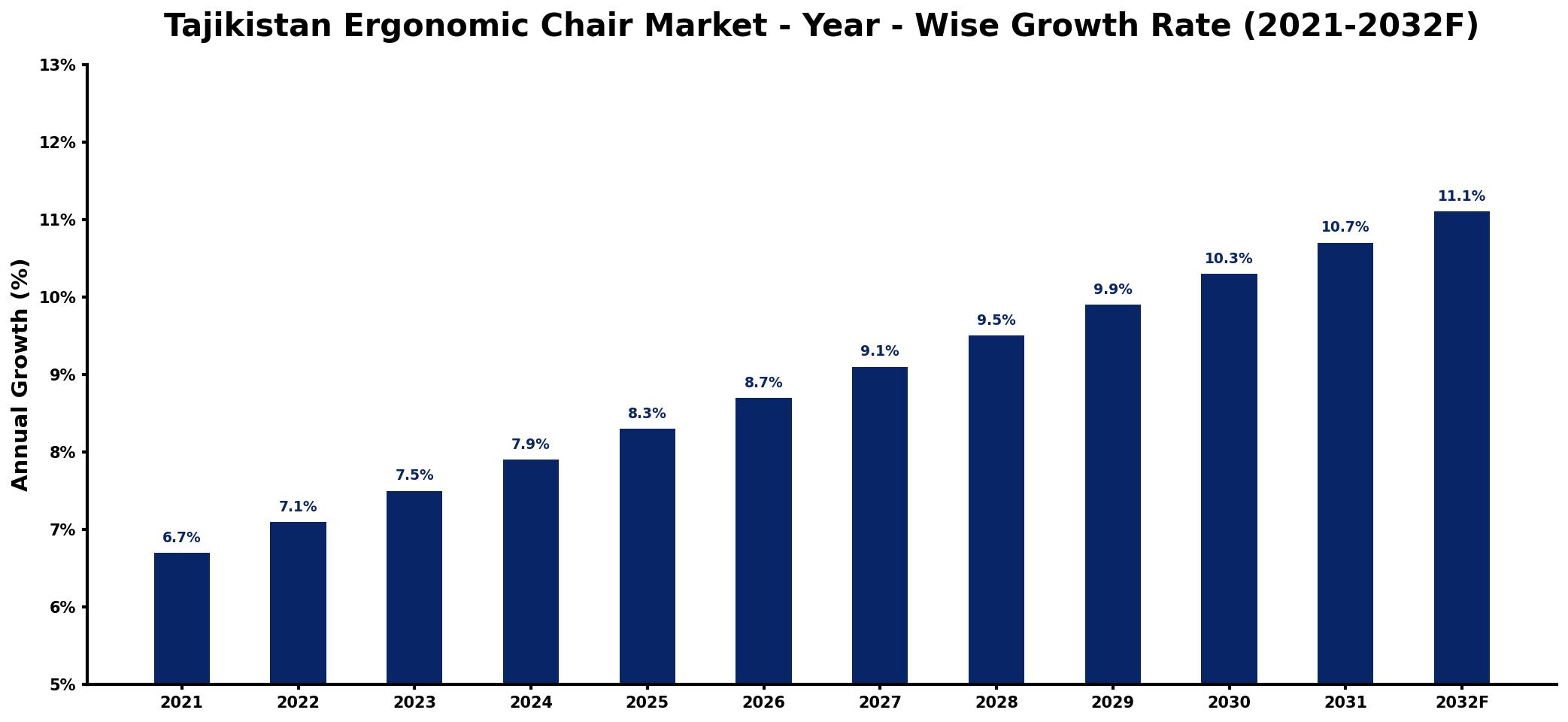
The table below presents the year‑wise growth rates along with the key drivers influencing the market
| Year | Growth Rate | Major Drivers |
| 2021 | 6.7% | Rising health awareness among consumers |
| 2022 | 7.1% | Increased remote working trends |
| 2023 | 7.5% | Growing focus on workplace comfort |
| 2024 | 7.9% | Expansion of office infrastructure projects |
| 2025 | 8.3% | Higher disposable income levels |
| 2026 | 8.7% | Investment in employee wellness programs |
| 2027 | 9.1% | Surge in online retail platforms |
| 2028 | 9.5% | Technological advancements in design |
| 2029 | 9.9% | Collaborations with interior designers |
| 2030 | 10.3% | Demand for sustainable materials |
| 2031 | 10.7% | Emergence of smart furniture solutions |
| 2032 | 11.1% | Increased awareness of posture health |
Note: Market size estimations and growth projections presented in this report are based on 6Wresearch's proprietary forecasting methodology, utilizing the latest available industry data, government publications, and primary research inputs.
Tajikistan Ergonomic Chair Market Synopsis
The Tajikistan ergonomic chair market is witnessing a significant evolution, reflecting a shift in consumer preferences towards health-centric seating solutions. As awareness grows, demand is expected to keep pace, leading to an expanded product range that meets diverse ergonomic needs.
While the market has recently benefited from a surge in local and online retailers offering various ergonomic chair options, the trajectory appears robust. The focus on innovative designs and adjustable features is likely to attract a wider audience as individuals increasingly prioritize comfort and wellness in their work environments.
Tajikistan Ergonomic Chair Market Key Takeaways
- The market shows significant growth potential driven by increased awareness of ergonomics.
- There is a growing preference for ergonomic chairs in both home and office settings.
- Sleek, modern designs that marry functionality with aesthetics are gaining traction among younger consumers.
- Sustainable materials are increasingly favored as environmentally-conscious buying behaviors rise.
- Investment opportunities exist in local manufacturing and distribution networks.
Evaluation of Restraints in Tajikistan Ergonomic Chair Market
Despite the promising growth trajectory, the Tajikistan ergonomic chair market faces several notable restraints. A significant challenge is the limited consumer awareness regarding the benefits of ergonomic seating, which hinders wider adoption. Furthermore, the high costs associated with importing quality ergonomic chairs limit the availability of products. This is compounded by logistical challenges and underdeveloped infrastructure, especially in remote areas, which obstruct efficient distribution. Additionally, the absence of stringent local regulations for ergonomic standards may contribute to the presence of inferior products, impacting consumer trust and overall market confidence.
Tajikistan Ergonomic Chair Market Trends
The market is currently witnessing several key trends that are shaping both demand and technology in ergonomic chairs. Notably, there is a rising demand for adjustable features that cater to diverse body types and preferences, enabling a more personalized sitting experience. Aesthetic considerations are also gaining importance, as younger consumers seek ergonomic solutions that complement modern decor. Furthermore, there is an increasing emphasis on sustainability, with many consumers looking for products made from eco-friendly materials, reflecting a broader global trend towards environmentally responsible purchasing.
Tajikistan Ergonomic Chair Market Opportunities
The growing recognition of the importance of ergonomic solutions in enhancing health and productivity presents a multitude of investment opportunities. Companies looking to establish manufacturing facilities or enhance distribution networks for ergonomic chairs can tap into this burgeoning market. Collaborating with local retailers or engaging in partnerships can help broaden market reach and bolster sales. Additionally, the potential for innovation in design and technology, tailored to the specific needs of the Tajik workforce, positions investors favorably for long-term returns.
Government Initiatives in the Tajikistan Ergonomic Chair Market
The Tajikistan government has initiated various policies aimed at promoting worker health and well-being through ergonomic solutions. These measures include the establishment of ergonomic standards and guidelines that govern chair design, as well as compliance inspections to ensure adherence. Incentives are provided for businesses that invest in ergonomic furniture, such as subsidies or tax breaks, thereby encouraging the adoption of safer and more comfortable work environments. These initiatives are critical in reducing workplace injuries and enhancing productivity across sectors.
Future Insights of the Tajikistan Ergonomic Chair Market
Looking ahead to the period from 2026 to 2032, the Tajikistan ergonomic chair market is poised for steady growth. As awareness of workplace health becomes even more pronounced, companies are likely to invest in ergonomic seating to enhance employee well-being and productivity. The shift towards remote work arrangements is expected to sustain demand, as more individuals seek ergonomic solutions for their home offices. Furthermore, the introduction of innovative features that cater to specific ergonomic needs will support market expansion, making this an exciting space for both consumers and investors alike.
Tajikistan Ergonomic Chair Market Latest Developments (2025 - 2026)
In recent months, the Tajikistan ergonomic chair market has witnessed various industry shifts, notably an increase in collaborations between local manufacturers and international suppliers to enhance product offerings. Retailers are expanding their online platforms to cater to the growing demand for ergonomic solutions, particularly among remote workers. Additionally, there is a growing emphasis on sustainability, prompting companies to explore eco-friendly materials in their manufacturing processes, aligning with global trends towards greener products.
Tajikistan Ergonomic Chair Market - Key Attractiveness of the Report
- 10 Years of Market Numbers
- Historical Data Starting from 2022 to 2025
- Base Year: 2025
- Forecast Data until 2032
- Key Performance Indicators Impacting the Market
- Major Upcoming Developments and Projects
Key Highlights of the Report:
- Tajikistan Ergonomic Chair Market Outlook
- Market Size of Tajikistan Ergonomic Chair Market, 2025
- Forecast of Tajikistan Ergonomic Chair Market, 2032
- Historical Data and Forecast of Tajikistan Ergonomic Chair Revenues & Volume for the Period 2022-2032F
- Tajikistan Ergonomic Chair Market Trend Evolution
- Tajikistan Ergonomic Chair Market Drivers and Challenges
- Tajikistan Ergonomic Chair Price Trends
- Tajikistan Ergonomic Chair Porter's Five Forces
- Tajikistan Ergonomic Chair Industry Life Cycle
- Historical Data and Forecast of Tajikistan Ergonomic Chair Market Revenues & Volume By Application for the Period 2022-2032F
- Historical Data and Forecast of Tajikistan Ergonomic Chair Market Revenues & Volume By Enterprise Procurement for the Period 2022-2032F
- Historical Data and Forecast of Tajikistan Ergonomic Chair Market Revenues & Volume By Government Procurement for the Period 2022-2032F
- Historical Data and Forecast of Tajikistan Ergonomic Chair Market Revenues & Volume By School Procurement for the Period 2022-2032F
- Historical Data and Forecast of Tajikistan Ergonomic Chair Market Revenues & Volume By Individual Procurement for the Period 2022-2032F
- Historical Data and Forecast of Tajikistan Ergonomic Chair Market Revenues & Volume By Other for the Period 2022-2032F
- Tajikistan Ergonomic Chair Import Export Trade Statistics
- Market Opportunity Assessment By Application
- Tajikistan Ergonomic Chair Top Companies Market Share
- Tajikistan Ergonomic Chair Competitive Benchmarking By Technical and Operational Parameters
- Tajikistan Ergonomic Chair Company Profiles
- Tajikistan Ergonomic Chair Key Strategic Recommendations






































