Tajikistan Food Retail Market Summary
The tajikistan food retail market was estimated at USD 1309 Million in 2025 and is projected to reach USD 2231 Million by 2032, growing at a CAGR of 9.1% from 2026 to 2032.
Tajikistan Food Retail Market Year-wise Growth Rate and Key Drivers
This graph highlights how the Tajikistan Food Retail Market has steadily grown over the past five years, supported by major growth factors.
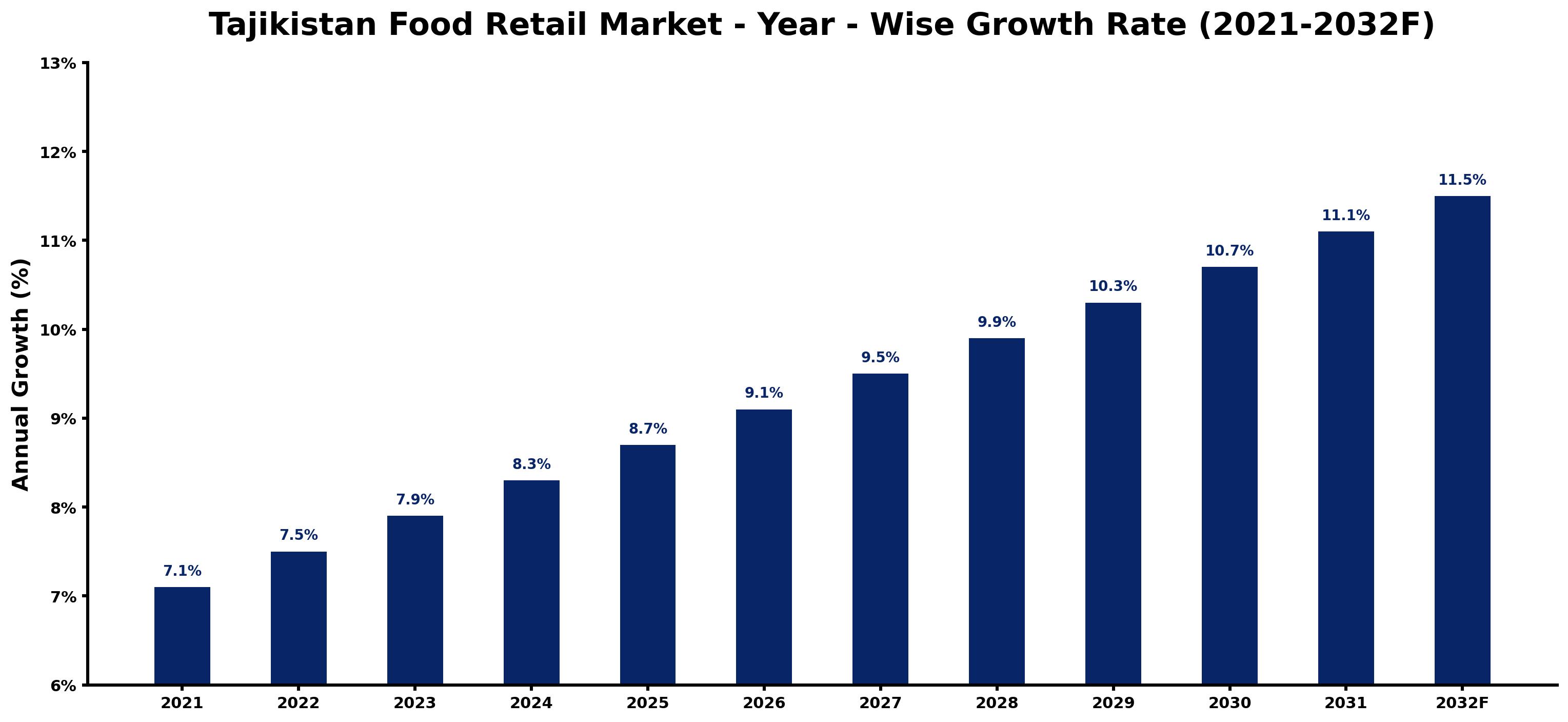
The table below presents the year wise growth rates along with the key drivers influencing the market
| Year | Growth Rate | Major Drivers |
| 2021 | 7.1% | In 2021, recovery from pandemic disruptions reshaped consumer purchasing behaviors in Tajikistan. |
| 2022 | 7.5% | The emergence of urban shopping centers attracted attention, transforming local food retail landscapes. |
| 2023 | 7.9% | E-commerce platforms began offering groceries, catering to tech-savvy younger consumers increasingly. |
| 2024 | 8.3% | Infrastructure improvements facilitated better supply chain efficiencies, reducing delivery times to customers. |
| 2025 | 8.7% | Growing interest in health-conscious products spurred investments from new entrants in food retail. |
| 2026 | 9.1% | Local food processing industries expanded, enhancing product availability in urban markets significantly. |
| 2027 | 9.5% | Regional trade agreements opened new channels for imported goods, diversifying available product ranges. |
| 2028 | 9.9% | Consumer awareness about sustainable products prompted retailers to stock organic and local options. |
| 2029 | 10.3% | Increased disposable incomes among urban populations fueled demand for premium food products. |
| 2030 | 10.7% | Technological advancements in inventory management improved operational efficiency for food retailers. |
| 2031 | 11.1% | Competition among retailers intensified, prompting innovative marketing strategies to attract customers. |
| 2032 | 11.5% | As digital payment methods became mainstream, online grocery shopping gained substantial traction. |
Note - Market size estimations and growth projections presented in this report are based on 6Wresearch's advanced forecasting approach, validated with industry datasets as of June 2026.
Tajikistan Food Retail Market Synopsis
The Tajikistan Food Retail Market is projected to reach 9.1% and witness significant growth during the forecast period (2026-2032). This market landscape is marked by an interesting mix of traditional bazaars and modern retail formats, with traditional markets still dominating due to cultural preferences and price sensitivity. However, urbanization is altering consumer behaviors, leading to an increasing acceptance and demand for supermarkets and hypermarkets, particularly in urban centers.
Tajikistan Food Retail Market Trends and Opportunities
The Tajikistan Food Retail Market is experiencing dynamic transformations, driven by a surge in urban lifestyles and evolving consumer demands. Notably, the following trends are shaping the future of food retail in the country:
- There is an escalating demand for convenience foods, including ready-to-eat and quick meal solutions, which cater to busy urban lifestyles.
- The health-conscious consumer segment is expanding, leading to an increased preference for organic and locally sourced products.
- With the rise of digital technology, e-commerce platforms for grocery shopping are gaining traction, particularly among younger demographics who prefer the convenience of online shopping.
- The entry of international food retail chains is broadening consumer choices, offering a diverse range of products and cuisines, thus enhancing the competitive landscape.
- Furthermore, investment in food processing and supply chain improvements is essential to meet the growing demand for quality products and enhance the overall market efficiency.
Tajikistan Food Retail Market Challenges and Restraints
While the Tajikistan Food Retail Market presents numerous opportunities, several challenges pose significant hurdles to growth:
- The infrastructure for logistics and distribution remains underdeveloped, creating inefficiencies in the supply chain and affecting market accessibility.
- Competition is intensified by the fragmentation of the market, where numerous small retailers operate, leading to price wars and diminishing margins.
- Economic fluctuations and currency volatility add a layer of unpredictability, impacting both consumer purchasing power and retailer profitability.
- Food safety concerns arise from inadequate cold storage facilities and inconsistent quality control measures, presenting risks to both consumers and businesses.
- Limited access to financing options constrains the ability of retailers to invest in modernization and technological enhancements that could improve operations.
Tajikistan Food Retail Market Investment Opportunities
The investment landscape in the Tajikistan Food Retail Market is increasingly attractive due to demographic shifts and rising economic prospects:
- With a young and growing population, there is heightened demand for innovative and convenience-oriented food offerings, which presents opportunities for new entries and expansions.
- Developing modern grocery stores and specialty food shops can cater to the evolving tastes and preferences of consumers.
- The online food delivery service sector is ripe for development, aligning with global trends toward e-commerce and convenience.
- Investments in agricultural production and supply chain enhancements can foster local sourcing, thereby fulfilling the consumer demand for fresh and organic products.
- Establishing food processing facilities can meet market demands while also creating jobs and contributing to economic growth.
Tajikistan Food Retail Market Government Investment and Initiatives
Government policies play a pivotal role in shaping the dynamics of the Tajikistan Food Retail Market. Initiatives focus on enhancing food safety and supporting local agricultural production:
- Regulatory frameworks are established to ensure food safety standards are met, protecting consumers from substandard products.
- Incentives for local farmers are designed to boost domestic production, decreasing reliance on imports and fostering food security.
- Efforts to improve infrastructure—particularly in transportation and logistics—are being prioritized to facilitate better distribution of food products throughout the country.
- Support for small and medium-sized enterprises in the food sector fosters entrepreneurship and promotes job creation.
- Overall, these initiatives aim to foster a competitive environment that benefits both consumers and local food producers.
Tajikistan Food Retail Market Latest Developments (May 2025 - June 2026)
Recent developments in the Tajikistan Food Retail Market indicate a positive trajectory, with various players adapting to changing market conditions:
- The rise of online grocery shopping has led to an increase in digital platforms, enabling consumers to access a broad array of products conveniently.
- Efforts to modernize logistics and distribution networks have seen collaborative initiatives aimed at addressing infrastructure deficiencies.
- Health trends have prompted retailers to diversify their product offerings, including a wider selection of organic and natural food items.
- Government-led training programs for retailers have been implemented to enhance operational standards and customer service skills.
- Overall, these trends reflect a market in transformation—driven by consumer preferences and supported by governmental initiatives aimed at fostering growth.
Tajikistan Food Retail Market - Key Attractiveness of the Report
- 10 Years of Market Numbers
- Historical Data Starting from 2022 to 2025
- Base Year: 2025
- Forecast Data until 2032
- Key Performance Indicators Impacting the Market
- Major Upcoming Developments and Projects
Key Highlights of the Report:
- Tajikistan Food Retail Market Outlook
- Market Size of Tajikistan Food Retail Market, 2025
- Forecast of Tajikistan Food Retail Market, 2032F
- Historical Data and Forecast of Tajikistan Food Retail Revenues & Volume for the Period 2022-2032F
- Tajikistan Food Retail Market Trend Evolution
- Tajikistan Food Retail Market Drivers and Challenges
- Tajikistan Food Retail Price Trends
- Tajikistan Food Retail Porter's Five Forces
- Tajikistan Food Retail Industry Life Cycle
- Historical Data and Forecast of Tajikistan Food Retail Market Revenues & Volume By Product Types for the Period 2022-2032F
- Historical Data and Forecast of Tajikistan Food Retail Market Revenues & Volume By Unpackaged Food for the Period 2022-2032F
- Historical Data and Forecast of Tajikistan Food Retail Market Revenues & Volume By Packaged Food for the Period 2022-2032F
- Historical Data and Forecast of Tajikistan Food Retail Market Revenues & Volume By Drinks for the Period 2022-2032F
- Historical Data and Forecast of Tajikistan Food Retail Market Revenues & Volume By Household Products for the Period 2022-2032F
- Historical Data and Forecast of Tajikistan Food Retail Market Revenues & Volume By Packaging Types for the Period 2022-2032F
- Historical Data and Forecast of Tajikistan Food Retail Market Revenues & Volume By Boxes for the Period 2022-2032F
- Historical Data and Forecast of Tajikistan Food Retail Market Revenues & Volume By Cans for the Period 2022-2032F
- Historical Data and Forecast of Tajikistan Food Retail Market Revenues & Volume By Cellophane Wrapping for the Period 2022-2032F
- Historical Data and Forecast of Tajikistan Food Retail Market Revenues & Volume By Cylindrical Cardboard for the Period 2022-2032F
- Tajikistan Food Retail Import Export Trade Statistics
- Market Opportunity Assessment By Product Types
- Market Opportunity Assessment By Packaging Types
- Tajikistan Food Retail Top Companies Market Share
- Tajikistan Food Retail Competitive Benchmarking By Technical and Operational Parameters
- Tajikistan Food Retail Company Profiles
- Tajikistan Food Retail Key Strategic Recommendations






































