Tajikistan Fuel Station Market Size, Share & Growth Rate
The Tajikistan Fuel Station Market was estimated at USD 381 Million in 2025 and is projected to reach USD 521 Million by 2032, growing at a CAGR of 4.6% from 2026 to 2032. This growth trajectory is largely fueled by the country's expanding transportation infrastructure and an increase in vehicle ownership among a growing middle class. As urbanization accelerates, the need for reliable fueling options continues to rise, driving demand for fuel stations across urban and rural areas.
Tajikistan Fuel Station Market Year-wise Growth Rate and Key Drivers
This graph highlights how the Tajikistan Fuel Station Market has steadily grown over the years, supported by major growth factors.
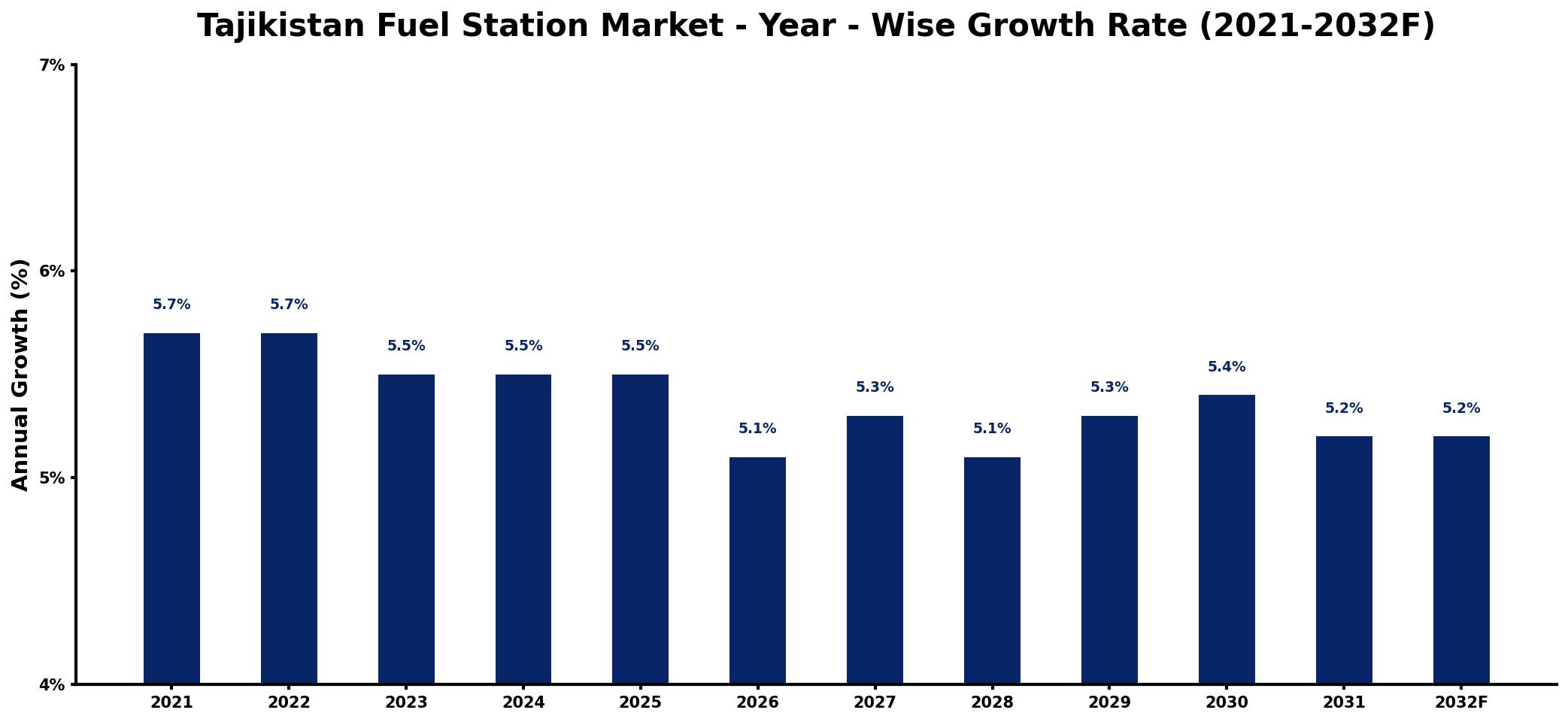
The table below presents the year‑wise growth rates along with the key drivers influencing the market
| Year | Growth Rate | Major Drivers |
| 2021 | 5.7% | Rising transportation demand drives growth |
| 2022 | 5.7% | Increased infrastructure investments observed |
| 2023 | 5.5% | Growing population boosts energy needs |
| 2024 | 5.5% | Expansion of logistics networks continues |
| 2025 | 5.5% | Higher disposable income influences consumption |
| 2026 | 5.1% | Emergence of alternative energy sources |
| 2027 | 5.3% | Urbanization trends create new opportunities |
| 2028 | 5.1% | Government policies support energy transition |
| 2029 | 5.3% | Technological advancements enhance efficiency |
| 2030 | 5.4% | Renewable energy projects attract investments |
| 2031 | 5.2% | Sustainable practices gain market traction |
| 2032 | 5.2% | Increased cross-border trade opportunities |
Note: Market size estimations and growth projections presented in this report are based on 6Wresearch's proprietary forecasting methodology, utilizing the latest available industry data, government publications, and primary research inputs.
Tajikistan Fuel Station Market Synopsis
The demand for fuel stations in Tajikistan is influenced by the country's strategic geographical position, which serves as a transit route for neighboring nations. This prime location enhances the significance of fuel stations along major highways, catering to both local and transitory traffic.
Currently, modernization efforts are reshaping the market landscape, with station operators increasingly diversifying their offerings. Beyond traditional fuel services, many fuel stations now include amenities such as convenience stores, quick-service restaurants, and vehicle maintenance options, aiming to enhance the overall customer experience.
Tajikistan Fuel Station Market Key Takeaways
- The market is driven by rising vehicle ownership and transportation infrastructure improvements.
- There is a notable trend towards modernization, including diversified services at fuel stations.
- Government regulations play a pivotal role in shaping market dynamics and pricing strategies.
- Investment in infrastructure is critical to support the anticipated growth in fuel demand.
- Sustainability initiatives, including alternative fuels, are emerging as essential market components.
Evaluation of Restraints in Tajikistan Fuel Station Market
Despite the promising growth outlook, several constraints persist that could impede market advancement. The competition is intensifying among existing players, often leading to price wars that affect profit margins. Limited infrastructure development can also slow the establishment of new stations in strategic locations. Moreover, fluctuations in global oil prices directly impact operational costs and profitability. Regulatory challenges, including stringent pricing policies, further complicate the market landscape, necessitating a strategic approach to navigate these obstacles effectively.
Tajikistan Fuel Station Market Trends
A significant trend in the Tajikistan Fuel Station Market is the modernization of facilities to meet evolving consumer expectations. Station owners are increasingly investing in technology to streamline operations and enhance service quality. Additionally, the introduction of alternative fuel options, such as compressed natural gas (CNG) and electric vehicle charging stations, reflects a growing awareness of environmental sustainability.
Customer experience is also becoming a focal point, with loyalty programs and enhanced service quality being implemented to attract and retain customers. This shift aligns with global market trends, demonstrating that local fuel stations are adapting to contemporary demands for convenience and quality.
Tajikistan Fuel Station Market Opportunities
Investors have a wealth of opportunities in the Tajikistan Fuel Station Market, particularly as the country's economy continues to grow. There is a pressing need for modern fuel stations, especially in strategically advantageous locations near highways and urban centers. Diversifying services at stations, such as incorporating food outlets or convenience stores, can significantly enhance revenue potential. Additionally, leveraging technology to optimize supply chain management and operational efficiency will be crucial for investors looking to capitalize on the markets growth.
Government Initiatives in the Tajikistan Fuel Station Market
The Tajik government has enacted various policies aimed at regulating the fuel station market to ensure fair competition and consumer protection. These initiatives include enforcing price controls to prevent excessive pricing, maintaining fuel quality standards, and licensing operators to ensure compliance with safety regulations. Moreover, tax incentives are being introduced to stimulate investment in the sector, thereby promoting innovation and competition among fuel station operators. These policies are integral to fostering a healthy market environment that encourages growth while safeguarding consumer interests.
Future Insights of the Tajikistan Fuel Station Market
Looking ahead, the Tajikistan Fuel Station Market is poised for steady growth driven by increased vehicle ownership and urbanization. Continued government focus on infrastructure projects is expected to further elevate the demand for fuel stations across the nation. Additionally, the transition toward cleaner fuels and electric vehicles presents both challenges and new avenues for growth, as fuel station operators look to diversify their services and adapt to changing consumer preferences. The overall outlook remains positive, with substantial opportunities for innovation and investment in the coming years.
Tajikistan Fuel Station Market Latest Developments (2025 - 2026)
Recent developments in the Tajikistan fuel station sector have focused on infrastructure expansion and modernization efforts. Companies are prioritizing upgrades to existing facilities, incorporating advanced technology to enhance service delivery. Furthermore, new partnerships with local suppliers have emerged to improve operational efficiency and product offerings. The growing interest in alternative fuel sources has also led to initial investments in infrastructure to support electric vehicle charging stations, reflecting a shift towards sustainability within the sector.
Tajikistan Fuel Station Market - Key Attractiveness of the Report
- 10 Years of Market Numbers
- Historical Data Starting from 2022 to 2025
- Base Year: 2025
- Forecast Data until 2032
- Key Performance Indicators Impacting the Market
- Major Upcoming Developments and Projects
Key Highlights of the Report:
- Tajikistan Fuel Station Market Outlook
- Market Size of Tajikistan Fuel Station Market, 2025
- Forecast of Tajikistan Fuel Station Market, 2032
- Historical Data and Forecast of Tajikistan Fuel Station Revenues & Volume for the Period 2022-2032F
- Tajikistan Fuel Station Market Trend Evolution
- Tajikistan Fuel Station Market Drivers and Challenges
- Tajikistan Fuel Station Price Trends
- Tajikistan Fuel Station Porter's Five Forces
- Tajikistan Fuel Station Industry Life Cycle
- Historical Data and Forecast of Tajikistan Fuel Station Market Revenues & Volume By Fuel for the Period 2022-2032F
- Historical Data and Forecast of Tajikistan Fuel Station Market Revenues & Volume By Gasoline for the Period 2022-2032F
- Historical Data and Forecast of Tajikistan Fuel Station Market Revenues & Volume By Diesel for the Period 2022-2032F
- Historical Data and Forecast of Tajikistan Fuel Station Market Revenues & Volume By Gas for the Period 2022-2032F
- Historical Data and Forecast of Tajikistan Fuel Station Market Revenues & Volume By others for the Period 2022-2032F
- Historical Data and Forecast of Tajikistan Fuel Station Market Revenues & Volume By End-User for the Period 2022-2032F
- Historical Data and Forecast of Tajikistan Fuel Station Market Revenues & Volume By Road Transport Vehicles for the Period 2022-2032F
- Historical Data and Forecast of Tajikistan Fuel Station Market Revenues & Volume By Air Transport Vehicles for the Period 2022-2032F
- Historical Data and Forecast of Tajikistan Fuel Station Market Revenues & Volume By Water Transport Vehicles for the Period 2022-2032F
- Tajikistan Fuel Station Import Export Trade Statistics
- Market Opportunity Assessment By Fuel
- Market Opportunity Assessment By End-User
- Tajikistan Fuel Station Top Companies Market Share
- Tajikistan Fuel Station Competitive Benchmarking By Technical and Operational Parameters
- Tajikistan Fuel Station Company Profiles
- Tajikistan Fuel Station Key Strategic Recommendations






































