Tajikistan Functional Apparel Market Size, Share & Growth Rate
The Tajikistan Functional Apparel Market was estimated at USD 310 Million in 2025 and is projected to reach USD 432 Million by 2032, growing at a CAGR of 4.9% from 2026 to 2032. This growth trajectory is driven by a significant shift in consumer behavior towards health and fitness, leading to increased demand for technologically advanced clothing. The rising popularity of outdoor activities, coupled with a youthful population eager for stylish yet functional attire, further propels the market forward.
Tajikistan Functional Apparel Market Year-wise Growth Rate and Key Drivers
This graph highlights how the Tajikistan Functional Apparel Market has steadily grown over the years, supported by major growth factors.
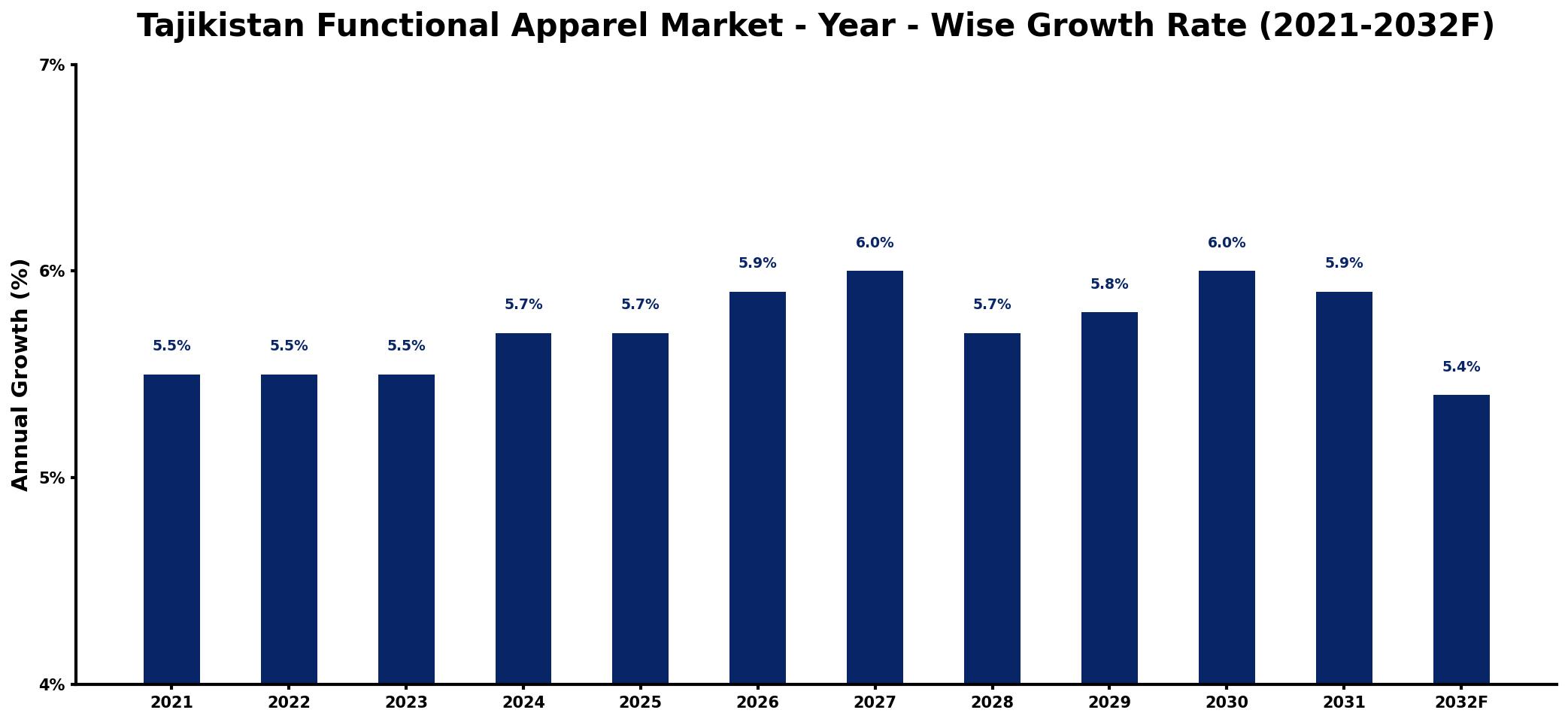
The table below presents the year‑wise growth rates along with the key drivers influencing the market
| Year | Growth Rate | Major Drivers |
| 2021 | 5.5% | Rising interest in outdoor activities |
| 2022 | 5.5% | Growth in e-commerce platforms |
| 2023 | 5.5% | Increased health consciousness among consumers |
| 2024 | 5.7% | Expansion of local manufacturing facilities |
| 2025 | 5.7% | Growing popularity of sustainable materials |
| 2026 | 5.9% | increased production capacity utilization |
| 2027 | 6.0% | Increase in urban lifestyle trends |
| 2028 | 5.7% | Enhanced marketing strategies by brands |
| 2029 | 5.8% | Emergence of new retail channels |
| 2030 | 6.0% | Rising disposable income levels |
| 2031 | 5.9% | Strengthening community engagement initiatives |
| 2032 | 5.4% | Development of innovative product features |
Note: Market size estimations and growth projections presented in this report are based on 6Wresearch's proprietary forecasting methodology, utilizing the latest available industry data, government publications, and primary research inputs.
Tajikistan Functional Apparel Market Synopsis
The demand for performance-oriented apparel is gaining momentum in Tajikistan, as consumers increasingly recognize the benefits of moisture-wicking and UV-protective fabrics. As fitness and wellness become integral to everyday life, brands that fuse style with performance are finding a receptive audience.
Additionally, local manufacturers are responding to this trend by producing high-quality functional apparel that meets international standards. With a burgeoning interest in outdoor activities such as hiking and running, the market is set for expansion, welcoming both local and international players.
Tajikistan Functional Apparel Market Key Takeaways
- The market shows a healthy growth rate, supported by the increasing trend of outdoor activities among the youth.
- Consumer awareness regarding the advantages of functional apparel is on the rise, influencing purchasing decisions.
- Technological advancements in fabric and design are critical drivers of market innovation.
- Local and international brands are focusing on collaborations to enhance distribution and reach.
- Government incentives are fostering a conducive environment for market players looking to invest in domestic production.
Evaluation of Restraints in Tajikistan Functional Apparel Market
Despite the promising outlook, the Tajikistan Functional Apparel Market faces several constraints. Limited consumer awareness regarding the advantages of functional clothing hinders market potential, particularly in rural areas. Additionally, low disposable incomes restrict purchasing power, causing many consumers to prioritize basic over specialized apparel. The market also struggles with a shortage of retail infrastructure and distribution channels, limiting access to a wider range of functional products. These barriers necessitate robust educational initiatives and strategic partnerships to cultivate a more informed consumer base.
Tajikistan Functional Apparel Market Trends
The trend towards integrating technology into apparel design is shaping the Tajikistan Functional Apparel Market. Consumers increasingly demand clothing that adapts to various activities and climates, emphasizing features like durability, breathability, and thermal regulation. Additionally, there is a noticeable shift towards sustainable practices, with consumers showing preference for eco-friendly materials and ethical manufacturing processes. This evolution indicates that brands must prioritize innovation while adhering to sustainable practices to maintain competitive advantage.
Tajikistan Functional Apparel Market Opportunities
The functional apparel market in Tajikistan is ripe with investment opportunities. The increasing participation in sports and outdoor activities opens avenues for brands to introduce specialized clothing catering to these segments. Furthermore, leveraging online platforms for e-commerce can enhance accessibility and distribution, especially in underserved areas. By creating targeted marketing campaigns that educate consumers about the benefits of functional apparel, brands can significantly boost their market presence.
Government Initiatives in the Tajikistan Functional Apparel Market
The Tajik government has implemented supportive policies aimed at enhancing the functional apparel market. Initiatives include providing incentives for local manufacturers, streamlining access to funding, and improving infrastructure to bolster production capabilities. Trade agreements with neighboring countries further facilitate export opportunities, thus boosting the local textile industry. These efforts aim to foster growth within the domestic market while creating jobs and increasing competitiveness on a global scale.
Future Insights of the Tajikistan Functional Apparel Market
Looking ahead to 2026-2032, the Tajikistan Functional Apparel Market is expected to thrive amid rising consumer awareness about the health benefits of functional clothing. As disposable incomes rise and fashion trends evolve, demand for innovative and versatile apparel will likely increase. Key players in the market are anticipated to invest in product development and sustainable practices, positioning themselves favorably to cater to the shifting preferences of consumers in the region.
Tajikistan Functional Apparel Market Latest Developments (2025 - 2026)
Recent developments within the Tajikistan functional apparel market indicate a significant focus on enhancing product offerings through technological advancements. Brands are increasingly investing in R&D to introduce innovative materials that improve performance and sustainability. Additionally, marketing efforts are becoming more aggressive, with campaigns tailored to educate consumers about the benefits of functional apparel. Collaborations with local retailers are also on the rise, aiming to improve distribution networks and accessibility for consumers across the country.
Tajikistan Functional Apparel Market - Key Attractiveness of the Report
- 10 Years of Market Numbers
- Historical Data Starting from 2022 to 2025
- Base Year: 2025
- Forecast Data until 2032
- Key Performance Indicators Impacting the Market
- Major Upcoming Developments and Projects
Key Highlights of the Report:
- Tajikistan Functional Apparel Market Outlook
- Market Size of Tajikistan Functional Apparel Market, 2025
- Forecast of Tajikistan Functional Apparel Market, 2032
- Historical Data and Forecast of Tajikistan Functional Apparel Revenues & Volume for the Period 2022-2032F
- Tajikistan Functional Apparel Market Trend Evolution
- Tajikistan Functional Apparel Market Drivers and Challenges
- Tajikistan Functional Apparel Price Trends
- Tajikistan Functional Apparel Porter's Five Forces
- Tajikistan Functional Apparel Industry Life Cycle
- Historical Data and Forecast of Tajikistan Functional Apparel Market Revenues & Volume By Product Type for the Period 2022-2032F
- Historical Data and Forecast of Tajikistan Functional Apparel Market Revenues & Volume By Sportswear for the Period 2022-2032F
- Historical Data and Forecast of Tajikistan Functional Apparel Market Revenues & Volume By Activewear for the Period 2022-2032F
- Historical Data and Forecast of Tajikistan Functional Apparel Market Revenues & Volume By Protective Clothing for the Period 2022-2032F
- Historical Data and Forecast of Tajikistan Functional Apparel Market Revenues & Volume By Others for the Period 2022-2032F
- Historical Data and Forecast of Tajikistan Functional Apparel Market Revenues & Volume By Application for the Period 2022-2032F
- Historical Data and Forecast of Tajikistan Functional Apparel Market Revenues & Volume By Sports Industry for the Period 2022-2032F
- Historical Data and Forecast of Tajikistan Functional Apparel Market Revenues & Volume By Outdoor Clothing for the Period 2022-2032F
- Historical Data and Forecast of Tajikistan Functional Apparel Market Revenues & Volume By Healthcare sector for the Period 2022-2032F
- Historical Data and Forecast of Tajikistan Functional Apparel Market Revenues & Volume By Distribution Channel for the Period 2022-2032F
- Historical Data and Forecast of Tajikistan Functional Apparel Market Revenues & Volume By Offline Store for the Period 2022-2032F
- Historical Data and Forecast of Tajikistan Functional Apparel Market Revenues & Volume By Online Store for the Period 2022-2032F
- Tajikistan Functional Apparel Import Export Trade Statistics
- Market Opportunity Assessment By Product Type
- Market Opportunity Assessment By Application
- Market Opportunity Assessment By Distribution Channel
- Tajikistan Functional Apparel Top Companies Market Share
- Tajikistan Functional Apparel Competitive Benchmarking By Technical and Operational Parameters
- Tajikistan Functional Apparel Company Profiles
- Tajikistan Functional Apparel Key Strategic Recommendations






































