Tajikistan Glass Lens Market Size, Share & Growth Rate
The Tajikistan Glass Lens Market was estimated at USD 463 Million in 2025 and is projected to reach USD 618 Million by 2032, growing at a CAGR of 4.2% from 2026 to 2032. This growth is being driven by a surge in demand for optical lenses across multiple sectors, including healthcare, automotive, and electronics. Additionally, increased consumer awareness surrounding eye health and the need for high-quality optics are further propelling this positive trajectory.
Tajikistan Glass Lens Market Year-wise Growth Rate and Key Drivers
This graph highlights how the Tajikistan Glass Lens Market has steadily grown over the years, supported by major growth factors.
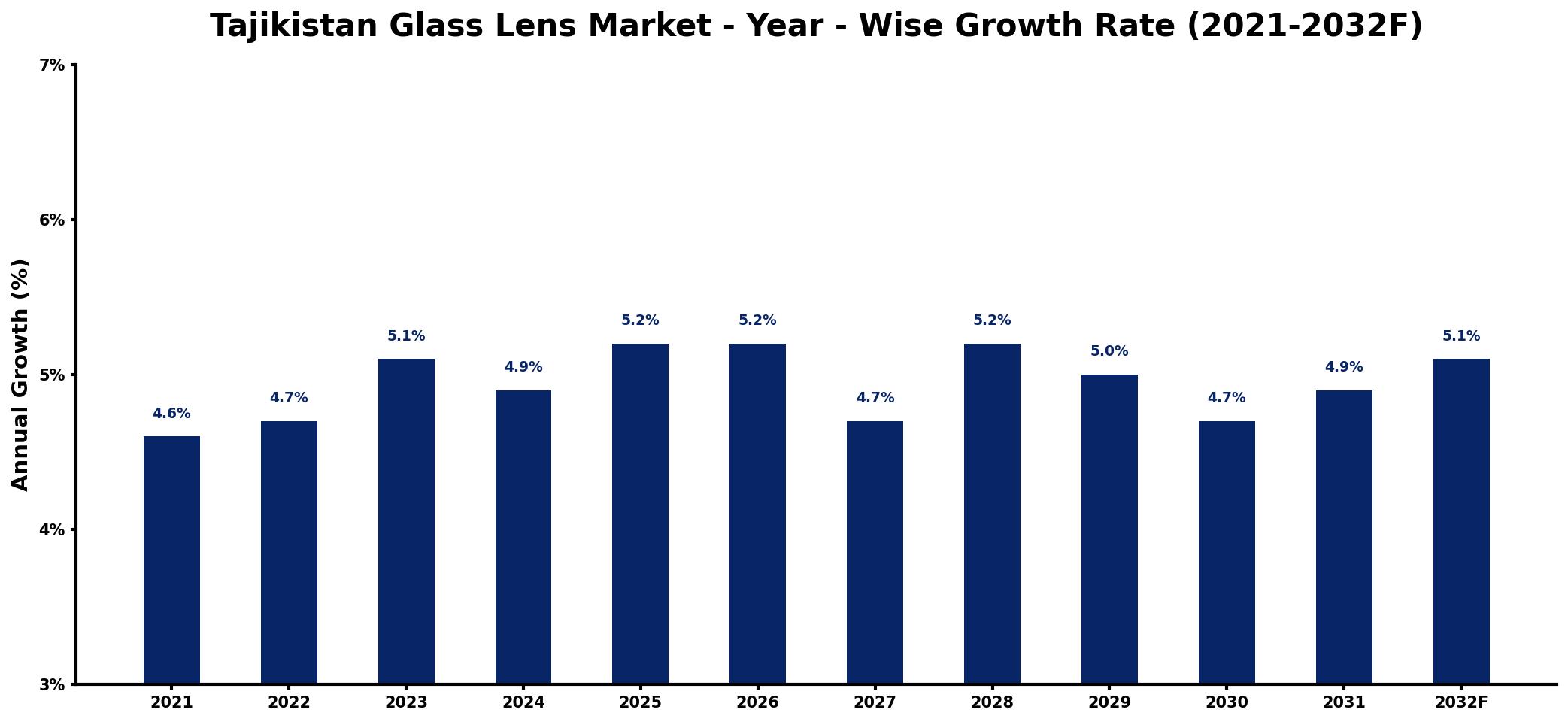
The table below presents the year‑wise growth rates along with the key drivers influencing the market
| Year | Growth Rate | Major Drivers |
| 2021 | 4.6% | Rising consumer awareness initiatives |
| 2022 | 4.7% | Increased demand for eyewear products |
| 2023 | 5.1% | Growth in healthcare infrastructure investments |
| 2024 | 4.9% | Expansion of retail distribution networks |
| 2025 | 5.2% | Technological advancements in manufacturing |
| 2026 | 5.2% | Surge in online shopping platforms |
| 2027 | 4.7% | Emergence of new market players |
| 2028 | 5.2% | Growing interest in fashion accessories |
| 2029 | 5.0% | Increased urbanization and lifestyle changes |
| 2030 | 4.7% | Higher disposable income levels |
| 2031 | 4.9% | Strengthened partnerships with suppliers |
| 2032 | 5.1% | Rising popularity of prescription services |
Note: Market size estimations and growth projections presented in this report are based on 6Wresearch's proprietary forecasting methodology, utilizing the latest available industry data, government publications, and primary research inputs.
Tajikistan Glass Lens Market Synopsis
The glass lens market in Tajikistan has seen recent momentum, primarily fueled by advancements in lens technology and a burgeoning interest in quality eyewear products. However, the market is poised for further expansion as domestic industries continue to grow and consumer preferences evolve towards technologically superior options.
With an expanding middle-class population and increased disposable income, the demand for prescription glasses and sunglasses is surging. Consequently, companies are investing in research and development to introduce innovative products that meet the sophisticated needs of consumers, ensuring that the market remains competitive and dynamic.
Tajikistan Glass Lens Market Key Takeaways
- The market is driven by a rising demand for high-quality optical lenses across various industries.
- Technological advancements, including anti-reflective coatings and blue light filters, are becoming key selling points.
- Government initiatives are fostering a favorable environment for local production and innovation.
- The consumer shift towards premium and technologically advanced eyewear is reshaping market dynamics.
- Investment in domestic manufacturing facilities presents significant growth opportunities for stakeholders.
Evaluation of Restraints in Tajikistan Glass Lens Market
Despite its growth potential, the Tajikistan Glass Lens Market is not without challenges. A significant constraint is the limited domestic production capacity, which results in heavy reliance on imported lenses. This dependency can lead to disruptions in supply chains, elevating costs and constricting the variety available to consumers. Moreover, the local industry faces hurdles in meeting international quality standards due to a lack of advanced manufacturing technologies. Furthermore, fluctuating exchange rates and potential trade restrictions could add uncertainty to the market landscape, necessitating strategic adaptations from industry players.
Tajikistan Glass Lens Market Trends
Current trends in the Tajikistan Glass Lens Market indicate a marked increase in the demand for specialized eyewear, particularly prescription glasses and protective sunglasses. Consumers are becoming increasingly conscious of eye health, partly due to the rise in digital device usage, which has resulted in a greater focus on lens features such as blue light filters. Additionally, the entry of international brands is intensifying competition, leading to the introduction of stylish, innovative products that appeal to a broader audience.
Tajikistan Glass Lens Market Opportunities
The Tajikistan Glass Lens Market is ripe with investment opportunities, especially in manufacturing and distribution channels catering to eyewear products. The growing middle-class population, accompanied by heightened awareness of eye health, is driving demand for quality prescription glasses and sunglasses. Investors may find substantial value in establishing local manufacturing facilities or collaborating with domestic optical retailers to enhance product accessibility. Furthermore, investing in technological innovations, such as improved lens designs and advanced coatings, can provide competitive advantages in the marketplace.
Government Initiatives in the Tajikistan Glass Lens Market
The Tajikistan government has taken several proactive steps to support the growth of the glass lens market. These include tax incentives and subsidies aimed at encouraging local manufacturing, as well as funding for research and development in the optical sector. Furthermore, the establishment of regulations to maintain quality standards aims to foster fair competition, thereby creating a more robust market environment that benefits both producers and consumers.
Future Insights of the Tajikistan Glass Lens Market
Looking ahead to 2026-2032, the Tajikistan Glass Lens Market is expected to sustain its upward trajectory, underpinned by increasing technological advancements and a burgeoning demand for optical products. The ongoing integration of glass lenses into consumer electronics, such as smartphones and cameras, is likely to bolster market growth. However, stakeholders will need to navigate challenges stemming from competition with alternative materials and fluctuations in raw material prices. Overall, the market offers promising avenues for innovation, ensuring that it remains adaptive and responsive to evolving consumer preferences.
Tajikistan Glass Lens Market Latest Developments (2025 - 2026)
In recent months, the Tajikistan Glass Lens Market has seen significant developments, particularly in terms of technological advancements and product offerings. Companies are increasingly focusing on enhancing lens quality through innovative manufacturing techniques. Collaborations between local manufacturers and international suppliers have started to emerge, paving the way for the introduction of new products tailored to meet local consumer demands. Additionally, awareness campaigns promoting eye health have gained momentum, further driving the demand for quality eyewear.
Tajikistan Glass Lens Market - Key Attractiveness of the Report
- 10 Years of Market Numbers
- Historical Data Starting from 2022 to 2025
- Base Year: 2025
- Forecast Data until 2032
- Key Performance Indicators Impacting the Market
- Major Upcoming Developments and Projects
Key Highlights of the Report:
- Tajikistan Glass Lens Market Outlook
- Market Size of Tajikistan Glass Lens Market, 2025
- Forecast of Tajikistan Glass Lens Market, 2032
- Historical Data and Forecast of Tajikistan Glass Lens Revenues & Volume for the Period 2022-2032F
- Tajikistan Glass Lens Market Trend Evolution
- Tajikistan Glass Lens Market Drivers and Challenges
- Tajikistan Glass Lens Price Trends
- Tajikistan Glass Lens Porter's Five Forces
- Tajikistan Glass Lens Industry Life Cycle
- Historical Data and Forecast of Tajikistan Glass Lens Market Revenues & Volume By Product Type for the Period 2022-2032F
- Historical Data and Forecast of Tajikistan Glass Lens Market Revenues & Volume By Single Vision Lenses for the Period 2022-2032F
- Historical Data and Forecast of Tajikistan Glass Lens Market Revenues & Volume By Progressive Lenses for the Period 2022-2032F
- Historical Data and Forecast of Tajikistan Glass Lens Market Revenues & Volume By Bifocal and Trifocal Lenses for the Period 2022-2032F
- Historical Data and Forecast of Tajikistan Glass Lens Market Revenues & Volume By Photochromic Lenses for the Period 2022-2032F
- Historical Data and Forecast of Tajikistan Glass Lens Market Revenues & Volume By Polarized Lenses for the Period 2022-2032F
- Historical Data and Forecast of Tajikistan Glass Lens Market Revenues & Volume By Others for the Period 2022-2032F
- Historical Data and Forecast of Tajikistan Glass Lens Market Revenues & Volume By Coating for the Period 2022-2032F
- Historical Data and Forecast of Tajikistan Glass Lens Market Revenues & Volume By Anti-Reflective for the Period 2022-2032F
- Historical Data and Forecast of Tajikistan Glass Lens Market Revenues & Volume By Blue Light Reduction for the Period 2022-2032F
- Historical Data and Forecast of Tajikistan Glass Lens Market Revenues & Volume By Scratch-Resistant for the Period 2022-2032F
- Historical Data and Forecast of Tajikistan Glass Lens Market Revenues & Volume By UV Protection for the Period 2022-2032F
- Historical Data and Forecast of Tajikistan Glass Lens Market Revenues & Volume By Distribution Channel for the Period 2022-2032F
- Historical Data and Forecast of Tajikistan Glass Lens Market Revenues & Volume By Offline for the Period 2022-2032F
- Historical Data and Forecast of Tajikistan Glass Lens Market Revenues & Volume By Online for the Period 2022-2032F
- Tajikistan Glass Lens Import Export Trade Statistics
- Market Opportunity Assessment By Product Type
- Market Opportunity Assessment By Coating
- Market Opportunity Assessment By Distribution Channel
- Tajikistan Glass Lens Top Companies Market Share
- Tajikistan Glass Lens Competitive Benchmarking By Technical and Operational Parameters
- Tajikistan Glass Lens Company Profiles
- Tajikistan Glass Lens Key Strategic Recommendations






































