Tajikistan Gold Bullion Market Size, Share & Growth Rate
The Tajikistan Gold Bullion Market was estimated at USD 248 Million in 2025 and is projected to reach USD 329 Million by 2032, growing at a CAGR of 4.1% from 2026 to 2032. This growth trajectory can be attributed to an increasing inclination towards gold as a safe-haven asset amid economic instability, as well as an ongoing shift in investor preferences towards physical gold over other investment vehicles. Furthermore, Tajikistan's strategic location and its rich mineral wealth contribute to the market's potential as a burgeoning center for gold trading.
Tajikistan Gold Bullion Market Year-wise Growth Rate and Key Drivers
This graph highlights how the Tajikistan Gold Bullion Market has steadily grown over the years, supported by major growth factors.
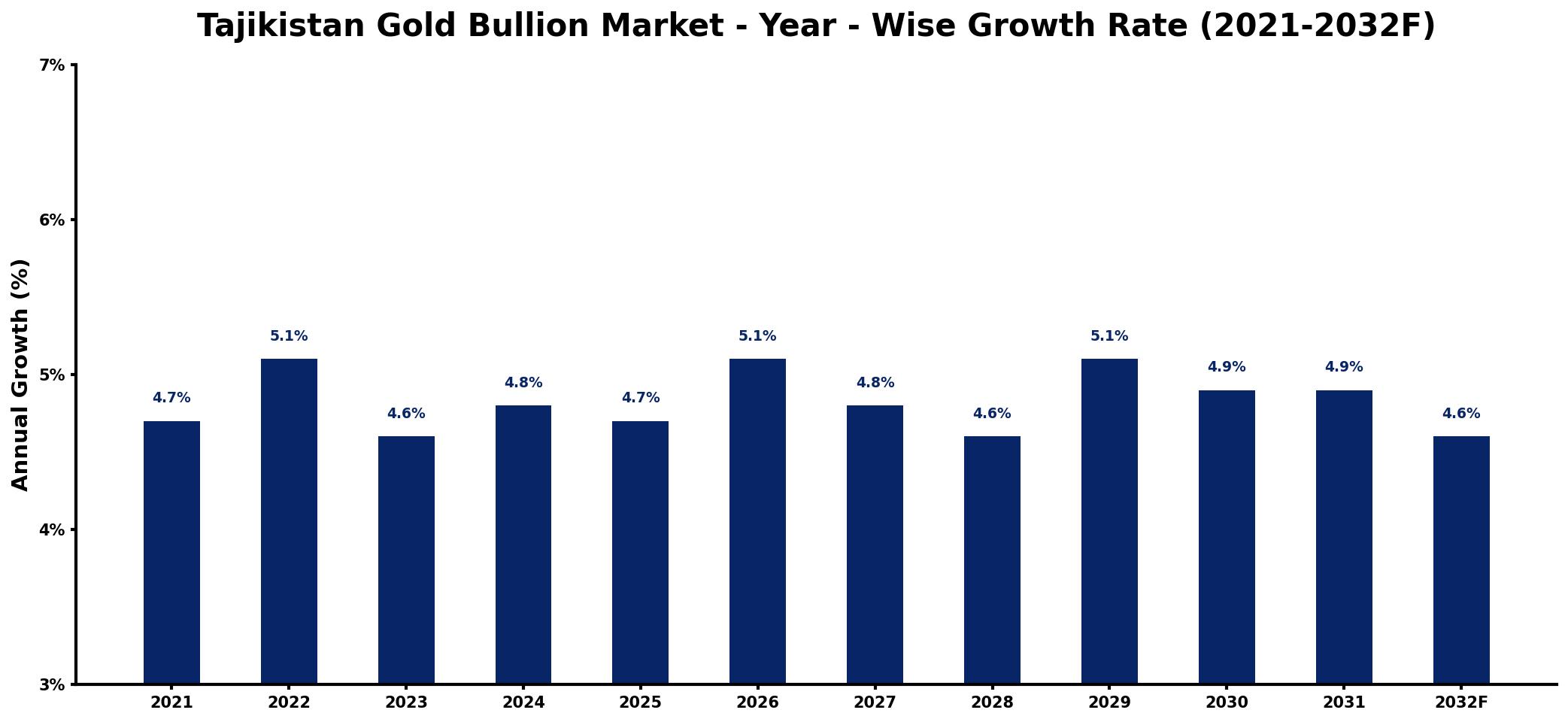
The table below presents the year‑wise growth rates along with the key drivers influencing the market
| Year | Growth Rate | Major Drivers |
| 2021 | 4.7% | Rising investment in precious metals |
| 2022 | 5.1% | Increased consumer confidence levels |
| 2023 | 4.6% | Growth in retail investment channels |
| 2024 | 4.8% | Expansion of mining exploration projects |
| 2025 | 4.7% | Higher demand from industrial applications |
| 2026 | 5.1% | Strengthening of local financial markets |
| 2027 | 4.8% | Surge in international market interest |
| 2028 | 4.6% | rising end-use demand growth |
| 2029 | 5.1% | Increased awareness of economic stability |
| 2030 | 4.9% | growing regional consumption patterns |
| 2031 | 4.9% | Rising popularity of alternative assets |
| 2032 | 4.6% | increased domestic production output |
Note: Market size estimations and growth projections presented in this report are based on 6Wresearch's proprietary forecasting methodology, utilizing the latest available industry data, government publications, and primary research inputs.
Tajikistan Gold Bullion Market Synopsis
The demand for physical gold in Tajikistan is experiencing a notable uptick, driven by local investors seeking stability amidst global economic fluctuations. Particularly, gold bars and coins are favored for their tangible value, making them a popular choice for both individual and institutional investors.
Despite high import taxes and stringent regulations, which have led to some gold smuggling, the market remains resilient. This indicates a strong underlying appetite for gold as a long-term investment, positioning Tajikistan as an attractive option for domestic and international investors alike.
Tajikistan Gold Bullion Market Key Takeaways
- The rising global economic uncertainties are driving demand for gold as a protective asset in Tajikistan.
- Local investors, along with central banks, are showing a growing preference for gold bullion over other forms of investment.
- Investment opportunities exist not only in physical gold but also in mining operations across the country.
- Government regulations are evolving to promote market transparency and curb illicit activities.
- Infrastructure improvements will be critical to enhance market access and reduce dependence on informal trading channels.
Evaluation of Restraints in Tajikistan Gold Bullion Market
The Tajikistan Gold Bullion Market is not without its hurdles. A significant challenge is the limited access to financing for small and medium-sized gold dealers, which hampers their ability to operate efficiently. Moreover, the lack of transparency in pricing can deter potential investors who are wary of fluctuating gold prices. Regulatory frameworks that may not be strictly enforced also raise concerns over illicit activities, including money laundering. Coupled with infrastructure deficiencies and heavy reliance on informal trading channels, these factors collectively restrict the full potential of the market.
Tajikistan Gold Bullion Market Trends
Current trends in the Tajikistan Gold Bullion Market reflect a growing interest in gold bullion as a means of wealth preservation. Investors are increasingly aware of gold's benefits during periods of economic turmoil, and this awareness is translating into increased purchasing activity. Technological advancements are also making it easier to buy and sell gold, while new formats of gold investment, such as digital gold, are starting to gain traction. Additionally, increasing collaborations between local mining companies and international investors signal an emerging trend towards sustainable gold production and ethical sourcing.
Tajikistan Gold Bullion Market Opportunities
Opportunities in the Tajikistan Gold Bullion Market are plentiful, especially given the country's substantial untapped gold reserves. Investors can look into acquiring physical gold in various forms—bars or coins—as a stable investment avenue. Moreover, investing in local gold mining ventures can present significant upside potential, particularly with the anticipated increase in international demand for gold. By engaging in thorough market research and understanding local dynamics, investors can navigate the challenges and leverage growth opportunities within this developing market.
Government Initiatives in the Tajikistan Gold Bullion Market
The Tajik government is actively working to enhance the stability and integrity of the gold bullion market through regulatory measures set by the National Bank of Tajikistan. This body governs the buying, selling, and storage of gold bullion, aiming to promote transparency and combat illicit activities. Additionally, the government has implemented restrictions on gold exports to ensure that domestic markets are protected. These policies are part of a broader strategy to foster a secure environment for gold trading while encouraging investments in the country's mining sector.
Future Insights of the Tajikistan Gold Bullion Market
Looking ahead to 2026-2032, the Tajikistan Gold Bullion Market is poised for significant growth. Increasing global demand for gold, coupled with persistent economic uncertainties, will continue to drive interest in gold as a viable investment option. Furthermore, the country's geographic advantages along the historic Silk Road, combined with ongoing government initiatives to attract foreign investments, could facilitate Tajikistan's emergence as a strategic trading hub in the region. While challenges remain, a favorable investment climate could substantially enhance market prospects in the coming years.
Tajikistan Gold Bullion Market Latest Developments (2025 - 2026)
Recent industry developments indicate a shift towards increased market transparency and enhanced regulatory oversight, which are becoming priorities for the National Bank of Tajikistan. Collaborative efforts between local authorities and international entities aim to improve market accessibility and mitigate risks associated with informal trading channels. Additionally, advancements in mining technology are being explored to elevate production efficiency, as new players enter the market seeking to capitalize on the nations rich gold resources.
Tajikistan Gold Bullion Market - Key Attractiveness of the Report
- 10 Years of Market Numbers
- Historical Data Starting from 2022 to 2025
- Base Year: 2025
- Forecast Data until 2032
- Key Performance Indicators Impacting the Market
- Major Upcoming Developments and Projects
Key Highlights of the Report:
- Tajikistan Gold Bullion Market Outlook
- Market Size of Tajikistan Gold Bullion Market, 2025
- Forecast of Tajikistan Gold Bullion Market, 2032
- Historical Data and Forecast of Tajikistan Gold Bullion Revenues & Volume for the Period 2022-2032F
- Tajikistan Gold Bullion Market Trend Evolution
- Tajikistan Gold Bullion Market Drivers and Challenges
- Tajikistan Gold Bullion Price Trends
- Tajikistan Gold Bullion Porter's Five Forces
- Tajikistan Gold Bullion Industry Life Cycle
- Historical Data and Forecast of Tajikistan Gold Bullion Market Revenues & Volume By Type for the Period 2022-2032F
- Historical Data and Forecast of Tajikistan Gold Bullion Market Revenues & Volume By Gold Bar for the Period 2022-2032F
- Historical Data and Forecast of Tajikistan Gold Bullion Market Revenues & Volume By Gold Coin for the Period 2022-2032F
- Historical Data and Forecast of Tajikistan Gold Bullion Market Revenues & Volume By Distribution Channel for the Period 2022-2032F
- Historical Data and Forecast of Tajikistan Gold Bullion Market Revenues & Volume By Online for the Period 2022-2032F
- Historical Data and Forecast of Tajikistan Gold Bullion Market Revenues & Volume By Offline for the Period 2022-2032F
- Tajikistan Gold Bullion Import Export Trade Statistics
- Market Opportunity Assessment By Type
- Market Opportunity Assessment By Distribution Channel
- Tajikistan Gold Bullion Top Companies Market Share
- Tajikistan Gold Bullion Competitive Benchmarking By Technical and Operational Parameters
- Tajikistan Gold Bullion Company Profiles
- Tajikistan Gold Bullion Key Strategic Recommendations






































