Tajikistan Golf Clubs Market Size, Share & Growth Rate
The Tajikistan Golf Clubs Market was estimated at USD 666 Million in 2025 and is projected to reach USD 948 Million by 2032, growing at a CAGR of 5.2% from 2026 to 2032. This growth trajectory is fueled by an emerging affluent class and increasing interest in golf as a leisure activity. The development of golf courses and improved infrastructure also plays a critical role in shaping market dynamics, ultimately expanding access to quality golfing experiences.
Tajikistan Golf Clubs Market Year-wise Growth Rate and Key Drivers
This graph highlights how the Tajikistan Golf Clubs Market has steadily grown over the years, supported by major growth factors.
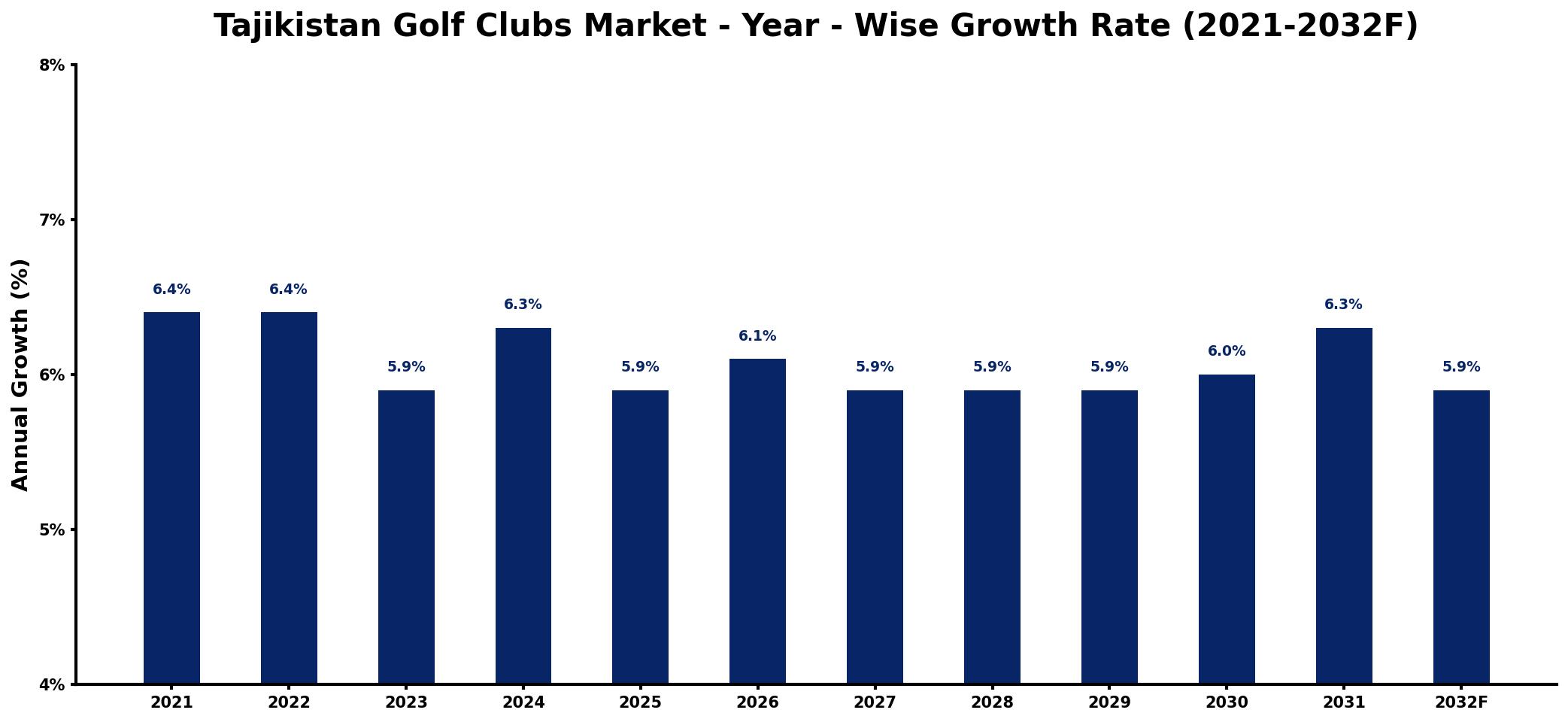
The table below presents the year‑wise growth rates along with the key drivers influencing the market
| Year | Growth Rate | Major Drivers |
| 2021 | 6.4% | increased participation in events |
| 2022 | 6.4% | growing interest in leisure activities |
| 2023 | 5.9% | rising disposable income levels |
| 2024 | 6.3% | expansion of local facilities |
| 2025 | 5.9% | enhanced tourism initiatives launched |
| 2026 | 6.1% | more corporate sponsorship opportunities |
| 2027 | 5.9% | development of training programs |
| 2028 | 5.9% | greater media coverage and promotion |
| 2029 | 5.9% | increased youth engagement strategies |
| 2030 | 6.0% | improvement in recreational infrastructure |
| 2031 | 6.3% | surge in community partnerships formed |
| 2032 | 5.9% | enhanced digital marketing efforts |
Note: Market size estimations and growth projections presented in this report are based on 6Wresearch's proprietary forecasting methodology, utilizing the latest available industry data, government publications, and primary research inputs.
Tajikistan Golf Clubs Market Synopsis
The Tajikistan Golf Clubs Market is characterized by a limited yet growing number of dedicated golf clubs and courses, primarily serving affluent individuals and expatriates. Currently, the market is concentrated in major urban centers, where a few specialized stores cater to the niche demand for high-quality golf equipment and accessories.
With ongoing investments in golf infrastructure and an increasing number of golf enthusiasts, the market is poised for expansion. Government initiatives to enhance tourism and recreational sports further support this trend, setting the stage for a vibrant golfing culture in Tajikistan.
Tajikistan Golf Clubs Market Key Takeaways
- The market is largely driven by a rising interest in golf among the affluent population.
- Limited availability of local manufacturers results in a predominance of international brands.
- Government support for tourism and sports initiatives is fostering infrastructure development.
- The increasing awareness of golfs health benefits is attracting new players to the sport.
- Investment opportunities abound as the market seeks to cater to both local and international tourists.
Evaluation of Restraints in Tajikistan Golf Clubs Market
Despite its potential, the Tajikistan Golf Clubs Market faces significant hurdles. Primarily, a lack of widespread awareness and interest in golf limits its appeal to the general population. Additionally, high costs associated with equipment and membership can deter potential golfers, confining the market's growth to a wealthy elite. Political uncertainties and economic fluctuations further complicate consumer spending habits, making it challenging for the market to reach a broader demographic.
Tajikistan Golf Clubs Market Trends
Current trends indicate a burgeoning interest in golf, coupled with an increased investment in golf course development. As more facilities emerge, theres an uptick in the number of people engaging with the sport, driven by health awareness and leisure trends. Additionally, the market is seeing an influx of golf-related events, which bolster community interest and participation. Furthermore, the blend of technology in golf training aids is enticing a younger audience.
Tajikistan Golf Clubs Market Opportunities
Investment opportunities in the Tajikistan Golf Clubs Market are particularly promising. Establishing new golf courses and enhancing existing ones can cater to both local and international tourists looking for unique recreational experiences. Furthermore, as the local economy improves, theres a potential for increased disposable income, fostering a larger consumer base. The government's push for tourism development presents a strategic opening for investors to contribute to the market while benefiting from its growth.
Government Initiatives in the Tajikistan Golf Clubs Market
The Tajikistan government has implemented various initiatives aimed at boosting the tourism and sports sectors. These initiatives include fostering foreign investments in recreational activities, particularly in golf. Moreover, the government is focused on improving infrastructure to support golf clubs and facilitate better experiences for both domestic and international visitors. These supportive measures reflect a positive governmental attitude towards the growth of the golf clubs market.
Future Insights of the Tajikistan Golf Clubs Market
Looking forward, the Tajikistan Golf Clubs Market is set for continued growth between 2026 and 2032. As economic stability improves and living standards rise, the market is likely to witness an increase in participation from a broader demographic. Furthermore, governmental efforts to enhance tourism and recreational offerings will pave the way for a robust golf culture. The market's future appears bright, particularly as the interest in healthy lifestyles grows among the populace.
Tajikistan Golf Clubs Market Latest Developments (2025 - 2026)
Recent developments in the Tajikistan Golf Clubs Market indicate a shift towards enhanced investment in golf infrastructure, with new courses being planned in multiple regions. Additionally, there has been a surge in golf-related events that have contributed to community engagement and raised awareness about the sport. Collaborations with international golf entities are becoming more common, positioning Tajikistan as an emerging destination for golf tourism.
Tajikistan Golf Clubs Market - Key Attractiveness of the Report
- 10 Years of Market Numbers
- Historical Data Starting from 2022 to 2025
- Base Year: 2025
- Forecast Data until 2032
- Key Performance Indicators Impacting the Market
- Major Upcoming Developments and Projects
Key Highlights of the Report:
- Tajikistan Golf Clubs Market Outlook
- Market Size of Tajikistan Golf Clubs Market, 2025
- Forecast of Tajikistan Golf Clubs Market, 2032
- Historical Data and Forecast of Tajikistan Golf Clubs Revenues & Volume for the Period 2022-2032F
- Tajikistan Golf Clubs Market Trend Evolution
- Tajikistan Golf Clubs Market Drivers and Challenges
- Tajikistan Golf Clubs Price Trends
- Tajikistan Golf Clubs Porter's Five Forces
- Tajikistan Golf Clubs Industry Life Cycle
- Historical Data and Forecast of Tajikistan Golf Clubs Market Revenues & Volume By Product Type for the Period 2022-2032F
- Historical Data and Forecast of Tajikistan Golf Clubs Market Revenues & Volume By Woods for the Period 2022-2032F
- Historical Data and Forecast of Tajikistan Golf Clubs Market Revenues & Volume By Iron for the Period 2022-2032F
- Historical Data and Forecast of Tajikistan Golf Clubs Market Revenues & Volume By Wedges for the Period 2022-2032F
- Historical Data and Forecast of Tajikistan Golf Clubs Market Revenues & Volume By Putters for the Period 2022-2032F
- Tajikistan Golf Clubs Import Export Trade Statistics
- Market Opportunity Assessment By Product Type
- Tajikistan Golf Clubs Top Companies Market Share
- Tajikistan Golf Clubs Competitive Benchmarking By Technical and Operational Parameters
- Tajikistan Golf Clubs Company Profiles
- Tajikistan Golf Clubs Key Strategic Recommendations






































