Tajikistan Ice maker Market Size Growth Rate
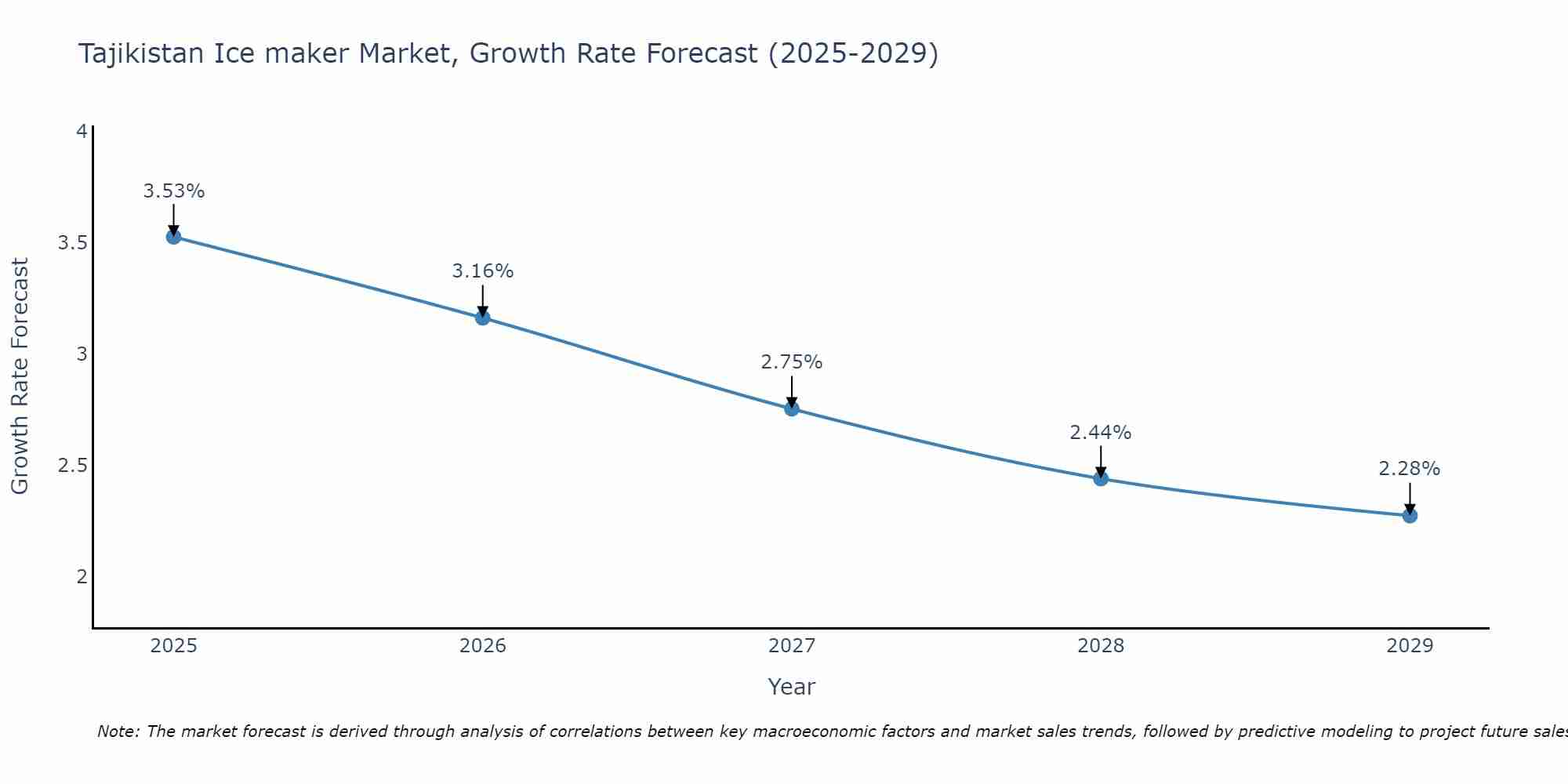
The Tajikistan Ice maker Market could see a tapering of growth rates over 2025 to 2029. Starting high at 3.53% in 2025, the market steadily declines to 2.28% by 2029.
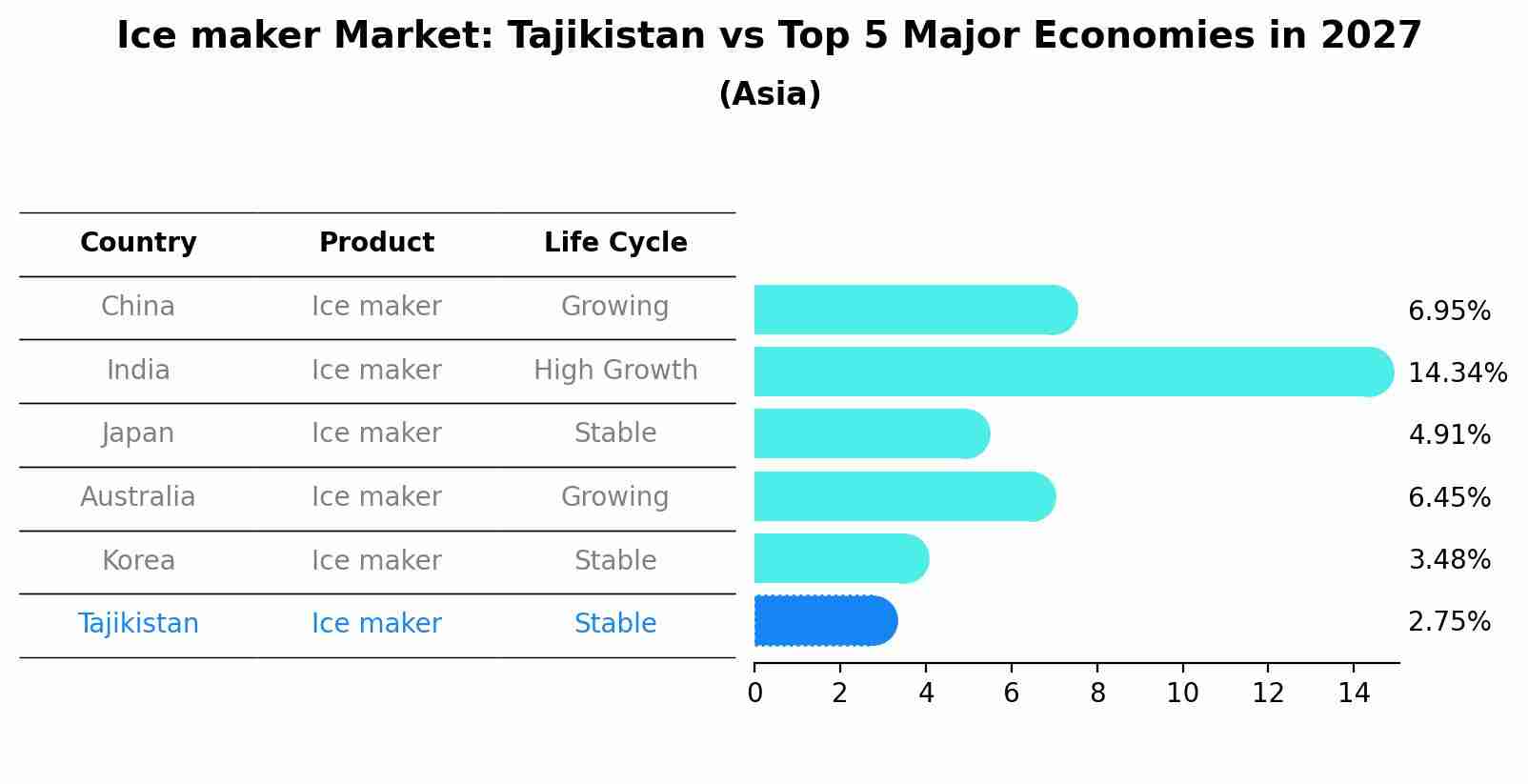
Ice maker Market: Tajikistan vs Top 5 Major Economies in 2027 (Asia)
Tajikistan's Ice maker market is anticipated to experience a stable growth rate of 2.75% by 2027, reflecting trends observed in the largest economy China, followed by India, Japan, Australia and South Korea.
Tajikistan Ice maker Market Overview
The Tajikistan ice maker market is experiencing steady growth driven by the increasing demand for ice across various sectors such as hospitality, healthcare, and food & beverage. The market is primarily dominated by commercial ice maker units, with a growing trend towards energy-efficient and environmentally friendly models. Key players in the Tajikistan ice maker market include international brands as well as local manufacturers catering to the diverse needs of the market. Factors such as improving infrastructure, rising disposable income, and changing consumer preferences towards convenience are expected to further fuel the growth of the ice maker market in Tajikistan. Additionally, the increasing number of hotels, restaurants, and cafes in the country is creating a favorable environment for the expansion of the ice maker market.
Tajikistan Ice maker Market Trends
The Tajikistan ice maker market is experiencing a growing demand for compact and portable ice makers, especially among households and small businesses. Consumers are increasingly looking for convenient solutions to produce ice quickly and efficiently for various purposes such as cooling beverages and preserving food. In addition, there is a rising interest in ice makers with advanced features such as energy efficiency, multiple ice size options, and easy maintenance. Commercial establishments such as restaurants and hotels are also investing in larger capacity ice makers to meet the demand from customers. Overall, the market is witnessing a shift towards more innovative and user-friendly ice maker products that cater to the diverse needs of both residential and commercial users in Tajikistan.
Tajikistan Ice maker Market Challenges
In the Tajikistan ice maker market, some of the main challenges faced include unreliable electricity supply, inadequate infrastructure for transportation and distribution, limited access to financing for small businesses, and the presence of counterfeit or low-quality products. The inconsistent power supply in Tajikistan can disrupt ice production operations, leading to inefficiencies and increased costs. Poor transportation infrastructure can hinder the timely delivery of ice to customers, impacting business performance. Additionally, small ice maker businesses often struggle to secure financing for equipment upgrades or expansion, limiting their growth potential. The prevalence of counterfeit or substandard ice maker products in the market can also undermine consumer trust and competitiveness among legitimate businesses. Addressing these challenges will be crucial for the sustainable development of the ice maker market in Tajikistan.
Tajikistan Ice maker Market Investment Opportunities
The Tajikistan ice maker market presents promising investment opportunities due to the country`s hot climate and the growing demand for ice in various sectors such as food and beverage, healthcare, and tourism. Investing in ice maker manufacturing companies or distribution networks can be lucrative, especially considering the lack of domestic production capacity in Tajikistan. Additionally, with increasing urbanization and economic development in the country, there is a rising need for ice for both commercial and residential purposes. Moreover, the government`s efforts to improve infrastructure and attract foreign investment further enhance the investment potential in the Tajikistan ice maker market. Overall, entering the Tajikistan ice maker market can offer investors a foothold in a growing industry with untapped potential.
Tajikistan Ice maker Market Government Policy
The Tajikistan government has implemented policies to support the ice maker market, recognizing its importance in sectors such as hospitality, tourism, and healthcare. These policies include providing financial incentives and subsidies to ice maker manufacturers to encourage production and investment in modern technology for energy-efficient and environmentally friendly operations. Additionally, the government has established regulations to ensure the quality and safety of ice production, including regular inspections and adherence to hygiene standards. Overall, these government policies aim to promote growth and competitiveness within the Tajikistan ice maker market while safeguarding consumer health and safety.
Tajikistan Ice maker Market Future Outlook
The Tajikistan ice maker market is projected to experience steady growth in the coming years, driven by increasing demand from various sectors such as hospitality, healthcare, and food and beverage. The market is expected to benefit from the country`s expanding tourism industry and rising disposable incomes, leading to higher consumption of cold beverages and food products. Additionally, the growing awareness of food safety and hygiene standards is likely to spur the adoption of ice makers in commercial establishments. With advancements in technology and the introduction of energy-efficient and eco-friendly ice maker models, the market is poised to witness further expansion. Overall, the Tajikistan ice maker market presents promising opportunities for manufacturers and suppliers to capitalize on the evolving consumer preferences and industry trends.
Key Highlights of the Report:
- Tajikistan Ice maker Market Outlook
- Market Size of Tajikistan Ice maker Market, 2021
- Forecast of Tajikistan Ice maker Market, 2027
- Historical Data and Forecast of Tajikistan Ice maker Revenues & Volume for the Period 2018 - 2027
- Tajikistan Ice maker Market Trend Evolution
- Tajikistan Ice maker Market Drivers and Challenges
- Tajikistan Ice maker Price Trends
- Tajikistan Ice maker Porter's Five Forces
- Tajikistan Ice maker Industry Life Cycle
- Historical Data and Forecast of Tajikistan Ice maker Market Revenues & Volume By Product type for the Period 2018 - 2027
- Historical Data and Forecast of Tajikistan Ice maker Market Revenues & Volume By Ice Cube Maker for the Period 2018 - 2027
- Historical Data and Forecast of Tajikistan Ice maker Market Revenues & Volume By Ice Flake Maker for the Period 2018 - 2027
- Historical Data and Forecast of Tajikistan Ice maker Market Revenues & Volume By Ice Nugget Maker for the Period 2018 - 2027
- Historical Data and Forecast of Tajikistan Ice maker Market Revenues & Volume By Others for the Period 2018 - 2027
- Historical Data and Forecast of Tajikistan Ice maker Market Revenues & Volume By Component for the Period 2018 - 2027
- Historical Data and Forecast of Tajikistan Ice maker Market Revenues & Volume By Condenser for the Period 2018 - 2027
- Historical Data and Forecast of Tajikistan Ice maker Market Revenues & Volume By Evaporator for the Period 2018 - 2027
- Historical Data and Forecast of Tajikistan Ice maker Market Revenues & Volume By Throttle Valve for the Period 2018 - 2027
- Historical Data and Forecast of Tajikistan Ice maker Market Revenues & Volume By Compressor for the Period 2018 - 2027
- Historical Data and Forecast of Tajikistan Ice maker Market Revenues & Volume By Motors for the Period 2018 - 2027
- Historical Data and Forecast of Tajikistan Ice maker Market Revenues & Volume By Heating Elements for the Period 2018 - 2027
- Historical Data and Forecast of Tajikistan Ice maker Market Revenues & Volume By Application for the Period 2018 - 2027
- Historical Data and Forecast of Tajikistan Ice maker Market Revenues & Volume By Residential for the Period 2018 - 2027
- Historical Data and Forecast of Tajikistan Ice maker Market Revenues & Volume By Commercial for the Period 2018 - 2027
- Tajikistan Ice maker Import Export Trade Statistics
- Market Opportunity Assessment By Product type
- Market Opportunity Assessment By Component
- Market Opportunity Assessment By Application
- Tajikistan Ice maker Top Companies Market Share
- Tajikistan Ice maker Competitive Benchmarking By Technical and Operational Parameters
- Tajikistan Ice maker Company Profiles
- Tajikistan Ice maker Key Strategic Recommendations






































