Tajikistan Industrial Machinery Market Size, Share & Growth Rate
The Tajikistan Industrial Machinery Market was estimated at USD 176 Million in 2025 and is projected to reach USD 193 Million by 2032, growing at a CAGR of 1.3% from 2026 to 2032. This growth trajectory is primarily fueled by robust government initiatives aimed at modernizing infrastructure and elevating industrial output. As sectors such as construction, agriculture, and manufacturing expand, the demand for advanced machinery continues to rise, highlighting the market's pivotal role in driving economic progress.
Tajikistan Industrial Machinery Market Year-wise Growth Rate and Key Drivers
This graph highlights how the Tajikistan Industrial Machinery Market has steadily grown over the years, supported by major growth factors.
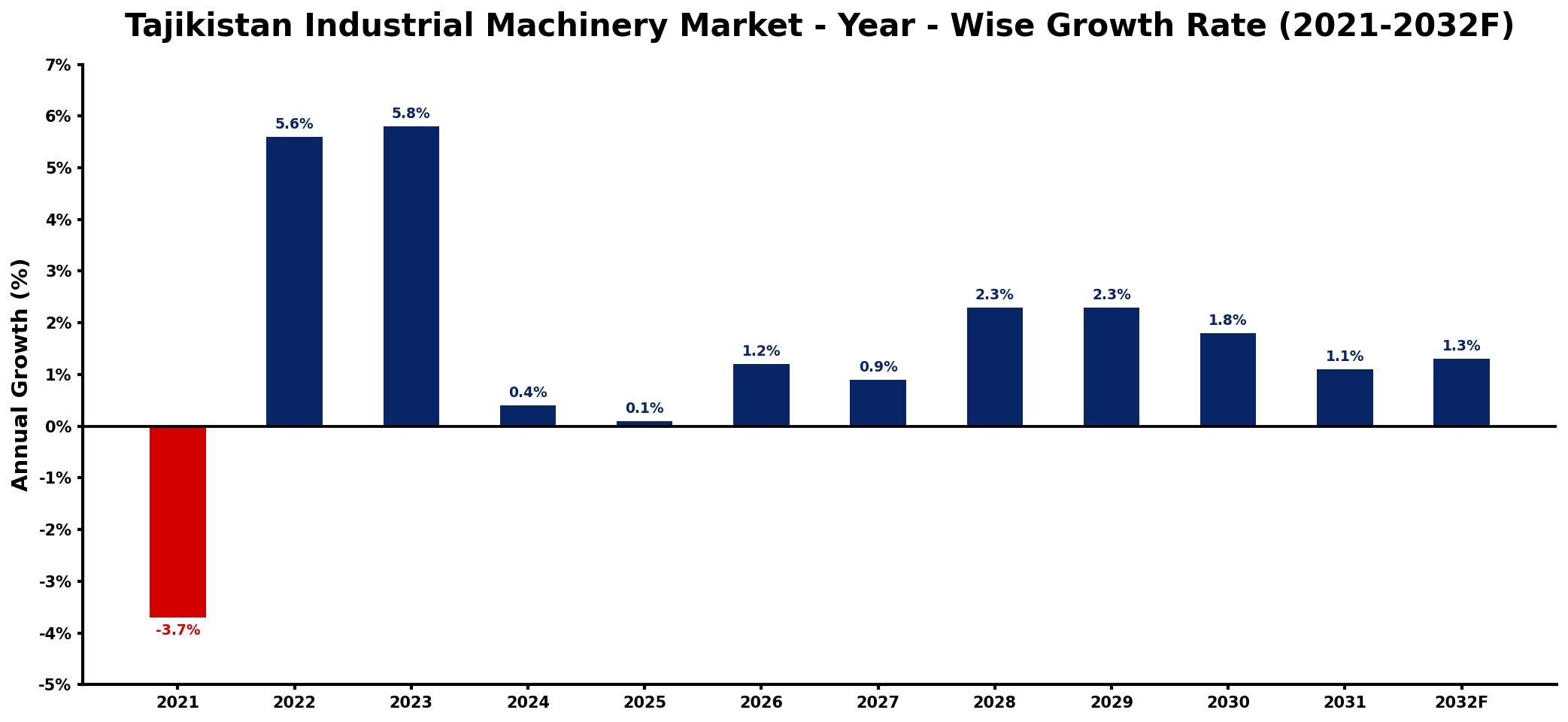
The table below presents the year‑wise growth rates along with the key drivers influencing the market
| Year | Growth Rate | Major Drivers |
| 2021 | -3.7% | decreased investment in infrastructure projects |
| 2022 | 5.6% | growing demand in construction sector |
| 2023 | 5.8% | increased foreign direct investment |
| 2024 | 0.4% | expansion of local manufacturing capabilities |
| 2025 | 0.1% | rising agricultural mechanization trends |
| 2026 | 1.2% | development of renewable energy projects |
| 2027 | 0.9% | enhanced logistics and distribution networks |
| 2028 | 2.3% | increased urbanization and housing needs |
| 2029 | 2.3% | growing interest in automation solutions |
| 2030 | 1.8% | strengthened trade agreements with neighbors |
| 2031 | 1.1% | rising focus on sustainable practices |
| 2032 | 1.3% | growing technology adoption in industries |
Note: Market size estimations and growth projections presented in this report are based on 6Wresearch's proprietary forecasting methodology, utilizing the latest available industry data, government publications, and primary research inputs.
Tajikistan Industrial Machinery Market Synopsis
The Tajikistan Industrial Machinery Market has shown remarkable momentum in recent years, propelled by rising investments in industrial infrastructure and a burgeoning agricultural sector. This momentum is expected to evolve into a more sustained growth phase, as the government actively fosters an environment conducive to both local and international players in the market.
While the industrial machinery landscape is transitioning towards advanced, efficiency-driven solutions, challenges such as limited access to modern technologies and adequate financing still impede the market's full potential. Nonetheless, the ongoing shift towards innovation and sustainability positions Tajikistan favorably for future industrial advancements.
Tajikistan Industrial Machinery Market Key Takeaways
- The market is experiencing steady growth driven by government infrastructure initiatives.
- There is an increasing demand for technologically advanced and energy-efficient machinery.
- Automation and smart technologies are becoming key components in industrial operations.
- Investment opportunities are emerging across various sectors, including construction and agriculture.
- Government policies are supportive, providing incentives for domestic production and foreign investment.
Evaluation of Restraints in Tajikistan Industrial Machinery Market
Despite its growth prospects, the Tajikistan Industrial Machinery Market is hindered by several significant restraints. Limited access to financing remains a primary concern, impacting the ability of both local businesses and foreign investors to acquire necessary equipment. Additionally, the country's inadequate infrastructure, especially in transportation and energy supply, presents challenges in facilitating efficient distribution and operational effectiveness. The heavy reliance on imports further escalates costs and affects local competitiveness, particularly in a market that is heavily characterized by fluctuating economic conditions. Addressing these limitations will require a multifaceted approach focusing on infrastructure investment and technological integration.
Tajikistan Industrial Machinery Market Trends
The landscape of the Tajikistan Industrial Machinery Market is being shaped by a number of current and emerging trends. There is a noticeable shift towards environmentally friendly and energy-efficient machinery as businesses increasingly seek to align with global sustainability goals. Additionally, the integration of automation technologies is streamlining operations, enhancing productivity while reducing reliance on manual labor. This trend reflects a broader commitment to modernizing industrial processes within the country, signifying a move towards a more innovative and efficient industrial environment.
Tajikistan Industrial Machinery Market Opportunities
In light of the evolving industrial landscape, the Tajikistan Industrial Machinery Market offers genuine investment opportunities across several sectors. The ongoing development of infrastructure is stimulating demand for advanced machinery, particularly in construction and agriculture. Furthermore, the governments focus on enhancing technological capabilities and promoting local manufacturing presents a favorable climate for investment. International manufacturers can explore strategic partnerships with local distributors to capitalize on the expanding market and the growing demand for machinery.
Government Initiatives in the Tajikistan Industrial Machinery Market
The Tajik government is actively implementing policies designed to bolster the industrial machinery market. These initiatives are aimed at promoting domestic production and attracting foreign investment through various incentives, including tax breaks and subsidies for machinery procurement. Support for research and development is also prioritized, alongside substantial efforts to improve infrastructure and logistics within the country. These government measures are crucial for fostering a robust industrial environment and enhancing the overall competitiveness of the Tajikistan Industrial Machinery Market.
Future Insights of the Tajikistan Industrial Machinery Market
Looking ahead to the period between 2026 and 2032, the Tajikistan Industrial Machinery Market is poised for significant growth. Increased industrialization and substantial infrastructure projects are expected to drive demand further. The countrys strategic geographical position may facilitate regional trade, potentially establishing Tajikistan as a trade hub. However, addressing challenges related to financing and reliance on imports will be critical for sustaining this growth trajectory. The overall outlook remains positive, contingent on targeted investments in technology and infrastructure.
Tajikistan Industrial Machinery Market Latest Developments (2025 - 2026)
Recent developments in the Tajikistan Industrial Machinery Market indicate a robust push towards modernization, with several initiatives launched to improve industrial capabilities. The government is focusing on creating partnerships with foreign investors to enhance technological access. Additionally, there has been an uptick in awareness around energy-efficient machinery, leading businesses to invest in sustainable solutions that align with global trends. Infrastructure projects continue to be a priority, reinforcing the commitment to support the growing demand for industrial machinery.
Tajikistan Industrial Machinery Market - Key Attractiveness of the Report
- 10 Years of Market Numbers
- Historical Data Starting from 2022 to 2025
- Base Year: 2025
- Forecast Data until 2032
- Key Performance Indicators Impacting the Market
- Major Upcoming Developments and Projects
Key Highlights of the Report:
- Tajikistan Industrial Machinery Market Outlook
- Market Size of Tajikistan Industrial Machinery Market, 2025
- Forecast of Tajikistan Industrial Machinery Market, 2032
- Historical Data and Forecast of Tajikistan Industrial Machinery Revenues & Volume for the Period 2022-2032F
- Tajikistan Industrial Machinery Market Trend Evolution
- Tajikistan Industrial Machinery Market Drivers and Challenges
- Tajikistan Industrial Machinery Price Trends
- Tajikistan Industrial Machinery Porter's Five Forces
- Tajikistan Industrial Machinery Industry Life Cycle
- Historical Data and Forecast of Tajikistan Industrial Machinery Market Revenues & Volume By Application for the Period 2022-2032F
- Historical Data and Forecast of Tajikistan Industrial Machinery Market Revenues & Volume By Agriculture for the Period 2022-2032F
- Historical Data and Forecast of Tajikistan Industrial Machinery Market Revenues & Volume By Construction for the Period 2022-2032F
- Historical Data and Forecast of Tajikistan Industrial Machinery Market Revenues & Volume By Packaging for the Period 2022-2032F
- Historical Data and Forecast of Tajikistan Industrial Machinery Market Revenues & Volume By Food Processing for the Period 2022-2032F
- Historical Data and Forecast of Tajikistan Industrial Machinery Market Revenues & Volume By Mining for the Period 2022-2032F
- Historical Data and Forecast of Tajikistan Industrial Machinery Market Revenues & Volume By Semiconductor Manufacturing for the Period 2022-2032F
- Tajikistan Industrial Machinery Import Export Trade Statistics
- Market Opportunity Assessment By Application
- Tajikistan Industrial Machinery Top Companies Market Share
- Tajikistan Industrial Machinery Competitive Benchmarking By Technical and Operational Parameters
- Tajikistan Industrial Machinery Company Profiles
- Tajikistan Industrial Machinery Key Strategic Recommendations






































