Tajikistan Insecticide Market Size, Share & Growth Rate
The Tajikistan Insecticide Market was estimated at USD 195 Million in 2025 and is projected to reach USD 258 Million by 2032, growing at a CAGR of 4.1% from 2026 to 2032. This positive trajectory is fueled by the agricultural sector's increasing focus on pest control for crop protection, as well as a growing shift towards more sustainable and eco-friendly insecticide solutions. Additionally, government initiatives aimed at promoting integrated pest management are fostering an environment conducive to market growth.
Tajikistan Insecticide Market Year-wise Growth Rate and Key Drivers
This graph highlights how the Tajikistan Insecticide Market has steadily grown over the years, supported by major growth factors.
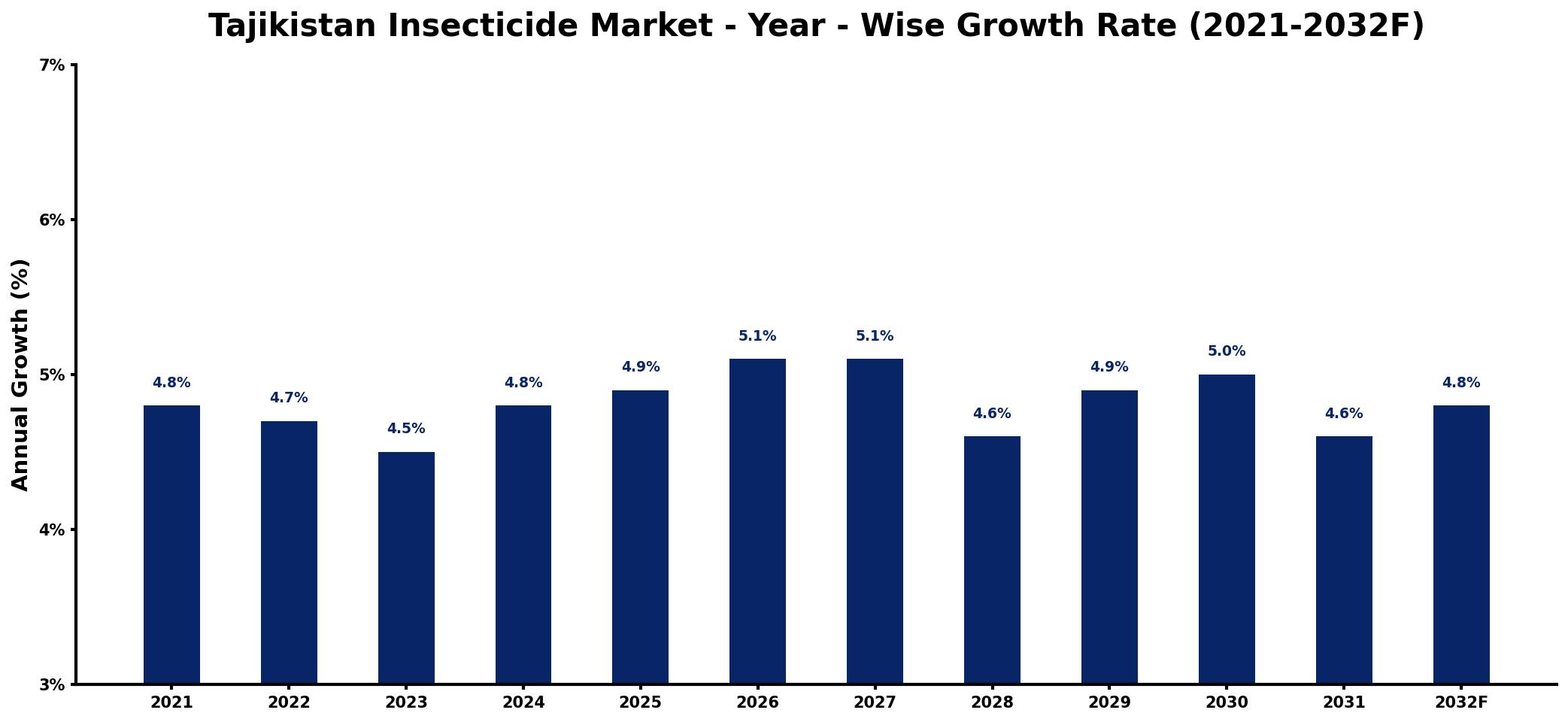
The table below presents the year‑wise growth rates along with the key drivers influencing the market
| Year | Growth Rate | Major Drivers |
| 2021 | 4.8% | Rising agricultural production needs |
| 2022 | 4.7% | Increased pest resistance awareness |
| 2023 | 4.5% | Growing organic farming practices |
| 2024 | 4.8% | Expansion of retail distribution networks |
| 2025 | 4.9% | Higher government agricultural investments |
| 2026 | 5.1% | Improved crop yield expectations |
| 2027 | 5.1% | Surge in agrochemical research funding |
| 2028 | 4.6% | Emergence of eco-friendly alternatives |
| 2029 | 4.9% | Rising global market demand |
| 2030 | 5.0% | Technological advancements in application |
| 2031 | 4.6% | Strengthened regulatory compliance standards |
| 2032 | 4.8% | Enhanced farmer education programs |
Note: Market size estimations and growth projections presented in this report are based on 6Wresearch's proprietary forecasting methodology, utilizing the latest available industry data, government publications, and primary research inputs.
Tajikistan Insecticide Market Synopsis
While the Tajikistan insecticide market has traditionally leaned on chemical products for pest control, recent trends indicate a noteworthy pivot towards sustainable solutions. Farmers are becoming more aware of the adverse effects of synthetic chemicals, prompting a demand for organic and bio-based insecticides.
As the market evolves, it's also experiencing challenges such as limited access to modern technologies and inconsistent regulatory enforcement. Nevertheless, the proactive approach of the government to encourage environmentally responsible practices is steering the market towards a more balanced and sustainable future.
Tajikistan Insecticide Market Key Takeaways
- The market is moving towards eco-friendly and sustainable insecticides as awareness grows among farmers.
- Government initiatives promoting integrated pest management are reshaping market dynamics.
- Limited access to modern technologies continues to be a significant barrier for market expansion.
- There is increasing investment potential in the development of innovative insecticides tailored to local needs.
- Consumer preferences are shifting, reflecting a desire for products perceived as safer for health and the environment.
Evaluation of Restraints in Tajikistan Insecticide Market
The Tajikistan insecticide market faces several restraints that inhibit its growth. Primarily, there is a significant reliance on traditional, less effective insecticides due to limited access to advanced technologies. The regulatory environment is often inconsistent, which complicates compliance with safety and efficacy standards. Furthermore, the prevalence of counterfeit products undermines trust in available insecticides, while inadequate infrastructure, particularly in remote areas, restricts effective distribution and access to quality products. These factors create a challenging landscape that stakeholders must navigate to foster sustainable growth in the market.
Tajikistan Insecticide Market Trends
In Tajikistan, the insecticide market is currently influenced by several key trends. The rising preference for organic and bio-based insecticides reflects a broader societal shift toward sustainability and environmental responsibility. Additionally, there is a notable demand for multi-functional products that can combat various pests, driven by the need for effective pest control solutions in both agricultural and urban settings. Companies are increasingly focusing on the development of biodegradable formulations that minimize ecological impact while maintaining efficacy. This shift is indicative of a market in transition, where long-term viability hinges on adopting innovative and eco-conscious practices.
Tajikistan Insecticide Market Opportunities
Investment opportunities abound in the Tajikistan insecticide market, primarily due to the vital role agriculture plays in the country's economy. The increasing need for effective pest management solutions presents an opportunity for companies to introduce a diverse range of insecticides, particularly those tailored to specific crop types and local pest challenges. Moreover, there is significant potential for research and development initiatives focused on creating environmentally friendly formulations that address the growing consumer demand for sustainable agricultural practices. Partnerships with local farmers for training and education on responsible insecticide usage can also enhance market penetration and foster community engagement.
Government Initiatives in the Tajikistan Insecticide Market
The Tajikistan government has implemented various regulations and policies aimed at regulating the insecticide market. These measures include stringent registration and licensing processes to ensure that products meet safety and efficacy standards. Additionally, the government has established maximum residue limits (MRLs) for insecticide residues in agricultural products, aiming to safeguard consumer health and the environment. Regulatory oversight on the import, distribution, and usage of insecticides serves to prevent misuse and promotes responsible practices. Overall, these initiatives are designed to encourage the sustainable use of insecticides and protect public health.
Future Insights of the Tajikistan Insecticide Market
Looking ahead, the Tajikistan insecticide market is poised for steady growth as the agricultural sector becomes increasingly aware of pest control's importance for food security and public health. Urbanization and changing lifestyles will likely spur additional demand for household insecticides, further diversifying market opportunities. The adoption of integrated pest management practices, alongside innovative product development, will be critical to addressing the dual challenges of efficacy and environmental sustainability. However, stakeholders should remain vigilant concerning environmental regulations and emerging competition from alternative pest control methods that may influence the market landscape.
Tajikistan Insecticide Market Latest Developments (2025 - 2026)
Recent developments in the Tajikistan insecticide market indicate a growing momentum towards sustainable practices. Increased collaboration between government bodies and agricultural organizations is evident, with a focus on promoting environmentally friendly insecticide options. Furthermore, the introduction of training programs aimed at educating farmers on the responsible use of insecticides is gaining traction, enhancing the overall effectiveness of pest management strategies. Additionally, companies are ramping up their research and development efforts to innovate new products that align with consumer preferences for safety and sustainability.
Tajikistan Insecticide Market - Key Attractiveness of the Report
- 10 Years of Market Numbers
- Historical Data Starting from 2022 to 2025
- Base Year: 2025
- Forecast Data until 2032
- Key Performance Indicators Impacting the Market
- Major Upcoming Developments and Projects
Key Highlights of the Report:
- Tajikistan Insecticide Market Outlook
- Market Size of Tajikistan Insecticide Market, 2025
- Forecast of Tajikistan Insecticide Market, 2032
- Historical Data and Forecast of Tajikistan Insecticide Revenues & Volume for the Period 2022-2032F
- Tajikistan Insecticide Market Trend Evolution
- Tajikistan Insecticide Market Drivers and Challenges
- Tajikistan Insecticide Price Trends
- Tajikistan Insecticide Porter's Five Forces
- Tajikistan Insecticide Industry Life Cycle
- Historical Data and Forecast of Tajikistan Insecticide Market Revenues & Volume By Type for the Period 2022-2032F
- Historical Data and Forecast of Tajikistan Insecticide Market Revenues & Volume By Pyrethroids for the Period 2022-2032F
- Historical Data and Forecast of Tajikistan Insecticide Market Revenues & Volume By Organophosphorus for the Period 2022-2032F
- Historical Data and Forecast of Tajikistan Insecticide Market Revenues & Volume By Carbamates for the Period 2022-2032F
- Historical Data and Forecast of Tajikistan Insecticide Market Revenues & Volume By Organochlorine for the Period 2022-2032F
- Historical Data and Forecast of Tajikistan Insecticide Market Revenues & Volume By Botanicals for the Period 2022-2032F
- Historical Data and Forecast of Tajikistan Insecticide Market Revenues & Volume By Other Types for the Period 2022-2032F
- Historical Data and Forecast of Tajikistan Insecticide Market Revenues & Volume By Crop Type for the Period 2022-2032F
- Historical Data and Forecast of Tajikistan Insecticide Market Revenues & Volume By Cereals & Grains for the Period 2022-2032F
- Historical Data and Forecast of Tajikistan Insecticide Market Revenues & Volume By Oilseeds & Pulses for the Period 2022-2032F
- Historical Data and Forecast of Tajikistan Insecticide Market Revenues & Volume By Fruits & Vegetables for the Period 2022-2032F
- Historical Data and Forecast of Tajikistan Insecticide Market Revenues & Volume By Other Crop Types for the Period 2022-2032F
- Historical Data and Forecast of Tajikistan Insecticide Market Revenues & Volume By Formulation for the Period 2022-2032F
- Historical Data and Forecast of Tajikistan Insecticide Market Revenues & Volume By Wettable Powder for the Period 2022-2032F
- Historical Data and Forecast of Tajikistan Insecticide Market Revenues & Volume By Emulsifiable Concentrate for the Period 2022-2032F
- Historical Data and Forecast of Tajikistan Insecticide Market Revenues & Volume By Suspension Concentrate for the Period 2022-2032F
- Historical Data and Forecast of Tajikistan Insecticide Market Revenues & Volume By Oil Emulsion In Water for the Period 2022-2032F
- Historical Data and Forecast of Tajikistan Insecticide Market Revenues & Volume By Microencapsulated Suspension for the Period 2022-2032F
- Historical Data and Forecast of Tajikistan Insecticide Market Revenues & Volume By Granules for the Period 2022-2032F
- Historical Data and Forecast of Tajikistan Insecticide Market Revenues & Volume By Other Formulations for the Period 2022-2032F
- Historical Data and Forecast of Tajikistan Insecticide Market Revenues & Volume By Form for the Period 2022-2032F
- Historical Data and Forecast of Tajikistan Insecticide Market Revenues & Volume By Sprays for the Period 2022-2032F
- Historical Data and Forecast of Tajikistan Insecticide Market Revenues & Volume By Baits for the Period 2022-2032F
- Historical Data and Forecast of Tajikistan Insecticide Market Revenues & Volume By Strips for the Period 2022-2032F
- Tajikistan Insecticide Import Export Trade Statistics
- Market Opportunity Assessment By Type
- Market Opportunity Assessment By Crop Type
- Market Opportunity Assessment By Formulation
- Market Opportunity Assessment By Form
- Tajikistan Insecticide Top Companies Market Share
- Tajikistan Insecticide Competitive Benchmarking By Technical and Operational Parameters
- Tajikistan Insecticide Company Profiles
- Tajikistan Insecticide Key Strategic Recommendations






































