Tajikistan Iron Market Size Growth Rate
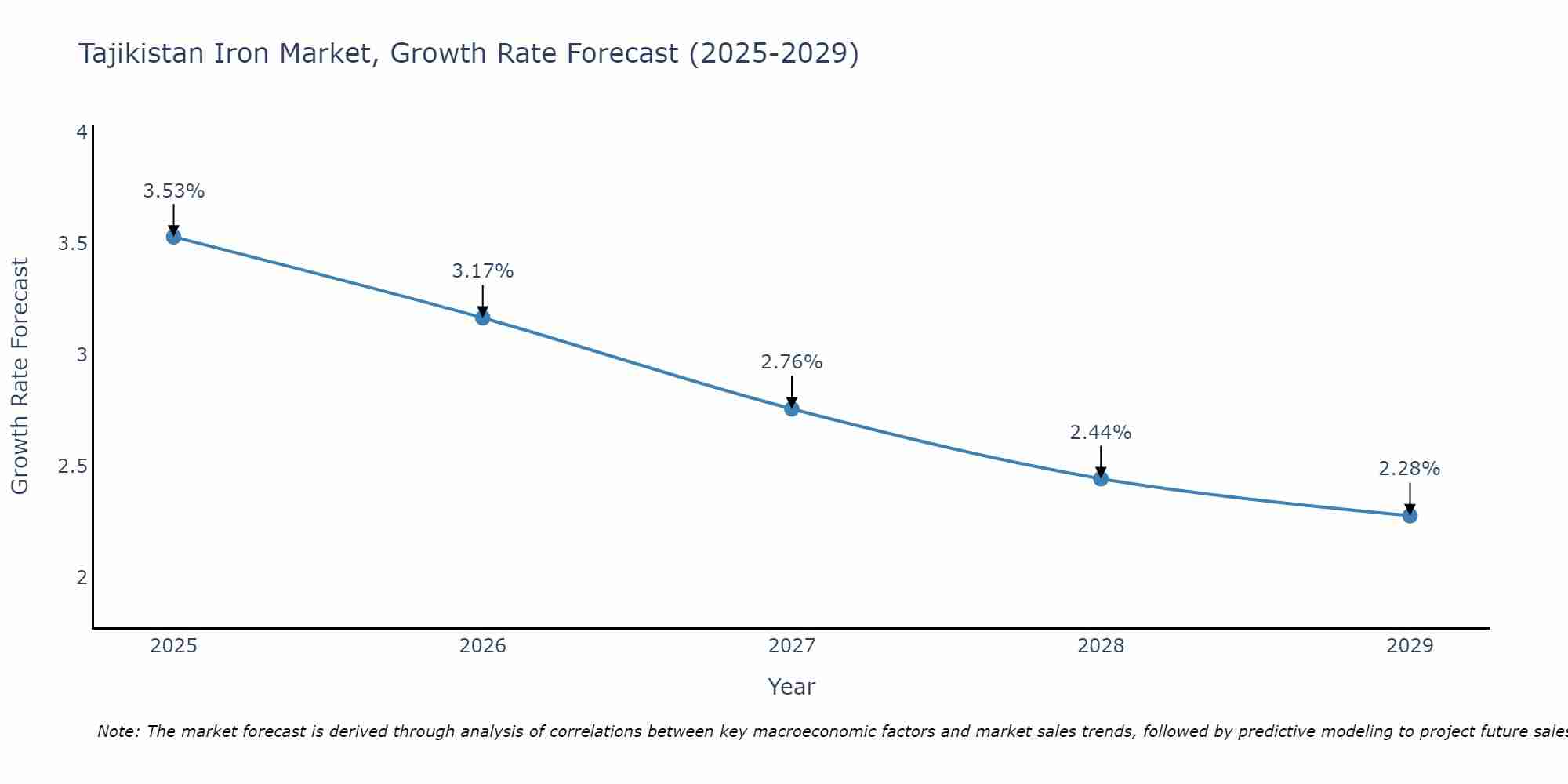
The Tajikistan Iron Market may undergo a gradual slowdown in growth rates between 2025 and 2029. Although the growth rate starts strong at 3.53% in 2025, it steadily loses momentum, ending at 2.28% by 2029.
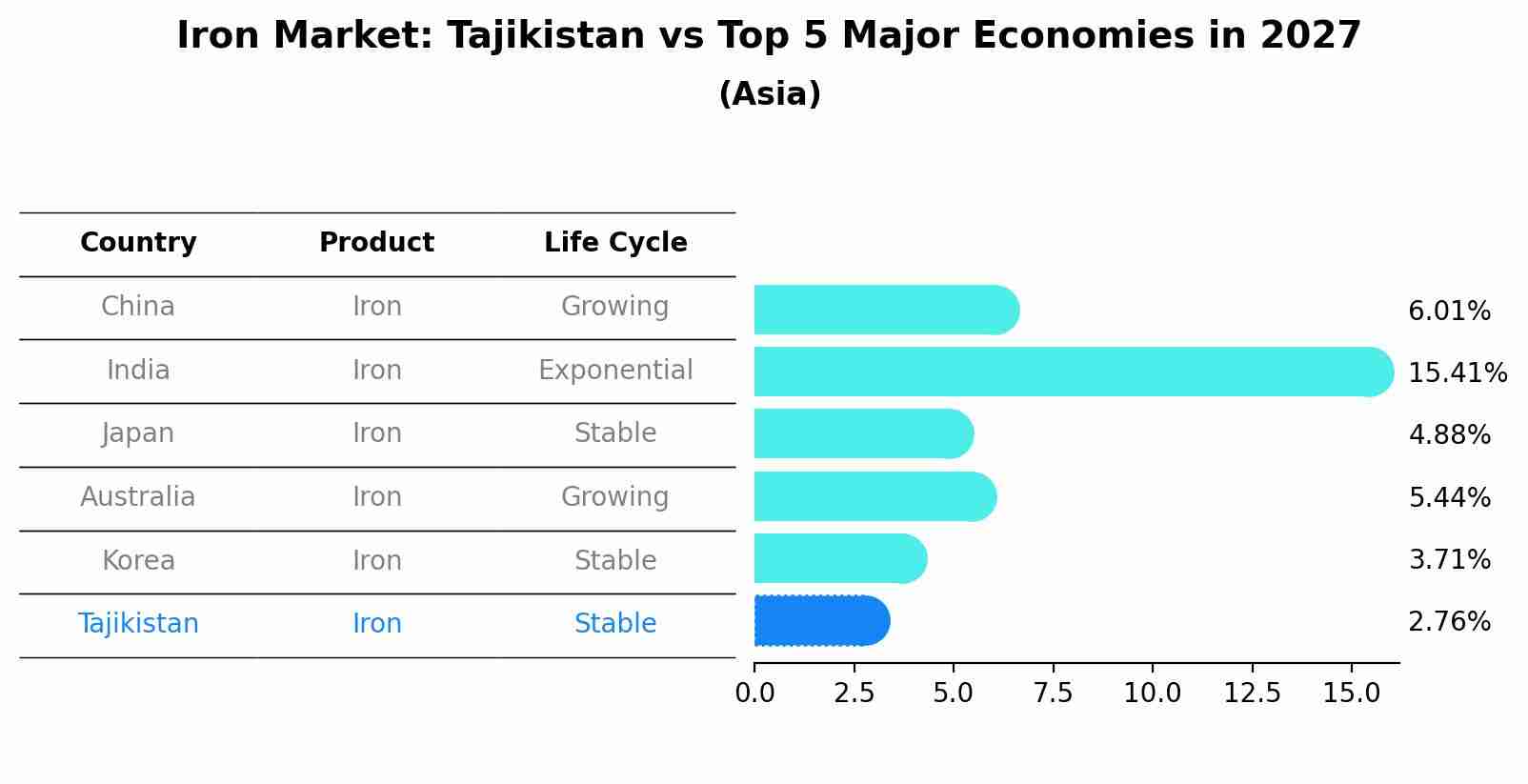
Iron Market: Tajikistan vs Top 5 Major Economies in 2027 (Asia)
In the Asia region, the Iron market in Tajikistan is projected to expand at a stable growth rate of 2.76% by 2027. The largest economy is China, followed by India, Japan, Australia and South Korea.
tajikistan iron market Synopsis
The iron market in Tajikistan is forecast to grow at a CAGR of 4.3% during the period 2020-2026. Increasing investments and rapid growth in infrastructure development are some of the factors driving demand for iron in Tajikistan. Moreover, increasing construction activities are further expected to boost global demand for iron products over the next few years. Furthermore, growing use of iron alloys and steel components across various industries is likely to contribute significantly towards revenue generation from this market during the forecast period. Additionally, rising urbanization rate along with shifting consumer preferences towards quality products are projected to fuel product sales which will have a positive impact on growth momentum in Tajikistan`s iron market over the next few years.
Key Highlights of the Report:
- Tajikistan Iron Market Outlook
- Market Size of Tajikistan Iron Market, 2019
- Forecast of Tajikistan Iron Market, 2026
- Historical Data and Forecast of Tajikistan Iron Revenues & Volume for the Period 2016 - 2026
- Tajikistan Iron Market Trend Evolution
- Tajikistan Iron Market Drivers and Challenges
- Tajikistan Iron Price Trends
- Tajikistan Iron Porter's Five Forces
- Tajikistan Iron Industry Life Cycle
- Historical Data and Forecast of Tajikistan Iron Market Revenues & Volume By Material Types for the Period 2016 - 2026
- Historical Data and Forecast of Tajikistan Iron Market Revenues & Volume By Pure Iron for the Period 2016 - 2026
- Historical Data and Forecast of Tajikistan Iron Market Revenues & Volume By Wrought Iron for the Period 2016 - 2026
- Historical Data and Forecast of Tajikistan Iron Market Revenues & Volume By Cast Iron for the Period 2016 - 2026
- Historical Data and Forecast of Tajikistan Iron Market Revenues & Volume By Pig Iron for the Period 2016 - 2026
- Historical Data and Forecast of Tajikistan Iron Market Revenues & Volume By Direct Reduced Iron for the Period 2016 - 2026
- Historical Data and Forecast of Tajikistan Iron Market Revenues & Volume By Applications for the Period 2016 - 2026
- Historical Data and Forecast of Tajikistan Iron Market Revenues & Volume By Building for the Period 2016 - 2026
- Historical Data and Forecast of Tajikistan Iron Market Revenues & Volume By Construction for the Period 2016 - 2026
- Historical Data and Forecast of Tajikistan Iron Market Revenues & Volume By Railways for the Period 2016 - 2026
- Historical Data and Forecast of Tajikistan Iron Market Revenues & Volume By Fertilizers for the Period 2016 - 2026
- Historical Data and Forecast of Tajikistan Iron Market Revenues & Volume By Industrial Uses for the Period 2016 - 2026
- Historical Data and Forecast of Tajikistan Iron Market Revenues & Volume By Others for the Period 2016 - 2026
- Tajikistan Iron Import Export Trade Statistics
- Market Opportunity Assessment By Material Types
- Market Opportunity Assessment By Applications
- Tajikistan Iron Top Companies Market Share
- Tajikistan Iron Competitive Benchmarking By Technical and Operational Parameters
- Tajikistan Iron Company Profiles
- Tajikistan Iron Key Strategic Recommendations






































