Tajikistan LED Professional Lighting Market Summary
The tajikistan led professional lighting market was estimated at USD 207 Million in 2025 and is projected to reach USD 272 Million by 2032, growing at a CAGR of 4.7% from 2026 to 2032.
Tajikistan LED Professional Lighting Market Year-wise Growth Rate and Key Drivers
This graph highlights how the Tajikistan LED Professional Lighting Market has steadily grown over the past five years, supported by major growth factors.
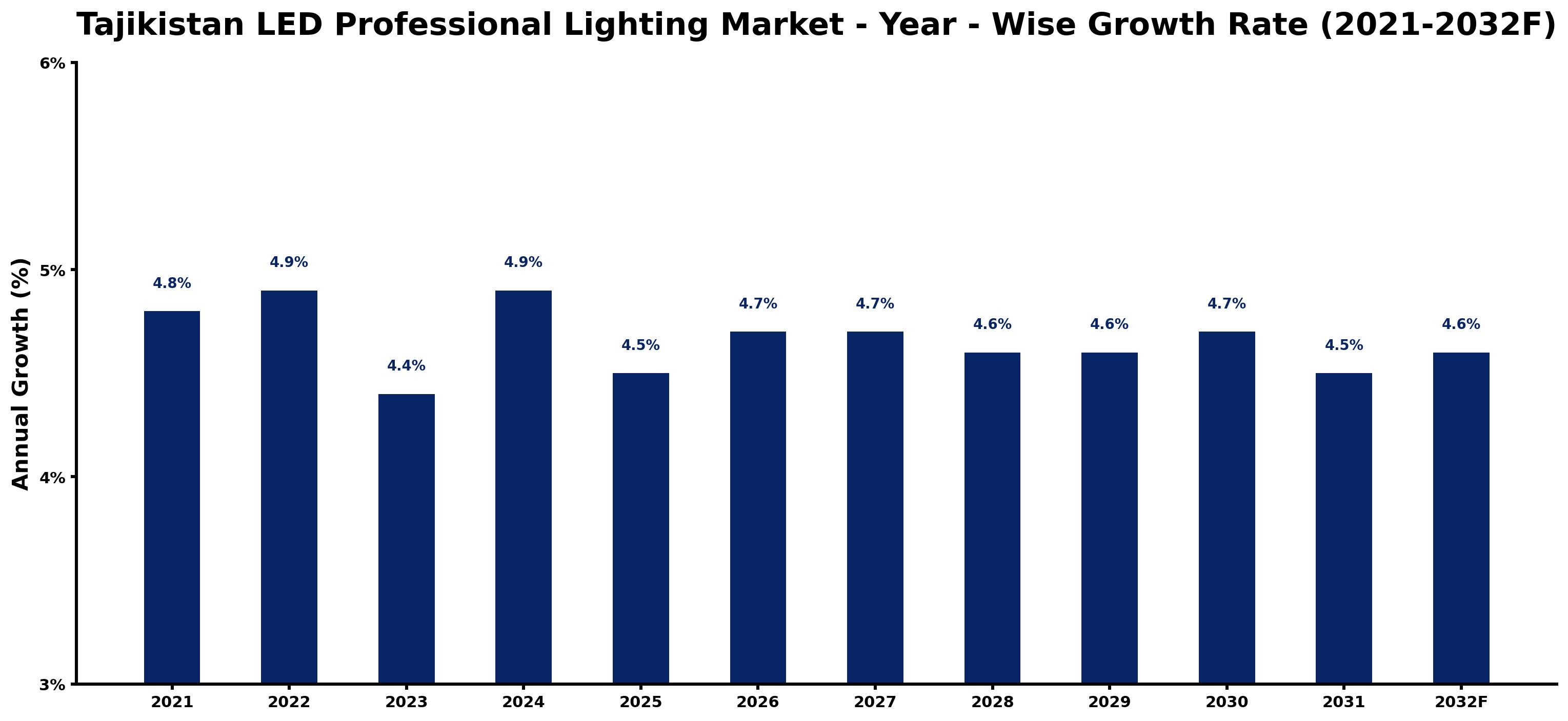
The table below presents the year wise growth rates along with the key drivers influencing the market
| Year | Growth Rate | Major Drivers |
| 2021 | 4.8% | Infrastructure projects initiated, paving the way for modern lighting solutions. |
| 2022 | 4.9% | Energy efficiency concerns push consumers towards LED lighting alternatives. |
| 2023 | 4.4% | Urban development trends create a surge in commercial lighting installations. |
| 2024 | 4.9% | Emerging technologies improve LED lifespan and reduce maintenance costs significantly. |
| 2025 | 4.5% | Investment in renewable energy enhances the appeal of efficient lighting systems. |
| 2026 | 4.7% | Public awareness campaigns highlight long-term benefits of LED lighting. |
| 2027 | 4.7% | Local manufacturing capabilities strengthen, reducing import dependency for fixtures. |
| 2028 | 4.6% | Smart city initiatives integrate advanced lighting systems into urban planning. |
| 2029 | 4.6% | Retail and hospitality sectors increasingly prioritize aesthetic lighting solutions. |
| 2030 | 4.7% | Collaborations between local businesses and international firms expand market reach. |
| 2031 | 4.5% | Environmental sustainability becomes a key consideration in lighting procurement. |
| 2032 | 4.6% | Technological innovations in smart controls optimize energy use and user experience. |
Note - Market size estimations and growth projections presented in this report are based on 6Wresearch's advanced forecasting approach, validated with industry datasets as of June 2026.
Tajikistan LED Professional Lighting Market Synopsis
The Tajikistan LED Professional Lighting Market is projected to reach 4.7% and witness significant growth during the forecast period (2026-2032). This growth trajectory can be attributed to various factors, including rapid urbanization, increasing infrastructure development, and a pronounced demand for energy-efficient lighting solutions across multiple sectors.
Tajikistan LED Professional Lighting Market Growth Drivers
Several key drivers are propelling the expansion of the Tajikistan LED Professional Lighting Market. First and foremost, the ongoing urbanization trend is replacing traditional lighting systems with modern LED solutions that offer superior energy efficiency. Moreover, infrastructure investment within urban and rural areas is fostering greater demand for advanced lighting solutions tailored for commercial buildings, public infrastructure, and industrial facilities.
- The growing emphasis on energy conservation and environmental sustainability is leading to an increase in the adoption of LED lighting technologies, which are recognized for their lower energy consumption and longer lifespan compared to conventional lighting solutions.
- Government initiatives promoting green building practices and energy-efficient technologies have created a favorable environment for the adoption of LED lighting systems, thus enhancing market prospects.
- With rising awareness among end users regarding the long-term cost savings associated with LED lighting, more businesses and public entities are transitioning to these high-performance lighting technologies.
- Technological advancements have paved the way for smart lighting solutions, which integrate automation and control features, making them increasingly appealing for both residential and commercial applications.
- Investment in tourism and hospitality sectors is also boosting demand for professional LED lighting, particularly in hotels and restaurants aiming for energy efficiency while enhancing aesthetic appeal.
Tajikistan LED Professional Lighting Market Challenges and Restraints
Despite the promising growth, the Tajikistan LED Professional Lighting Market faces several challenges that may hinder its progress. Chief among these is the initial capital investment required for the installation of advanced lighting systems, which can be daunting for smaller enterprises and local governments.
- The lack of comprehensive data regarding the benefits of LED technology among potential consumers can result in a slow adoption rate, as many remain hesitant to transition from traditional lighting methods.
- Supply chain constraints due to reliance on imported LED technologies may lead to increased costs and delays in implementation, particularly in remote areas where installation is logistically challenging.
- Limited access to financing options for small- and medium-sized enterprises may restrict their ability to invest in energy-efficient lighting systems, thus stalling overall market growth.
- Awareness and education initiatives regarding the benefits of LED professional lighting are still in their infancy, which may impact consumer readiness to switch from traditional solutions.
- Potential fluctuations in government policy concerning energy efficiency and sustainable development could impact market stability and investment confidence.
Tajikistan LED Professional Lighting Market Government Investment and Initiatives
The role of government investment and initiatives is pivotal in shaping the landscape of the Tajikistan LED Professional Lighting Market. Recent government policies emphasize the importance of energy efficiency and sustainable development, creating numerous incentives for adopting LED technologies.
- Public spending on infrastructure development projects has increased, with a focus on incorporating energy-efficient lighting solutions in urban planning and renovation projects.
- The government is actively promoting regulations that encourage the use of LED lighting in public spaces, which not only enhances safety but also demonstrates commitment to sustainability.
- Various initiatives aimed at raising awareness of the economic and environmental advantages of LED lighting are being implemented, targeting both commercial entities and residential consumers.
- Partnerships with international organizations have been established to facilitate knowledge transfer and access to innovative lighting solutions, thus accelerating the adoption of advanced technologies.
- Incentive programs that provide subsidies or tax breaks for businesses transitioning to energy-efficient lighting are being rolled out, further supporting the market growth and encouraging investment.
Tajikistan LED Professional Lighting Market Latest Developments (May 2025 - June 2026)
Between May 2025 and June 2026, significant developments have emerged within the Tajikistan LED Professional Lighting Market, reflecting the sector's dynamic evolution. The growing commitment to urban development has led to substantial infrastructure projects that incorporate advanced lighting technologies.
- Continued government emphasis on energy-efficient public infrastructure is fostering collaboration with local and international stakeholders, driving innovation in the lighting sector.
- Emerging trends in smart lighting solutions are gaining traction as municipalities look to enhance urban management through intelligent lighting systems that are responsive to environmental conditions.
- Awareness campaigns aimed at educating businesses and the public about the advantages of LED lighting technology have been launched, resulting in increased inquiries and installations.
- Investment in local capabilities for the assembly of LED lighting components is on the rise, contributing to job creation and reducing dependency on imports.
- The market has seen a gradual increase in the number of suppliers offering a wide range of LED products catering to various applications, thereby expanding consumer choice and promoting competition.
Tajikistan LED Professional Lighting Market - Key Attractiveness of the Report
- 10 Years of Market Numbers
- Historical Data Starting from 2022 to 2025
- Base Year: 2025
- Forecast Data until 2032
- Key Performance Indicators Impacting the Market
- Major Upcoming Developments and Projects
Key Highlights of the Report:
- Tajikistan LED Professional Lighting Market Outlook
- Market Size of Tajikistan LED Professional Lighting Market, 2025
- Forecast of Tajikistan LED Professional Lighting Market, 2032
- Historical Data and Forecast of Tajikistan LED Professional Lighting Revenues & Volume for the Period 2022-2032
- Tajikistan LED Professional Lighting Market Trend Evolution
- Tajikistan LED Professional Lighting Market Drivers and Challenges
- Tajikistan LED Professional Lighting Price Trends
- Tajikistan LED Professional Lighting Porter's Five Forces
- Tajikistan LED Professional Lighting Industry Life Cycle
- Historical Data and Forecast of Tajikistan LED Professional Lighting Market Revenues & Volume By Product Type for the Period 2022-2032
- Historical Data and Forecast of Tajikistan LED Professional Lighting Market Revenues & Volume By LED Bulbs for the Period 2022-2032
- Historical Data and Forecast of Tajikistan LED Professional Lighting Market Revenues & Volume By LED Fixtures for the Period 2022-2032
- Historical Data and Forecast of Tajikistan LED Professional Lighting Market Revenues & Volume By Bare LED Tubes for the Period 2022-2032
- Historical Data and Forecast of Tajikistan LED Professional Lighting Market Revenues & Volume By LED Down lights for the Period 2022-2032
- Historical Data and Forecast of Tajikistan LED Professional Lighting Market Revenues & Volume By Applications for the Period 2022-2032
- Historical Data and Forecast of Tajikistan LED Professional Lighting Market Revenues & Volume By Indoor for the Period 2022-2032
- Historical Data and Forecast of Tajikistan LED Professional Lighting Market Revenues & Volume By Outdoor for the Period 2022-2032
- Historical Data and Forecast of Tajikistan LED Professional Lighting Market Revenues & Volume By Automotive for the Period 2022-2032
- Historical Data and Forecast of Tajikistan LED Professional Lighting Market Revenues & Volume By Backlighting for the Period 2022-2032
- Tajikistan LED Professional Lighting Import Export Trade Statistics
- Market Opportunity Assessment By Product Type
- Market Opportunity Assessment By Applications
- Tajikistan LED Professional Lighting Top Companies Market Share
- Tajikistan LED Professional Lighting Competitive Benchmarking By Technical and Operational Parameters
- Tajikistan LED Professional Lighting Company Profiles
- Tajikistan LED Professional Lighting Key Strategic Recommendations
Market Covered
This report offers a comprehensive study of the subsequent market segments:
By Product Type
- LED Bulbs
- LED Fixtures
- Bare LED Tubes
- LED Down lights
By Applications
- Indoor, Outdoor
- Automotive
- Backlighting






































