Tajikistan Linen Yarn Market Size, Share & Growth Rate
The Tajikistan Linen Yarn Market was estimated at USD 358 Million in 2025 and is projected to reach USD 479 Million by 2032, growing at a CAGR of 4.2% from 2026 to 2032. This growth trajectory is primarily driven by a surge in demand for sustainable textiles, as local producers enhance their offerings to align with global consumer preferences. Additionally, the increasing focus on high-quality materials in apparel and home furnishing sectors contributes significantly to the market's expansion.
Tajikistan Linen Yarn Market Year-wise Growth Rate and Key Drivers
This graph highlights how the Tajikistan Linen Yarn Market has steadily grown over the years, supported by major growth factors.
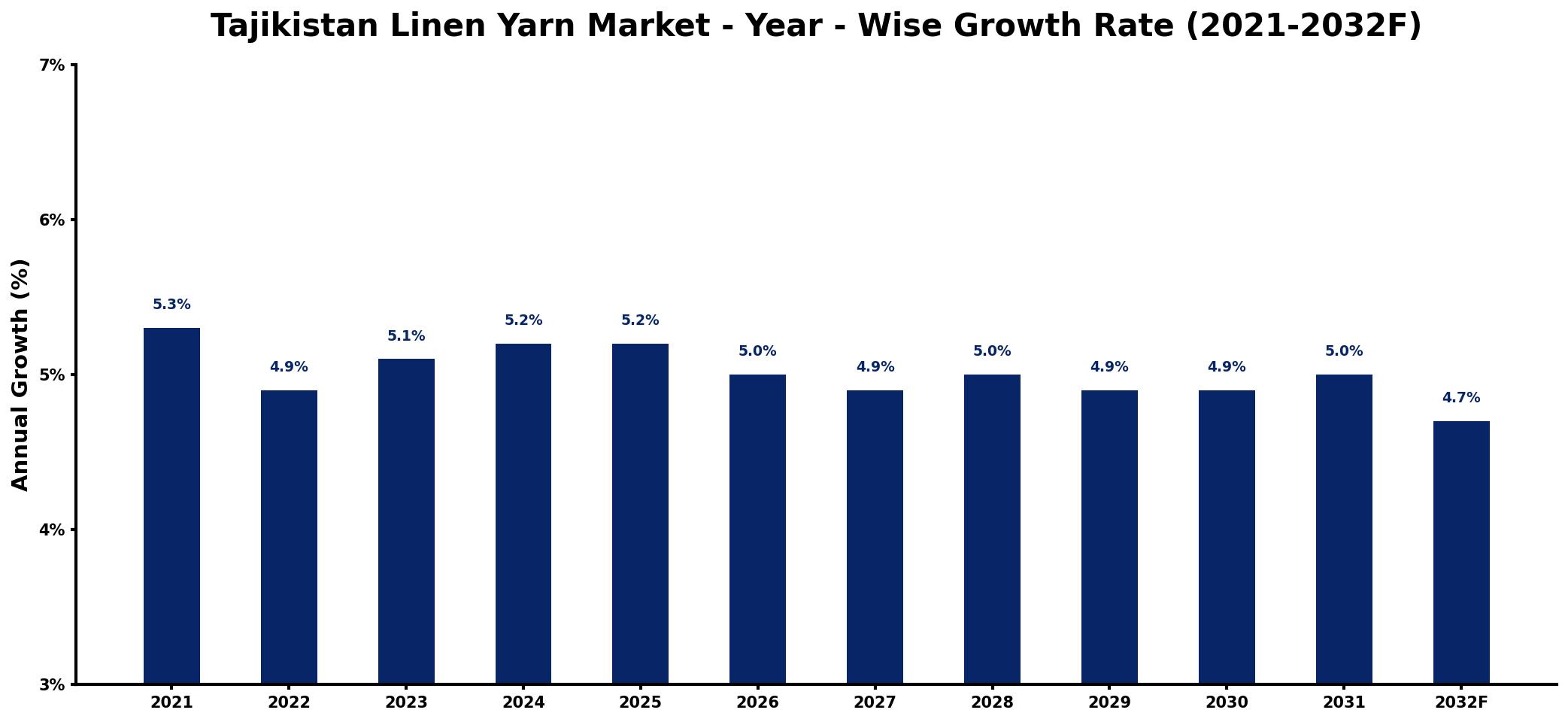
The table below presents the year‑wise growth rates along with the key drivers influencing the market
| Year | Growth Rate | Major Drivers |
| 2021 | 5.3% | Rising textile manufacturing investments |
| 2022 | 4.9% | Increased consumer fashion awareness |
| 2023 | 5.1% | Growing home textiles demand |
| 2024 | 5.2% | Expansion of sustainable practices |
| 2025 | 5.2% | Boost in export opportunities |
| 2026 | 5.0% | Emergence of eco-friendly alternatives |
| 2027 | 4.9% | Strengthened local production capacities |
| 2028 | 5.0% | Diversification of textile applications |
| 2029 | 4.9% | Enhanced supply chain efficiencies |
| 2030 | 4.9% | Growth in retail sector offerings |
| 2031 | 5.0% | Innovation in textile technologies |
| 2032 | 4.7% | Development of niche markets |
Note: Market size estimations and growth projections presented in this report are based on 6Wresearch's proprietary forecasting methodology, utilizing the latest available industry data, government publications, and primary research inputs.
Tajikistan Linen Yarn Market Synopsis
The strongest force currently shaping the Tajikistan Linen Yarn Market is the shift towards natural and eco-friendly fibers. As consumers become more environmentally conscious, the demand for linen yarn—a sustainable option—continues to rise across various applications.
Furthermore, the modernization of Tajikistan's textile manufacturing sector is enhancing production capabilities, driving innovation, and improving the overall quality of linen yarn. This modernization not only supports domestic needs but also positions the country favorably in international markets.
Tajikistan Linen Yarn Market Key Takeaways
- The market is driven by an increasing preference for eco-friendly and sustainable fibers.
- Local producers are investing in quality improvement and product variety to meet consumer demands.
- Government policies support the growth of the linen yarn sector through incentives and regulatory enhancements.
- Global trends toward natural textiles present significant opportunities for domestic manufacturers.
- Challenges such as infrastructure constraints and competition from established markets must be addressed for continued growth.
Evaluation of Restraints in Tajikistan Linen Yarn Market
While the Tajikistan Linen Yarn Market shows promising growth potential, it faces significant restraints that may hinder its progress. A major limitation is the lack of access to modern machinery and advanced technology for linen production. This deficiency affects both the efficiency and quality of the yarn produced. Additionally, inadequate infrastructure for transportation and logistics complicates distribution, resulting in delays and increased costs for producers. Fluctuating prices of raw materials, particularly flax, further complicate profitability and may restrict operational scalability. Addressing these constraints through targeted investments and strategic improvements will be essential to harness the market's full potential.
Tajikistan Linen Yarn Market Trends
Current trends in the Tajikistan Linen Yarn Market reveal a growing consumer appetite for high-quality linen products. There is an observable shift towards innovative blends, where linen is combined with other natural fibers to create textiles that enhance performance and offer unique textures. The local textile industry is increasingly focusing on sustainability, fostering a demand for locally sourced materials that cater to both domestic and global audiences.
Tajikistan Linen Yarn Market Opportunities
Investment opportunities within the Tajikistan Linen Yarn Market are expanding. The country has a rich historical backdrop in linen production, and with growing global interest in sustainable textiles, there is significant potential for growth. By leveraging the availability of raw materials and a skilled workforce, investors can enter a relatively undeveloped market with promising returns. Innovations in product offerings and production methods could further attract investment, particularly in response to the rising trend of biodegradable materials.
Government Initiatives in the Tajikistan Linen Yarn Market
The Tajikistan government is actively supporting the linen yarn market through a series of initiatives aimed at boosting domestic production and enhancing export competitiveness. These policies include providing subsidies and incentives to local producers, simplifying regulatory processes, and promoting sustainable practices in the textile sector. Such efforts not only aim to stimulate economic growth but also to position Tajikistan as a significant player in the global linen industry.
Future Insights of the Tajikistan Linen Yarn Market
Looking ahead to 2026-2032, the Tajikistan Linen Yarn Market is projected to continue its positive momentum. The increasing global demand for eco-friendly materials will further cement linen's position as a preferred choice among consumers. As awareness grows regarding the negative environmental impact of synthetic fibers, the inclination towards natural alternatives is set to amplify. With continued government support and investment in infrastructure improvements, the market is likely to experience robust growth, despite some existing challenges.
Tajikistan Linen Yarn Market Latest Developments (2025 - 2026)
Recent developments in the Tajikistan Linen Yarn Market indicate a strong push towards innovation and sustainability. Local manufacturers are increasingly investing in advanced technologies and processes to enhance production efficiency and product quality. Furthermore, there is a notable rise in collaborative initiatives aimed at promoting the benefits of linen as a sustainable textile, both in domestic and international markets. As these trends continue to evolve, the industry is positioned for a transformative period ahead.
Tajikistan Linen Yarn Market - Key Attractiveness of the Report
- 10 Years of Market Numbers
- Historical Data Starting from 2022 to 2025
- Base Year: 2025
- Forecast Data until 2032
- Key Performance Indicators Impacting the Market
- Major Upcoming Developments and Projects
Key Highlights of the Report:
- Tajikistan Linen Yarn Market Outlook
- Market Size of Tajikistan Linen Yarn Market, 2025
- Forecast of Tajikistan Linen Yarn Market, 2032
- Historical Data and Forecast of Tajikistan Linen Yarn Revenues & Volume for the Period 2022-2032F
- Tajikistan Linen Yarn Market Trend Evolution
- Tajikistan Linen Yarn Market Drivers and Challenges
- Tajikistan Linen Yarn Price Trends
- Tajikistan Linen Yarn Porter's Five Forces
- Tajikistan Linen Yarn Industry Life Cycle
- Historical Data and Forecast of Tajikistan Linen Yarn Market Revenues & Volume By Products for the Period 2022-2032F
- Historical Data and Forecast of Tajikistan Linen Yarn Market Revenues & Volume By Dry spun yarn for the Period 2022-2032F
- Historical Data and Forecast of Tajikistan Linen Yarn Market Revenues & Volume By Wet spun yarn for the Period 2022-2032F
- Historical Data and Forecast of Tajikistan Linen Yarn Market Revenues & Volume By Blended yarn for the Period 2022-2032F
- Historical Data and Forecast of Tajikistan Linen Yarn Market Revenues & Volume By Applications for the Period 2022-2032F
- Historical Data and Forecast of Tajikistan Linen Yarn Market Revenues & Volume By Clothings for the Period 2022-2032F
- Historical Data and Forecast of Tajikistan Linen Yarn Market Revenues & Volume By Beddings for the Period 2022-2032F
- Historical Data and Forecast of Tajikistan Linen Yarn Market Revenues & Volume By Others for the Period 2022-2032F
- Tajikistan Linen Yarn Import Export Trade Statistics
- Market Opportunity Assessment By Products
- Market Opportunity Assessment By Applications
- Tajikistan Linen Yarn Top Companies Market Share
- Tajikistan Linen Yarn Competitive Benchmarking By Technical and Operational Parameters
- Tajikistan Linen Yarn Company Profiles
- Tajikistan Linen Yarn Key Strategic Recommendations






































