Tajikistan Military Laser Rangefinder Market Size, Share & Growth Rate
The Tajikistan Military Laser Rangefinder Market was estimated at USD 402 Million in 2025 and is projected to reach USD 556 Million by 2032, growing at a CAGR of 4.7% from 2026 to 2032. This growth trajectory is fueled by the Tajikistan Armed Forces' increasing investments in modernizing their technological capabilities and the urgent need for improved targeting accuracy in military operations. Furthermore, geopolitical dynamics in Central Asia are pushing for advanced military technologies, which further bolsters market potential.
Tajikistan Military Laser Rangefinder Market Year-wise Growth Rate and Key Drivers
This graph highlights how the Tajikistan Military Laser Rangefinder Market has steadily grown over the years, supported by major growth factors.
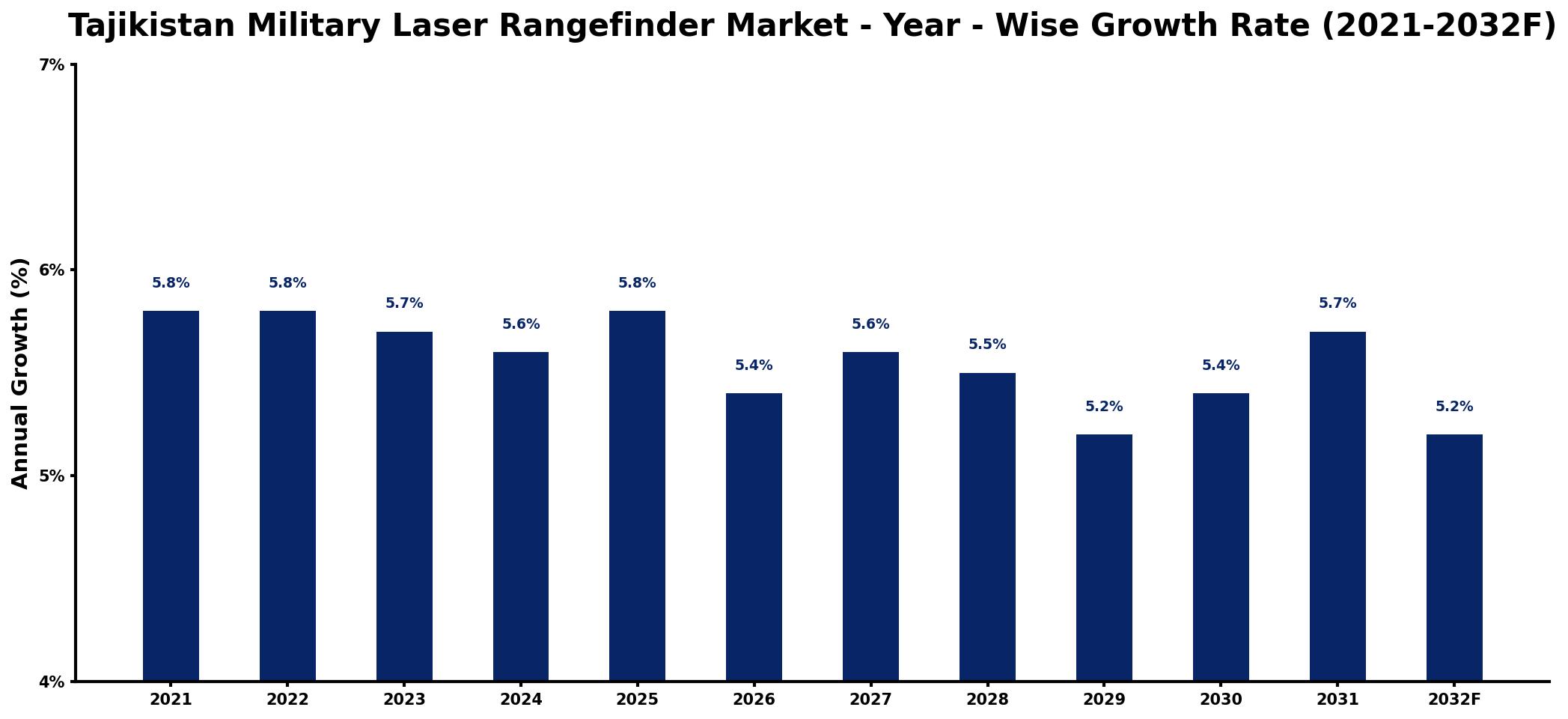
The table below presents the year‑wise growth rates along with the key drivers influencing the market
| Year | Growth Rate | Major Drivers |
| 2021 | 5.8% | increased defense spending initiatives |
| 2022 | 5.8% | growing demand for precision equipment |
| 2023 | 5.7% | expansion of technological advancements |
| 2024 | 5.6% | rising investments in defense technologies |
| 2025 | 5.8% | enhanced training programs for personnel |
| 2026 | 5.4% | increased collaboration with foreign partners |
| 2027 | 5.6% | development of advanced surveillance systems |
| 2028 | 5.5% | growing focus on border security |
| 2029 | 5.2% | increased procurement from local manufacturers |
| 2030 | 5.4% | expanding industrial usage applications |
| 2031 | 5.7% | growing interest in tactical solutions |
| 2032 | 5.2% | increased emphasis on operational efficiency |
Note: Market size estimations and growth projections presented in this report are based on 6Wresearch's proprietary forecasting methodology, utilizing the latest available industry data, government publications, and primary research inputs.
Tajikistan Military Laser Rangefinder Market Synopsis
The Tajikistan Military Laser Rangefinder Market has experienced notable momentum driven by an urgent demand for precision targeting systems. Currently, the market is entering a phase of sustained growth as the government prioritizes modernization initiatives within the armed forces to enhance operational effectiveness and combat readiness.
Looking forward, the market is poised for expansion, with increasing adoption of advanced laser rangefinders for applications such as artillery control, reconnaissance, and target acquisition. This aligns with the broader regional security challenges that necessitate state-of-the-art military solutions.
Tajikistan Military Laser Rangefinder Market Key Takeaways
- Growing demand for precision targeting systems is driving market growth.
- Integration of laser rangefinders with other military technologies enhances operational capabilities.
- Investment opportunities exist in manufacturing and supplying cutting-edge rangefinders.
- Regional security dynamics are pushing military modernization efforts in Tajikistan.
- Challenges like limited defense budgets could influence procurement decisions.
Evaluation of Restraints in Tajikistan Military Laser Rangefinder Market
Despite the promising prospects, the Tajikistan Military Laser Rangefinder Market faces critical constraints, primarily due to budget limitations in defense spending. These restrictions can hinder the acquisition of advanced laser rangefinder systems, which are essential for maintaining operational effectiveness. Additionally, a heavy reliance on imported technologies complicates the supply chain and can introduce vulnerabilities, particularly in times of geopolitical tension. Ensuring alignment with existing military systems and high-quality standards also poses significant challenges that need to be addressed by manufacturers and suppliers.
Tajikistan Military Laser Rangefinder Market Trends
Current trends highlight a significant shift towards the development of more compact and lightweight laser rangefinders, facilitating easier transportation and deployment in various operational scenarios. The integration of advanced optics, such as binoculars and scopes, with rangefinders is becoming increasingly prevalent, enhancing the capabilities of military personnel during missions. Moreover, there is an intensified focus on improving the accuracy and range of these systems to meet the evolving demands of the Tajikistan Armed Forces.
Tajikistan Military Laser Rangefinder Market Opportunities
The market presents lucrative investment opportunities, particularly for manufacturers looking to establish a presence in Tajikistan's defense sector. Collaborations with local defense contractors can pave the way for joint manufacturing ventures, significantly benefiting from lower operational costs. There is also a growing demand for maintenance and support services related to laser rangefinder systems, creating avenues for service-oriented companies. This relatively untapped market is attractive for investors who can navigate local procurement processes and regulations.
Government Initiatives in the Tajikistan Military Laser Rangefinder Market
While specific policies targeting the Military Laser Rangefinder Market have not been enacted, the overall regulatory framework for defense procurement is governed by the Ministry of Defense and the State Committee for National Security. These authorities oversee military equipment acquisitions, emphasizing the need for transparency and compliance with international trade agreements. The government's ongoing commitment to modernizing the military infrastructure is indicative of its strategic priorities and opens pathways for international partnerships in the procurement of advanced technologies.
Future Insights of the Tajikistan Military Laser Rangefinder Market
Looking ahead to 2026-2032, the Tajikistan Military Laser Rangefinder Market is set to experience continuous growth driven by technological advancements and a heightened emphasis on military effectiveness. The integration of laser rangefinders with other military systems will likely be a significant focus area, enhancing overall capabilities. As the Tajikistan Armed Forces further modernize, international collaborations and technology transfers will play a crucial role in shaping the market landscape, positioning it for a dynamic future.
Tajikistan Military Laser Rangefinder Market Latest Developments (2025 - 2026)
Recent developments in the Tajikistan Military Laser Rangefinder Market suggest a shift towards more innovative and integrated solutions. Manufacturers are focusing on enhancing product features to meet the specific demands of military operations. There has been an increased interest in partnerships between local entities and international suppliers, highlighting a trend towards collaborative efforts in upgrading military capabilities. Moreover, procurement processes are evolving, with a notable emphasis on quality assurance and technology integration, reflecting the armed forces' commitment to operational excellence.
Tajikistan Military Laser Rangefinder Market - Key Attractiveness of the Report
- 10 Years of Market Numbers
- Historical Data Starting from 2022 to 2025
- Base Year: 2025
- Forecast Data until 2032
- Key Performance Indicators Impacting the Market
- Major Upcoming Developments and Projects
Key Highlights of the Report:
- Tajikistan Military Laser Rangefinder Market Outlook
- Market Size of Tajikistan Military Laser Rangefinder Market, 2025
- Forecast of Tajikistan Military Laser Rangefinder Market, 2032
- Historical Data and Forecast of Tajikistan Military Laser Rangefinder Revenues & Volume for the Period 2022-2032F
- Tajikistan Military Laser Rangefinder Market Trend Evolution
- Tajikistan Military Laser Rangefinder Market Drivers and Challenges
- Tajikistan Military Laser Rangefinder Price Trends
- Tajikistan Military Laser Rangefinder Porter's Five Forces
- Tajikistan Military Laser Rangefinder Industry Life Cycle
- Historical Data and Forecast of Tajikistan Military Laser Rangefinder Market Revenues & Volume By Type for the Period 2022-2032F
- Historical Data and Forecast of Tajikistan Military Laser Rangefinder Market Revenues & Volume By Man-Portable for the Period 2022-2032F
- Historical Data and Forecast of Tajikistan Military Laser Rangefinder Market Revenues & Volume By Vehicle-Mounted for the Period 2022-2032F
- Historical Data and Forecast of Tajikistan Military Laser Rangefinder Market Revenues & Volume By Application for the Period 2022-2032F
- Historical Data and Forecast of Tajikistan Military Laser Rangefinder Market Revenues & Volume By Weapon Guidance for the Period 2022-2032F
- Historical Data and Forecast of Tajikistan Military Laser Rangefinder Market Revenues & Volume By Detection for the Period 2022-2032F
- Tajikistan Military Laser Rangefinder Import Export Trade Statistics
- Market Opportunity Assessment By Type
- Market Opportunity Assessment By Application
- Tajikistan Military Laser Rangefinder Top Companies Market Share
- Tajikistan Military Laser Rangefinder Competitive Benchmarking By Technical and Operational Parameters
- Tajikistan Military Laser Rangefinder Company Profiles
- Tajikistan Military Laser Rangefinder Key Strategic Recommendations






































