Tajikistan Nail Polish Market Size, Share & Growth Rate
The Tajikistan Nail Polish Market was estimated at USD 703 Million in 2025 and is projected to reach USD 1159 Million by 2032, growing at a CAGR of 7.4% from 2026 to 2032. This growth trajectory is primarily fueled by an increasing interest in personal grooming and beauty practices among the Tajik population. Furthermore, the rise of beauty salons and nail care services in urban areas, along with a greater influence from social media and beauty influencers, is reshaping consumer preferences and driving demand for nail polish products.
Tajikistan Nail Polish Market Year-wise Growth Rate and Key Drivers
This graph highlights how the Tajikistan Nail Polish Market has steadily grown over the years, supported by major growth factors.
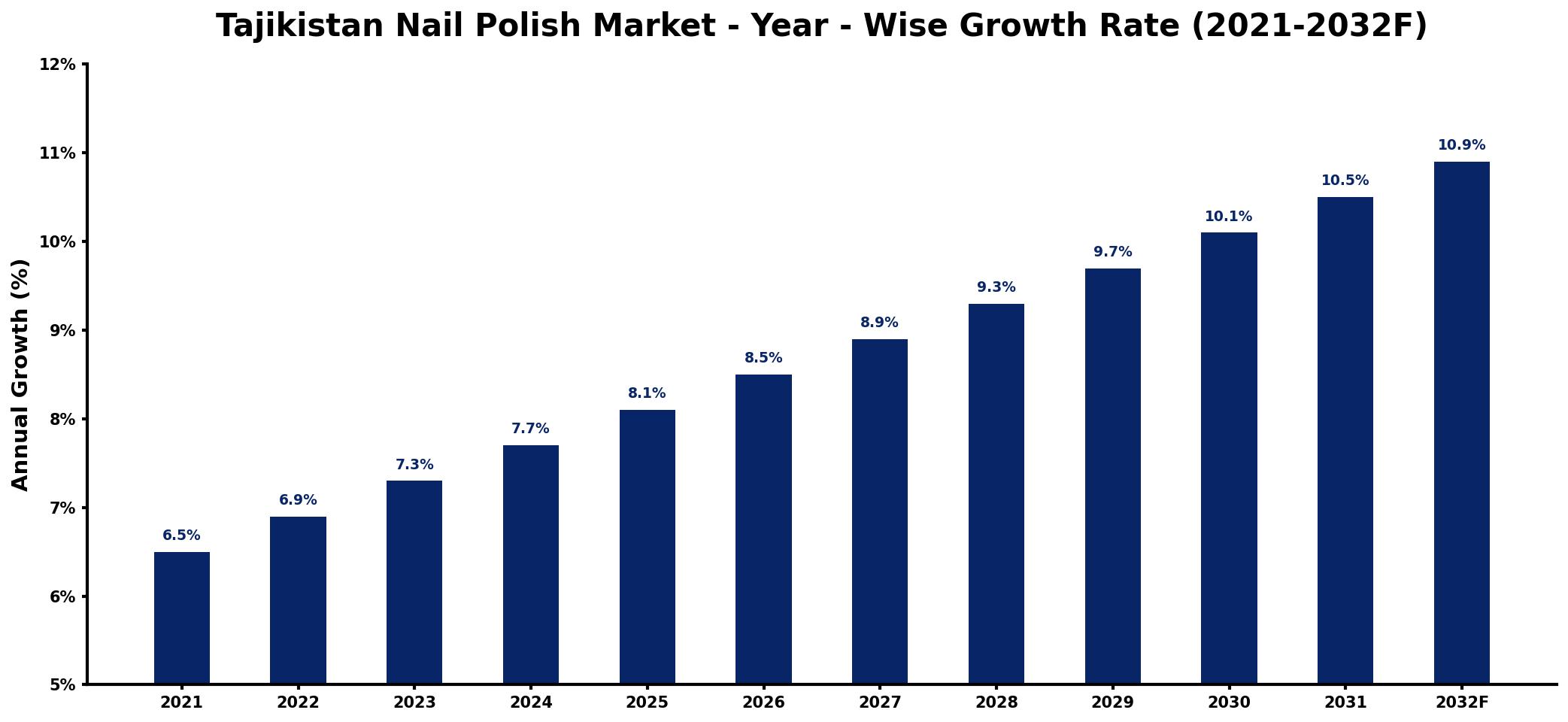
The table below presents the year‑wise growth rates along with the key drivers influencing the market
| Year | Growth Rate | Major Drivers |
| 2021 | 6.5% | Rising consumer beauty awareness |
| 2022 | 6.9% | Increased social media influence |
| 2023 | 7.3% | Growth in e-commerce platforms |
| 2024 | 7.7% | Expansion of retail distribution |
| 2025 | 8.1% | Emergence of new brands |
| 2026 | 8.5% | Surge in beauty events |
| 2027 | 8.9% | Innovations in product formulations |
| 2028 | 9.3% | Growing demand for sustainability |
| 2029 | 9.7% | Increase in disposable income |
| 2030 | 10.1% | Development of premium segments |
| 2031 | 10.5% | Strengthening of influencer marketing |
| 2032 | 10.9% | Diversification of product offerings |
Note: Market size estimations and growth projections presented in this report are based on 6Wresearch's proprietary forecasting methodology, utilizing the latest available industry data, government publications, and primary research inputs.
Tajikistan Nail Polish Market Synopsis
In Tajikistan, the nail polish market is characterized by a vibrant mix of local and international brands, each striving to meet diverse consumer needs. The growing number of beauty salons, especially in urban regions, significantly boosts the accessibility and popularity of nail polish among various demographic groups.
As consumers become more aware of beauty trends and product offerings, they are increasingly gravitating towards options that reflect their individuality. This shift in consumer behavior, driven by social media exposure and beauty trends, is leading to an expanded market for innovative nail care solutions.
Tajikistan Nail Polish Market Key Takeaways
- The nail polish market in Tajikistan is expanding, with a growing emphasis on personal grooming.
- Eco-friendly and cruelty-free nail polish products are becoming increasingly popular among consumers.
- Social media influencers play a pivotal role in shaping nail polish trends and consumer choices.
- Strategic marketing and product innovation are essential for brands aiming to thrive in this competitive landscape.
- Collaboration with local beauty salons presents a promising channel for distribution and brand promotion.
Evaluation of Restraints in Tajikistan Nail Polish Market
Despite the market's positive outlook, certain factors hinder its growth potential. Limited consumer awareness regarding product varieties and benefits hampers market penetration. Furthermore, the economic landscape presents challenges with relatively low purchasing power among the general population. Import restrictions may also affect the availability of high-quality products, while conservative cultural norms can stifle broader acceptance of nail polish as a staple beauty product. These constraints necessitate tailored marketing strategies to effectively engage consumers and foster market expansion.
Tajikistan Nail Polish Market Trends
The Tajikistan nail polish market is witnessing notable trends reflecting global shifts towards sustainability. A rising awareness of health and environmental impacts is leading consumers to seek out non-toxic and eco-friendly nail polish options. Additionally, demand for a diverse palette of colors and finishes is surging, as younger consumers experiment with nail art and intricate designs inspired by social media trends. This evolution is prompting brands to innovate in formulations and marketing strategies to cater to changing consumer preferences.
Tajikistan Nail Polish Market Opportunities
The potential for growth in the Tajikistan Nail Polish Market is robust, driven by increasing consumer interest in beauty and grooming products. Investors have the opportunity to introduce unique nail polish formulations and captivating packaging to capture consumer attention. Moreover, forming partnerships with local beauty salons and retailers can enhance brand visibility and facilitate effective distribution channels. As consumers continue to embrace beauty trends, brands that focus on marketing and education initiatives will be well-positioned to gain a competitive advantage.
Government Initiatives in the Tajikistan Nail Polish Market
The Tajik government has implemented regulations aimed at ensuring product safety and quality in the nail polish market. These regulations include health and safety standards that restrict harmful ingredients and enforce proper labeling. Additionally, the government actively monitors import activities to safeguard against substandard products entering the market. Tariffs and taxes may also be applied to protect local manufacturers, ensuring a balanced competitive environment while fostering domestic production.
Future Insights of the Tajikistan Nail Polish Market
Looking ahead to 2026-2032, the Tajikistan Nail Polish Market is poised for significant growth. As the economic climate improves and disposable incomes rise, consumers are expected to allocate more funds toward beauty products, including nail polish. The influence of social media will likely continue to shape consumer preferences, leading to increased demand for innovative and trendy products. Furthermore, the focus on sustainability will prompt brands to develop eco-friendly options, thus appealing to a broader audience concerned with ethical consumption.
Tajikistan Nail Polish Market Latest Developments (2025 - 2026)
In recent months, the Tajikistan nail polish market has seen a shift towards more innovative product offerings, with several brands launching lines that emphasize eco-friendliness and unique formulations. Beauty salons have also begun hosting workshops and promotional events to engage consumers and showcase the latest trends. Social media campaigns are playing an essential role in this new direction, as influencers increasingly promote nail care products, thereby expanding market reach and consumer engagement.
Tajikistan Nail Polish Market - Key Attractiveness of the Report
- 10 Years of Market Numbers
- Historical Data Starting from 2022 to 2025
- Base Year: 2025
- Forecast Data until 2032
- Key Performance Indicators Impacting the Market
- Major Upcoming Developments and Projects
Key Highlights of the Report:
- Tajikistan Nail Polish Market Outlook
- Market Size of Tajikistan Nail Polish Market, 2025
- Forecast of Tajikistan Nail Polish Market, 2032
- Historical Data and Forecast of Tajikistan Nail Polish Revenues & Volume for the Period 2022-2032F
- Tajikistan Nail Polish Market Trend Evolution
- Tajikistan Nail Polish Market Drivers and Challenges
- Tajikistan Nail Polish Price Trends
- Tajikistan Nail Polish Porter's Five Forces
- Tajikistan Nail Polish Industry Life Cycle
- Historical Data and Forecast of Tajikistan Nail Polish Market Revenues & Volume By Product for the Period 2022-2032F
- Historical Data and Forecast of Tajikistan Nail Polish Market Revenues & Volume By Regular Nail Polish for the Period 2022-2032F
- Historical Data and Forecast of Tajikistan Nail Polish Market Revenues & Volume By Gel Nail Polish for the Period 2022-2032F
- Historical Data and Forecast of Tajikistan Nail Polish Market Revenues & Volume By Others for the Period 2022-2032F
- Historical Data and Forecast of Tajikistan Nail Polish Market Revenues & Volume By Distribution Channel for the Period 2022-2032F
- Historical Data and Forecast of Tajikistan Nail Polish Market Revenues & Volume By Hypermarkets & Supermarkets for the Period 2022-2032F
- Historical Data and Forecast of Tajikistan Nail Polish Market Revenues & Volume By Specialty Stores for the Period 2022-2032F
- Historical Data and Forecast of Tajikistan Nail Polish Market Revenues & Volume By E-commerce for the Period 2022-2032F
- Historical Data and Forecast of Tajikistan Nail Polish Market Revenues & Volume By Others for the Period 2022-2032F
- Tajikistan Nail Polish Import Export Trade Statistics
- Market Opportunity Assessment By Product
- Market Opportunity Assessment By Distribution Channel
- Tajikistan Nail Polish Top Companies Market Share
- Tajikistan Nail Polish Competitive Benchmarking By Technical and Operational Parameters
- Tajikistan Nail Polish Company Profiles
- Tajikistan Nail Polish Key Strategic Recommendations






































