Tajikistan Office Chair Market Size Growth Rate
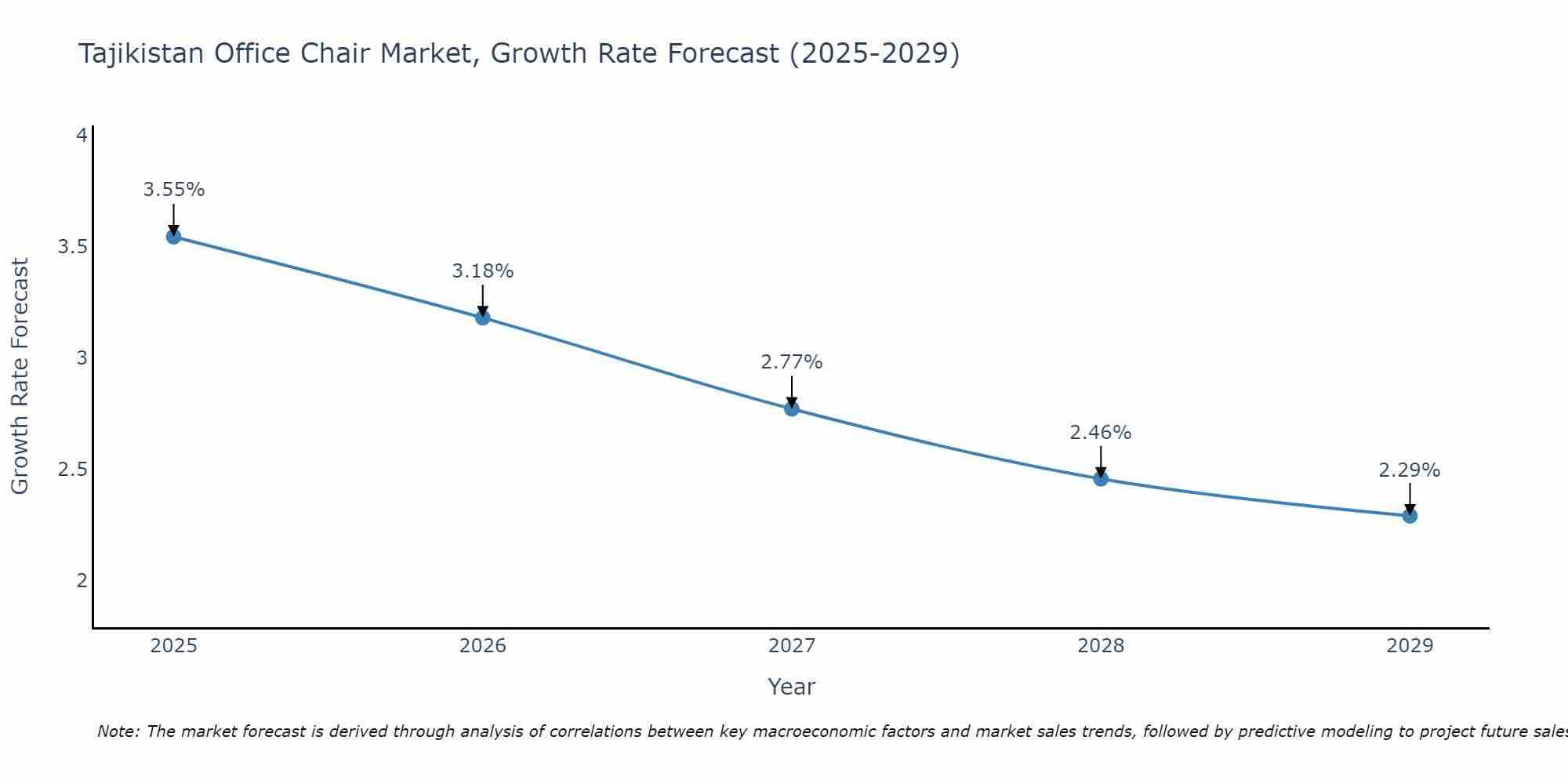
The Tajikistan Office Chair Market could see a tapering of growth rates over 2025 to 2029. Although the growth rate starts strong at 3.55% in 2025, it steadily loses momentum, ending at 2.29% by 2029.
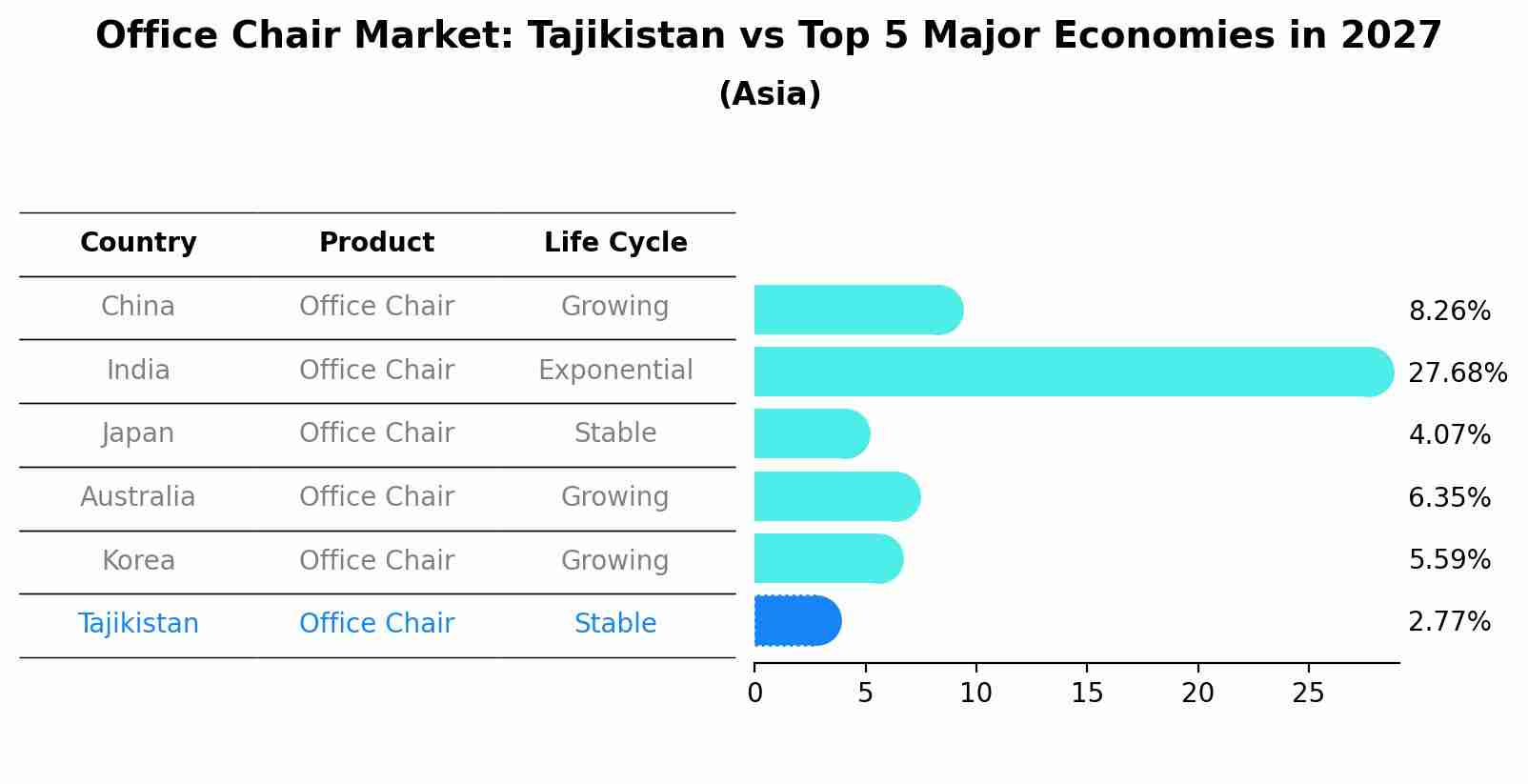
Office Chair Market: Tajikistan vs Top 5 Major Economies in 2027 (Asia)
Tajikistan's Office Chair market is anticipated to experience a stable growth rate of 2.77% by 2027, reflecting trends observed in the largest economy China, followed by India, Japan, Australia and South Korea.
Tajikistan Office Chair Market Synopsis
The Tajikistan office chair market is currently experiencing steady growth driven by the expanding corporate sector and increasing demand for ergonomic furniture. The market is characterized by a variety of offerings ranging from basic chairs to high-end ergonomic designs. Local manufacturers cater to the mid to low-end segment, while international brands dominate the premium market. The trend towards open office layouts and remote work arrangements has led to the demand for versatile and comfortable office chairs with adjustable features. Factors such as rising disposable incomes, urbanization, and a growing number of commercial establishments are expected to further drive market growth. However, challenges such as limited awareness of ergonomic benefits and price sensitivity among consumers remain key considerations for market players looking to capitalize on this evolving sector.
Tajikistan Office Chair Market Trends
The Tajikistan office chair market is experiencing a trend towards ergonomic designs and sustainable materials. With an increasing awareness of the importance of employee health and wellbeing, companies are investing in office chairs that offer better support and comfort for long hours of sitting. Additionally, there is a growing demand for environmentally friendly products, leading to a shift towards office chairs made from recycled materials or sustainable sources. As remote work becomes more common, there is also a preference for versatile office chairs that can easily transition between home and office settings. Overall, the Tajikistan office chair market is seeing a movement towards ergonomic, sustainable, and adaptable designs to meet the evolving needs of modern workplaces.
Tajikistan Office Chair Market Challenges
In the Tajikistan office chair market, several challenges are prevalent. One major challenge is the limited purchasing power of consumers due to the country`s relatively low income levels. This results in a smaller target market for office chair manufacturers and retailers. Additionally, the lack of awareness about the importance of ergonomic furniture in promoting workplace health and productivity poses a challenge in promoting higher-end office chairs. Infrastructure limitations and logistical challenges in distribution and transportation further hinder the market`s growth potential. Political and economic instability in the region also create uncertainties for businesses operating in the office chair sector. Overall, navigating these challenges requires strategic market positioning, effective marketing strategies, and an understanding of the local business environment in Tajikistan.
Tajikistan Office Chair Market Investment Opportunities
In the Tajikistan office chair market, there are several investment opportunities for growth and development. With the country experiencing economic growth and an increasing focus on modernizing workplaces, there is a rising demand for ergonomic, comfortable, and aesthetically pleasing office chairs. Investors can capitalize on this trend by introducing innovative and high-quality office chair designs that cater to the specific needs of Tajikistan`s workforce. Additionally, there is potential for partnerships with local businesses and government offices to supply office chairs for their growing operations. Investing in sustainable and environmentally friendly office chair options could also appeal to the environmentally conscious consumer segment in Tajikistan. Overall, the Tajikistan office chair market presents opportunities for investors to tap into a growing market segment with the right product offerings and strategic partnerships.
Jordan Agar Market Government Policies
In Tajikistan, government policies related to the office chair market primarily focus on promoting local manufacturing and ensuring product quality standards. The government provides incentives and support for local furniture manufacturers to enhance production capacity and competitiveness. Import regulations are in place to protect domestic producers, including tariffs and quality inspections for imported office chairs. Additionally, the government emphasizes sustainability and environmental considerations in the manufacturing process, encouraging the use of eco-friendly materials and production practices. Overall, the government`s policies aim to develop a robust domestic office chair market, support local businesses, and ensure consumer safety and satisfaction with high-quality products.
Tajikistan Office Chair Market Future Outlook
The future outlook for the Tajikistan Office Chair Market appears optimistic, driven by the country`s growing economy and increasing focus on modernizing workspaces. As more businesses in Tajikistan aim to enhance employee comfort and productivity, the demand for ergonomic and stylish office chairs is expected to rise. Additionally, as the workforce becomes more tech-savvy and remote work arrangements become more common, there will likely be a need for versatile and adjustable office chairs that cater to different work environments. With ongoing urbanization and a shift towards more office-based jobs, the Tajikistan Office Chair Market is poised for growth in the coming years, presenting opportunities for both local and international office chair manufacturers and retailers to capitalize on this evolving market trend.
Key Highlights of the Report:
- Tajikistan Office Chair Market Outlook
- Market Size of Tajikistan Office Chair Market, 2021
- Forecast of Tajikistan Office Chair Market, 2031
- Historical Data and Forecast of Tajikistan Office Chair Revenues & Volume for the Period 2018 - 2031
- Tajikistan Office Chair Market Trend Evolution
- Tajikistan Office Chair Market Drivers and Challenges
- Tajikistan Office Chair Price Trends
- Tajikistan Office Chair Porter's Five Forces
- Tajikistan Office Chair Industry Life Cycle
- Historical Data and Forecast of Tajikistan Office Chair Market Revenues & Volume By Product Type for the Period 2018 - 2031
- Historical Data and Forecast of Tajikistan Office Chair Market Revenues & Volume By Executive Office for the Period 2018 - 2031
- Historical Data and Forecast of Tajikistan Office Chair Market Revenues & Volume By Ergonomic for the Period 2018 - 2031
- Historical Data and Forecast of Tajikistan Office Chair Market Revenues & Volume By Conference for the Period 2018 - 2031
- Historical Data and Forecast of Tajikistan Office Chair Market Revenues & Volume By Material for the Period 2018 - 2031
- Historical Data and Forecast of Tajikistan Office Chair Market Revenues & Volume By Mesh for the Period 2018 - 2031
- Historical Data and Forecast of Tajikistan Office Chair Market Revenues & Volume By Lather for the Period 2018 - 2031
- Historical Data and Forecast of Tajikistan Office Chair Market Revenues & Volume By Plastic for the Period 2018 - 2031
- Historical Data and Forecast of Tajikistan Office Chair Market Revenues & Volume By Fabric for the Period 2018 - 2031
- Historical Data and Forecast of Tajikistan Office Chair Market Revenues & Volume By Sales Channel for the Period 2018 - 2031
- Historical Data and Forecast of Tajikistan Office Chair Market Revenues & Volume By Offline for the Period 2018 - 2031
- Historical Data and Forecast of Tajikistan Office Chair Market Revenues & Volume By Online for the Period 2018 - 2031
- Tajikistan Office Chair Import Export Trade Statistics
- Market Opportunity Assessment By Product Type
- Market Opportunity Assessment By Material
- Market Opportunity Assessment By Sales Channel
- Tajikistan Office Chair Top Companies Market Share
- Tajikistan Office Chair Competitive Benchmarking By Technical and Operational Parameters
- Tajikistan Office Chair Company Profiles
- Tajikistan Office Chair Key Strategic Recommendations






































