Tajikistan Online Grocery Market Size, Share & Growth Rate
The Tajikistan Online Grocery Market was estimated at USD 439 Million in 2025 and is projected to reach USD 606 Million by 2032, growing at a CAGR of 4.7% from 2026 to 2032. This growth trajectory is largely fueled by escalating internet access, especially among the younger population, who are increasingly embracing digital platforms for shopping. The rising demand for convenience, coupled with evolving consumer habits, is propelling a shift toward online grocery shopping that promises to redefine the retail landscape in Tajikistan.
Tajikistan Online Grocery Market Year-wise Growth Rate and Key Drivers
This graph highlights how the Tajikistan Online Grocery Market has steadily grown over the years, supported by major growth factors.
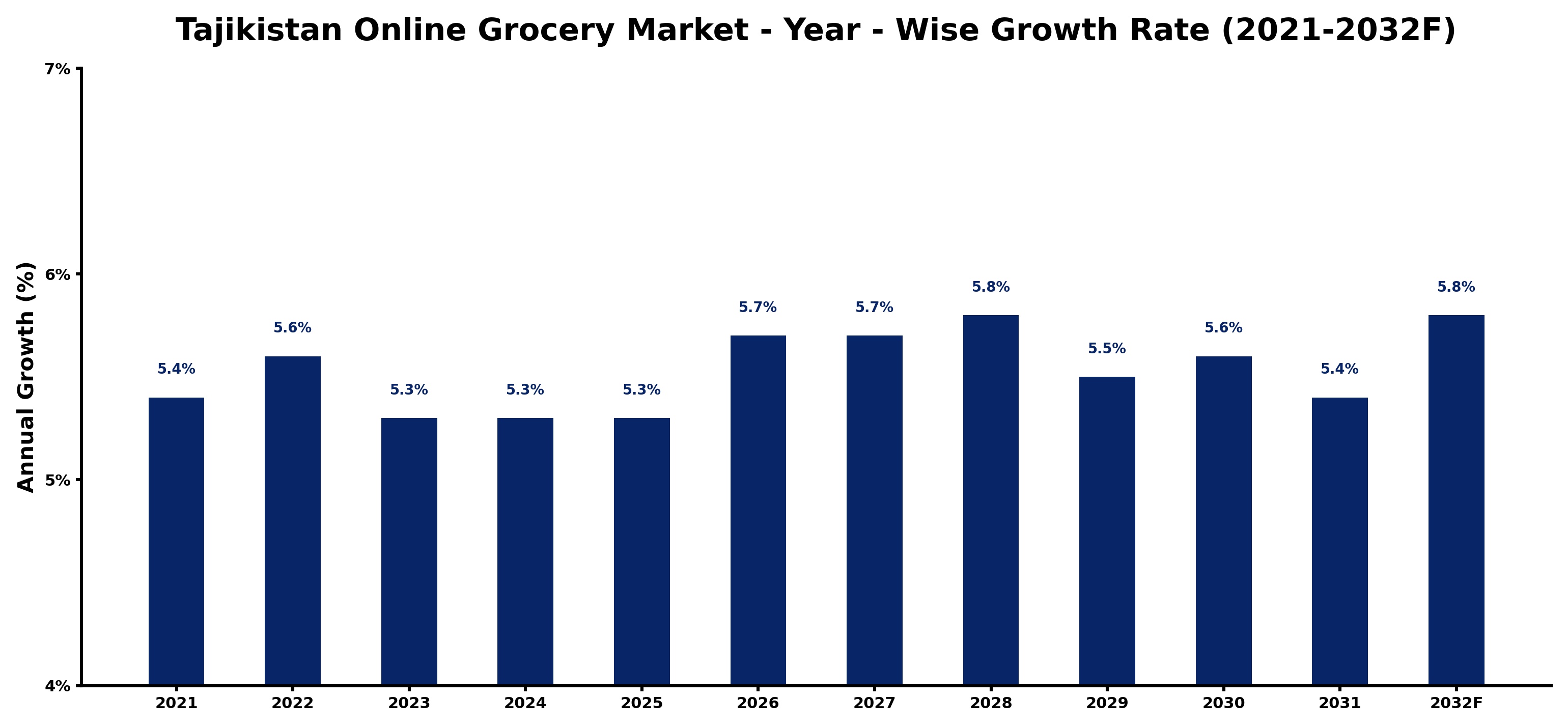
The table below presents the year‑wise growth rates along with the key drivers influencing the market
| Year | Growth Rate | Major Drivers |
| 2021 | 5.4% | E-commerce adoption accelerated shopping |
| 2022 | 5.6% | Mobile payment options expanded usage |
| 2023 | 5.3% | Home delivery services gained popularity |
| 2024 | 5.3% | Local sourcing improved product freshness |
| 2025 | 5.3% | Subscription models attracted loyal customers |
| 2026 | 5.7% | Digital marketing strategies enhanced visibility |
| 2027 | 5.7% | Industrial activity supported growth |
| 2028 | 5.8% | Sustainable packaging gained consumer interest |
| 2029 | 5.5% | Social media influence drove engagement |
| 2030 | 5.6% | Partnerships with local farmers expanded |
| 2031 | 5.4% | Innovative product offerings attracted shoppers |
| 2032 | 5.8% | Loyalty programs enhanced customer retention |
Note - Market size estimations and growth projections presented in this report are based on 6Wresearch’s advanced forecasting approach, validated with industry datasets as of June 2026.
Tajikistan Online Grocery Market Synopsis
The online grocery market in Tajikistan is witnessing a notable transformation as consumers increasingly prefer the convenience of digital shopping platforms. More residents are turning to these online services to meet their grocery needs, marking a significant shift in shopping habits.
In this evolving landscape, e-commerce platforms are stepping up to offer diverse product ranges that include fresh produce, packaged goods, and household essentials. This growing acceptance of online shopping signals a promising future for digital grocery retail in the country.
Tajikistan Online Grocery Market Key Takeaways
- The market is experiencing robust growth, driven by rising internet penetration and a shift in consumer preferences towards online shopping.
- Significant challenges related to logistics and payment methods remain, but innovations in these areas are on the horizon.
- Government initiatives are supporting the digital transformation of the grocery sector through enhanced internet connectivity and consumer protection regulations.
- Opportunities for investment and market entry continue to expand as more consumers embrace the convenience of online grocery shopping.
- The future of the market appears bright, with expectations of continued growth and increased competition among service providers.
Evaluation of Restraints in Tajikistan Online Grocery Market
The Tajikistan online grocery market is not without its hurdles. Limited internet penetration remains a significant barrier, especially in rural regions where access to digital platforms is still developing. Additionally, logistical challenges are prevalent, with inadequate road infrastructure complicating timely deliveries. Payment preferences also skew towards cash, which can deter the adoption of online transactions. Moreover, lingering concerns about product quality and freshness contribute to consumer hesitation when it comes to fully embracing online grocery shopping. Addressing these constraints requires strategic investments in both technology and infrastructure, as well as educational initiatives to build consumer trust.
Tajikistan Online Grocery Market Trends
Several key trends are shaping the Tajikistan online grocery landscape. The COVID-19 pandemic has acted as a catalyst, with many consumers now prioritizing safety and convenience, leading to a lasting shift toward online shopping. E-commerce companies are leveraging advanced technologies, such as mobile applications and enhanced user interfaces, to offer a seamless shopping experience. Additionally, local grocery stores are beginning to partner with online platforms to widen their reach and improve product accessibility. As urbanization increases, the demand for quick and efficient grocery shopping is expected to rise, further driving the evolution of this market.
Tajikistan Online Grocery Market Opportunities
Investors looking toward the Tajikistan Online Grocery Market can find promising opportunities in various areas. The burgeoning tech-savvy young population presents a ripe customer base for innovative e-commerce platforms. Enhancing delivery services, investing in local supply chains, and diversifying product offerings can help new entrants differentiate themselves and capture market share. Additionally, the potential for partnerships with local suppliers and grocery stores can streamline logistics and create a reliable ecosystem for online shopping. As the market is still relatively untapped, early movers have the potential for significant returns as consumer habits continue to evolve.
Government Initiatives in the Tajikistan Online Grocery Market
The Tajik government has implemented various initiatives aimed at bolstering the online grocery sector. Key policies focus on improving internet infrastructure to enhance accessibility for consumers, thereby facilitating the growth of e-commerce. Additionally, regulations are in place to ensure consumer protection, data privacy, and fair competition in the digital marketplace. Efforts are also underway to support the development of digital payment systems and logistics services, which are crucial for the success of online grocery platforms. These initiatives reflect a commitment to fostering innovation and efficiency in a rapidly advancing digital economy.
Future Insights of the Tajikistan Online Grocery Market
Looking ahead to 2026-2032, the Tajikistan Online Grocery Market is expected to maintain its upward trajectory, driven by continued improvements in internet access and shifts in consumer behavior toward online shopping. As e-commerce becomes more entrenched, retailers will likely face intensified competition, prompting enhancements in service quality, product variety, and pricing strategies. The growing emphasis on convenience and safety will further stimulate the market, with consumers increasingly seeking efficient and reliable grocery shopping experiences. Overall, the future appears optimistic, with significant opportunities for both new entrants and established players.
Tajikistan Online Grocery Market Latest Developments (May 2025 - June 2026)
In recent months, the Tajikistan online grocery sector has seen notable developments, with several platforms enhancing their technological capabilities to improve user experiences. Innovations in payment systems, including the introduction of more cashless options, are being explored to cater to evolving consumer preferences. Partnerships between local suppliers and e-commerce platforms are also on the rise, aimed at optimizing logistics and ensuring product freshness. These trends reflect a dynamic environment where adaptation and evolution are key to success in the online grocery market.
Tajikistan Online Grocery Market - Key Attractiveness of the Report
- 10 Years of Market Numbers
- Historical Data Starting from 2022 to 2025
- Base Year: 2025
- Forecast Data until 2032
- Key Performance Indicators Impacting the Market
- Major Upcoming Developments and Projects
Key Highlights of the Report:
- Tajikistan Online Grocery Market Outlook
- Market Size of Tajikistan Online Grocery Market, 2025
- Forecast of Tajikistan Online Grocery Market, 2032
- Historical Data and Forecast of Tajikistan Online Grocery Revenues & Volume for the Period 2022-2032F
- Tajikistan Online Grocery Market Trend Evolution
- Tajikistan Online Grocery Market Drivers and Challenges
- Tajikistan Online Grocery Price Trends
- Tajikistan Online Grocery Porter's Five Forces
- Tajikistan Online Grocery Industry Life Cycle
- Historical Data and Forecast of Tajikistan Online Grocery Market Revenues & Volume By Product Type for the Period 2022-2032F
- Historical Data and Forecast of Tajikistan Online Grocery Market Revenues & Volume By Food Grains for the Period 2022-2032F
- Historical Data and Forecast of Tajikistan Online Grocery Market Revenues & Volume By Bread, Bakery and Dairy Products for the Period 2022-2032F
- Historical Data and Forecast of Tajikistan Online Grocery Market Revenues & Volume By Fruits and Vegetables for the Period 2022-2032F
- Historical Data and Forecast of Tajikistan Online Grocery Market Revenues & Volume By Personal Care for the Period 2022-2032F
- Historical Data and Forecast of Tajikistan Online Grocery Market Revenues & Volume By Dry and Baking Products for the Period 2022-2032F
- Historical Data and Forecast of Tajikistan Online Grocery Market Revenues & Volume By Household Products for the Period 2022-2032F
- Historical Data and Forecast of Tajikistan Online Grocery Market Revenues & Volume By Meat and Meat Products for the Period 2022-2032F
- Historical Data and Forecast of Tajikistan Food Grains Online Grocery Market Revenues & Volume By Others for the Period 2022-2032F
- Historical Data and Forecast of Tajikistan Online Grocery Market Revenues & Volume By Platform for the Period 2022-2032F
- Historical Data and Forecast of Tajikistan Online Grocery Market Revenues & Volume By App-based for the Period 2022-2032F
- Historical Data and Forecast of Tajikistan Online Grocery Market Revenues & Volume By Web-based for the Period 2022-2032F
- Tajikistan Online Grocery Import Export Trade Statistics
- Market Opportunity Assessment By Product Type
- Market Opportunity Assessment By Platform
- Tajikistan Online Grocery Top Companies Market Share
- Tajikistan Online Grocery Competitive Benchmarking By Technical and Operational Parameters
- Tajikistan Online Grocery Company Profiles
- Tajikistan Online Grocery Key Strategic Recommendations






































