Tajikistan Optical Glass Market Size, Share & Growth Rate
The Tajikistan Optical Glass Market was estimated at USD 152 Million in 2025 and is projected to reach USD 215 Million by 2032, growing at a CAGR of 5.1% from 2026 to 2032. This anticipated growth is driven by increasing demand for optical glass products across various sectors, particularly telecommunications, healthcare, and electronics. Furthermore, the government's commitment to industrial development will enhance local manufacturing capabilities, potentially reducing reliance on imports.
Tajikistan Optical Glass Market Year-wise Growth Rate and Key Drivers
This graph highlights how the Tajikistan Optical Glass Market has steadily grown over the years, supported by major growth factors.
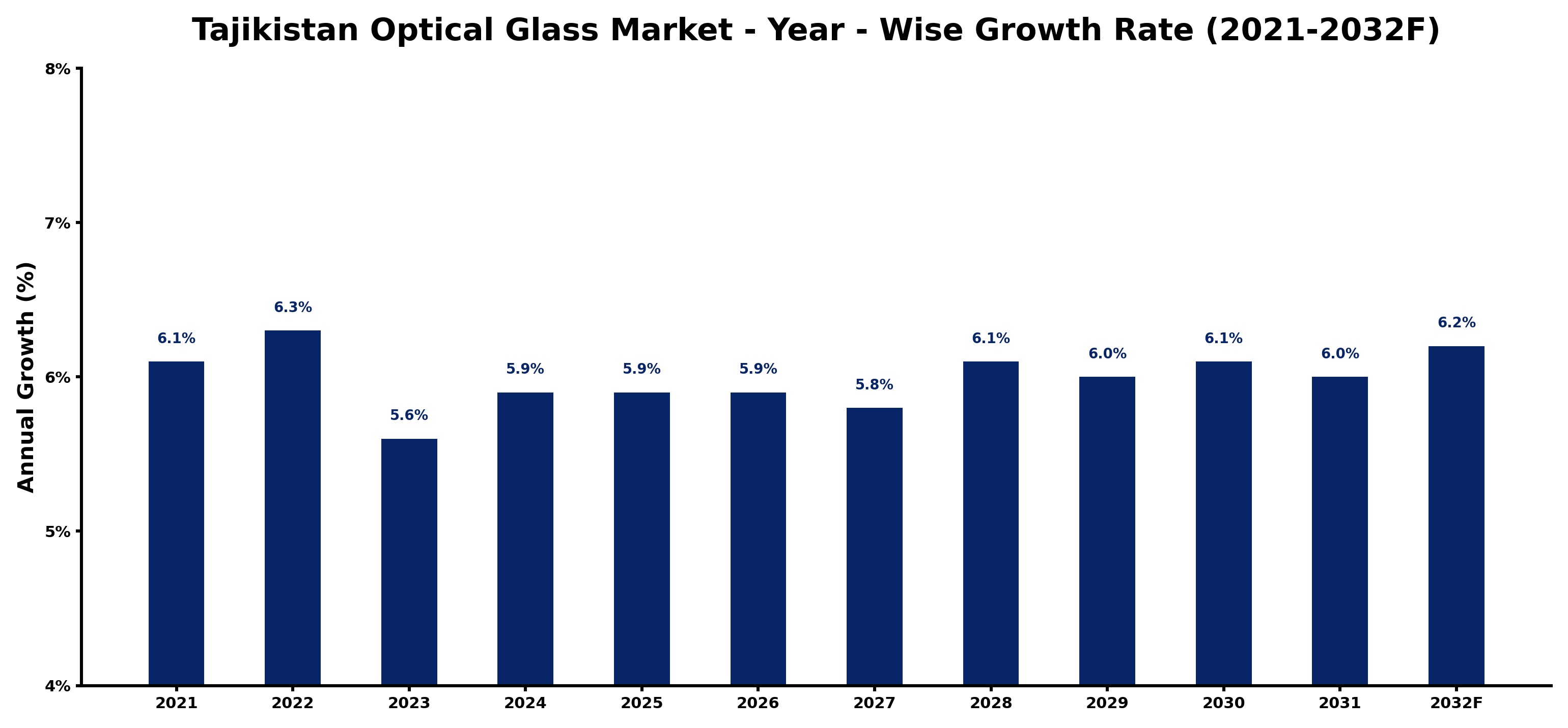
The table below presents the year‑wise growth rates along with the key drivers influencing the market
| Year | Growth Rate | Major Drivers |
| 2021 | 6.1% | Export driven investments boosted local optical glass production capacity |
| 2022 | 6.3% | Manufacturing investments in glass processing boost local export capabilities |
| 2023 | 5.6% | Higher investment in advanced glass processing technology boosts productivity |
| 2024 | 5.9% | Export driven infrastructure upgrades boosted domestic optical glass production |
| 2025 | 5.9% | Local investments in optical glass production enhanced export competitiveness |
| 2026 | 5.9% | Domestic glass manufacturing investments boost local supply chain capabilities |
| 2027 | 5.8% | Improved glass manufacturing processes boosted local export competitiveness |
| 2028 | 6.1% | Increased domestic demand spurred local optical glass production investments |
| 2029 | 6.0% | Manufacturing investments in optical glass enhance local production capabilities |
| 2030 | 6.1% | New optical glass plant enhances domestic supply chain capabilities |
| 2031 | 6.0% | Local glass manufacturers enhance production lines through advanced technologies |
| 2032 | 6.2% | Technology integration in optical glass production enhances manufacturing efficiency |
Note - Market size estimations and growth projections presented in this report are based on 6Wresearch's advanced forecasting approach, validated with industry datasets as of June 2026.
Tajikistan Optical Glass Market Synopsis
The Tajikistan Optical Glass Market is at a pivotal point, where increasing investments in technology and infrastructure are shaping its future. As local industries expand and evolve, there is a notable shift towards acquiring high-quality optical glass products to meet specific operational requirements.
Given the market's reliance on imports, local manufacturers have the opportunity to innovate and fill gaps left by international suppliers. With the global demand for optical glass on the rise, Tajikistan can position itself as a competitive player by leveraging its unique advantages in terms of labor and investment potential.
Tajikistan Optical Glass Market Key Takeaways
- The market is experiencing robust growth due to rising demand in various sectors, particularly telecommunications and healthcare.
- Local production capabilities are currently limited, leading to a heavy reliance on imported optical glass products.
- Government policies aim to enhance industrial development and attract foreign investment in the optical glass sector.
- Innovations in production techniques and environmentally friendly practices are becoming increasingly important.
- The market presents significant investment opportunities for stakeholders looking to establish or expand manufacturing facilities.
Evaluation of Restraints in Tajikistan Optical Glass Market
Despite its growth potential, the Tajikistan Optical Glass Market faces considerable restraints. The dependence on imported optical glass products is a significant limitation, exacerbated by high transportation costs and customs duties. Moreover, the absence of advanced manufacturing technologies and machinery constrains local production quality and volume. A shortage of a skilled workforce further complicates efforts to improve production capabilities, hindering competitiveness against cheaper imports from other regions.
Tajikistan Optical Glass Market Trends
Current trends indicate a marked shift towards high-performance and specialty optical glass products, driven by evolving applications in telecommunications, aerospace, and healthcare. Additionally, the demand for sustainable manufacturing processes is rising, with many companies investing in eco-friendly production techniques. As technology continues to advance, precision optics and custom glass solutions are becoming vital for businesses looking to enhance their operational efficiency.
Tajikistan Optical Glass Market Opportunities
The Tajikistan Optical Glass Market is ripe with investment opportunities, particularly for businesses willing to establish local manufacturing facilities. As demand for specialized optical glass rises, there's a significant gap that local manufacturers can fill. Investors can also explore research and development avenues to innovate new glass types with advanced properties, thus catering to the evolving needs of various industries. Establishing strategic partnerships with international entities could further bolster local capabilities and foster knowledge transfer.
Government Initiatives in the Tajikistan Optical Glass Market
The government of Tajikistan has put forth several initiatives aimed at fostering the optical glass market. By offering financial incentives and tax breaks to investors, the government is encouraging local production of optical glass. Moreover, policies aimed at improving infrastructure and logistics are facilitating smoother transportation of raw materials and finished products. The emphasis on adhering to international quality standards reflects the government's commitment to enhancing competitiveness in the global marketplace.
Future Insights of the Tajikistan Optical Glass Market
Looking ahead to 2026-2032, the Tajikistan Optical Glass Market is anticipated to thrive on the back of increasing demand across key sectors. Continued investments in infrastructure and manufacturing technology will likely bolster production capacity, enabling local companies to compete more effectively on a global scale. As technological advancements pave the way for high-quality optical glass products, Tajikistan stands poised to attract further investment and innovation, marking a new era for the industry.
Tajikistan Optical Glass Market Latest Developments (May 2025 - June 2026)
Recent developments in the Tajikistan Optical Glass Market reflect a trend towards modernization and capability enhancement. Companies are increasingly focusing on adopting advanced manufacturing techniques to improve quality and efficiency. There is also a notable surge in collaborations between local manufacturers and international firms to share knowledge and resources, which is expected to further boost the sector's growth trajectory in the coming years.
Tajikistan Optical Glass Market - Key Attractiveness of the Report
- 10 Years of Market Numbers
- Historical Data Starting from 2022 to 2025
- Base Year: 2025
- Forecast Data until 2032
- Key Performance Indicators Impacting the Market
- Major Upcoming Developments and Projects
Key Highlights of the Report:
- Tajikistan Optical Glass Market Outlook
- Market Size of Tajikistan Optical Glass Market, 2025
- Forecast of Tajikistan Optical Glass Market, 2032
- Historical Data and Forecast of Tajikistan Optical Glass Revenues & Volume for the Period 2022-2032F
- Tajikistan Optical Glass Market Trend Evolution
- Tajikistan Optical Glass Market Drivers and Challenges
- Tajikistan Optical Glass Price Trends
- Tajikistan Optical Glass Porter's Five Forces
- Tajikistan Optical Glass Industry Life Cycle
- Historical Data and Forecast of Tajikistan Optical Glass Market Revenues & Volume By Type for the Period 2022-2032F
- Historical Data and Forecast of Tajikistan Optical Glass Market Revenues & Volume By Colorless for the Period 2022-2032F
- Historical Data and Forecast of Tajikistan Optical Glass Market Revenues & Volume By Colored for the Period 2022-2032F
- Historical Data and Forecast of Tajikistan Optical Glass Market Revenues & Volume By Supply Form for the Period 2022-2032F
- Historical Data and Forecast of Tajikistan Optical Glass Market Revenues & Volume By Plate for the Period 2022-2032F
- Historical Data and Forecast of Tajikistan Optical Glass Market Revenues & Volume By Round Plate for the Period 2022-2032F
- Historical Data and Forecast of Tajikistan Optical Glass Market Revenues & Volume By Worked Rod for the Period 2022-2032F
- Historical Data and Forecast of Tajikistan Optical Glass Market Revenues & Volume By Prism for the Period 2022-2032F
- Historical Data and Forecast of Tajikistan Optical Glass Market Revenues & Volume By Others for the Period 2022-2032F
- Historical Data and Forecast of Tajikistan Optical Glass Market Revenues & Volume By Application for the Period 2022-2032F
- Historical Data and Forecast of Tajikistan Optical Glass Market Revenues & Volume By Consumer Optics for the Period 2022-2032F
- Historical Data and Forecast of Tajikistan Optical Glass Market Revenues & Volume By Astronomy for the Period 2022-2032F
- Historical Data and Forecast of Tajikistan Optical Glass Market Revenues & Volume By Industrial Equipment for the Period 2022-2032F
- Historical Data and Forecast of Tajikistan Optical Glass Market Revenues & Volume By Medical & Biotech for the Period 2022-2032F
- Historical Data and Forecast of Tajikistan Optical Glass Market Revenues & Volume By Electronics & Semiconductors for the Period 2022-2032F
- Historical Data and Forecast of Tajikistan Optical Glass Market Revenues & Volume By Others for the Period 2022-2032F
- Tajikistan Optical Glass Import Export Trade Statistics
- Market Opportunity Assessment By Type
- Market Opportunity Assessment By Supply Form
- Market Opportunity Assessment By Application
- Tajikistan Optical Glass Top Companies Market Share
- Tajikistan Optical Glass Competitive Benchmarking By Technical and Operational Parameters
- Tajikistan Optical Glass Company Profiles
- Tajikistan Optical Glass Key Strategic Recommendations






































