Tajikistan Organic Poultry Market Size, Share & Growth Rate
The Tajikistan Organic Poultry Market was estimated at USD 151 Million in 2025 and is projected to reach USD 201 Million by 2032, growing at a CAGR of 4.2% from 2026 to 2032. This growth trajectory is largely fueled by rising consumer awareness surrounding the health benefits of organic poultry, alongside a growing concern for food safety and environmental sustainability. Additionally, government initiatives supporting organic farming and a more affluent middle class willing to invest in quality food products are further propelling market expansion.
Tajikistan Organic Poultry Market Year-wise Growth Rate and Key Drivers
This graph highlights how the Tajikistan Organic Poultry Market has steadily grown over the years, supported by major growth factors.
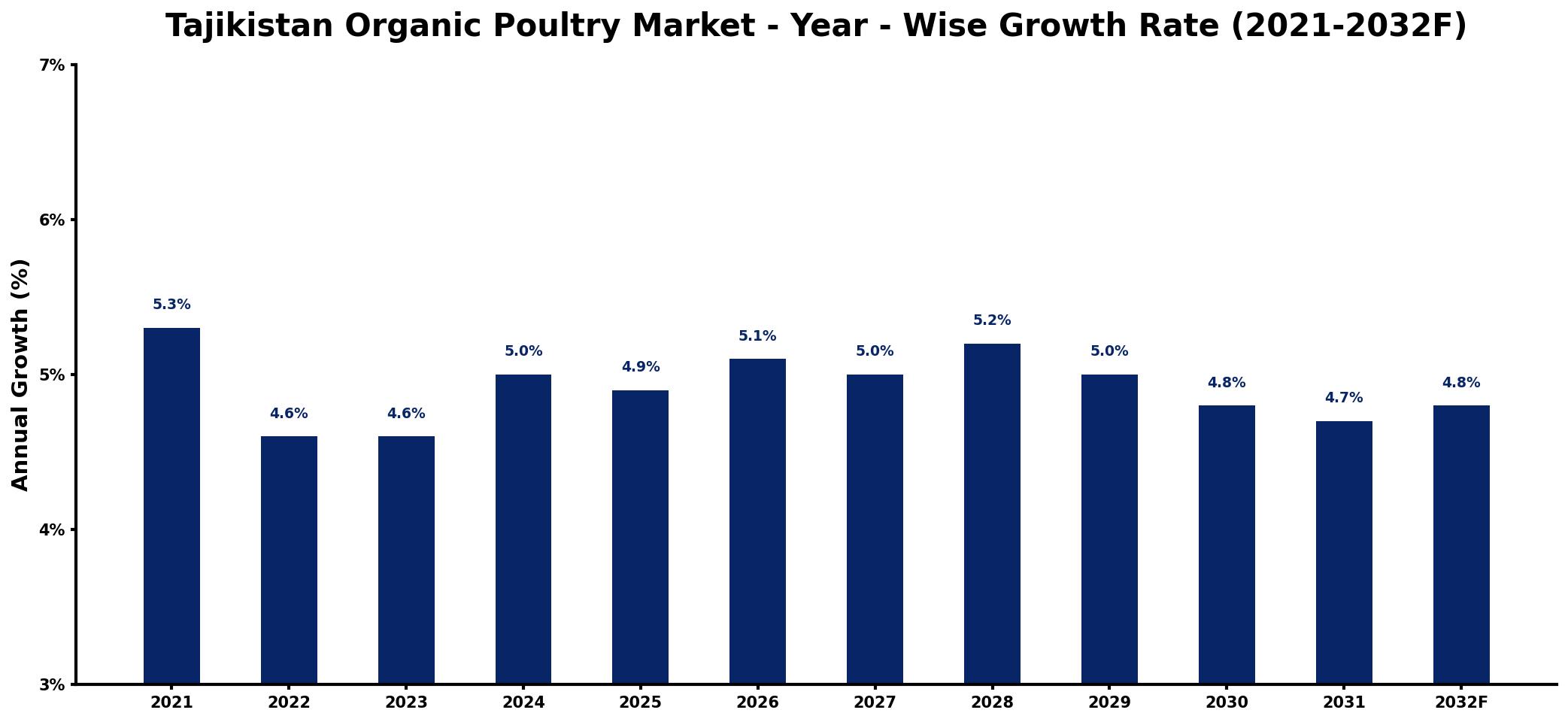
The table below presents the year‑wise growth rates along with the key drivers influencing the market
| Year | Growth Rate | Major Drivers |
| 2021 | 5.3% | Increased consumer health awareness |
| 2022 | 4.6% | Rising demand for local sourcing |
| 2023 | 4.6% | Expansion of distribution networks |
| 2024 | 5.0% | Growing interest in sustainable practices |
| 2025 | 4.9% | Investment in innovative farming technologies |
| 2026 | 5.1% | Strengthening of local farmer cooperatives |
| 2027 | 5.0% | Enhanced marketing strategies adopted |
| 2028 | 5.2% | Development of value-added products |
| 2029 | 5.0% | Collaboration with health organizations |
| 2030 | 4.8% | Boost in export opportunities available |
| 2031 | 4.7% | Emerging trends in dietary preferences |
| 2032 | 4.8% | Increased support for agribusiness initiatives |
Note: Market size estimations and growth projections presented in this report are based on 6Wresearch's proprietary forecasting methodology, utilizing the latest available industry data, government publications, and primary research inputs.
Tajikistan Organic Poultry Market Synopsis
The Tajikistan Organic Poultry Market has seen a remarkable surge in demand driven by the health-conscious preferences of consumers. This momentum indicates a shift towards organic products, which contrasts with traditional poultry consumption patterns. Looking ahead, the market is positioned for significant growth as local farmers increasingly embrace organic practices to satisfy this burgeoning demand.
As more poultry products become available through expanded distribution networks, consumers are expected to become more educated about the benefits of organic options. Government support for sustainable agriculture further enhances the potential for continued growth, establishing a solid foundation for the market's future trajectory.
Tajikistan Organic Poultry Market Key Takeaways
- The market is set to grow significantly due to rising health consciousness and environmental concerns among consumers.
- Government support through subsidies and certification programs is vital for organic poultry development.
- Local producers are increasingly focused on meeting organic standards, enhancing product quality.
- Investment opportunities are emerging in organic farming, processing, and distribution sectors.
- Export potential to neighboring countries is being explored, contributing to market expansion.
Evaluation of Restraints in Tajikistan Organic Poultry Market
Despite the optimistic outlook for the Tajikistan Organic Poultry Market, several constraints pose challenges to its growth. Limited consumer knowledge regarding organic poultry hampers widespread adoption, while infrastructural deficits hinder farmers' ability to scale their production effectively. The inconsistent enforcement of organic standards can create confusion and mistrust in the certification process, affecting product credibility. Furthermore, the scarcity of organic feed and resources in the country constrains production capabilities, making it difficult for producers to compete with conventional poultry options.
Tajikistan Organic Poultry Market Trends
Several trends are shaping the Tajikistan Organic Poultry Market. A noticeable increase in consumer preference for high-quality, organic products has emerged, significantly altering purchasing behaviors. Additionally, advancements in organic farming techniques and sustainable practices are influencing production methods. The market is also seeing a rise in demand for transparency regarding sourcing and farming practices, compelling producers to showcase their organic credentials more effectively. These trends highlight an evolving consumer landscape that values both health and sustainability.
Tajikistan Organic Poultry Market Opportunities
The Tajikistan Organic Poultry Market is rife with opportunities for investment. With increasing consumer demand for organic products, potential investors can tap into organic poultry farming, processing, and distribution sectors. The country's favorable climate conditions for poultry farming, paired with its abundant agricultural resources, present a unique advantage for organic production. Collaborating with local farmers and embracing sustainable practices can further enhance profitability and market presence, establishing a competitive edge in this burgeoning sector.
Government Initiatives in the Tajikistan Organic Poultry Market
The Tajikistan government is actively promoting the organic poultry market through various supportive initiatives. These include financial incentives and subsidies aimed at encouraging farmers to adopt sustainable agricultural practices. Furthermore, the introduction of certification programs and regulations seeks to ensure the quality and authenticity of organic poultry products. Such government actions are not only intended to enhance food safety but also to elevate the competitiveness of Tajikistan's organic poultry sector on both domestic and international stages.
Future Insights of the Tajikistan Organic Poultry Market
Looking towards 2026-2032, the Tajikistan Organic Poultry Market is projected to continue its upward trajectory. With an increasing consumer focus on health and sustainability, the demand for organic products is anticipated to rise. Additionally, the growth of a middle-class population willing to invest in organic food will significantly contribute to market development. Government initiatives aimed at promoting organic agriculture will bolster the sector further, ensuring a robust foundation for growth and innovation in Tajikistan's organic poultry industry.
Tajikistan Organic Poultry Market Latest Developments (2025 - 2026)
In recent months, the Tajikistan Organic Poultry Market has witnessed several significant developments. Local farmers are increasingly adopting cutting-edge organic farming practices, resulting in improved product quality. Retailers are expanding their organic product ranges in response to heightened consumer demand. Additionally, there is a growing emphasis on establishing export channels to neighboring countries, highlighting the market's ambition to position itself as a regional leader in organic poultry products.
Tajikistan Organic Poultry Market - Key Attractiveness of the Report
- 10 Years of Market Numbers
- Historical Data Starting from 2022 to 2025
- Base Year: 2025
- Forecast Data until 2032
- Key Performance Indicators Impacting the Market
- Major Upcoming Developments and Projects
Key Highlights of the Report:
- Tajikistan Organic Poultry Market Outlook
- Market Size of Tajikistan Organic Poultry Market, 2025
- Forecast of Tajikistan Organic Poultry Market, 2032
- Historical Data and Forecast of Tajikistan Organic Poultry Revenues & Volume for the Period 2022-2032F
- Tajikistan Organic Poultry Market Trend Evolution
- Tajikistan Organic Poultry Market Drivers and Challenges
- Tajikistan Organic Poultry Price Trends
- Tajikistan Organic Poultry Porter's Five Forces
- Tajikistan Organic Poultry Industry Life Cycle
- Historical Data and Forecast of Tajikistan Organic Poultry Market Revenues & Volume By Type for the Period 2022-2032F
- Historical Data and Forecast of Tajikistan Organic Poultry Market Revenues & Volume By Organic Eggs for the Period 2022-2032F
- Historical Data and Forecast of Tajikistan Organic Poultry Market Revenues & Volume By Organic Meat for the Period 2022-2032F
- Historical Data and Forecast of Tajikistan Organic Poultry Market Revenues & Volume By Sales Channel for the Period 2022-2032F
- Historical Data and Forecast of Tajikistan Organic Poultry Market Revenues & Volume By Business To Business for the Period 2022-2032F
- Historical Data and Forecast of Tajikistan Organic Poultry Market Revenues & Volume By Business To Consumer for the Period 2022-2032F
- Tajikistan Organic Poultry Import Export Trade Statistics
- Market Opportunity Assessment By Type
- Market Opportunity Assessment By Sales Channel
- Tajikistan Organic Poultry Top Companies Market Share
- Tajikistan Organic Poultry Competitive Benchmarking By Technical and Operational Parameters
- Tajikistan Organic Poultry Company Profiles
- Tajikistan Organic Poultry Key Strategic Recommendations






































