Tajikistan Peat Market Size, Share & Growth Rate
The Tajikistan Peat Market was estimated at USD 274 Million in 2025 and is projected to reach USD 379 Million by 2032, growing at a CAGR of 4.7% from 2026 to 2032. This growth trajectory is being driven by an increasing demand for peat in agricultural applications, particularly for soil enhancement and greenhouse cultivation. Additionally, the growing interest in renewable energy sources is expected to further contribute to the expansion of the peat market in the country.
Tajikistan Peat Market Year-wise Growth Rate and Key Drivers
This graph highlights how the Tajikistan Peat Market has steadily grown over the years, supported by major growth factors.
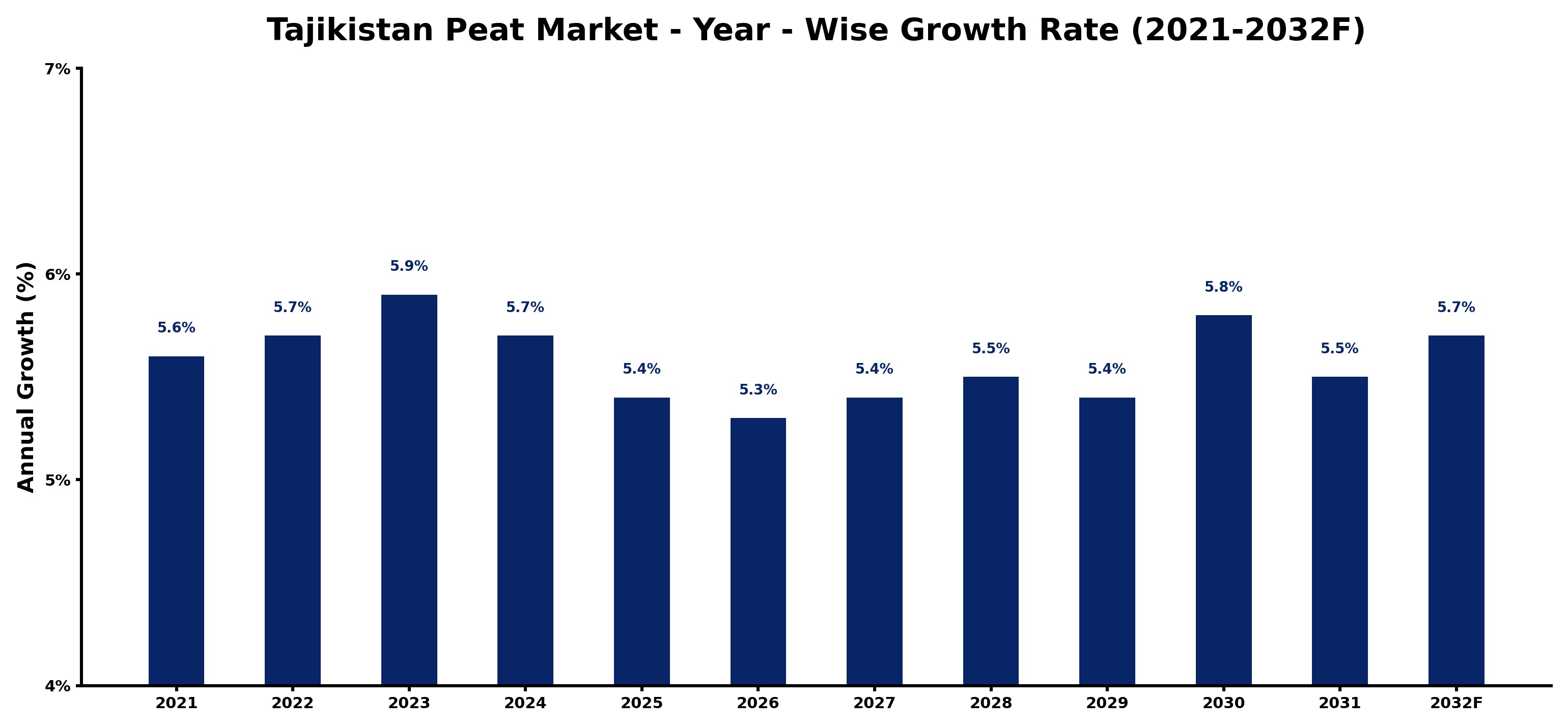
The table below presents the year‑wise growth rates along with the key drivers influencing the market
| Year | Growth Rate | Major Drivers |
| 2021 | 5.6% | Peat briquette production boosts local energy independence initiatives |
| 2022 | 5.7% | Peat processing facilities modernized with advanced drying technologies |
| 2023 | 5.9% | Peat extraction efficiency drives local bioenergy project investments |
| 2024 | 5.7% | Peat processing innovations drive efficiency in energy sector applications |
| 2025 | 5.4% | Peat production process optimizations boosted energy sector feedstock supplies |
| 2026 | 5.3% | New peat processing facility boosts local energy production capabilities |
| 2027 | 5.4% | Domestic peat processing investments boosted energy production capabilities |
| 2028 | 5.5% | New processing technologies enhance peat extraction and transportation efficiency |
| 2029 | 5.4% | New manufacturing facilities boost local peat processing capacity |
| 2030 | 5.8% | Technology adoption in peat harvesting improved energy efficiency significantly |
| 2031 | 5.5% | Government incentives boost investments in peat extraction technology |
| 2032 | 5.7% | New processing facilities boost peat product export capabilities |
Note - Market size estimations and growth projections presented in this report are based on 6Wresearch's advanced forecasting approach, validated with industry datasets as of June 2026.
Tajikistan Peat Market Synopsis
Tajikistan boasts significant peat reserves, which are largely underutilized. The agricultural sector heavily relies on peat as an organic soil amendment, essential for improving soil fertility and structure. Additionally, the expanding horticulture industry in Tajikistan is propelling the demand for peat-based products, as growers seek to enhance plant health and productivity.
However, the market remains fragmented, with only a handful of local producers addressing the demand. Despite this limitation, there is a notable shift toward innovative uses of peat, particularly in renewable energy applications, which signifies a potential for market transformation and growth.
Tajikistan Peat Market Key Takeaways
- The market is driven by agricultural applications, especially in soil improvement.
- Government initiatives are aimed at promoting sustainable peat extraction practices.
- There is an emerging interest in peat as a renewable energy source.
- Investments in technology and infrastructure are essential for market growth.
- Environmental concerns are influencing regulatory frameworks around peat extraction.
Evaluation of Restraints in Tajikistan Peat Market
Despite its potential, the Tajikistan peat market faces several significant challenges. The limited availability of high-quality peat resources often hampers production. Inefficient extraction processes, coupled with outdated technologies, further restrict market capabilities. Additionally, infrastructure inadequacies impede the effective transportation and storage of peat products. Environmental concerns about habitat destruction and greenhouse gas emissions from peat extraction complicate regulatory frameworks, necessitating a careful approach to balancing economic development and ecological sustainability.
Tajikistan Peat Market Trends
The demand for peat in Tajikistan is increasingly influenced by a focus on organic and sustainable agricultural practices. There is a noticeable trend toward using peat as an organic soil amendment, which enhances soil structure and fertility. Furthermore, as the government champions renewable energy initiatives, peat's role as a potential biofuel alternative is gaining traction. Companies in the peat sector are also innovating, exploring new product developments and applications to align with evolving consumer needs.
Tajikistan Peat Market Opportunities
The rich peat resources in Tajikistan present various investment opportunities. Stakeholders may consider developing peat extraction and processing facilities to satisfy the rising demand in agricultural and horticultural markets. Furthermore, exploring innovative uses for peat—such as biofuel production or environmental remediation—presents lucrative avenues for growth. Enhanced government policies supporting sustainable practices further bolster the attractiveness of these opportunities.
Government Initiatives in the Tajikistan Peat Market
The Tajikistan government has been proactive in implementing regulations to oversee the sustainable management of peat resources. Licensing requirements for peat extraction activities ensure responsible practices, while environmental protection guidelines aim to mitigate habitat disruption. The government encourages research and innovation in peat production methods, supporting initiatives that enhance both efficiency and sustainability in the industry. This regulatory environment is crucial for fostering growth while safeguarding environmental interests.
Future Insights of the Tajikistan Peat Market
The outlook for the Tajikistan Peat Market from 2026 to 2032 appears positive, driven by increasing agricultural needs for high-quality soil amendments. The government's commitment to supporting local farmers and promoting sustainable practices will likely enhance market conditions. However, the market must navigate environmental concerns and competition from alternative soil amendments. Balancing these factors will be key to achieving sustainable growth in the peat sector.
Tajikistan Peat Market Latest Developments (May 2025 - June 2026)
Recent developments in the Tajikistan peat market indicate a growing recognition of peat's potential in both agricultural and energy sectors. Initiatives aimed at modernizing extraction processes and investing in infrastructure are gaining attention. Furthermore, local producers are beginning to collaborate on research projects to innovate peat-based products, thereby increasing competitiveness within the market. These trends suggest a proactive approach to addressing both supply and demand dynamics in the peat industry.
Tajikistan Peat Market - Key Attractiveness of the Report
- 10 Years of Market Numbers
- Historical Data Starting from 2022 to 2025
- Base Year: 2025
- Forecast Data until 2032
- Key Performance Indicators Impacting the Market
- Major Upcoming Developments and Projects
Key Highlights of the Report:
- Tajikistan Peat Market Outlook
- Market Size of Tajikistan Peat Market, 2025
- Forecast of Tajikistan Peat Market, 2032
- Historical Data and Forecast of Tajikistan Peat Revenues & Volume for the Period 2022-2032F
- Tajikistan Peat Market Trend Evolution
- Tajikistan Peat Market Drivers and Challenges
- Tajikistan Peat Price Trends
- Tajikistan Peat Porter's Five Forces
- Tajikistan Peat Industry Life Cycle
- Historical Data and Forecast of Tajikistan Peat Market Revenues & Volume By Type for the Period 2022-2032F
- Historical Data and Forecast of Tajikistan Peat Market Revenues & Volume By Coco Peat for the Period 2022-2032F
- Historical Data and Forecast of Tajikistan Peat Market Revenues & Volume By Sod Peat for the Period 2022-2032F
- Historical Data and Forecast of Tajikistan Peat Market Revenues & Volume By Other for the Period 2022-2032F
- Historical Data and Forecast of Tajikistan Peat Market Revenues & Volume By Material Type for the Period 2022-2032F
- Historical Data and Forecast of Tajikistan Peat Market Revenues & Volume By Fibric for the Period 2022-2032F
- Historical Data and Forecast of Tajikistan Peat Market Revenues & Volume By Hemic for the Period 2022-2032F
- Historical Data and Forecast of Tajikistan Peat Market Revenues & Volume By Sapric for the Period 2022-2032F
- Historical Data and Forecast of Tajikistan Peat Market Revenues & Volume By Others for the Period 2022-2032F
- Historical Data and Forecast of Tajikistan Peat Market Revenues & Volume By Application for the Period 2022-2032F
- Historical Data and Forecast of Tajikistan Peat Market Revenues & Volume By Agriculture for the Period 2022-2032F
- Historical Data and Forecast of Tajikistan Peat Market Revenues & Volume By Fuel & Energy for the Period 2022-2032F
- Historical Data and Forecast of Tajikistan Peat Market Revenues & Volume By Others for the Period 2022-2032F
- Tajikistan Peat Import Export Trade Statistics
- Market Opportunity Assessment By Type
- Market Opportunity Assessment By Material Type
- Market Opportunity Assessment By Application
- Tajikistan Peat Top Companies Market Share
- Tajikistan Peat Competitive Benchmarking By Technical and Operational Parameters
- Tajikistan Peat Company Profiles
- Tajikistan Peat Key Strategic Recommendations






































