Tajikistan Photosensitive Semiconductor Device Market Size, Share & Growth Rate
The Tajikistan Photosensitive Semiconductor Device Market was estimated at USD 1019 Million in 2025 and is projected to reach USD 1699 Million by 2032, growing at a CAGR of 7.6% from 2026 to 2032. This growth trajectory is primarily driven by the increasing integration of photosensitive devices in diverse sectors such as consumer electronics, automotive applications, and healthcare. The rising demand for advanced imaging technologies and the government's support for infrastructure and technological advancements further reinforce this optimistic outlook.
Tajikistan Photosensitive Semiconductor Device Market Year-wise Growth Rate and Key Drivers
This graph highlights how the Tajikistan Photosensitive Semiconductor Device Market has steadily grown over the years, supported by major growth factors.
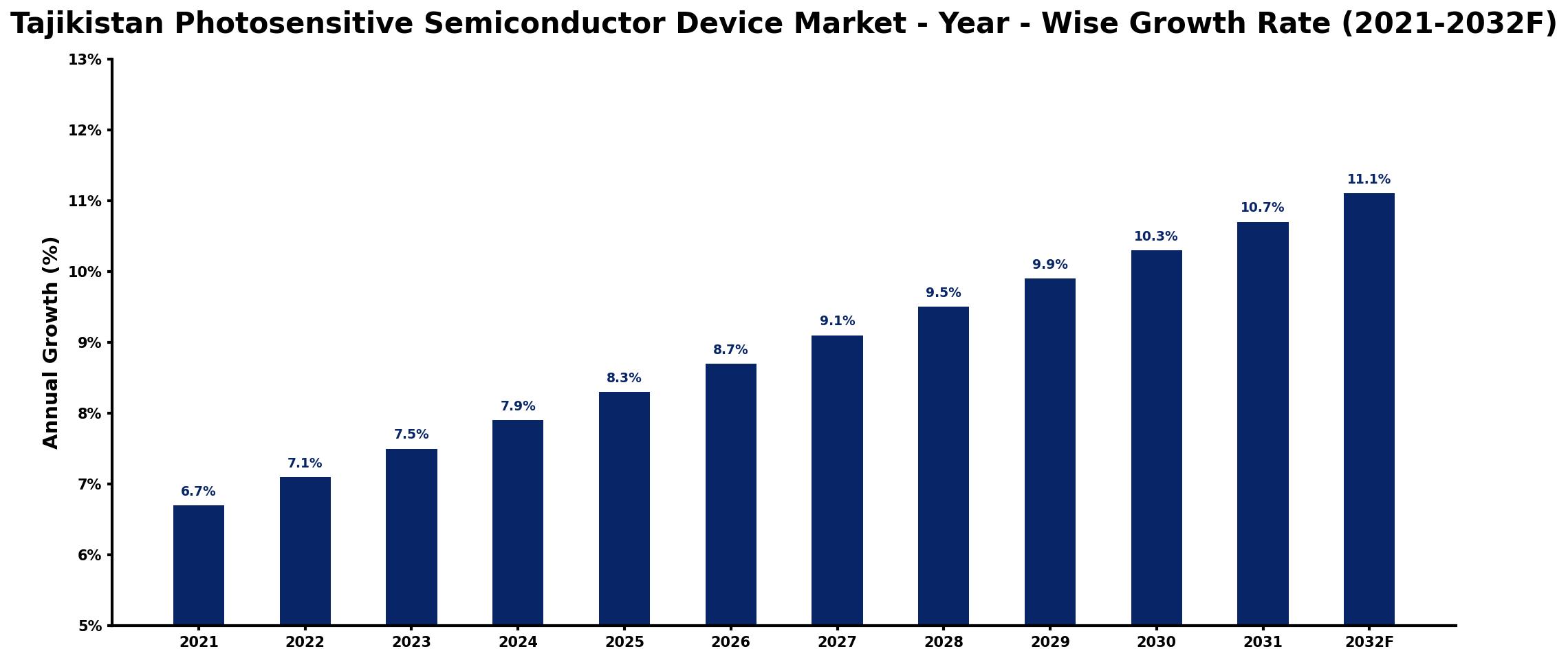
The table below presents the year‑wise growth rates along with the key drivers influencing the market
| Year | Growth Rate | Major Drivers |
| 2021 | 6.7% | Rising demand for renewable energy |
| 2022 | 7.1% | Increased investment in technology |
| 2023 | 7.5% | Expansion of telecommunications infrastructure |
| 2024 | 7.9% | Growth in consumer electronics sector |
| 2025 | 8.3% | Surge in automotive innovation |
| 2026 | 8.7% | Development of smart city projects |
| 2027 | 9.1% | Advancements in industrial automation |
| 2028 | 9.5% | Increased research and development funding |
| 2029 | 9.9% | Growing demand for sustainable solutions |
| 2030 | 10.3% | increased capital investment inflows |
| 2031 | 10.7% | Rising applications in healthcare |
| 2032 | 11.1% | Boost in global trade agreements |
Note: Market size estimations and growth projections presented in this report are based on 6Wresearch's proprietary forecasting methodology, utilizing the latest available industry data, government publications, and primary research inputs.
Tajikistan Photosensitive Semiconductor Device Market Synopsis
The strongest force currently shaping the Tajikistan Photosensitive Semiconductor Device Market is the surging demand for image sensors. This demand is fueled by applications in smartphones, security systems, and medical imaging, which are becoming essential in everyday life.
Additionally, ongoing advancements in technology are pushing manufacturers to innovate and adapt their offerings. This trend includes the development of specialized sensors tailored for emerging fields, such as augmented reality, indicating a vibrant and dynamic market landscape.
Tajikistan Photosensitive Semiconductor Device Market Key Takeaways
- The market is set to grow significantly, projected to reach USD 1699 Million by 2032.
- Technological advancements are driving innovation in image sensors and photodetectors.
- The government is actively promoting initiatives to bolster the semiconductor industry.
- Healthcare and automotive sectors are key demand drivers for photosensitive devices.
- Challenges related to infrastructure and skilled workforce persist, impacting local production capabilities.
Evaluation of Restraints in Tajikistan Photosensitive Semiconductor Device Market
Despite its growth potential, the Tajikistan Photosensitive Semiconductor Device Market faces significant restraints that hinder its expansion. High import costs pose a challenge, as many advanced semiconductor components are sourced from abroad, which can inflate prices for local manufacturers and consumers. Furthermore, the limited technological infrastructure and a shortage of skilled workforce prevent the local production of high-quality semiconductor devices, creating reliance on imports. This dependency can expose the market to fluctuating exchange rates and trade restrictions, complicating supply chain dynamics and market stability.
Tajikistan Photosensitive Semiconductor Device Market Trends
The market is currently experiencing several notable trends, primarily characterized by a growing demand for enhanced image sensors. Manufacturers are focusing on developing technology that not only improves image quality but also reduces power consumption and enhances performance in low-light environments. The trend toward smaller form factors and higher resolutions caters to evolving customer preferences, particularly in consumer electronics and surveillance systems. Additionally, the rising interest in specialized sensors for facial recognition and augmented reality applications is shaping future product developments.
Tajikistan Photosensitive Semiconductor Device Market Opportunities
Investment opportunities within the Tajikistan Photosensitive Semiconductor Device Market are burgeoning, especially as sectors like healthcare, security, and consumer electronics witness an uptick in demand for advanced imaging technologies. The increasing proliferation of digital cameras, mobile devices, and surveillance systems creates a fertile ground for investors looking to manufacture and supply photosensitive devices. Furthermore, advancements in artificial intelligence and the rise of autonomous vehicles are anticipated to drive further demand for sophisticated semiconductor technologies, presenting a lucrative landscape for investment in the semiconductor industry.
Government Initiatives in the Tajikistan Photosensitive Semiconductor Device Market
The Tajik government has implemented several initiatives aimed at nurturing the growth of the photosensitive semiconductor device market. These include providing incentives for investments in research and development and infrastructure enhancements, as well as workforce training programs to build a skilled labor pool. Efforts to improve intellectual property rights protection are also crucial in fostering an environment conducive to innovation. Collectively, these governmental policies are designed to attract both domestic and foreign investments, stimulating technological advancement and boosting the semiconductor sector in Tajikistan.
Future Insights of the Tajikistan Photosensitive Semiconductor Device Market
Looking ahead to 2026-2032, the Tajikistan Photosensitive Semiconductor Device Market is anticipated to flourish, driven by the accelerating pace of digitalization and the Internet of Things (IoT). With continued advancements in automation and sensor-based applications across various industries, the need for sophisticated photosensitive devices will intensify. The government's ongoing initiatives to promote technological innovation, coupled with favorable investment conditions, are likely to create a supportive ecosystem for growth. As a result, companies operating in this space will have ample opportunities to innovate and capture market share.
Tajikistan Photosensitive Semiconductor Device Market Latest Developments (2025 - 2026)
Recent developments in the Tajikistan Photosensitive Semiconductor Device Market indicate a heightened focus on product innovation, particularly in the realm of image sensor technology. Local companies are increasingly exploring partnerships with international firms to enhance their technological capabilities and expand their product offerings. Additionally, there have been efforts to improve the local manufacturing landscape to reduce import dependency, aiming to address the market's challenges related to skilled labor and infrastructure development.
Tajikistan Photosensitive Semiconductor Device Market - Key Attractiveness of the Report
- 10 Years of Market Numbers
- Historical Data Starting from 2022 to 2025
- Base Year: 2025
- Forecast Data until 2032
- Key Performance Indicators Impacting the Market
- Major Upcoming Developments and Projects
Key Highlights of the Report:
- Tajikistan Photosensitive Semiconductor Device Market Outlook
- Market Size of Tajikistan Photosensitive Semiconductor Device Market, 2025
- Forecast of Tajikistan Photosensitive Semiconductor Device Market, 2032
- Historical Data and Forecast of Tajikistan Photosensitive Semiconductor Device Revenues & Volume for the Period 2022-2032F
- Tajikistan Photosensitive Semiconductor Device Market Trend Evolution
- Tajikistan Photosensitive Semiconductor Device Market Drivers and Challenges
- Tajikistan Photosensitive Semiconductor Device Price Trends
- Tajikistan Photosensitive Semiconductor Device Porter's Five Forces
- Tajikistan Photosensitive Semiconductor Device Industry Life Cycle
- Historical Data and Forecast of Tajikistan Photosensitive Semiconductor Device Market Revenues & Volume By Device for the Period 2022-2032F
- Historical Data and Forecast of Tajikistan Photosensitive Semiconductor Device Market Revenues & Volume By Photocell for the Period 2022-2032F
- Historical Data and Forecast of Tajikistan Photosensitive Semiconductor Device Market Revenues & Volume By Photodiode for the Period 2022-2032F
- Historical Data and Forecast of Tajikistan Photosensitive Semiconductor Device Market Revenues & Volume By Phototransistor for the Period 2022-2032F
- Historical Data and Forecast of Tajikistan Photosensitive Semiconductor Device Market Revenues & Volume By Photoresistor for the Period 2022-2032F
- Historical Data and Forecast of Tajikistan Photosensitive Semiconductor Device Market Revenues & Volume By Photo IC for the Period 2022-2032F
- Historical Data and Forecast of Tajikistan Photosensitive Semiconductor Device Market Revenues & Volume By End User for the Period 2022-2032F
- Historical Data and Forecast of Tajikistan Photosensitive Semiconductor Device Market Revenues & Volume By Automotive and Transportation for the Period 2022-2032F
- Historical Data and Forecast of Tajikistan Photosensitive Semiconductor Device Market Revenues & Volume By Consumer Electronics for the Period 2022-2032F
- Historical Data and Forecast of Tajikistan Photosensitive Semiconductor Device Market Revenues & Volume By Aerospace and Defence for the Period 2022-2032F
- Historical Data and Forecast of Tajikistan Photosensitive Semiconductor Device Market Revenues & Volume By Healthcare for the Period 2022-2032F
- Historical Data and Forecast of Tajikistan Photosensitive Semiconductor Device Market Revenues & Volume By Industrial for the Period 2022-2032F
- Historical Data and Forecast of Tajikistan Photosensitive Semiconductor Device Market Revenues & Volume By Security and Survelliance for the Period 2022-2032F
- Tajikistan Photosensitive Semiconductor Device Import Export Trade Statistics
- Market Opportunity Assessment By Device
- Market Opportunity Assessment By End User
- Tajikistan Photosensitive Semiconductor Device Top Companies Market Share
- Tajikistan Photosensitive Semiconductor Device Competitive Benchmarking By Technical and Operational Parameters
- Tajikistan Photosensitive Semiconductor Device Company Profiles
- Tajikistan Photosensitive Semiconductor Device Key Strategic Recommendations






































