Tajikistan Ploughing and Cultivating Machinery Market Size, Share & Growth Rate
The Tajikistan Ploughing and Cultivating Machinery Market was estimated at USD 1417 Million in 2025 and is projected to reach USD 2028 Million by 2032, growing at a CAGR of 5.3% from 2026 to 2032. This growth trajectory is driven by a concerted effort to modernize the agricultural sector, as farmers increasingly seek efficient solutions to address labor shortages and enhance productivity. The adoption of advanced machinery is set against a backdrop of government initiatives promoting agricultural mechanization and improved access to financing options for farmers.
Tajikistan Ploughing and Cultivating Machinery Market Year-wise Growth Rate and Key Drivers
This graph highlights how the Tajikistan Ploughing and Cultivating Machinery Market has steadily grown over the years, supported by major growth factors.
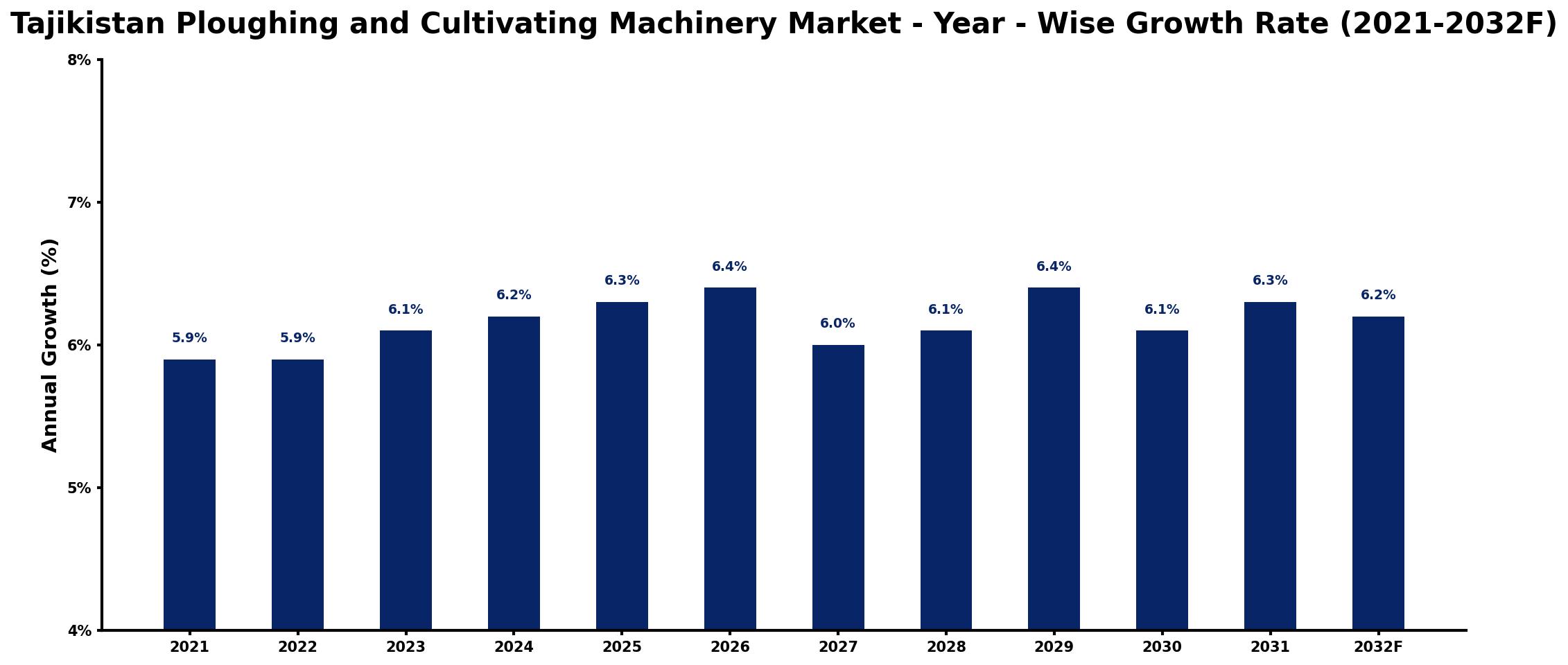
The table below presents the year‑wise growth rates along with the key drivers influencing the market
| Year | Growth Rate | Major Drivers |
| 2021 | 5.9% | Rising agricultural technology investments |
| 2022 | 5.9% | Increased demand for mechanization |
| 2023 | 6.1% | Expansion of farming cooperatives |
| 2024 | 6.2% | Government subsidies for farmers |
| 2025 | 6.3% | Growing export opportunities for crops |
| 2026 | 6.4% | Advancements in precision agriculture |
| 2027 | 6.0% | Strengthening agricultural supply chains |
| 2028 | 6.1% | Emergence of new farming practices |
| 2029 | 6.4% | Higher crop yield expectations |
| 2030 | 6.1% | Development of rural infrastructure projects |
| 2031 | 6.3% | Enhanced farmer training programs |
| 2032 | 6.2% | Adoption of sustainable farming methods |
Note: Market size estimations and growth projections presented in this report are based on 6Wresearch's proprietary forecasting methodology, utilizing the latest available industry data, government publications, and primary research inputs.
Tajikistan Ploughing and Cultivating Machinery Market Synopsis
The demand for ploughing and cultivating machinery in Tajikistan is rising as farmers strive to enhance crop yields through mechanization. A notable trend is the increasing purchase of multi-functional equipment, which is suited for the diverse terrains and climate conditions across the country. This shift towards modernization is essential in transitioning away from traditional farming practices.
Currently, the market is characterized by a variety of machinery tailored to meet the needs of both small-scale farmers and larger agricultural enterprises. While the market presents significant opportunities, barriers such as limited technology access and inadequate infrastructure remain persistent challenges that need addressing.
Tajikistan Ploughing and Cultivating Machinery Market Key Takeaways
- The market is witnessing a transition towards advanced machinery to boost agricultural productivity.
- Government initiatives are fostering mechanization through financial support and subsidies.
- Farmers are increasingly favoring eco-friendly and fuel-efficient machinery options.
- Investment opportunities abound in supplying high-quality agricultural equipment and services.
- Understanding regional needs is crucial for tailoring solutions to the unique agricultural landscape of Tajikistan.
Evaluation of Restraints in Tajikistan Ploughing and Cultivating Machinery Market
Despite the promising outlook for the Tajikistan Ploughing and Cultivating Machinery Market, several constraints impede rapid growth. Limited financial resources among small-scale farmers often inhibit their ability to invest in modern equipment, forcing reliance on traditional farming methods. Additionally, inadequate rural infrastructure hampers the distribution and maintenance of machinery, while a lack of technical knowledge poses further barriers to the effective adoption of advanced technology. The situation is exacerbated by a fluctuating economic landscape, which can create uncertainties for market players and potential investors.
Tajikistan Ploughing and Cultivating Machinery Market Trends
The market is currently marked by several key trends shaping its evolution. The shift toward sustainable practices is gaining traction, as farmers actively seek machinery that minimizes environmental impact. Advances in technology have prompted a demand for equipment that combines efficiency with versatility, addressing the varied agricultural needs across different regions. Furthermore, as mechanization becomes increasingly crucial for enhancing food security, government support is amplifying the emphasis on technological upgrades within the sector.
Tajikistan Ploughing and Cultivating Machinery Market Opportunities
Significant investment opportunities exist in the Tajikistan Ploughing and Cultivating Machinery Market, particularly for companies looking to introduce modern agricultural solutions. Given the government's commitment to agricultural development, there is a high demand for quality machinery and technical support services. Investors can find value in partnerships with local manufacturers to facilitate production and distribution while also providing training programs to enhance farmers' technical skills. Emphasizing research and development efforts to align products with local agricultural requirements can yield long-term benefits.
Government Initiatives in the Tajikistan Ploughing and Cultivating Machinery Market
The Tajikistan government has rolled out various supportive policies aimed at bolstering the Ploughing and Cultivating Machinery Market. These measures include subsidies and financial assistance for farmers to facilitate the purchase of modern machinery. To drive technological advancements, the government also promotes research and development initiatives, coupled with regulatory frameworks that ensure the safety and quality of agricultural machinery. Such initiatives aim to enhance productivity in the agricultural sector, aligning with national goals for food security and economic stability.
Future Insights of the Tajikistan Ploughing and Cultivating Machinery Market
Looking ahead to the period from 2026 to 2032, the Tajikistan Ploughing and Cultivating Machinery Market is expected to continue its moderate growth trajectory. Increasing mechanization efforts, coupled with rising awareness among farmers regarding the benefits of advanced equipment, will fuel market expansion. However, overcoming barriers such as limited financing options and technological access will be critical. As manufacturers and stakeholders adapt to these evolving dynamics, the market holds promising potential for innovation and efficiency.
Tajikistan Ploughing and Cultivating Machinery Market Latest Developments (2025 - 2026)
Recent developments in the Tajikistan Ploughing and Cultivating Machinery Market indicate a heightened focus on integrating advanced technologies into agricultural practices. There has been a noticeable increase in public and private partnerships aimed at enhancing the mechanization process. Additionally, companies are increasingly exploring sustainable practices within machinery production, aligning with global trends toward environmental consciousness. Furthermore, infrastructure improvements in rural areas are beginning to facilitate better access to machinery and technical support services.
Tajikistan Ploughing and Cultivating Machinery Market - Key Attractiveness of the Report
- 10 Years of Market Numbers
- Historical Data Starting from 2022 to 2025
- Base Year: 2025
- Forecast Data until 2032
- Key Performance Indicators Impacting the Market
- Major Upcoming Developments and Projects
Key Highlights of the Report:
- Tajikistan Ploughing and Cultivating Machinery Market Outlook
- Market Size of Tajikistan Ploughing and Cultivating Machinery Market, 2025
- Forecast of Tajikistan Ploughing and Cultivating Machinery Market, 2032
- Historical Data and Forecast of Tajikistan Ploughing and Cultivating Machinery Revenues & Volume for the Period 2022-2032F
- Tajikistan Ploughing and Cultivating Machinery Market Trend Evolution
- Tajikistan Ploughing and Cultivating Machinery Market Drivers and Challenges
- Tajikistan Ploughing and Cultivating Machinery Price Trends
- Tajikistan Ploughing and Cultivating Machinery Porter's Five Forces
- Tajikistan Ploughing and Cultivating Machinery Industry Life Cycle
- Historical Data and Forecast of Tajikistan Ploughing and Cultivating Machinery Market Revenues & Volume By Type for the Period 2022-2032F
- Historical Data and Forecast of Tajikistan Ploughing and Cultivating Machinery Market Revenues & Volume By Ploughs for the Period 2022-2032F
- Historical Data and Forecast of Tajikistan Ploughing and Cultivating Machinery Market Revenues & Volume By Harrows for the Period 2022-2032F
- Historical Data and Forecast of Tajikistan Ploughing and Cultivating Machinery Market Revenues & Volume By Others for the Period 2022-2032F
- Historical Data and Forecast of Tajikistan Ploughing and Cultivating Machinery Market Revenues & Volume By Application for the Period 2022-2032F
- Historical Data and Forecast of Tajikistan Ploughing and Cultivating Machinery Market Revenues & Volume By Soil Loosening for the Period 2022-2032F
- Historical Data and Forecast of Tajikistan Ploughing and Cultivating Machinery Market Revenues & Volume By Clod Size Reduction for the Period 2022-2032F
- Historical Data and Forecast of Tajikistan Ploughing and Cultivating Machinery Market Revenues & Volume By Clod Sorting for the Period 2022-2032F
- Historical Data and Forecast of Tajikistan Ploughing and Cultivating Machinery Market Revenues & Volume By Others for the Period 2022-2032F
- Tajikistan Ploughing and Cultivating Machinery Import Export Trade Statistics
- Market Opportunity Assessment By Type
- Market Opportunity Assessment By Application
- Tajikistan Ploughing and Cultivating Machinery Top Companies Market Share
- Tajikistan Ploughing and Cultivating Machinery Competitive Benchmarking By Technical and Operational Parameters
- Tajikistan Ploughing and Cultivating Machinery Company Profiles
- Tajikistan Ploughing and Cultivating Machinery Key Strategic Recommendations






































