Tajikistan Public Cloud Market Size & Growth Rate (2026-2032)
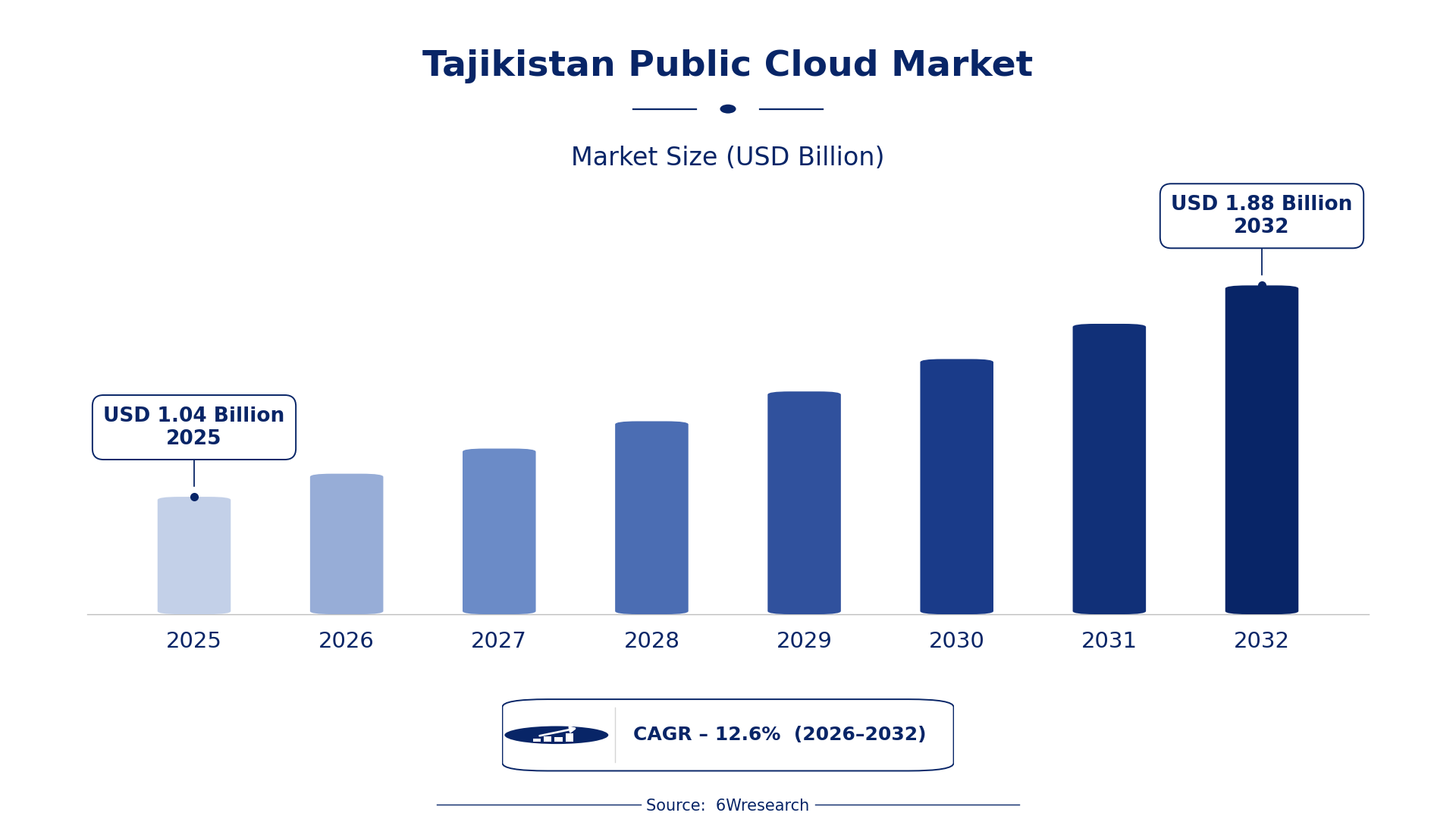
The Tajikistan Public Cloud Market was estimated at USD 1041 Million in 2025 and is projected to reach USD 1884 Million by 2032, growing at a CAGR of 12.6% from 2026 to 2032.
Tajikistan Public Cloud Market Synopsis
The Tajikistan public cloud market is witnessing an upward trajectory, spurred by the country’s digital transformation initiatives. As businesses across various sectors adopt cloud solutions for enhanced efficiency and scalability, the landscape is becoming increasingly competitive.
While the momentum is promising, challenges such as internet infrastructure deficiencies and data security concerns must be addressed. The government's commitment to modernizing ICT infrastructure will play a crucial role in shaping the future of public cloud services in Tajikistan.
Tajikistan Public Cloud Market Year-wise Growth Rate and Key Drivers
This graph illustrates the annual growth rates of the Tajikistan Public Cloud Market from 2021 to 2032, highlighting a steady upward trajectory and projected expansion over the forecast period.
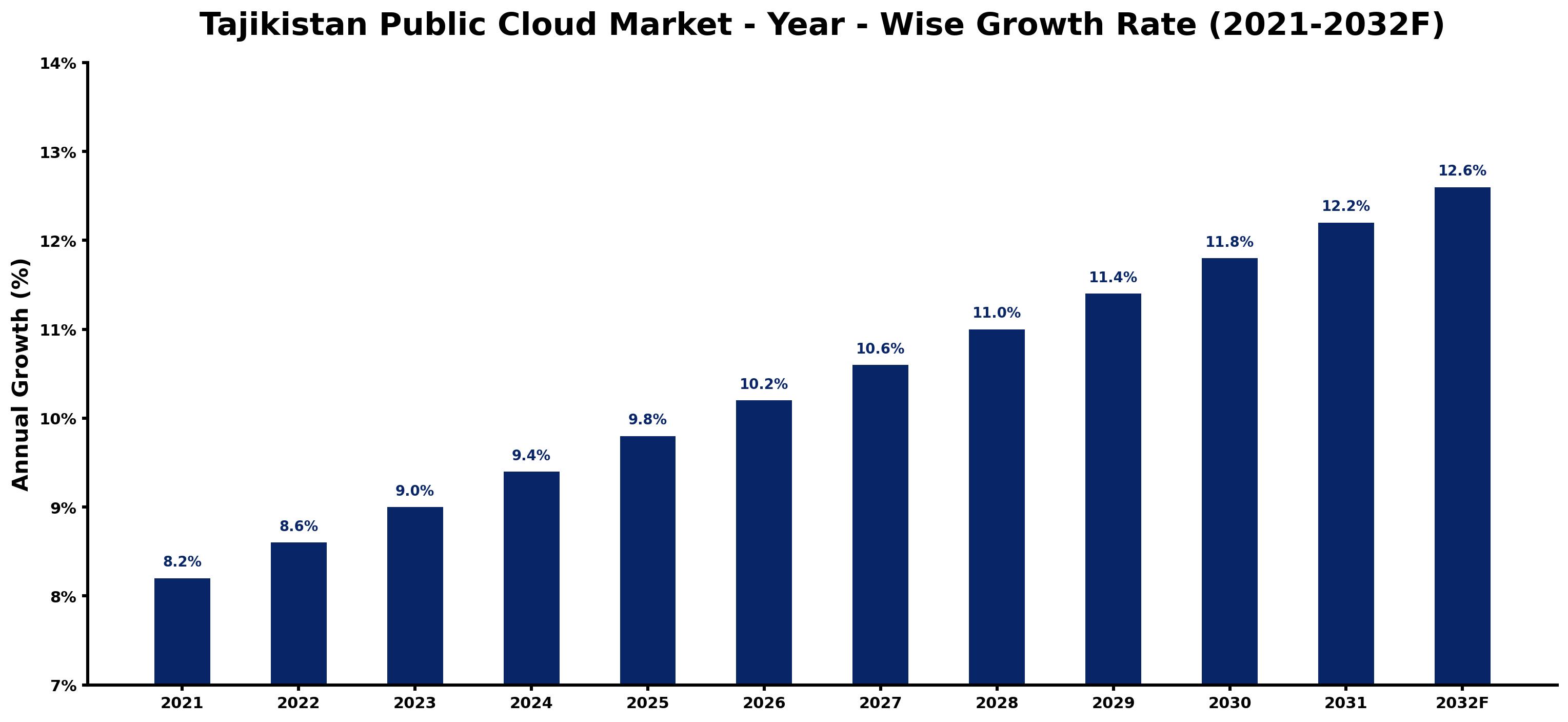
The table below presents the year‑wise growth rates along with the key drivers influencing the market
| Year | Growth Rate | Major Drivers |
| 2021 | 8.2% | Government's digitalization initiative boosting cloud adoption. |
| 2022 | 8.6% | Soaring mobile internet penetration enabling cloud services expansion. |
| 2023 | 9.0% | Local startups increasingly leveraging cloud for technological innovation. |
| 2024 | 9.4% | Increased foreign investment promoting cloud service infrastructures. |
| 2025 | 9.8% | Emergence of local cloud providers enhancing competitive offerings. |
| 2026 | 10.2% | Tajikistan's ICT policy encouraging tech sector growth. |
| 2027 | 10.6% | Youth demographic driving demand for digital solutions. |
| 2028 | 11.0% | Partnerships with global tech firms improving cloud services access. |
| 2029 | 11.4% | Regulatory enhancements supporting data protection and cloud security. |
| 2030 | 11.8% | Rise in digital literacy fostering cloud service utilization. |
| 2031 | 12.2% | Local universities offering cloud computing programs increasing skilled workforce. |
| 2032 | 12.6% | Government incentives for businesses to adopt cloud solutions. |
Note: Market size estimations and growth projections presented in this report are based on 6Wresearch's proprietary forecasting methodology, utilizing the latest available industry data, government publications, and primary research inputs.
Tajikistan Public Cloud Market Key Takeaways
Below are some of the specific key takeaways from the market, including:
- The market is set for substantial growth, with a projected size increase from USD 1041 Million in 2025 to USD 1884 Million by 2032.
- Increasing digitalization efforts are driving demand across key sectors such as government, healthcare, and finance.
- Hybrid cloud solutions are gaining traction as businesses seek to balance public and private cloud benefits.
- Data analytics and AI services are becoming essential offerings as organizations look to leverage cloud technologies.
- Challenges in internet infrastructure and data security need strategic solutions for widespread adoption.
Evaluation of Restraints in Tajikistan Public Cloud Market
Despite its growth potential, the Tajikistan public cloud market grapples with significant restraints. Limited internet access, especially in remote areas, hampers the broader adoption of cloud services. Additionally, businesses often express concerns about data security and the potential risks associated with storing sensitive information in the cloud. A lack of awareness about cloud benefits further slows the pace of adoption. Addressing these issues will require concerted efforts in infrastructure development, education, and regulatory support.
Tajikistan Public Cloud Market Trends
Several trends are currently shaping the Tajikistan public cloud market. Businesses are increasingly opting for hybrid cloud solutions, which allow them to utilize both public and private cloud environments for optimized performance. There is a notable rise in demand for cloud-based data analytics and AI services, as companies look to derive actionable insights from their data. on top of that, as organizations recognize the benefits of cloud technologies for operational efficiency, the adoption rates are expected to surge in the coming years.
Tajikistan Public Cloud Market Opportunities
The market presents a wealth of opportunities, particularly for small and medium enterprises eager to digitize their operations. Tailored cloud solutions catering to specific industries like finance, healthcare, and education are increasingly in demand. With the government's focus on ICT development and digital transformation, both domestic and international cloud service providers can capitalize on these emerging opportunities to expand their footprint in Tajikistan.
Government Initiatives in the Tajikistan Public Cloud Market
Government policy is instrumental in shaping the trajectory of the Tajikistan public cloud market. While there aren't specific regulations targeting cloud services, broader initiatives to enhance digital infrastructure and cybersecurity are underway. These efforts are crucial for boosting confidence in cloud adoption and ensuring a secure environment for businesses to operate in.
- A national digital infrastructure upgrade programme is currently in its rollout phase, aimed at improving internet connectivity across the country.
- Ongoing initiatives include the development of cybersecurity regulations that will safeguard data privacy and protection.
- Planned public-private partnerships are expected to enhance ICT infrastructure access by 2028, facilitating broader cloud service adoption.
- A regulatory framework introduced in 2025 mandates billing transparency for cloud services, fostering trust among consumers.
- Recent digital literacy programs launched in mid-2025 aim to educate businesses about the benefits of cloud computing.
Future Insights of the Tajikistan Public Cloud Market
Looking ahead to 2026-2032, the Tajikistan public cloud market is set for dynamic growth. The combination of increasing internet penetration and a government push for digital transformation will create a fertile ground for cloud adoption. This evolving environment suggests that we will see heightened investment from both local and international cloud service providers, ultimately leading to enhanced service offerings and competitive pricing for consumers.
Tajikistan Public Cloud Market Latest Developments
Over the past year, the Tajikistan public cloud market has seen a flurry of activity, with several initiatives aimed at bolstering cloud adoption and service delivery. As the focus on digital transformation intensifies, businesses are increasingly looking to cloud solutions to meet their operational needs.
- A major technology vendor launched a new cloud-based service in early 2025, targeting the healthcare sector to streamline data management.
- An initiative that began in mid-2025 focuses on enhancing cybersecurity measures for cloud services, ensuring safer user experiences.
- By the end of 2025, a leading regional operator is expected to introduce a new hybrid cloud solution designed for small businesses.
- A rollout planned for Q3 2026 aims to expand cloud service availability in rural areas, addressing accessibility challenges.
- Recently completed in early 2025, a collaborative project between government and private sectors focused on cloud education and awareness has been launched.
Tajikistan Public Cloud Market - Key Attractiveness of the Report
- 10 Years of Market Numbers
- Historical Data Starting from 2022 to 2025
- Base Year: 2025
- Forecast Data until 2032
- Key Performance Indicators Impacting the Market
- Major Upcoming Developments and Projects
Key Highlights of the Report:
- Tajikistan Public Cloud Market Outlook
- Market Size of Tajikistan Public Cloud Market, 2025
- Forecast of Tajikistan Public Cloud Market, 2032
- Historical Data and Forecast of Tajikistan Public Cloud Revenues & Volume for the Period 2022-2032F
- Tajikistan Public Cloud Market Trend Evolution
- Tajikistan Public Cloud Market Drivers and Challenges
- Tajikistan Public Cloud Price Trends
- Tajikistan Public Cloud Porter's Five Forces
- Tajikistan Public Cloud Industry Life Cycle
- Historical Data and Forecast of Tajikistan Public Cloud Market Revenues & Volume By Service Model for the Period 2022-2032F
- Historical Data and Forecast of Tajikistan Public Cloud Market Revenues & Volume By Infrastructure as a Service for the Period 2022-2032F
- Historical Data and Forecast of Tajikistan Public Cloud Market Revenues & Volume By Platform as a Service for the Period 2022-2032F
- Historical Data and Forecast of Tajikistan Public Cloud Market Revenues & Volume By Software as a Service for the Period 2022-2032F
- Historical Data and Forecast of Tajikistan Public Cloud Market Revenues & Volume By Organization Size Large enterprises for the Period 2022-2032F
- Historical Data and Forecast of Tajikistan Public Cloud Market Revenues & Volume By Small for the Period 2022-2032F
- Historical Data and Forecast of Tajikistan Public Cloud Market Revenues & Volume By Medium Enterprises SMEs for the Period 2022-2032F
- Historical Data and Forecast of Tajikistan Public Cloud Market Revenues & Volume By Verticals for the Period 2022-2032F
- Historical Data and Forecast of Tajikistan Public Cloud Market Revenues & Volume By BFSI for the Period 2022-2032F
- Historical Data and Forecast of Tajikistan Public Cloud Market Revenues & Volume By Telecommunication for the Period 2022-2032F
- Historical Data and Forecast of Tajikistan Public Cloud Market Revenues & Volume By IT & ITeS for the Period 2022-2032F
- Historical Data and Forecast of Tajikistan Public Cloud Market Revenues & Volume By Government & Public Sector for the Period 2022-2032F
- Historical Data and Forecast of Tajikistan Public Cloud Market Revenues & Volume By Retail & Consumer Goods for the Period 2022-2032F
- Historical Data and Forecast of Tajikistan Public Cloud Market Revenues & Volume By Manufacturing for the Period 2022-2032F
- Historical Data and Forecast of Tajikistan Public Cloud Market Revenues & Volume By Energy & Utility for the Period 2022-2032F
- Historical Data and Forecast of Tajikistan Public Cloud Market Revenues & Volume By Media & Entertainment for the Period 2022-2032F
- Tajikistan Public Cloud Import Export Trade Statistics
- Market Opportunity Assessment By Service Model
- Market Opportunity Assessment By Organization Size Large enterprises
- Market Opportunity Assessment By Verticals
- Tajikistan Public Cloud Top Companies Market Share
- Tajikistan Public Cloud Competitive Benchmarking By Technical and Operational Parameters
- Tajikistan Public Cloud Company Profiles
- Tajikistan Public Cloud Key Strategic Recommendations






































