Tajikistan Renewable Chemicals Market Size, Share & Growth Rate
The Tajikistan Renewable Chemicals Market was estimated at USD 489 Million in 2025 and is projected to reach USD 650 Million by 2032, growing at a CAGR of 4.1% from 2026 to 2032. This growth trajectory is fueled by an increasing demand for sustainable and environmentally friendly products across various sectors, alongside favorable government policies encouraging investment in renewable resources. As awareness of climate change issues rises, both consumers and businesses in Tajikistan are increasingly shifting toward renewable chemical alternatives, driving market expansion.
Tajikistan Renewable Chemicals Market Year-wise Growth Rate and Key Drivers
This graph highlights how the Tajikistan Renewable Chemicals Market has steadily grown over the years, supported by major growth factors.
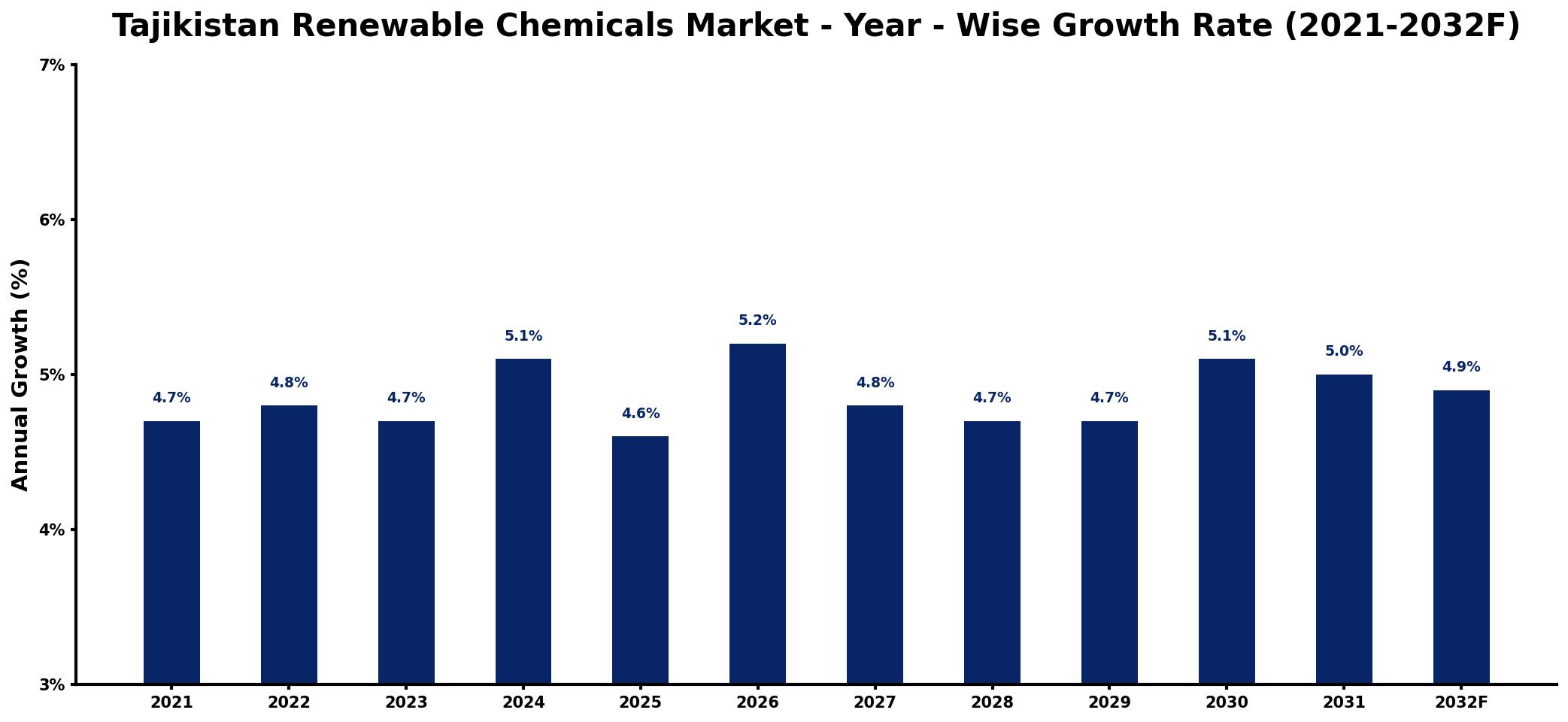
The table below presents the year‑wise growth rates along with the key drivers influencing the market
| Year | Growth Rate | Major Drivers |
| 2021 | 4.7% | Rising consumer demand for sustainability |
| 2022 | 4.8% | Increased investments in green technologies |
| 2023 | 4.7% | Expansion of eco-friendly product lines |
| 2024 | 5.1% | Growth in bio-based material applications |
| 2025 | 4.6% | Strengthened regulatory support for sustainability |
| 2026 | 5.2% | Emergence of new market players |
| 2027 | 4.8% | rising procurement volume requirements |
| 2028 | 4.7% | strengthening international trade flows |
| 2029 | 4.7% | Development of innovative production methods |
| 2030 | 5.1% | Growing partnerships in sustainable industries |
| 2031 | 5.0% | improved processing technologies adoption |
| 2032 | 4.9% | improved raw material availability |
Note: Market size estimations and growth projections presented in this report are based on 6Wresearch's proprietary forecasting methodology, utilizing the latest available industry data, government publications, and primary research inputs.
Tajikistan Renewable Chemicals Market Synopsis
The Tajikistan renewable chemicals market is gaining momentum, reflecting the nations commitment to sustainable development. With a focus on reducing carbon emissions, industries are exploring bio-based chemicals and bioplastics as effective alternatives to traditional petrochemicals.
Despite being in its early stages, the market is characterized by a growing interest from both consumers and manufacturers in adopting renewable solutions. Challenges remain, particularly related to infrastructure and awareness, yet the potential for growth is substantial as Tajikistan aligns itself with global sustainability goals.
Tajikistan Renewable Chemicals Market Key Takeaways
- The market is on a growth trajectory, driven by increasing environmental awareness and government support.
- Investment opportunities in bio-based chemicals are emerging as local companies seek innovative solutions.
- The shift towards renewable chemicals is evident across sectors like agriculture, healthcare, and manufacturing.
- Infrastructure development is critical for enhancing production and distribution capabilities in the market.
- Government policies are becoming increasingly favorable, creating a conducive environment for market players.
Evaluation of Restraints in Tajikistan Renewable Chemicals Market
The growth of the Tajikistan renewable chemicals market is impeded by several constraints that demand attention. A primary concern is the limited infrastructure needed for the efficient production and distribution of renewable chemicals. Additionally, a lack of awareness regarding the benefits and applications of renewable chemicals among both consumers and industries hinders market penetration. The competition posed by established petroleum-based chemical products presents another significant challenge. Addressing these issues will require dedicated investments in infrastructure, educational initiatives, and strategic partnerships with international entities to gain access to technology and expertise.
Tajikistan Renewable Chemicals Market Trends
The demand for renewable chemicals in Tajikistan is being shaped by several key trends. Firstly, there is a pronounced consumer shift towards products made from renewable resources, such as biomass and agricultural waste. This is partly driven by increased environmental consciousness and the desire for safer, greener alternatives in everyday products. Furthermore, companies are channeling resources into research and development, focusing on the creation of innovative bio-based feedstocks and manufacturing processes. As the market evolves, a clear trend toward sustainable practices across various industries is becoming more pronounced.
Tajikistan Renewable Chemicals Market Opportunities
The Tajikistan renewable chemicals market presents a wealth of investment opportunities, particularly in the development of bio-based chemicals sourced from local agricultural and forestry resources. The rising global emphasis on sustainability bolsters demand across sectors including pharmaceuticals, agriculture, and cosmetics. Investors are well-positioned to collaborate with local businesses, leveraging government incentives while tapping into the increasing trend of eco-friendly products. As the market matures, the potential for innovation and long-term profitability will likely attract further interest and investment.
Government Initiatives in the Tajikistan Renewable Chemicals Market
The Tajikistan government has implemented various initiatives aimed at promoting the renewable chemicals sector. Key actions include the National Renewable Energy Program, which seeks to elevate the share of renewable sources in the overall energy mix. Additionally, tax incentives and subsidies are being extended to businesses that invest in renewable chemicals production. Regulations are also being put in place to encourage environmentally friendly practices within the chemical industry, which fosters innovation and economic development.
Future Insights of the Tajikistan Renewable Chemicals Market
Looking ahead to 2026-2032, the Tajikistan Renewable Chemicals Market is poised for steady growth. The emphasis on sustainable practices globally and the governments initiatives aimed at attracting foreign investments are expected to be significant catalysts. With abundant biomass resources available for processing, the market has vast potential for development. Advancements in technology and a broader acceptance of green chemistry will further drive market expansion, ultimately contributing to job creation and economic advancement in the country.
Tajikistan Renewable Chemicals Market Latest Developments (2025 - 2026)
Recent developments in the Tajikistan renewable chemicals market highlight an increasing focus on sustainability. There is a marked interest from local businesses to adopt bio-based alternatives, driven by both market demand and regulatory incentives. Additionally, partnerships between local firms and international entities are beginning to flourish, aimed at enhancing production capabilities and sharing technological expertise. These collaborative efforts reflect a growing recognition of the importance of renewable chemicals in Tajikistan's economic landscape.
Tajikistan Renewable Chemicals Market - Key Attractiveness of the Report
- 10 Years of Market Numbers
- Historical Data Starting from 2022 to 2025
- Base Year: 2025
- Forecast Data until 2032
- Key Performance Indicators Impacting the Market
- Major Upcoming Developments and Projects
Key Highlights of the Report:
- Tajikistan Renewable Chemicals Market Outlook
- Market Size of Tajikistan Renewable Chemicals Market, 2025
- Forecast of Tajikistan Renewable Chemicals Market, 2032
- Historical Data and Forecast of Tajikistan Renewable Chemicals Revenues & Volume for the Period 2022-2032F
- Tajikistan Renewable Chemicals Market Trend Evolution
- Tajikistan Renewable Chemicals Market Drivers and Challenges
- Tajikistan Renewable Chemicals Price Trends
- Tajikistan Renewable Chemicals Porter's Five Forces
- Tajikistan Renewable Chemicals Industry Life Cycle
- Historical Data and Forecast of Tajikistan Renewable Chemicals Market Revenues & Volume By Product Type for the Period 2022-2032F
- Historical Data and Forecast of Tajikistan Renewable Chemicals Market Revenues & Volume By Alcohols for the Period 2022-2032F
- Historical Data and Forecast of Tajikistan Renewable Chemicals Market Revenues & Volume By Organic Acids for the Period 2022-2032F
- Historical Data and Forecast of Tajikistan Renewable Chemicals Market Revenues & Volume By Ketones for the Period 2022-2032F
- Historical Data and Forecast of Tajikistan Renewable Chemicals Market Revenues & Volume By Platform Chemicals for the Period 2022-2032F
- Historical Data and Forecast of Tajikistan Renewable Chemicals Market Revenues & Volume By Biopolymers for the Period 2022-2032F
- Historical Data and Forecast of Tajikistan Renewable Chemicals Market Revenues & Volume By Others for the Period 2022-2032F
- Historical Data and Forecast of Tajikistan Renewable Chemicals Market Revenues & Volume By Applications for the Period 2022-2032F
- Historical Data and Forecast of Tajikistan Renewable Chemicals Market Revenues & Volume By Transportation for the Period 2022-2032F
- Historical Data and Forecast of Tajikistan Renewable Chemicals Market Revenues & Volume By Textiles for the Period 2022-2032F
- Historical Data and Forecast of Tajikistan Renewable Chemicals Market Revenues & Volume By Food safety for the Period 2022-2032F
- Historical Data and Forecast of Tajikistan Renewable Chemicals Market Revenues & Volume By Environment for the Period 2022-2032F
- Historical Data and Forecast of Tajikistan Renewable Chemicals Market Revenues & Volume By Communication for the Period 2022-2032F
- Historical Data and Forecast of Tajikistan Renewable Chemicals Market Revenues & Volume By Housing for the Period 2022-2032F
- Historical Data and Forecast of Tajikistan Renewable Chemicals Market Revenues & Volume By Recreation for the Period 2022-2032F
- Historical Data and Forecast of Tajikistan Renewable Chemicals Market Revenues & Volume By Other Applications for the Period 2022-2032F
- Tajikistan Renewable Chemicals Import Export Trade Statistics
- Market Opportunity Assessment By Product Type
- Market Opportunity Assessment By Applications
- Tajikistan Renewable Chemicals Top Companies Market Share
- Tajikistan Renewable Chemicals Competitive Benchmarking By Technical and Operational Parameters
- Tajikistan Renewable Chemicals Company Profiles
- Tajikistan Renewable Chemicals Key Strategic Recommendations






































