Tajikistan Robotic Vacuum Cleaner Market Size, Share & Growth Rate
The Tajikistan Robotic Vacuum Cleaner Market was estimated at USD 447 Million in 2025 and is projected to reach USD 598 Million by 2032, growing at a CAGR of 4.2% from 2026 to 2032. This growth trajectory is primarily fueled by increasing urbanization, where more households are embracing modern living solutions. The combination of busy lifestyles and a rising middle class in Tajikistan is driving the demand for convenient cleaning technologies, resulting in a shift from traditional vacuum cleaners to robotic alternatives.
Tajikistan Robotic Vacuum Cleaner Market Year-wise Growth Rate and Key Drivers
This graph highlights how the Tajikistan Robotic Vacuum Cleaner Market has steadily grown over the years, supported by major growth factors.
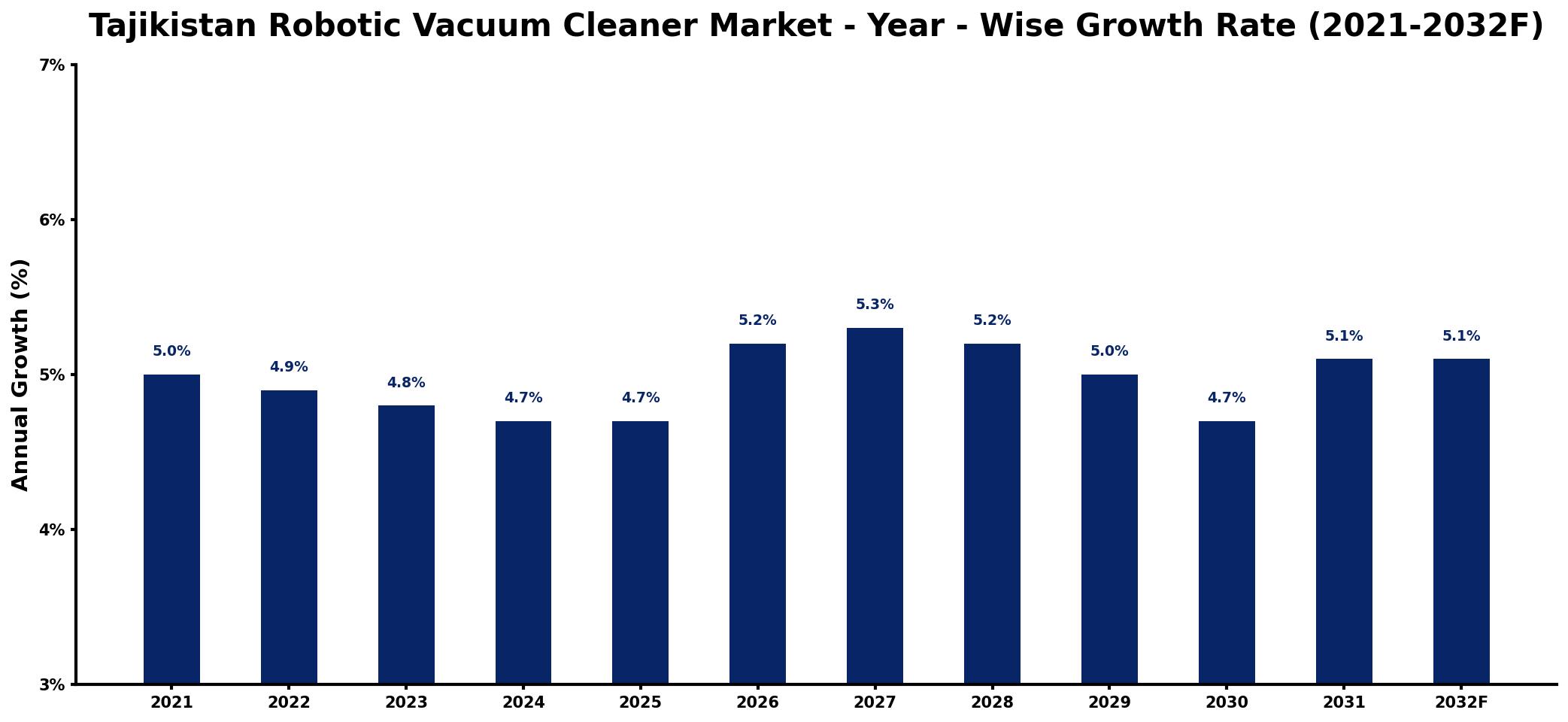
The table below presents the year‑wise growth rates along with the key drivers influencing the market
| Year | Growth Rate | Major Drivers |
| 2021 | 5.0% | Rising consumer interest in automation |
| 2022 | 4.9% | Increased disposable income levels |
| 2023 | 4.8% | Growth in smart home technology |
| 2024 | 4.7% | Expansion of online retail channels |
| 2025 | 4.7% | Emergence of eco-friendly alternatives |
| 2026 | 5.2% | Technological advancements in AI |
| 2027 | 5.3% | Higher urban population density |
| 2028 | 5.2% | Increased awareness of hygiene standards |
| 2029 | 5.0% | Investment in home automation systems |
| 2030 | 4.7% | Growing trend of remote work |
| 2031 | 5.1% | growing regional consumption patterns |
| 2032 | 5.1% | Rising demand for convenience solutions |
Note: Market size estimations and growth projections presented in this report are based on 6Wresearch's proprietary forecasting methodology, utilizing the latest available industry data, government publications, and primary research inputs.
Tajikistan Robotic Vacuum Cleaner Market Synopsis
In Tajikistan, the demand for robotic vacuum cleaners is becoming increasingly pronounced as consumers seek solutions that blend efficiency with ease of use. The growing penetration of smart home technologies is encouraging households to invest in automated devices that complement their fast-paced lives.
Moreover, the introduction of advanced features such as app connectivity and voice control is reshaping consumer expectations. This trend suggests that the market is not only about cleaning but also about enhancing the overall lifestyle through technology.
Tajikistan Robotic Vacuum Cleaner Market Key Takeaways
- Increased urbanization and rising disposable incomes are key growth drivers.
- Consumer interest in smart home technologies is rapidly evolving.
- Advanced features are becoming crucial for competitive differentiation in the market.
- There is a growing demand for eco-friendly and energy-efficient models.
- Marketing strategies focusing on customer education are vital for market penetration.
Evaluation of Restraints in Tajikistan Robotic Vacuum Cleaner Market
Despite the promising growth, the Tajikistan Robotic Vacuum Cleaner Market faces several constraints. High costs compared to traditional vacuum cleaners limit widespread consumer adoption. Additionally, the limited availability of these devices in retail outlets restricts access for potential buyers. Moreover, concerns about the effectiveness of robotic vacuum cleaners in addressing specific cleaning needs, such as the management of local dust and pet hair, hinder market expansion. This necessitates targeted marketing and consumer education to demonstrate the value of these advanced cleaning solutions.
Tajikistan Robotic Vacuum Cleaner Market Trends
Emerging trends in the Tajikistan Robotic Vacuum Cleaner Market indicate a strong consumer preference for high-tech features. Models equipped with autonomous navigation systems and mapping capabilities are gaining traction as they offer improved cleaning efficiency. There is also an increasing awareness of eco-friendly products, which is prompting manufacturers to develop energy-efficient robotic vacuum cleaners. As consumers become more tech-savvy, the integration of artificial intelligence is expected to further enhance product appeal, driving the market forward.
Tajikistan Robotic Vacuum Cleaner Market Opportunities
Investment opportunities in the Tajikistan robotic vacuum cleaner market are on the rise. The expanding middle class presents a burgeoning customer base eager for home automation products. The growing trend toward urbanization leads to households seeking convenient solutions for maintenance chores. Collaborations with local retailers and online marketplaces can significantly widen market reach. Furthermore, emphasizing the time-saving aspects of robotic vacuum cleaners in marketing campaigns will likely resonate with busy urban dwellers, enhancing adoption rates.
Government Initiatives in the Tajikistan Robotic Vacuum Cleaner Market
Currently, the Tajikistan government does not have specific policies dedicated to the robotic vacuum cleaner market. However, existing trade regulations and import policies will apply to this category. Tajikistan's membership in the Eurasian Economic Union (EAEU) establishes common customs duties and regulations, impacting the import process for these technologies. Companies looking to enter this market must be aware of consumer protection laws and product safety standards to effectively navigate regulatory landscapes.
Future Insights of the Tajikistan Robotic Vacuum Cleaner Market
Looking ahead to 2026-2032, the Tajikistan robotic vacuum cleaner market is poised for considerable expansion. Increasing disposable incomes and an emphasis on smart home integration will drive adoption rates. Advancements in technology, especially in sensors and AI capabilities, promise to enhance the usability and effectiveness of these devices. As consumer lifestyles increasingly prioritize convenience, the demand for innovative cleaning solutions is expected to surge, setting the stage for dynamic growth in this sector.
Tajikistan Robotic Vacuum Cleaner Market Latest Developments (2025 - 2026)
Recent developments in the Tajikistan robotic vacuum cleaner market indicate a growing trend toward integrating smart features in home appliances. Many manufacturers are focusing on enhancing connectivity options and user interfaces to appeal to tech-savvy consumers. Furthermore, promotional events and consumer education campaigns have emerged as essential strategies to raise awareness about the benefits of robotic cleaning solutions. As the market evolves, competitive dynamics among various brands are expected to intensify, influencing pricing and feature offerings.
Tajikistan Robotic Vacuum Cleaner Market - Key Attractiveness of the Report
- 10 Years of Market Numbers
- Historical Data Starting from 2022 to 2025
- Base Year: 2025
- Forecast Data until 2032
- Key Performance Indicators Impacting the Market
- Major Upcoming Developments and Projects
Key Highlights of the Report:
- Tajikistan Robotic Vacuum Cleaner Market Outlook
- Market Size of Tajikistan Robotic Vacuum Cleaner Market, 2025
- Forecast of Tajikistan Robotic Vacuum Cleaner Market, 2032
- Historical Data and Forecast of Tajikistan Robotic Vacuum Cleaner Revenues & Volume for the Period 2022-2032F
- Tajikistan Robotic Vacuum Cleaner Market Trend Evolution
- Tajikistan Robotic Vacuum Cleaner Market Drivers and Challenges
- Tajikistan Robotic Vacuum Cleaner Price Trends
- Tajikistan Robotic Vacuum Cleaner Porter's Five Forces
- Tajikistan Robotic Vacuum Cleaner Industry Life Cycle
- Historical Data and Forecast of Tajikistan Robotic Vacuum Cleaner Market Revenues & Volume By Type for the Period 2022-2032F
- Historical Data and Forecast of Tajikistan Robotic Vacuum Cleaner Market Revenues & Volume By Floor Vacuum Cleaner for the Period 2022-2032F
- Historical Data and Forecast of Tajikistan Robotic Vacuum Cleaner Market Revenues & Volume By Window Vacuum Cleaner for the Period 2022-2032F
- Historical Data and Forecast of Tajikistan Robotic Vacuum Cleaner Market Revenues & Volume By Pool Vacuum Cleaner for the Period 2022-2032F
- Historical Data and Forecast of Tajikistan Robotic Vacuum Cleaner Market Revenues & Volume By Application for the Period 2022-2032F
- Historical Data and Forecast of Tajikistan Robotic Vacuum Cleaner Market Revenues & Volume By Household for the Period 2022-2032F
- Historical Data and Forecast of Tajikistan Robotic Vacuum Cleaner Market Revenues & Volume By Commercial for the Period 2022-2032F
- Historical Data and Forecast of Tajikistan Robotic Vacuum Cleaner Market Revenues & Volume By Operation Mode for the Period 2022-2032F
- Historical Data and Forecast of Tajikistan Robotic Vacuum Cleaner Market Revenues & Volume By Self-Drive for the Period 2022-2032F
- Historical Data and Forecast of Tajikistan Robotic Vacuum Cleaner Market Revenues & Volume By Remote Control for the Period 2022-2032F
- Historical Data and Forecast of Tajikistan Robotic Vacuum Cleaner Market Revenues & Volume By Distribution Channel for the Period 2022-2032F
- Historical Data and Forecast of Tajikistan Robotic Vacuum Cleaner Market Revenues & Volume By Online for the Period 2022-2032F
- Historical Data and Forecast of Tajikistan Robotic Vacuum Cleaner Market Revenues & Volume By Offline for the Period 2022-2032F
- Historical Data and Forecast of Tajikistan Robotic Vacuum Cleaner Market Revenues & Volume By Price for the Period 2022-2032F
- Historical Data and Forecast of Tajikistan Robotic Vacuum Cleaner Market Revenues & Volume By Below USD 150 for the Period 2022-2032F
- Historical Data and Forecast of Tajikistan Robotic Vacuum Cleaner Market Revenues & Volume By USD 150 - 300 for the Period 2022-2032F
- Historical Data and Forecast of Tajikistan Robotic Vacuum Cleaner Market Revenues & Volume By USD 300 - 500 for the Period 2022-2032F
- Historical Data and Forecast of Tajikistan Robotic Vacuum Cleaner Market Revenues & Volume By Above USD 500 for the Period 2022-2032F
- Tajikistan Robotic Vacuum Cleaner Import Export Trade Statistics
- Market Opportunity Assessment By Type
- Market Opportunity Assessment By Application
- Market Opportunity Assessment By Operation Mode
- Market Opportunity Assessment By Distribution Channel
- Market Opportunity Assessment By Price
- Tajikistan Robotic Vacuum Cleaner Top Companies Market Share
- Tajikistan Robotic Vacuum Cleaner Competitive Benchmarking By Technical and Operational Parameters
- Tajikistan Robotic Vacuum Cleaner Company Profiles
- Tajikistan Robotic Vacuum Cleaner Key Strategic Recommendations






































