Tajikistan Secondhand Apparel Market Size, Share & Growth Rate
The Tajikistan Secondhand Apparel Market was estimated at USD 389 Million in 2025 and is projected to reach USD 524 Million by 2032, growing at a CAGR of 4.3% from 2026 to 2032. This trajectory is driven by a shifting consumer mindset favoring sustainability and the economic advantages of purchasing pre-owned garments, particularly among the emerging middle class. Additionally, the growth of online platforms further enhances accessibility, catering to a broad demographic seeking unique fashion choices without the premium price tag.
Tajikistan Secondhand Apparel Market Year-wise Growth Rate and Key Drivers
This graph highlights how the Tajikistan Secondhand Apparel Market has steadily grown over the years, supported by major growth factors.
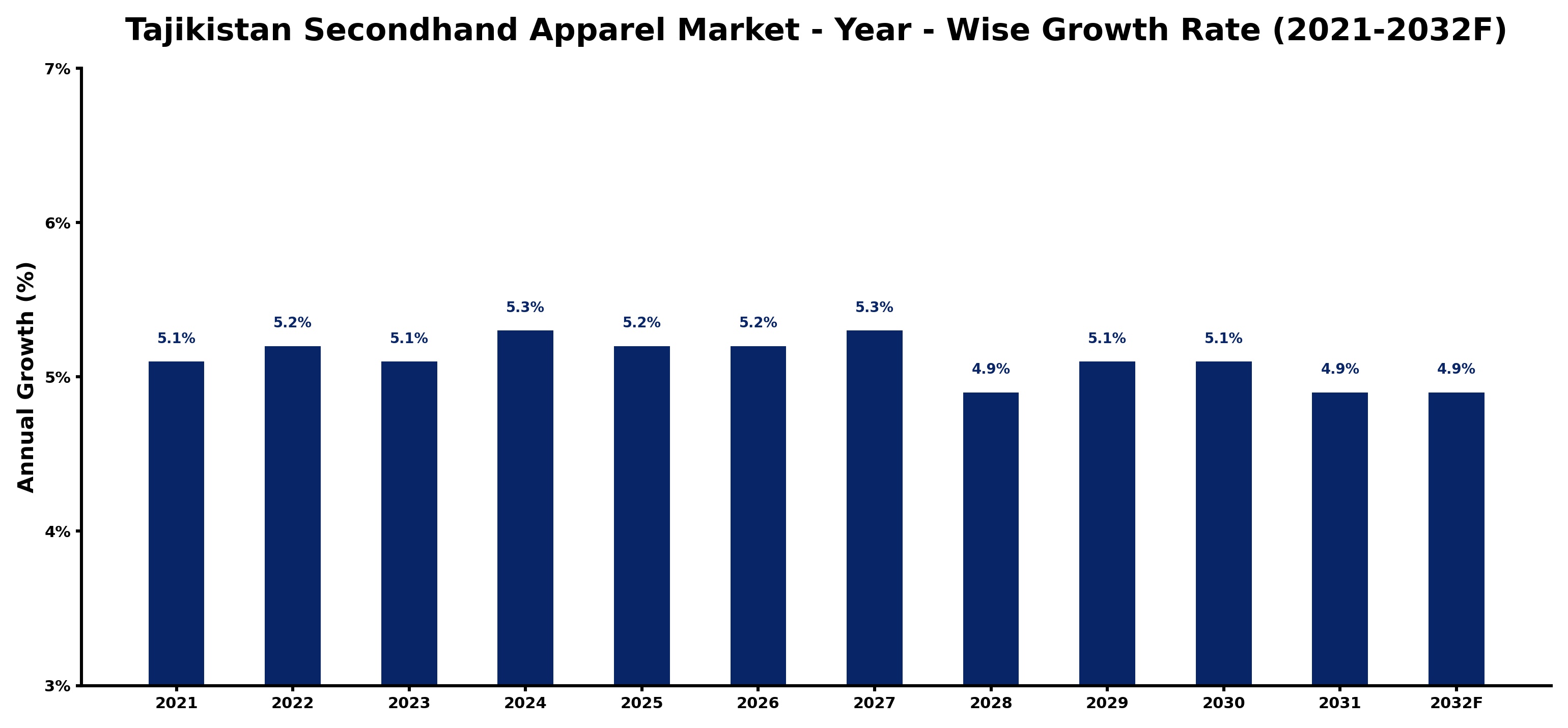
The table below presents the year‑wise growth rates along with the key drivers influencing the market
| Year | Growth Rate | Major Drivers |
| 2021 | 5.1% | Increasing industrial automation investments |
| 2022 | 5.2% | Rapid growth in telecom and data center sectors |
| 2023 | 5.1% | Expansion of manufacturing activities |
| 2024 | 5.3% | Expansion of transportation and logistics networks |
| 2025 | 5.2% | Increasing industrial automation investments |
| 2026 | 5.2% | Growing urbanization and commercial development |
| 2027 | 5.3% | Growing urbanization and commercial development |
| 2028 | 4.9% | Expansion of commercial construction activities |
| 2029 | 5.1% | Growing urbanization and commercial development |
| 2030 | 5.1% | Growing renewable energy integration projects |
| 2031 | 4.9% | Increasing industrial automation investments |
| 2032 | 4.9% | Increasing adoption of advanced technologies |
Note - Market size estimations and growth projections presented in this report are based on 6Wresearch’s advanced forecasting approach, validated with industry datasets as of June 2026.
Tajikistan Secondhand Apparel Market Synopsis
In Tajikistan, the secondhand apparel market is characterized by a rich tapestry of local markets and online platforms where consumers can find an array of unique and vintage clothing. This diverse supply caters to a growing demand for affordable fashion options, particularly among youth and budget-conscious families. The appeal of gently used clothing is amplified by an increasing cultural acceptance of secondhand shopping as a valid and stylish choice.
The popularity of secondhand apparel is further propelled by heightened awareness of sustainability and environmental concerns associated with fast fashion. Consumers are increasingly inclined to explore thrift options as a means of expressing individuality while making eco-conscious choices, thereby redefining the fashion landscape in Tajikistan.
Tajikistan Secondhand Apparel Market Key Takeaways
- The market is evolving with increasing consumer awareness of sustainable fashion practices.
- Affordability drives demand, particularly among budget-conscious shoppers and a burgeoning middle class.
- Online platforms and social media are pivotal in promoting secondhand clothing accessibility.
- Government regulations support the market by balancing import restrictions and local textile production.
- Investment opportunities abound for businesses focusing on collecting and reselling gently used garments.
Evaluation of Restraints in Tajikistan Secondhand Apparel Market
Despite its growth, the Tajikistan Secondhand Apparel Market faces significant challenges. Concerns about quality control and the presence of counterfeit items can damage consumer perceptions of secondhand clothing. Furthermore, inadequate distribution networks limit the availability of popular items, while the lack of robust regulations allows unauthorized replicas to proliferate. Stigma surrounding secondhand purchases in certain segments of society remains a barrier to expanding the customer base. Addressing these challenges through enhanced quality control and targeted marketing strategies is essential for fostering a positive market image.
Tajikistan Secondhand Apparel Market Trends
Current trends indicate a strong shift towards vintage and unique apparel, which resonates particularly well with younger consumers seeking to differentiate their style. This trend is further supported by rising social media influence, where platforms showcase thrifted outfits, thus enhancing their appeal. Additionally, sustainable practices such as upcycling and recycling are gaining traction, shaping consumer behavior and expectations within the market. These trends reflect a broader societal move toward eco-friendliness, signaling a promising future for the secondhand apparel sector.
Tajikistan Secondhand Apparel Market Opportunities
The landscape for investment in the Tajikistan Secondhand Apparel Market is bright, especially given the rising demand for affordable clothing. Opportunities exist for entrepreneurs to establish businesses that specialize in sourcing and curating quality secondhand garments. Moreover, the digital space offers tremendous potential, with online marketplaces that facilitate the buying and selling of pre-owned items likely to thrive. By capitalizing on the dual trends of cost-effectiveness and sustainability, investors can tap into a burgeoning market with significant growth potential.
Government Initiatives in the Tajikistan Secondhand Apparel Market
The Tajik government has implemented various policies aimed at regulating the secondhand apparel market. These include import restrictions to safeguard domestic textile industries and quality control measures to ensure that incoming secondhand products meet safety standards. Furthermore, taxation policies on imported secondhand clothing encourage local production while simultaneously promoting sustainable practices like recycling and upcycling. These initiatives reflect a strategic approach to balancing consumer needs with local economic support and environmental considerations.
Future Insights of the Tajikistan Secondhand Apparel Market
Looking ahead to 2026-2032, the Tajikistan Secondhand Apparel Market is poised for continued expansion. With the increasing popularity of sustainable fashion and thrift shopping, demand is expected to escalate. As disposable incomes rise, more consumers are likely to view secondhand clothing as an attractive alternative to new garments, particularly those that offer unique aesthetic value. Additionally, the continuous evolution of online platforms will enhance shopping convenience and accessibility, driving further growth in this dynamic market.
Tajikistan Secondhand Apparel Market Latest Developments (May 2025 - June 2026)
Recent developments in the Tajikistan secondhand apparel market reflect a growing trend toward digital transformation. The rise of local e-commerce platforms dedicated to secondhand clothing has made it easier for consumers to buy and sell pre-owned items. Additionally, community-based initiatives promoting thrift shops and clothing swaps are gaining traction, further embedding the culture of sustainable fashion within Tajik society. As these trends unfold, the market is likely to experience shifts that enhance both consumer engagement and industry sustainability.
Tajikistan Secondhand Apparel Market - Key Attractiveness of the Report
- 10 Years of Market Numbers
- Historical Data Starting from 2022 to 2025
- Base Year: 2025
- Forecast Data until 2032
- Key Performance Indicators Impacting the Market
- Major Upcoming Developments and Projects
Key Highlights of the Report:
- Tajikistan Secondhand Apparel Market Outlook
- Market Size of Tajikistan Secondhand Apparel Market, 2025
- Forecast of Tajikistan Secondhand Apparel Market, 2032
- Historical Data and Forecast of Tajikistan Secondhand Apparel Revenues & Volume for the Period 2022-2032F
- Tajikistan Secondhand Apparel Market Trend Evolution
- Tajikistan Secondhand Apparel Market Drivers and Challenges
- Tajikistan Secondhand Apparel Price Trends
- Tajikistan Secondhand Apparel Porter's Five Forces
- Tajikistan Secondhand Apparel Industry Life Cycle
- Historical Data and Forecast of Tajikistan Secondhand Apparel Market Revenues & Volume By Sector for the Period 2022-2032F
- Historical Data and Forecast of Tajikistan Secondhand Apparel Market Revenues & Volume By Resale for the Period 2022-2032F
- Historical Data and Forecast of Tajikistan Secondhand Apparel Market Revenues & Volume By Traditional Thrift Stores and Donations for the Period 2022-2032F
- Historical Data and Forecast of Tajikistan Secondhand Apparel Market Revenues & Volume By Product Type for the Period 2022-2032F
- Historical Data and Forecast of Tajikistan Secondhand Apparel Market Revenues & Volume By Dresses & Tops for the Period 2022-2032F
- Historical Data and Forecast of Tajikistan Secondhand Apparel Market Revenues & Volume By Shirts & T-shirts for the Period 2022-2032F
- Historical Data and Forecast of Tajikistan Secondhand Apparel Market Revenues & Volume By Sweaters, Coats & Jackets for the Period 2022-2032F
- Historical Data and Forecast of Tajikistan Secondhand Apparel Market Revenues & Volume By Jeans & Pants for the Period 2022-2032F
- Historical Data and Forecast of Tajikistan Secondhand Apparel Market Revenues & Volume By Others for the Period 2022-2032F
- Historical Data and Forecast of Tajikistan Secondhand Apparel Market Revenues & Volume By Target Population for the Period 2022-2032F
- Historical Data and Forecast of Tajikistan Secondhand Apparel Market Revenues & Volume By Men for the Period 2022-2032F
- Historical Data and Forecast of Tajikistan Secondhand Apparel Market Revenues & Volume By Women for the Period 2022-2032F
- Historical Data and Forecast of Tajikistan Secondhand Apparel Market Revenues & Volume By Kids for the Period 2022-2032F
- Historical Data and Forecast of Tajikistan Secondhand Apparel Market Revenues & Volume By Sales Channel for the Period 2022-2032F
- Historical Data and Forecast of Tajikistan Secondhand Apparel Market Revenues & Volume By Wholesalers/Distributors for the Period 2022-2032F
- Historical Data and Forecast of Tajikistan Secondhand Apparel Market Revenues & Volume By Hypermarkets/Supermarkets for the Period 2022-2032F
- Historical Data and Forecast of Tajikistan Secondhand Apparel Market Revenues & Volume By Multi-brand Stores for the Period 2022-2032F
- Historical Data and Forecast of Tajikistan Secondhand Apparel Market Revenues & Volume By Independent Small Stores for the Period 2022-2032F
- Historical Data and Forecast of Tajikistan Secondhand Apparel Market Revenues & Volume By Departmental Stores for the Period 2022-2032F
- Historical Data and Forecast of Tajikistan Secondhand Apparel Market Revenues & Volume By Online Retailers for the Period 2022-2032F
- Historical Data and Forecast of Tajikistan Secondhand Apparel Market Revenues & Volume By Others for the Period 2022-2032F
- Tajikistan Secondhand Apparel Import Export Trade Statistics
- Market Opportunity Assessment By Sector
- Market Opportunity Assessment By Product Type
- Market Opportunity Assessment By Target Population
- Market Opportunity Assessment By Sales Channel
- Tajikistan Secondhand Apparel Top Companies Market Share
- Tajikistan Secondhand Apparel Competitive Benchmarking By Technical and Operational Parameters
- Tajikistan Secondhand Apparel Company Profiles
- Tajikistan Secondhand Apparel Key Strategic Recommendations






































