Tajikistan Security Door Market Size, Share & Growth Rate
The Tajikistan Security Door Market was estimated at USD 257 Million in 2025 and is projected to reach USD 344 Million by 2032, growing at a CAGR of 4.3% from 2026 to 2032. This growth is propelled by increasing urbanization, a burgeoning middle class, and heightened awareness of the necessity for residential and commercial security solutions. Consumers are prioritizing the installation of high-quality, technologically advanced security doors as they seek to protect their homes and businesses from rising crime rates.
Tajikistan Security Door Market Year-wise Growth Rate and Key Drivers
This graph highlights how the Tajikistan Security Door Market has steadily grown over the years, supported by major growth factors.
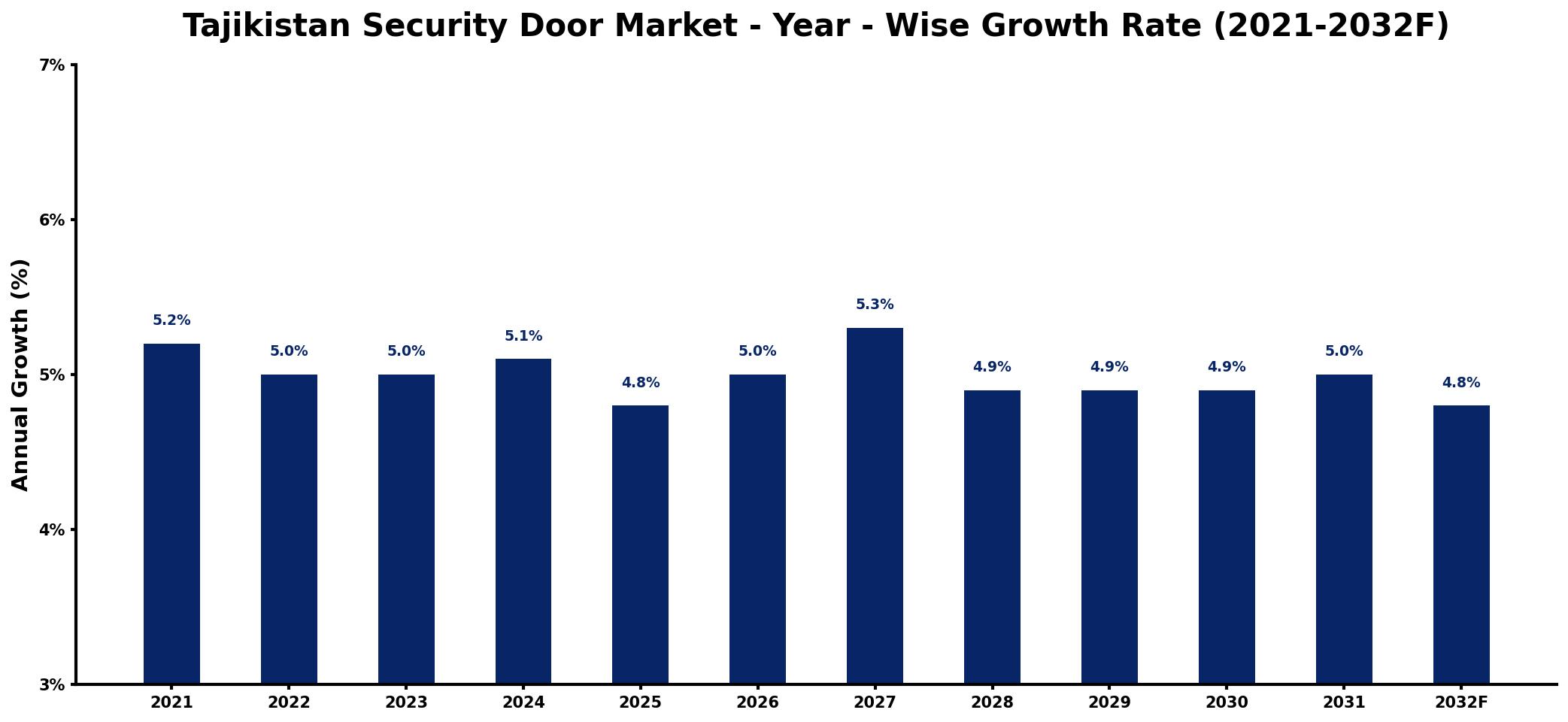
The table below presents the year‑wise growth rates along with the key drivers influencing the market
| Year | Growth Rate | Major Drivers |
| 2021 | 5.2% | Rising construction activity demand |
| 2022 | 5.0% | Increased safety awareness initiatives |
| 2023 | 5.0% | Urban development projects expansion |
| 2024 | 5.1% | Growing residential market investments |
| 2025 | 4.8% | Emerging manufacturing sector growth |
| 2026 | 5.0% | Boost in commercial real estate |
| 2027 | 5.3% | Increased foreign direct investments |
| 2028 | 4.9% | Technological advancements in production |
| 2029 | 4.9% | Expansion of urban infrastructure projects |
| 2030 | 4.9% | Growing demand for renovation projects |
| 2031 | 5.0% | Strengthened regulatory safety measures |
| 2032 | 4.8% | Rising disposable income levels |
Note: Market size estimations and growth projections presented in this report are based on 6Wresearch's proprietary forecasting methodology, utilizing the latest available industry data, government publications, and primary research inputs.
Tajikistan Security Door Market Synopsis
The demand for security doors in Tajikistan is escalating, driven by a notable increase in both disposable incomes and urban development. As more individuals invest in home security, there is a marked shift towards doors that not only offer security but also enhance the aesthetic appeal of properties.
Moreover, government policies aimed at improving overall safety standards are fostering a more secure environment in both residential and commercial sectors. This regulatory push is further stimulating market growth, as consumers become more discerning about the products they choose for safeguarding their assets.
Tajikistan Security Door Market Key Takeaways
- Growing consumer awareness about the importance of security is propelling market growth.
- Technological advancements, including smart locks and biometric systems, are becoming more prevalent.
- Government initiatives are creating a conducive environment for the security door market.
- The construction industry's expansion is significantly driving demand for security doors in new developments.
- Customization and innovation are key competitive strategies among manufacturers to attract diverse consumer needs.
Evaluation of Restraints in Tajikistan Security Door Market
Despite its growth prospects, the Tajikistan Security Door Market faces notable challenges. Limited consumer awareness regarding the necessity of security doors translates to slower adoption rates in some segments. Furthermore, the market contends with cheaper, low-quality imports from neighboring countries, which threaten local manufacturers. Infrastructure constraints and elevated production costs also impede the market's potential, as do issues related to standardization and quality control. These hurdles must be addressed to bolster consumer trust and stimulate growth in this evolving market.
Tajikistan Security Door Market Trends
The current landscape of the Tajikistan Security Door Market is characterized by a significant shift towards high-security features. Increasing concerns about burglary and theft have led consumers to prefer doors equipped with advanced locking mechanisms, such as biometric recognition and smart technology. Another emerging trend is the demand for environmentally friendly materials and energy-efficient designs, reflecting global sustainability movements. Aesthetics also play a crucial role, as consumers seek security doors that seamlessly integrate with their home decor while maintaining robust protection.
Tajikistan Security Door Market Opportunities
Investors looking at the Tajikistan Security Door Market will find a myriad of opportunities due to the increasing focus on safety and security. The rising urbanization and growth of the middle class point toward a burgeoning demand for premium security doors. Exploring avenues in manufacturing diverse products, including steel doors and fire-resistant options, presents a pathway for expansion. Collaborations with local construction firms and home builders could also open new channels for growth, while customization to meet specific security requirements will drive innovation in this space.
Government Initiatives in the Tajikistan Security Door Market
The government of Tajikistan has implemented various policies to regulate the security door market, aimed at enhancing consumer safety and establishing quality standards. Mandatory certifications for manufacturers ensure that products meet essential safety criteria before entering the market. Strict enforcement against counterfeit products bolsters consumer confidence and promotes local manufacturing through incentives. Overall, these initiatives are designed to strengthen the security infrastructure within the country, fostering a reliable and safe market environment.
Future Insights of the Tajikistan Security Door Market
Looking ahead to the period between 2026 and 2032, the Tajikistan Security Door Market is set to continue its upward trajectory. Increasing crime rates and public safety concerns will likely sustain the demand for security solutions. Infrastructure development and urbanization will further contribute to market growth, alongside a rising disposable income among consumers. As manufacturers adopt advanced technologies, innovative security solutions will become available, ensuring that the market evolves in line with consumer expectations for safety and style.
Tajikistan Security Door Market Latest Developments (2025 - 2026)
Recent developments in the Tajikistan Security Door Market indicate a growing emphasis on product innovation and the integration of smart technology. Manufacturers are increasingly focusing on energy-efficient designs that not only enhance security but also promote sustainability. Consumer feedback is shaping new designs, leading to more customizable options that appeal to diverse tastes. Additionally, partnerships between local producers and international technology firms are on the rise, driving advancements in security features.
Tajikistan Security Door Market - Key Attractiveness of the Report
- 10 Years of Market Numbers
- Historical Data Starting from 2022 to 2025
- Base Year: 2025
- Forecast Data until 2032
- Key Performance Indicators Impacting the Market
- Major Upcoming Developments and Projects
Key Highlights of the Report:
- Tajikistan Security Door Market Outlook
- Market Size of Tajikistan Security Door Market, 2025
- Forecast of Tajikistan Security Door Market, 2032
- Historical Data and Forecast of Tajikistan Security Door Revenues & Volume for the Period 2022-2032F
- Tajikistan Security Door Market Trend Evolution
- Tajikistan Security Door Market Drivers and Challenges
- Tajikistan Security Door Price Trends
- Tajikistan Security Door Porter's Five Forces
- Tajikistan Security Door Industry Life Cycle
- Historical Data and Forecast of Tajikistan Security Door Market Revenues & Volume By Product Type for the Period 2022-2032F
- Historical Data and Forecast of Tajikistan Security Door Market Revenues & Volume By Wood Security Door for the Period 2022-2032F
- Historical Data and Forecast of Tajikistan Security Door Market Revenues & Volume By Metal Security Door for the Period 2022-2032F
- Historical Data and Forecast of Tajikistan Security Door Market Revenues & Volume By Industry for the Period 2022-2032F
- Historical Data and Forecast of Tajikistan Security Door Market Revenues & Volume By Individual Purchaser for the Period 2022-2032F
- Historical Data and Forecast of Tajikistan Security Door Market Revenues & Volume By Corporate Buyers for the Period 2022-2032F
- Historical Data and Forecast of Tajikistan Security Door Market Revenues & Volume By Channel for the Period 2022-2032F
- Historical Data and Forecast of Tajikistan Security Door Market Revenues & Volume By Direct Sales for the Period 2022-2032F
- Historical Data and Forecast of Tajikistan Security Door Market Revenues & Volume By Distributor for the Period 2022-2032F
- Tajikistan Security Door Import Export Trade Statistics
- Market Opportunity Assessment By Product Type
- Market Opportunity Assessment By Industry
- Market Opportunity Assessment By Channel
- Tajikistan Security Door Top Companies Market Share
- Tajikistan Security Door Competitive Benchmarking By Technical and Operational Parameters
- Tajikistan Security Door Company Profiles
- Tajikistan Security Door Key Strategic Recommendations






































