Tajikistan Shapewear Market Size, Share & Growth Rate
The Tajikistan Shapewear Market was estimated at USD 511 Million in 2025 and is projected to reach USD 725 Million by 2032, growing at a CAGR of 5.1% from 2026 to 2032. This growth trajectory is being fueled by a rising middle class and increasing disposable incomes, leading consumers to prioritize appearance-enhancing products. Furthermore, a shift towards body positivity and comfort in clothing is making shapewear an attractive option for many Tajik consumers.
Tajikistan Shapewear Market Year-wise Growth Rate and Key Drivers
This graph highlights how the Tajikistan Shapewear Market has steadily grown over the years, supported by major growth factors.
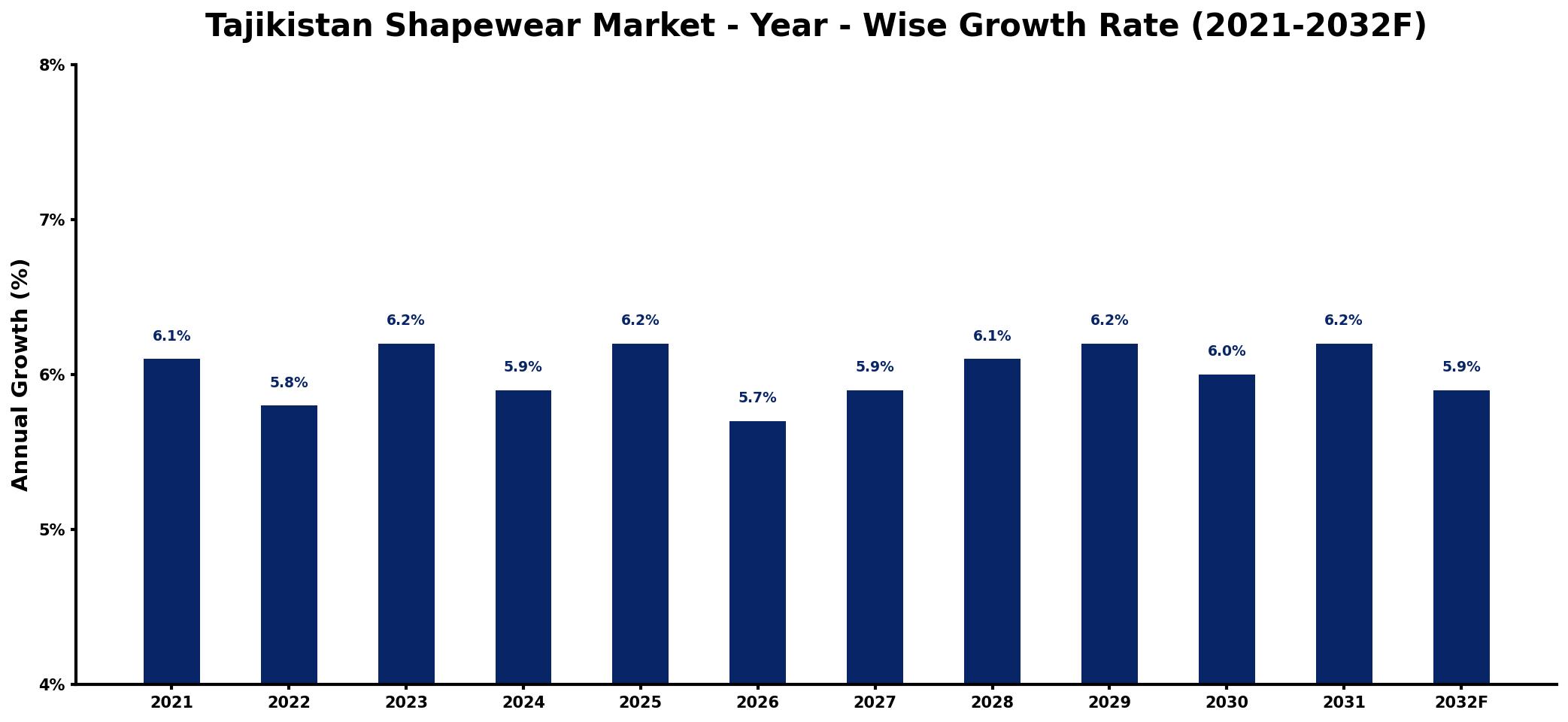
The table below presents the year‑wise growth rates along with the key drivers influencing the market
| Year | Growth Rate | Major Drivers |
| 2021 | 6.1% | increased overall sector activity |
| 2022 | 5.8% | strengthening underlying market demand |
| 2023 | 6.2% | Increased online shopping penetration rates |
| 2024 | 5.9% | Expansion of local retail outlets |
| 2025 | 6.2% | Investment in innovative fabric technologies |
| 2026 | 5.7% | Emergence of new fashion influencers |
| 2027 | 5.9% | growing commercial sector adoption |
| 2028 | 6.1% | Diversification of product offerings available |
| 2029 | 6.2% | Strengthening of e-commerce platforms |
| 2030 | 6.0% | increased capital investment inflows |
| 2031 | 6.2% | Collaboration with fitness brands increasing |
| 2032 | 5.9% | Rising demand for sustainable materials |
Note: Market size estimations and growth projections presented in this report are based on 6Wresearch's proprietary forecasting methodology, utilizing the latest available industry data, government publications, and primary research inputs.
Tajikistan Shapewear Market Synopsis
The landscape of the Tajikistan shapewear market is evolving, marked by a greater acceptance of body-shaping solutions as tools for empowerment rather than concealment. Consumers are increasingly seeking shapewear that not only enhances their physique but also provides comfort and versatility, catering to a broad spectrum of body types.
International brands dominate the market, leveraging e-commerce platforms to offer a diverse array of products. As the market grows, it reflects a mix of traditional values and modern consumer trends, highlighting both opportunities and challenges in appealing to a culturally diverse population.
Tajikistan Shapewear Market Key Takeaways
- The market is experiencing robust growth fueled by increasing disposable incomes and a shift in cultural attitudes towards body positivity.
- International brands lead the market, with online platforms enhancing accessibility and variety for consumers.
- There's a rising demand for shapewear that focuses on comfort, functionality, and sustainability, reflecting changing consumer preferences.
- Investment opportunities abound, particularly for brands willing to innovate and cater to the local market.
- While traditional beliefs may pose challenges, they also create a unique landscape for marketing and consumer education.
Evaluation of Restraints in Tajikistan Shapewear Market
Despite the promising outlook, the Tajikistan shapewear market faces significant restraints. Limited awareness and understanding of shapewear products can hinder consumer adoption. Traditional cultural beliefs may also negatively influence perceptions of shapewear as a necessary item rather than a luxury. Additionally, the prevalence of counterfeit products and low-quality alternatives can undermine the efforts of established brands. Logistics and distribution challenges, particularly in remote areas, further complicate market penetration and growth.
Tajikistan Shapewear Market Trends
The market is currently witnessing several notable trends. A move towards inclusivity has resulted in a greater range of size offerings, appealing to a more diverse customer base. Consumers are increasingly interested in shapewear made from breathable, eco-friendly materials, as sustainability becomes a priority for many. Additionally, the demand for innovative, seamless designs that allow for both aesthetic appeal and functional support is on the rise. E-commerce continues to play a crucial role, offering convenience and a vast selection of products that consumers can explore from home.
Tajikistan Shapewear Market Opportunities
There are significant opportunities for growth in the Tajikistan shapewear market. Investors can capitalize on the rising trend of body positivity by introducing high-quality, comfortable shapewear tailored specifically to local preferences. With limited local competition, there is ample room for international brands to establish a foothold. Furthermore, leveraging digital marketing and e-commerce platforms can help reach consumers in both urban and rural areas, promoting a broader acceptance of shapewear. Emphasizing innovative designs and sustainable materials can also attract a dedicated customer base looking for responsible fashion choices.
Government Initiatives in the Tajikistan Shapewear Market
While there are no specific government policies directed at the shapewear market in Tajikistan, companies must navigate general regulations related to consumer goods and quality standards set by the Eurasian Economic Union (EAEU). Compliance with these regulations is essential for maintaining consumer trust and ensuring product quality. Additionally, the government's overall support for trade can indirectly impact the attractiveness of the market for foreign investors and local entrepreneurs alike.
Future Insights of the Tajikistan Shapewear Market
Looking ahead to 2026-2032, the Tajikistan shapewear market is poised for substantial expansion. Growing consumer awareness of health and fitness, along with evolving fashion trends, will likely propel the demand for shapewear. As disposable incomes continue to rise, more consumers will seek products that enhance their appearance and boost confidence. The ongoing development of e-commerce infrastructure will further facilitate market accessibility, setting the stage for innovative brands to thrive. A focus on product diversification and consumer education will be critical as the market landscape continues to evolve.
Tajikistan Shapewear Market Latest Developments (2025 - 2026)
Recent developments in the Tajikistan shapewear market indicate a strengthening trend towards greater inclusivity in size offerings and a broader variety of products. This evolution is coupled with an increasing focus on sustainability, prompting several brands to explore eco-friendly materials and practices. E-commerce sales are surging, reflecting a shift in consumer shopping behaviors, as more individuals turn to online platforms for convenience and choice. Meanwhile, local initiatives aimed at promoting body positivity are beginning to shape public perception, creating a fertile ground for shapewear acceptance.
Tajikistan Shapewear Market - Key Attractiveness of the Report
- 10 Years of Market Numbers
- Historical Data Starting from 2022 to 2025
- Base Year: 2025
- Forecast Data until 2032
- Key Performance Indicators Impacting the Market
- Major Upcoming Developments and Projects
Key Highlights of the Report:
- Tajikistan Shapewear Market Outlook
- Market Size of Tajikistan Shapewear Market, 2025
- Forecast of Tajikistan Shapewear Market, 2032
- Historical Data and Forecast of Tajikistan Shapewear Revenues & Volume for the Period 2022-2032F
- Tajikistan Shapewear Market Trend Evolution
- Tajikistan Shapewear Market Drivers and Challenges
- Tajikistan Shapewear Price Trends
- Tajikistan Shapewear Porter's Five Forces
- Tajikistan Shapewear Industry Life Cycle
- Historical Data and Forecast of Tajikistan Shapewear Market Revenues & Volume By End-user for the Period 2022-2032F
- Historical Data and Forecast of Tajikistan Shapewear Market Revenues & Volume By Male for the Period 2022-2032F
- Historical Data and Forecast of Tajikistan Shapewear Market Revenues & Volume By Female for the Period 2022-2032F
- Historical Data and Forecast of Tajikistan Shapewear Market Revenues & Volume By Distribution Channel for the Period 2022-2032F
- Historical Data and Forecast of Tajikistan Shapewear Market Revenues & Volume By Hypermarkets & Supermarkets for the Period 2022-2032F
- Historical Data and Forecast of Tajikistan Shapewear Market Revenues & Volume By Specialty Stores for the Period 2022-2032F
- Historical Data and Forecast of Tajikistan Shapewear Market Revenues & Volume By Online for the Period 2022-2032F
- Historical Data and Forecast of Tajikistan Shapewear Market Revenues & Volume By Others for the Period 2022-2032F
- Tajikistan Shapewear Import Export Trade Statistics
- Market Opportunity Assessment By End-user
- Market Opportunity Assessment By Distribution Channel
- Tajikistan Shapewear Top Companies Market Share
- Tajikistan Shapewear Competitive Benchmarking By Technical and Operational Parameters
- Tajikistan Shapewear Company Profiles
- Tajikistan Shapewear Key Strategic Recommendations






































