Tajikistan Swine Feed Market Size, Share & Growth Rate
The Tajikistan Swine Feed Market was estimated at USD 362 Million in 2025 and is projected to reach USD 509 Million by 2032, growing at a CAGR of 5.0% from 2026 to 2032. This positive trajectory is driven by a substantial rise in domestic pork consumption and government initiatives aimed at enhancing livestock productivity. Moreover, the increasing focus on sustainable practices in agriculture is likely to further stimulate demand for innovative and high-quality swine feed formulations.
Tajikistan Swine Feed Market Year-wise Growth Rate and Key Drivers
This graph highlights how the Tajikistan Swine Feed Market has steadily grown over the years, supported by major growth factors.
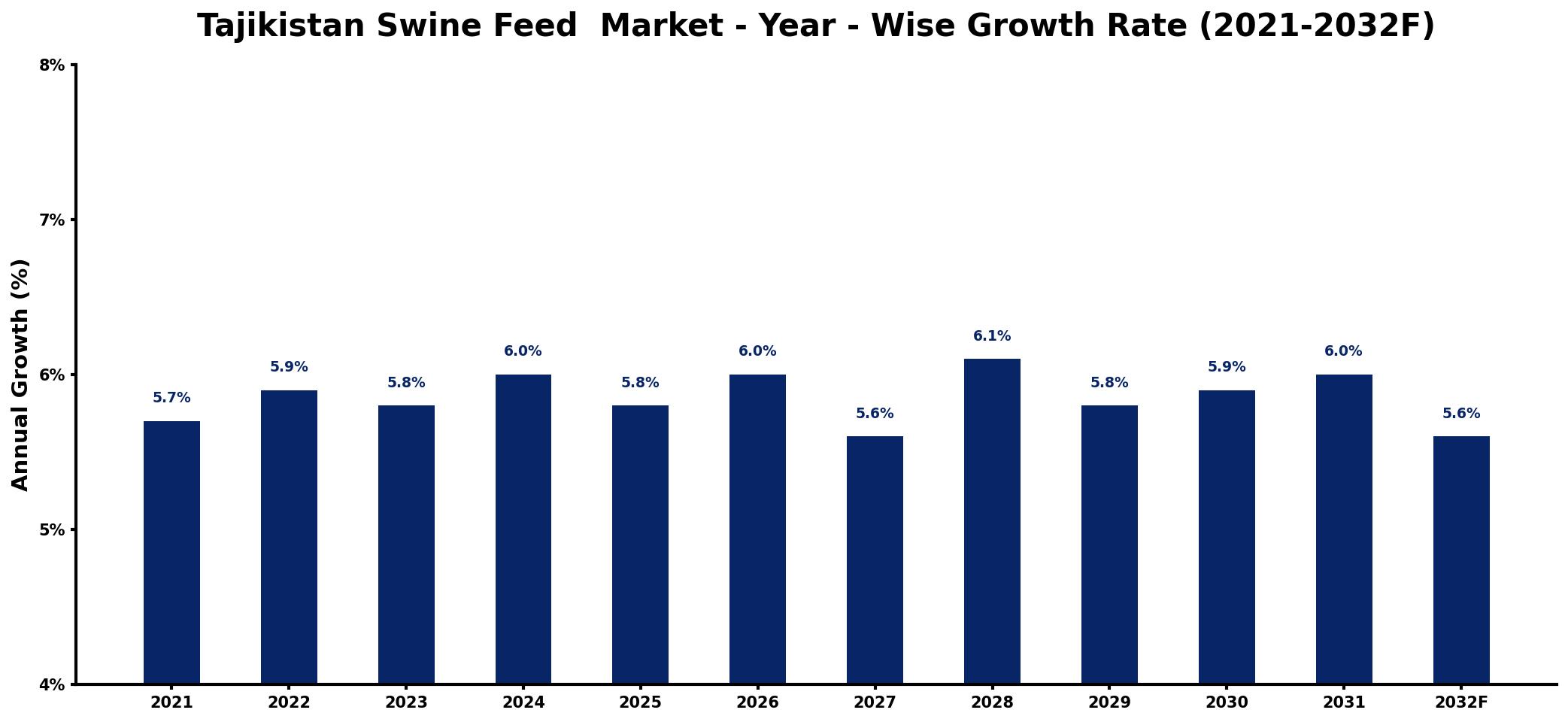
The table below presents the year‑wise growth rates along with the key drivers influencing the market
| Year | Growth Rate | Major Drivers |
| 2021 | 5.7% | Rising consumer protein demand |
| 2022 | 5.9% | Increased livestock production investments |
| 2023 | 5.8% | Expanding agricultural technology adoption |
| 2024 | 6.0% | Growing export opportunities emerging |
| 2025 | 5.8% | Strengthening local farming cooperatives |
| 2026 | 6.0% | Enhanced supply chain efficiencies |
| 2027 | 5.6% | Market diversification strategies implemented |
| 2028 | 6.1% | Innovative product development initiatives |
| 2029 | 5.8% | Increased availability of raw materials |
| 2030 | 5.9% | Higher livestock health standards |
| 2031 | 6.0% | Strengthening regional trade agreements |
| 2032 | 5.6% | Growing awareness of sustainability |
Note: Market size estimations and growth projections presented in this report are based on 6Wresearch's proprietary forecasting methodology, utilizing the latest available industry data, government publications, and primary research inputs.
Tajikistan Swine Feed Market Synopsis
In Tajikistan, the swine feed market is responding to an increasing consumer preference for pork, which is spurring local farmers to boost production. This surge in demand is encouraging feed producers to develop higher quality, nutritionally balanced feed that caters specifically to the various growth stages of swine.
Furthermore, the incorporation of alternative feed ingredients is becoming prevalent as industry players strive to manage costs and enhance sustainability. By optimizing feed formulations and integrating locally sourced ingredients, stakeholders are not only supporting local agriculture but also responding to a broader trend towards environmental responsibility in animal husbandry.
Tajikistan Swine Feed Market Key Takeaways
- The market is driven by rising pork consumption and government support for livestock production.
- Innovative, nutritionally balanced feed formulations are becoming the industry standard.
- Alternative feed ingredients are being explored to lower production costs and promote sustainability.
- Increased awareness of animal health and welfare is influencing product development.
- Infrastructure and expertise challenges remain, necessitating investments for growth.
Evaluation of Restraints in Tajikistan Swine Feed Market
Despite the robust growth potential, several constraints are hindering the advancement of the Tajikistan swine feed market. A notable challenge is the limited availability of high-quality feed ingredients, which often necessitates reliance on imports, further complicating supply chains. Additionally, the existing infrastructure for feed production and distribution lacks the necessary advancements to support the growing industry. Fluctuations in raw material prices, coupled with a deficit of technical expertise in formulating balanced diets, pose additional obstacles that stakeholders must navigate to ensure sustained growth.
Tajikistan Swine Feed Market Trends
Emerging trends within the Tajikistan swine feed market highlight a clear pivot towards higher quality, scientifically formulated feed. Producers are increasingly integrating locally sourced ingredients, which not only enhance nutritional profiles but also bolster the local agricultural economy. Furthermore, there is a growing consciousness about sustainability, leading to the development of environmentally friendly feed options. Technological advancements in feed processing are also making strides, with innovative techniques aimed at improving feed efficiency and overall animal health.
Tajikistan Swine Feed Market Opportunities
The Tajikistan swine feed market is rich with investment opportunities, particularly in specialized product segments. With an increasing population and shifting dietary preferences, theres a burgeoning demand for high-protein and premixed feed formulations tailored to local needs. Investors can benefit from manufacturing initiatives that focus on organic options and sustainable practices. Additionally, investing in research and development initiatives to refine feed formulations is likely to yield significant returns, especially as the market moves toward prioritizing swine health and productivity.
Government Initiatives in the Tajikistan Swine Feed Market
The Tajikistan government is actively fostering the growth of its swine feed market through various supportive policies and initiatives. Key measures include providing subsidies for local farmers and feed manufacturers, aiming to enhance domestic production and reduce import reliance. The government also places a strong emphasis on research and development in feed formulations, ensuring that quality standards are upheld. By incentivizing investment in the sector, these initiatives are designed to promote self-sufficiency and sustainability within the swine feed industry.
Future Insights of the Tajikistan Swine Feed Market
Looking ahead to 2026-2032, the Tajikistan swine feed market is expected to experience steady growth, propelled by demographic shifts and increased disposable incomes, which boost demand for pork products. Ongoing government efforts to enhance agricultural infrastructure will provide further impetus for market expansion. The trend towards sustainable and innovative feed solutions is anticipated to gain momentum, ultimately improving both feed efficiency and animal health. However, careful management of potential challenges, such as price volatility and disease outbreaks, will be crucial for navigating the evolving landscape.
Tajikistan Swine Feed Market Latest Developments (2025 - 2026)
In recent months, the Tajikistan swine feed market has witnessed a shift towards enhanced production practices, as producers increasingly adopt innovative feed processing technologies. There has been a notable rise in collaboration between local farmers and feed manufacturers to develop customized formulations that cater to the specific nutritional needs of swine at different growth stages. Additionally, growing partnerships with research institutions are driving advancements in feed efficiency, focusing on the integration of sustainable practices and locally sourced ingredients.
Tajikistan Swine Feed Market - Key Attractiveness of the Report
- 10 Years of Market Numbers
- Historical Data Starting from 2022 to 2025
- Base Year: 2025
- Forecast Data until 2032
- Key Performance Indicators Impacting the Market
- Major Upcoming Developments and Projects
Key Highlights of the Report:
- Tajikistan Swine Feed Market Outlook
- Market Size of Tajikistan Swine Feed Market, 2025
- Forecast of Tajikistan Swine Feed Market, 2032
- Historical Data and Forecast of Tajikistan Swine Feed Revenues & Volume for the Period 2022-2032F
- Tajikistan Swine Feed Market Trend Evolution
- Tajikistan Swine Feed Market Drivers and Challenges
- Tajikistan Swine Feed Price Trends
- Tajikistan Swine Feed Porter's Five Forces
- Tajikistan Swine Feed Industry Life Cycle
- Historical Data and Forecast of Tajikistan Swine Feed Market Revenues & Volume By Product Type for the Period 2022-2032F
- Historical Data and Forecast of Tajikistan Swine Feed Market Revenues & Volume By Grower for the Period 2022-2032F
- Historical Data and Forecast of Tajikistan Swine Feed Market Revenues & Volume By Starter for the Period 2022-2032F
- Historical Data and Forecast of Tajikistan Swine Feed Market Revenues & Volume By Sow for the Period 2022-2032F
- Historical Data and Forecast of Tajikistan Swine Feed Market Revenues & Volume By Others for the Period 2022-2032F
- Historical Data and Forecast of Tajikistan Swine Feed Market Revenues & Volume By Feed Essence for the Period 2022-2032F
- Historical Data and Forecast of Tajikistan Swine Feed Market Revenues & Volume By Vitamins for the Period 2022-2032F
- Historical Data and Forecast of Tajikistan Swine Feed Market Revenues & Volume By Antioxidants for the Period 2022-2032F
- Historical Data and Forecast of Tajikistan Swine Feed Market Revenues & Volume By Feed Acidifiers for the Period 2022-2032F
- Historical Data and Forecast of Tajikistan Swine Feed Market Revenues & Volume By Feed Enzymes for the Period 2022-2032F
- Historical Data and Forecast of Tajikistan Swine Feed Market Revenues & Volume By Amino Acids for the Period 2022-2032F
- Historical Data and Forecast of Tajikistan Swine Feed Market Revenues & Volume By Others for the Period 2022-2032F
- Historical Data and Forecast of Tajikistan Swine Feed Market Revenues & Volume By Feed Additive Type for the Period 2022-2032F
- Historical Data and Forecast of Tajikistan Swine Feed Market Revenues & Volume By Zootechnical Feed Additives for the Period 2022-2032F
- Historical Data and Forecast of Tajikistan Swine Feed Market Revenues & Volume By Sensory Feed Additives for the Period 2022-2032F
- Historical Data and Forecast of Tajikistan Swine Feed Market Revenues & Volume By Nutritional Feed Additives for the Period 2022-2032F
- Tajikistan Swine Feed Import Export Trade Statistics
- Market Opportunity Assessment By Product Type
- Market Opportunity Assessment By Feed Essence
- Market Opportunity Assessment By Feed Additive Type
- Tajikistan Swine Feed Top Companies Market Share
- Tajikistan Swine Feed Competitive Benchmarking By Technical and Operational Parameters
- Tajikistan Swine Feed Company Profiles
- Tajikistan Swine Feed Key Strategic Recommendations






































