Tajikistan Television Market Summary
The tajikistan television market was estimated at USD 1401 Million in 2025 and is projected to reach USD 2592 Million by 2032, growing at a CAGR of 10.6% from 2026 to 2032.
Tajikistan Television Market Year-wise Growth Rate and Key Drivers
This graph highlights how the Tajikistan Television Market has steadily grown over the past five years, supported by major growth factors.
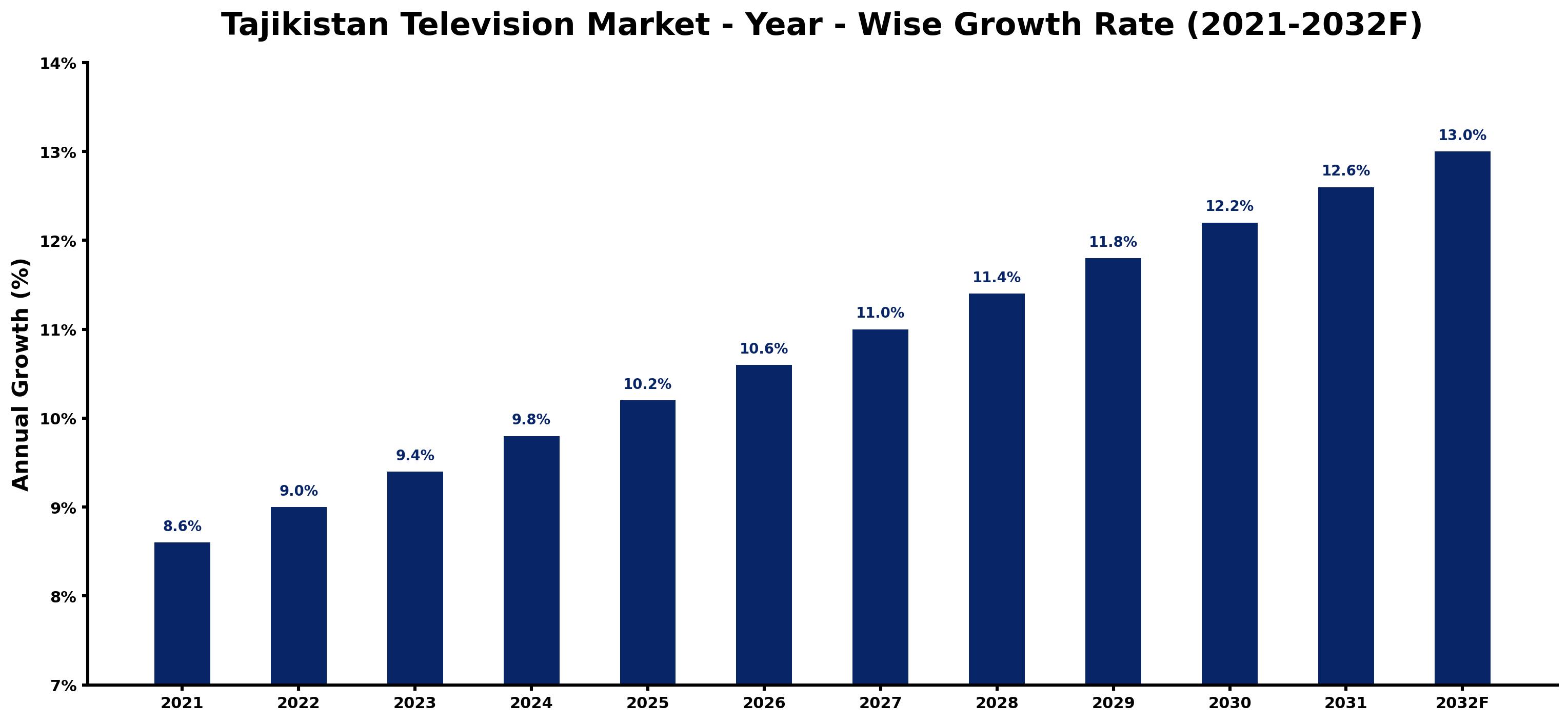
The table below presents the year wise growth rates along with the key drivers influencing the market
| Year | Growth Rate | Major Drivers |
| 2021 | 8.6% | Television households in Tajikistan show steady engagement with local content offerings. |
| 2022 | 9.0% | New investments in broadcasting infrastructure enhance signal quality across urban areas. |
| 2023 | 9.4% | Streaming platforms introduce localized content, catering to diverse Tajik cultural interests. |
| 2024 | 9.8% | Advertisers begin targeting younger demographics through innovative digital marketing strategies. |
| 2025 | 10.2% | Partnerships between local producers and international networks expand content variety significantly. |
| 2026 | 10.6% | Technological advancements in smart TVs increase consumer access to online streaming services. |
| 2027 | 11.0% | Regional competition compels local channels to innovate, improving overall viewing experiences. |
| 2028 | 11.4% | Growing smartphone penetration allows audiences to engage with content on multiple devices. |
| 2029 | 11.8% | Increased interest in regional news drives demand for more comprehensive reporting. |
| 2030 | 12.2% | Advertising revenues from digital platforms start to rival traditional television channels. |
| 2031 | 12.6% | Local television stations collaborate with tech firms to enhance viewer interaction capabilities. |
| 2032 | 13.0% | Consumer preferences shift towards on-demand content, reshaping traditional broadcast schedules. |
Note - Market size estimations and growth projections presented in this report are based on 6Wresearch's advanced forecasting approach, validated with industry datasets as of June 2026.
Tajikistan Television Market Synopsis
The Tajikistan Television Market is projected to reach 10.6% and witness significant growth during the forecast period (2026-2032). This market is characterized by a unique blend of state-owned and private broadcasting channels, creating a diverse viewing environment for its audience. As the primary public broadcaster, Tajikistan Television (TT) plays a crucial role in delivering content, while private broadcasters such as Safina TV and Jahonnamo TV contribute substantially to the market landscape. The rising trends of digitalization, increasing disposable income, and evolving consumer preferences are set to shape the future of television in Tajikistan.
Tajikistan Television Market Trends and Opportunities
The Tajikistan Television Market is undergoing a significant transformation, driven by technological advancements and changing viewer habits. Notably, the demand for high-definition content and smart television capabilities is on the rise. This shift reflects a broader trend where consumers are increasingly seeking enhanced viewing experiences. Moreover, the popularity of streaming platforms is creating a competitive environment for traditional broadcasting methods. The surge in local content production is particularly noteworthy, as broadcasters strive to create original programming that resonates with domestic audiences.
- Viewers are gravitating towards platforms that offer personalized content, pushing broadcasters to innovate and diversify their offerings.
- International partnerships are becoming more common, providing local channels with access to globally recognized content and broadcasting rights.
- The growing interest in informative and entertaining news programming is prompting broadcasters to enhance their news segments, catering to the demands of a more knowledgeable audience.
- Increased internet penetration in rural areas is expanding access to television services, thereby broadening the potential viewer base for both local and international content.
- Digital platforms are facilitating the rise of interactive and on-demand viewing experiences, compelling traditional providers to adapt to stay competitive.
Tajikistan Television Market Challenges and Restraints
Despite its growth potential, the Tajikistan Television Market faces several challenges that may hinder its progress. One of the major issues is the limited advertising revenue driven by the relatively small market size and lower purchasing power among consumers. This limitation constrains the ability of channels to invest in high-quality programming and innovative content production.
- The regulatory environment imposes restrictions that can limit broadcasters' creative freedom, affecting the diversity and quality of content available to viewers.
- A lack of modern broadcasting infrastructure hinders the delivery of high-definition and interactive services, impacting viewer satisfaction.
- Competition from digital streaming platforms is intensifying, as these services often offer more flexible and appealing viewing options.
- Limited access to international investment could stifle growth opportunities for local broadcasters seeking to expand their capabilities.
- The continued reliance on state-controlled media can result in a lack of diverse perspectives in programming, presenting challenges for audience engagement.
Tajikistan Television Market Investment Opportunities
The evolving landscape of the Tajikistan Television Market presents numerous opportunities for investment. As disposable incomes rise and consumer expectations grow, there is a burgeoning demand for quality content and advanced television services. Investment in local production capabilities, including the creation of original programming, can significantly enhance market competitiveness.
- Expanding digital television services can help broadcasters reach a larger audience, particularly as internet accessibility improves across the country.
- Innovative services such as video-on-demand and subscription streaming platforms offer lucrative avenues for investors looking to capture market share.
- Partnering with local media companies can facilitate the exchange of expertise and resources, fostering growth through collaboration.
- Investments aimed at upgrading broadcasting technology and infrastructure can enhance the viewing experience, driving customer loyalty and engagement.
- Capitalizing on the local interest in international content through licensing deals provides a mechanism for broadcasters to diversify their offerings.
Tajikistan Television Market Government Investment and Initiatives
The Tajikistan Television Market is supported by various government policies aimed at fostering local content production and ensuring diverse programming. The government has enacted the Law on Television and Radio Broadcasting, which mandates a specific percentage of airtime be allocated to domestic programming in the Tajik language. This initiative is crucial for preserving national identity while promoting local talent.
Furthermore, the government emphasizes the importance of news and informational programming to keep the populace informed. Regulations are in place to prevent monopolistic practices, ensuring a competitive environment for broadcasters. The licensing process for TV stations is rigorously managed, with adherence to specific content guidelines and ethical standards, promoting a responsible broadcasting culture.
Tajikistan Television Market Latest Developments (May 2025 - June 2026)
In the period from May 2025 to June 2026, the Tajikistan Television Market has witnessed significant developments reflecting the industry's dynamic nature. There has been a notable increase in local broadcasting initiatives, with many channels focusing on original content that addresses the interests of the domestic audience. This trend is accompanied by an uptick in collaboration between local and international broadcasters, enhancing the variety of available programming.
Additionally, advancements in technology have led to the introduction of more user-friendly digital platforms, allowing viewers to access content seamlessly. The government has continued to enforce regulations that promote local culture while ensuring a competitive landscape, benefitting both audiences and content creators. These developments indicate a robust trajectory for the Tajikistan Television Market as it adapts to contemporary viewer demands.
Tajikistan Television Market - Key Attractiveness of the Report
- 10 Years of Market Numbers
- Historical Data Starting from 2022 to 2025
- Base Year: 2025
- Forecast Data until 2032
- Key Performance Indicators Impacting the Market
- Major Upcoming Developments and Projects
Key Highlights of the Report:
- Tajikistan Television Market Outlook
- Market Size of Tajikistan Television Market, 2025
- Forecast of Tajikistan Television Market, 2032F
- Historical Data and Forecast of Tajikistan Television Revenues & Volume for the Period 2022-2032F
- Tajikistan Television Market Trend Evolution
- Tajikistan Television Market Drivers and Challenges
- Tajikistan Television Price Trends
- Tajikistan Television Porter's Five Forces
- Tajikistan Television Industry Life Cycle
- Historical Data and Forecast of Tajikistan Television Market Revenues & Volume By Resolution for the Period 2022-2032F
- Historical Data and Forecast of Tajikistan Television Market Revenues & Volume By LCD TVs for the Period 2022-2032F
- Historical Data and Forecast of Tajikistan Television Market Revenues & Volume By OLED TVs for the Period 2022-2032F
- Historical Data and Forecast of Tajikistan Television Market Revenues & Volume By Types for the Period 2022-2032F
- Historical Data and Forecast of Tajikistan Television Market Revenues & Volume By 2D TVs for the Period 2022-2032F
- Historical Data and Forecast of Tajikistan Television Market Revenues & Volume By 3D TVs for the Period 2022-2032F
- Tajikistan Television Import Export Trade Statistics
- Market Opportunity Assessment By Resolution
- Market Opportunity Assessment By Types
- Tajikistan Television Top Companies Market Share
- Tajikistan Television Competitive Benchmarking By Technical and Operational Parameters
- Tajikistan Television Company Profiles
- Tajikistan Television Key Strategic Recommendations






































