Tajikistan Trolley Market Size, Share & Growth Rate
The Tajikistan Trolley Market was estimated at USD 942 Million in 2025 and is projected to reach USD 1341 Million by 2032, growing at a CAGR of 5.2% from 2026 to 2032. This growth trajectory is driven by a combination of rising urbanization, an urgent need for efficient public transport systems, and government efforts to promote sustainable transit solutions. As cities like Dushanbe and Khujand expand, the demand for environmentally friendly transportation options is becoming increasingly crucial.
Tajikistan Trolley Market Year-wise Growth Rate and Key Drivers
This graph highlights how the Tajikistan Trolley Market has steadily grown over the years, supported by major growth factors.
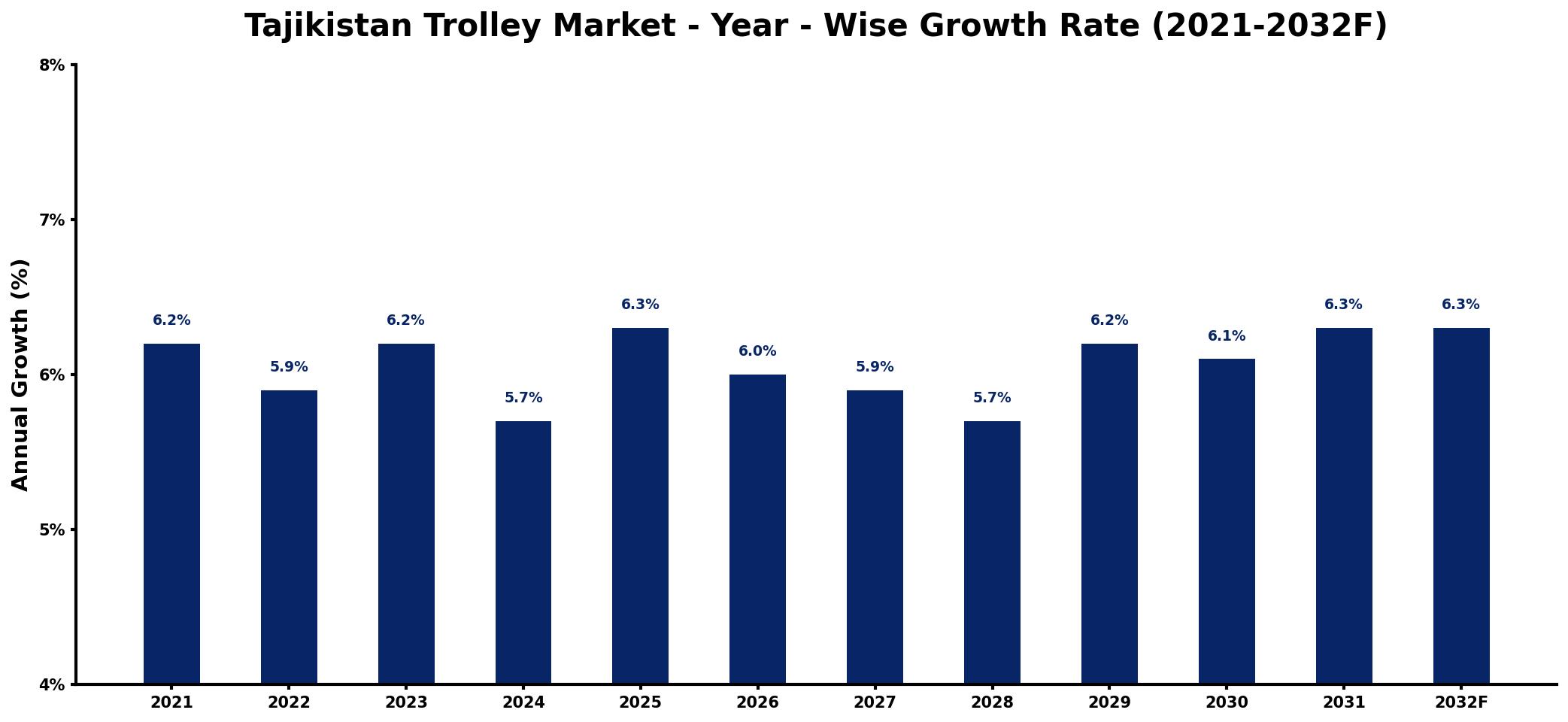
The table below presents the year‑wise growth rates along with the key drivers influencing the market
| Year | Growth Rate | Major Drivers |
| 2021 | 6.2% | Rising consumer purchasing power |
| 2022 | 5.9% | Expansion of urban transportation networks |
| 2023 | 6.2% | Increased demand for efficient logistics |
| 2024 | 5.7% | Growing investments in infrastructure projects |
| 2025 | 6.3% | Surge in tourism and travel |
| 2026 | 6.0% | Emergence of eco-friendly transport solutions |
| 2027 | 5.9% | Strengthening of local manufacturing capabilities |
| 2028 | 5.7% | Enhancement of public transport systems |
| 2029 | 6.2% | Growing awareness of environmental sustainability |
| 2030 | 6.1% | Increased government support for transport |
| 2031 | 6.3% | Development of new market segments |
| 2032 | 6.3% | Rise in e-commerce delivery services |
Note: Market size estimations and growth projections presented in this report are based on 6Wresearch's proprietary forecasting methodology, utilizing the latest available industry data, government publications, and primary research inputs.
Tajikistan Trolley Market Synopsis
Currently, the Tajikistan trolley market is positioned for significant growth, buoyed by government initiatives aimed at enhancing public transportation infrastructure. Trolleys are gaining traction as a viable alternative to conventional fossil fuel-based transportation, appealing to both eco-conscious consumers and urban planners seeking cost-effective solutions.
With an array of options available from both domestic manufacturers and international suppliers, the market is evolving to meet the specific needs of urban populations. Improved trolley models, incorporating advanced technology and innovative features, are increasingly being embraced for their potential to provide sustainable mobility.
Tajikistan Trolley Market Key Takeaways
- The market is experiencing growth due to increasing urbanization and demand for efficient public transport.
- Government policies are prioritizing sustainable transportation, enhancing market attractiveness.
- Technological advancements are being integrated into trolley systems for improved user experience.
- Domestic manufacturers are emerging alongside international suppliers, enriching product diversity.
- Investment opportunities are rising as urban infrastructure projects gain momentum.
Evaluation of Restraints in Tajikistan Trolley Market
Despite its growth potential, the Tajikistan trolley market faces significant challenges. Outdated infrastructure severely hampers service reliability, with an aging fleet often leading to operational breakdowns. Limited financial resources for fleet modernization and insufficient investment in infrastructure upgrades are also key hurdles. Furthermore, the lack of seamless integration between trolley services and other transportation modes complicates route efficiency, thereby reducing the overall appeal of trolley systems to commuters.
Tajikistan Trolley Market Trends
A noticeable trend in the Tajikistan trolley market is the shift toward electric trolleys, driven by environmental considerations and operational cost savings. Technological advancements, including GPS tracking systems and contactless payment options, are enhancing both passenger convenience and operational efficiency. Manufacturers are focusing on designs that emphasize durability and safety, catering to the growing consumer demand for reliable public transport. The market also sees increasing interest in trolleys that offer aesthetic enhancements, contributing to their appeal in urban landscapes.
Tajikistan Trolley Market Opportunities
Investment in the Tajikistan trolley market holds substantial promise, primarily due to rising urban populations and government infrastructure initiatives. The emphasis on sustainable transportation opens avenues for investors to introduce modern trolley systems. Collaboration with local authorities can facilitate smoother market entry, helping investors to align with regulatory frameworks while seizing growth opportunities. As the government continues to prioritize public transport improvements, the market is ripe for innovation and strategic partnerships.
Government Initiatives in the Tajikistan Trolley Market
Government efforts in Tajikistan are focused on fostering sustainable transportation solutions to reduce urban air pollution. Initiatives include financial incentives for trolley operators and investments in infrastructure development. Regulatory frameworks are being established to ensure that trolleys meet safety and environmental standards. Furthermore, the government collaborates with international organizations to enhance the reliability of trolley services, demonstrating a commitment to improving public transport accessibility for citizens.
Future Insights of the Tajikistan Trolley Market
Looking ahead to 2026-2032, the Tajikistan trolley market is on course for steady growth, bolstered by urbanization and continued infrastructure enhancements. Increasing consumer demand for eco-friendly transport options will likely spur further adoption of trolley systems. Advances in manufacturing and design will improve safety and operational efficiency, propelling market expansion. However, navigating funding limitations and competition from alternative transport modes will be essential for sustained success in this evolving landscape.
Tajikistan Trolley Market Latest Developments (2025 - 2026)
In recent months, the Tajikistan trolley market has witnessed significant activity as local governments initiate projects aimed at modernizing public transport systems. Efforts are underway to enhance the integration of trolley services with other transportation modes, improving overall service efficiency. Additionally, manufacturers are exploring new technologies to streamline operations, aiming for a greater user-friendly experience. As stakeholders position themselves strategically, the market is likely to see robust developments leading into the next year.
Tajikistan Trolley Market - Key Attractiveness of the Report
- 10 Years of Market Numbers
- Historical Data Starting from 2022 to 2025
- Base Year: 2025
- Forecast Data until 2032
- Key Performance Indicators Impacting the Market
- Major Upcoming Developments and Projects
Key Highlights of the Report:
- Tajikistan Trolley Market Outlook
- Market Size of Tajikistan Trolley Market, 2025
- Forecast of Tajikistan Trolley Market, 2032
- Historical Data and Forecast of Tajikistan Trolley Revenues & Volume for the Period 2022-2032F
- Tajikistan Trolley Market Trend Evolution
- Tajikistan Trolley Market Drivers and Challenges
- Tajikistan Trolley Price Trends
- Tajikistan Trolley Porter's Five Forces
- Tajikistan Trolley Industry Life Cycle
- Historical Data and Forecast of Tajikistan Trolley Market Revenues & Volume By Product for the Period 2022-2032F
- Historical Data and Forecast of Tajikistan Trolley Market Revenues & Volume By Manual for the Period 2022-2032F
- Historical Data and Forecast of Tajikistan Trolley Market Revenues & Volume By Electric for the Period 2022-2032F
- Historical Data and Forecast of Tajikistan Trolley Market Revenues & Volume By Application for the Period 2022-2032F
- Historical Data and Forecast of Tajikistan Trolley Market Revenues & Volume By Commercial for the Period 2022-2032F
- Historical Data and Forecast of Tajikistan Trolley Market Revenues & Volume By Non-commercial for the Period 2022-2032F
- Historical Data and Forecast of Tajikistan Trolley Market Revenues & Volume By Distribution for the Period 2022-2032F
- Historical Data and Forecast of Tajikistan Trolley Market Revenues & Volume By Offline for the Period 2022-2032F
- Historical Data and Forecast of Tajikistan Trolley Market Revenues & Volume By Online for the Period 2022-2032F
- Tajikistan Trolley Import Export Trade Statistics
- Market Opportunity Assessment By Product
- Market Opportunity Assessment By Application
- Market Opportunity Assessment By Distribution
- Tajikistan Trolley Top Companies Market Share
- Tajikistan Trolley Competitive Benchmarking By Technical and Operational Parameters
- Tajikistan Trolley Company Profiles
- Tajikistan Trolley Key Strategic Recommendations






































