Tajikistan Two Wheeler Market Summary
The tajikistan two wheeler market was estimated at USD 892 Million in 2025 and is projected to reach USD 1272 Million by 2032, growing at a CAGR of 5.9% from 2026 to 2032.
Tajikistan Two Wheeler Market Year-wise Growth Rate and Key Drivers
This graph highlights how the Tajikistan Two Wheeler Market has steadily grown over the past five years, supported by major growth factors.
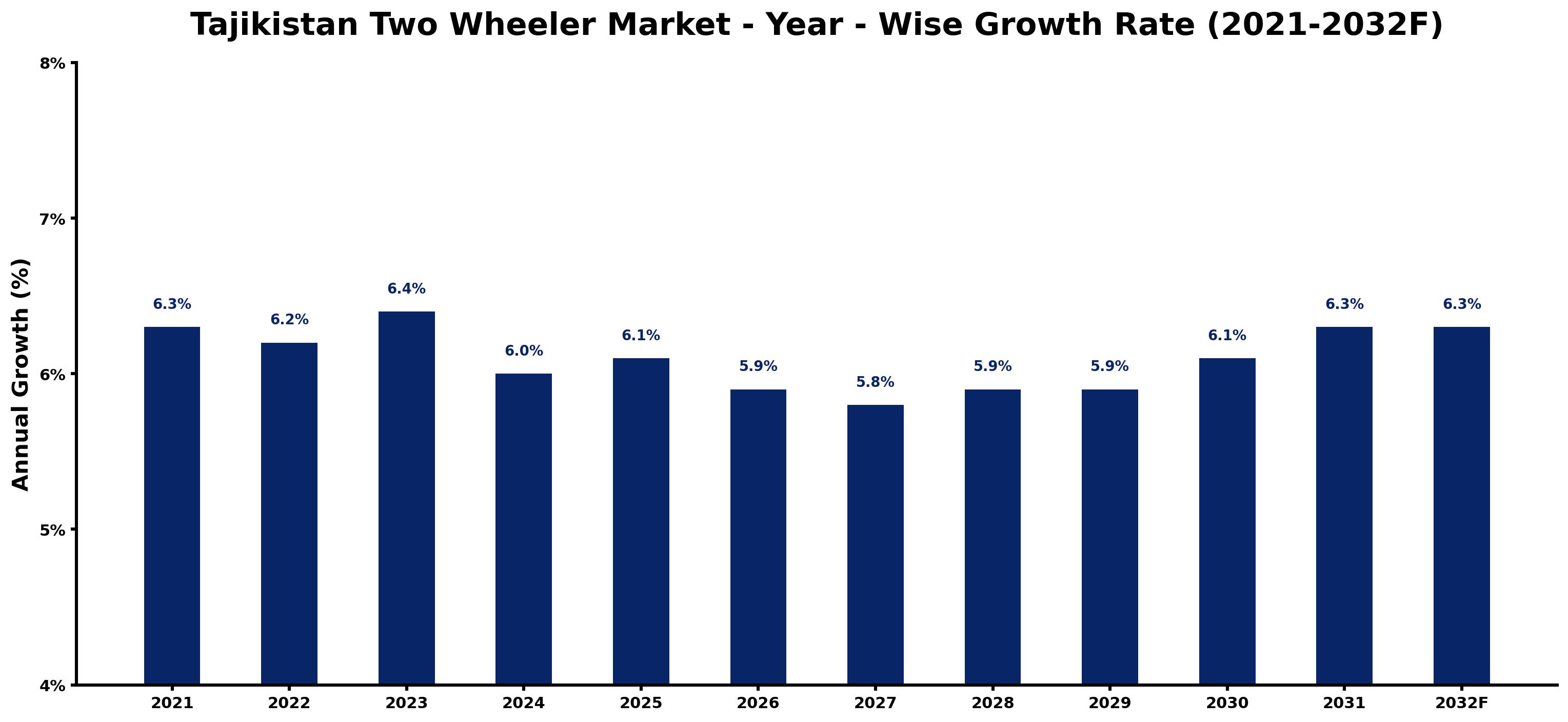
The table below presents the year wise growth rates along with the key drivers influencing the market
| Year | Growth Rate | Major Drivers |
| 2021 | 6.3% | Economic recovery post-pandemic fosters increased consumer spending on two-wheelers. |
| 2022 | 6.2% | Affordable financing options become available, enhancing accessibility for potential buyers. |
| 2023 | 6.4% | Urbanization trends prompt a shift towards efficient urban mobility solutions. |
| 2024 | 6.0% | Youth population growth contributes to higher interest in affordable transportation alternatives. |
| 2025 | 6.1% | Local manufacturers expand production capabilities, reducing dependence on imports significantly. |
| 2026 | 5.9% | Environmental awareness drives interest in electric two-wheelers among eco-conscious consumers. |
| 2027 | 5.8% | Infrastructure improvements enhance road conditions, boosting two-wheeler usage in rural areas. |
| 2028 | 5.9% | Technological advancements in fuel efficiency attract buyers seeking cost-effective commuting options. |
| 2029 | 5.9% | E-commerce expansion encourages last-mile delivery services utilizing two-wheelers extensively. |
| 2030 | 6.1% | Rising fuel prices motivate consumers to consider more economical two-wheeler alternatives. |
| 2031 | 6.3% | Cultural shifts favor two-wheelers as a symbol of freedom and personal mobility. |
| 2032 | 6.3% | Innovative marketing strategies engage younger audiences, redefining brand loyalty in the market. |
Note - Market size estimations and growth projections presented in this report are based on 6Wresearch's advanced forecasting approach, validated with industry datasets as of June 2026.
Tajikistan Two Wheeler Market Synopsis
The Tajikistan Two Wheeler Market is projected to reach 5.9% and witness significant growth during the forecast period (2026-2032). The market is poised for expansion due to several motivating factors that encompass both consumer preferences and supportive government initiatives. Rising demand for two-wheelers, particularly motorbikes and scooters, is evident as these vehicles are seen as convenient, easy to maintain, and cost-effective for daily commuting. Furthermore, the increasing disposable income among consumers has led to enhanced purchasing power, directly impacting the sales trajectory of the two-wheeler segment. However, the market does face challenges including high import duties and fluctuating fuel prices, which may pose constraints on future growth.
Tajikistan Two Wheeler Market Growth Drivers
The growth of the Tajikistan Two Wheeler Market is influenced by multiple drivers that are transforming the landscape of personal transport in the region:
- The increasing urbanization in Tajikistan is leading to a higher concentration of the population in cities, which in turn boosts the demand for efficient two-wheeler transportation options.
- Government incentives, including tax exemptions on select models and subsidies for fuel costs, are encouraging consumers to opt for two-wheelers as a practical alternative to cars.
- The affordability of scooters and motorbikes, compared to other modes of transportation, makes them an attractive option for lower and middle-income households, further expanding the customer base.
- Technological advancements in the two-wheeler segment are improving vehicle reliability and safety, thus enhancing consumer confidence in these modes of transport.
- Growing awareness about the environmental benefits of using two-wheelers, such as reduced emissions and lower fuel consumption, is steering consumers towards adopting these vehicles.
Tajikistan Two Wheeler Market Challenges and Restraints
Despite the promising outlook for the Tajikistan Two Wheeler Market, it encounters certain challenges that could impede its growth:
- Escalating fuel prices pose a significant barrier, as higher operational costs can discourage potential buyers from investing in two-wheelers.
- High import duties on two-wheeler vehicles can lead to increased retail prices, making them less accessible to a broader audience.
- The lack of extensive infrastructure for two-wheeler maintenance and repair services can deter users from purchasing these vehicles, given concerns about long-term upkeep.
- Environment-related regulations and initiatives may become more stringent, potentially leading to increased costs for manufacturers and consumers alike.
- Economic instability in the region may affect consumer confidence and spending patterns, creating uncertainty within the market.
Tajikistan Two Wheeler Market Government Investment and Initiatives
The Tajikistan government plays a crucial role in shaping the two-wheeler market through various investments and initiatives designed to stimulate economic growth and enhance mobility:
- Government policies focused on improving transportation infrastructure, including roads and traffic management systems, are essential for facilitating safe and efficient two-wheeler operation.
- Tax reductions and subsidies aimed at specific two-wheeler models serve to lower the cost burden on consumers, thereby fostering increased sales and market penetration.
- Initiatives aimed at promoting environmental sustainability are encouraging manufacturers and consumers to adopt cleaner technologies in two-wheeler production, aligning with global trends.
- Public awareness campaigns regarding the benefits of two-wheelers, both in terms of convenience and environmental impact, are helping to drive consumer interest.
- Collaborative efforts between government and private sectors are crucial for developing financing options, making two-wheelers more accessible to a wider audience.
Tajikistan Two Wheeler Market Latest Developments (May 2025 - June 2026)
Recent developments in the Tajikistan Two Wheeler Market from May 2025 to June 2026 indicate a dynamic environment, with several notable trends:
- Government initiatives to provide subsidies on fuel and tax impressions have gained traction, further incentivizing consumers to invest in two-wheelers.
- The introduction of new models featuring advanced technology and eco-friendly designs is helping to attract a diverse consumer base.
- Efforts to improve road safety and promote responsible riding have been emphasized, with government campaigns aimed at educating riders on safety protocols.
- Market analysts have observed a gradual shift toward electric two-wheelers as consumers become more environmentally conscious.
- Increased consumer engagement through digital platforms is resulting in higher online sales, showcasing a shift in purchasing behavior among younger demographics.
Tajikistan Two Wheeler Market - Key Attractiveness of the Report
- 10 Years of Market Numbers
- Historical Data Starting from 2022 to 2025
- Base Year: 2025
- Forecast Data until 2032
- Key Performance Indicators Impacting the Market
- Major Upcoming Developments and Projects
Key Highlights of the Report:
- Tajikistan Two Wheeler Market Outlook
- Market Size of Tajikistan Two Wheeler Market, 2025
- Forecast of Tajikistan Two Wheeler Market, 2032F
- Historical Data and Forecast of Tajikistan Two Wheeler Revenues & Volume for the Period 2022-2032F
- Tajikistan Two Wheeler Market Trend Evolution
- Tajikistan Two Wheeler Market Drivers and Challenges
- Tajikistan Two Wheeler Price Trends
- Tajikistan Two Wheeler Porter's Five Forces
- Tajikistan Two Wheeler Industry Life Cycle
- Historical Data and Forecast of Tajikistan Two Wheeler Market Revenues & Volume By Vehicle Type for the Period 2022-2032F
- Historical Data and Forecast of Tajikistan Two Wheeler Market Revenues & Volume By Motorcycle for the Period 2022-2032F
- Historical Data and Forecast of Tajikistan Two Wheeler Market Revenues & Volume By Scooter/Moped for the Period 2022-2032F
- Historical Data and Forecast of Tajikistan Two Wheeler Market Revenues & Volume By Engine Capacity for the Period 2022-2032F
- Historical Data and Forecast of Tajikistan Two Wheeler Market Revenues & Volume By Up to 125cc for the Period 2022-2032F
- Historical Data and Forecast of Tajikistan Two Wheeler Market Revenues & Volume By 126-250cc for the Period 2022-2032F
- Historical Data and Forecast of Tajikistan Two Wheeler Market Revenues & Volume By 251-500cc for the Period 2022-2032F
- Historical Data and Forecast of Tajikistan Two Wheeler Market Revenues & Volume By Above 500cc for the Period 2022-2032F
- Tajikistan Two Wheeler Import Export Trade Statistics
- Market Opportunity Assessment By Vehicle Type
- Market Opportunity Assessment By Engine Capacity
- Tajikistan Two Wheeler Top Companies Market Share
- Tajikistan Two Wheeler Competitive Benchmarking By Technical and Operational Parameters
- Tajikistan Two Wheeler Company Profiles
- Tajikistan Two Wheeler Key Strategic Recommendations






































