Tajikistan Wallet Market Summary
The tajikistan wallet market was estimated at USD 534 Million in 2025 and is projected to reach USD 779 Million by 2032, growing at a CAGR of 6.5% from 2026 to 2032.
Tajikistan Wallet Market Year-wise Growth Rate and Key Drivers
This graph highlights how the Tajikistan Wallet Market has steadily grown over the past five years, supported by major growth factors.
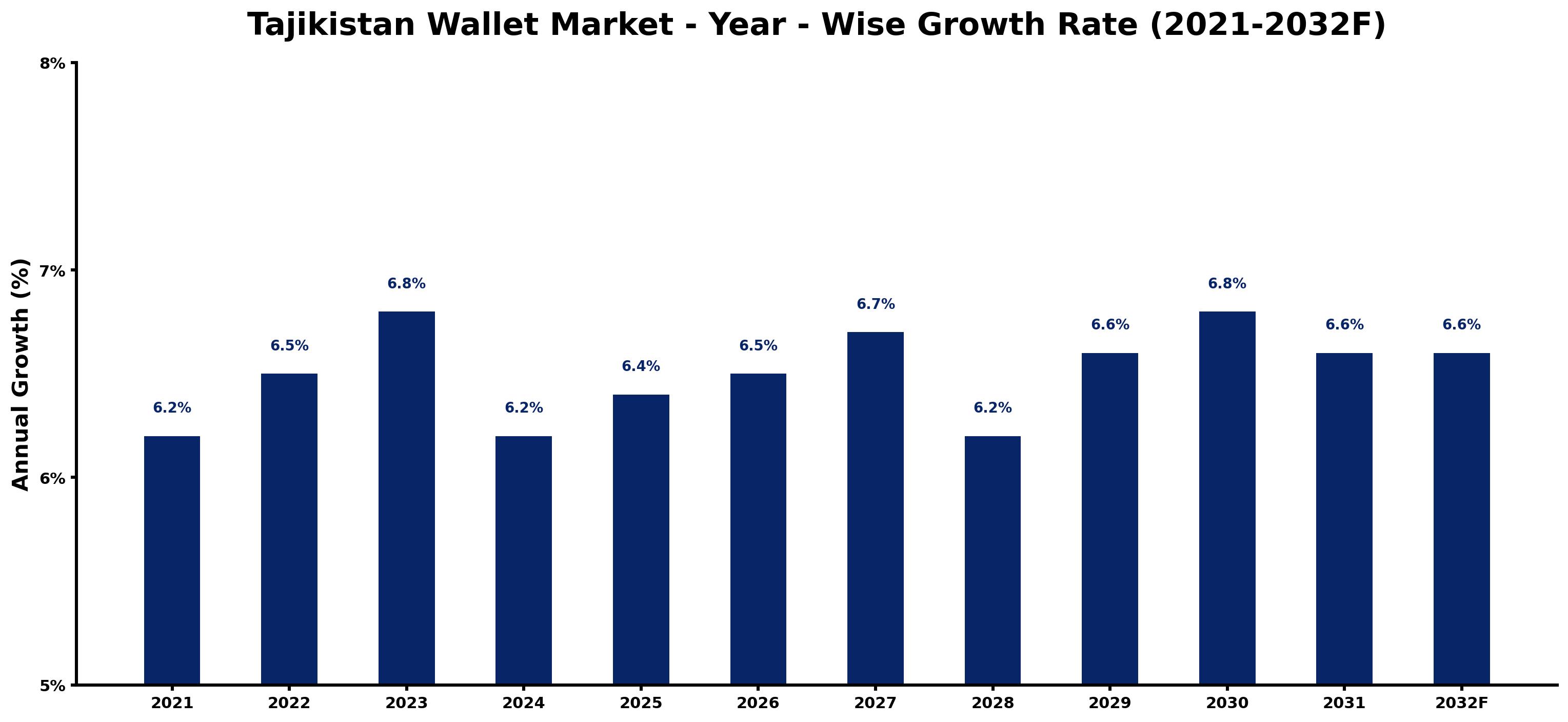
The table below presents the year wise growth rates along with the key drivers influencing the market
| Year | Growth Rate | Major Drivers |
| 2021 | 6.2% | Digital payment platforms began gaining traction among urban youth in Tajikistan. |
| 2022 | 6.5% | Economic recovery post-pandemic spurred investment in mobile wallet technology. |
| 2023 | 6.8% | Increased smartphone penetration facilitated access to digital financial services nationwide. |
| 2024 | 6.2% | Local startups emerged offering tailored wallet solutions for small businesses. |
| 2025 | 6.4% | Cross-border trade with neighboring countries expanded opportunities for digital transactions. |
| 2026 | 6.5% | Consumer awareness campaigns highlighted the benefits of cashless transactions significantly. |
| 2027 | 6.7% | Partnerships between banks and fintech companies enhanced wallet functionalities and security. |
| 2028 | 6.2% | Integration of international payment systems attracted foreign investment and users. |
| 2029 | 6.6% | Rural electrification projects enabled digital payment access in previously underserved areas. |
| 2030 | 6.8% | Cultural shifts toward convenience and efficiency drove more users to adopt wallets. |
| 2031 | 6.6% | Increased collaboration between tech firms and government improved regulatory frameworks significantly. |
| 2032 | 6.6% | Continuous innovation in wallet features kept consumer engagement and loyalty at high levels. |
Note - Market size estimations and growth projections presented in this report are based on 6Wresearch's advanced forecasting approach, validated with industry datasets as of June 2026.
Tajikistan Wallet Market Synopsis
The Tajikistan Wallet Market is projected to reach 6.5% and witness significant growth during the forecast period (2026-2032). This growth is driven primarily by increasing disposable income levels, evolving consumer preferences, and the rising trend of utilizing wallets as fashionable accessories. The expanding middle-class demographic and a growing awareness of international fashion trends are leading consumers in Tajikistan to seek wallets that combine functionality with style. Leather wallets have emerged as the most favored choice due to their durability and premium aesthetics; however, the demand for eco-friendly and sustainable wallet options is also increasing, with consumers showing a preference for wallets crafted from materials such as cork or recycled materials.
Tajikistan Wallet Market Growth Drivers
Several factors contribute to the steady growth of the Tajikistan Wallet Market. Firstly, the increasing disposable income among the population allows consumers to invest more in personal accessories, thereby driving wallet sales. Secondly, the changing consumer preferences towards stylish and multifunctional wallets reflect a shift in lifestyle, where wallets are not merely functional items but also fashion statements. Thirdly, e-commerce platforms are enhancing the market's accessibility, enabling brands to reach a broader audience. Fourthly, the rise in smartphone penetration is facilitating the adoption of digital wallets, making transactional processes more convenient. Lastly, the growing trend towards sustainability encourages consumers to opt for eco-friendly wallet options, which further stimulates market growth.
Tajikistan Wallet Market Trends and Opportunities
The Tajikistan Wallet Market is undergoing significant transformations as it adapts to new consumer desires and technological advancements. Digital wallets are becoming increasingly popular, driven by the surge in smartphone usage and consumer interest in the convenience and security they offer. The trend towards eco-friendly materials is noteworthy, with consumers actively seeking wallets made from recycled or ethically sourced materials. Customized wallets are also gaining traction, as individuals prefer unique designs that reflect personal style. Furthermore, the growing acceptance of contactless payment methods is opening new avenues for wallet manufacturers to innovate and integrate advanced functionalities such as RFID protection and mobile payment capabilities.
Tajikistan Wallet Market Challenges and Restraints
Despite the promising growth prospects, the Tajikistan Wallet Market faces several challenges. One of the main obstacles is the relatively low disposable income among a significant portion of the population, which limits their spending capacity on non-essential items. Additionally, the population's limited access to formal banking services poses a barrier to the adoption of digital wallets. The prevalence of cash transactions further complicates efforts to encourage a shift towards digital payment solutions. Moreover, a lack of consumer awareness regarding the benefits of digital wallets, along with security and privacy concerns, hinders market expansion. Addressing these challenges will necessitate targeted educational initiatives, strategic marketing, and partnerships with local financial institutions.
Tajikistan Wallet Market Government Investment and Initiatives
The government of Tajikistan has recognized the importance of a robust regulatory framework to promote growth within the wallet market. Policies aimed at consumer protection and financial transparency are pivotal in ensuring the safety of consumer funds and personal information. Regulatory measures encourage competition among wallet providers, helping to prevent monopolistic practices in the market. Furthermore, the government actively supports innovation in financial technologies to enhance financial inclusion and accessibility. Initiatives are underway to integrate modern payment systems into the economy, aligning with global standards and fostering a secure environment for both consumers and providers in the Tajikistan Wallet Market.
Tajikistan Wallet Market Latest Developments (May 2025 - June 2026)
Recent developments within the Tajikistan Wallet Market illustrate a significant focus on digital transformation and consumer adaptation. During the specified period, there has been an observable increase in the introduction of digital wallet services, highlighting the sector's responsiveness to technological advancements. Market players are increasingly emphasizing enhanced user experience, security features, and the integration of contactless payments to align with consumer expectations. Furthermore, environmental considerations have gained prominence, with products made from sustainable materials being marketed to eco-conscious consumers. Overall, the wallet market is evolving, influenced by both consumer demand and technological progress.
Tajikistan Wallet Market - Key Attractiveness of the Report
- 10 Years of Market Numbers
- Historical Data Starting from 2022 to 2025
- Base Year: 2025
- Forecast Data until 2032
- Key Performance Indicators Impacting the Market
- Major Upcoming Developments and Projects
Key Highlights of the Report:
- Tajikistan Wallet Market Outlook
- Market Size of Tajikistan Wallet Market, 2025
- Forecast of Tajikistan Wallet Market, 2032F
- Historical Data and Forecast of Tajikistan Wallet Revenues & Volume for the Period 2022-2032F
- Tajikistan Wallet Market Trend Evolution
- Tajikistan Wallet Market Drivers and Challenges
- Tajikistan Wallet Price Trends
- Tajikistan Wallet Porter's Five Forces
- Tajikistan Wallet Industry Life Cycle
- Historical Data and Forecast of Tajikistan Wallet Market Revenues & Volume By Product Type for the Period 2022-2032F
- Historical Data and Forecast of Tajikistan Wallet Market Revenues & Volume By Short Wallet for the Period 2022-2032F
- Historical Data and Forecast of Tajikistan Wallet Market Revenues & Volume By Long Wallet for the Period 2022-2032F
- Historical Data and Forecast of Tajikistan Wallet Market Revenues & Volume By Material for the Period 2022-2032F
- Historical Data and Forecast of Tajikistan Wallet Market Revenues & Volume By Leather for the Period 2022-2032F
- Historical Data and Forecast of Tajikistan Wallet Market Revenues & Volume By Fabric for the Period 2022-2032F
- Historical Data and Forecast of Tajikistan Wallet Market Revenues & Volume By Gender for the Period 2022-2032F
- Historical Data and Forecast of Tajikistan Wallet Market Revenues & Volume By Men for the Period 2022-2032F
- Historical Data and Forecast of Tajikistan Wallet Market Revenues & Volume By Women for the Period 2022-2032F
- Historical Data and Forecast of Tajikistan Wallet Market Revenues & Volume By Kids for the Period 2022-2032F
- Historical Data and Forecast of Tajikistan Wallet Market Revenues & Volume By Distribution Channel for the Period 2022-2032F
- Historical Data and Forecast of Tajikistan Wallet Market Revenues & Volume By Online for the Period 2022-2032F
- Historical Data and Forecast of Tajikistan Wallet Market Revenues & Volume By Offline for the Period 2022-2032F
- Tajikistan Wallet Import Export Trade Statistics
- Market Opportunity Assessment By Product Type
- Market Opportunity Assessment By Material
- Market Opportunity Assessment By Gender
- Market Opportunity Assessment By Distribution Channel
- Tajikistan Wallet Top Companies Market Share
- Tajikistan Wallet Competitive Benchmarking By Technical and Operational Parameters
- Tajikistan Wallet Company Profiles
- Tajikistan Wallet Key Strategic Recommendations






































