Tajikistan Wheat Starch Market Size, Share & Growth Rate
The Tajikistan Wheat Starch Market was estimated at USD 1084 Million in 2025 and is projected to reach USD 1537 Million by 2032, growing at a CAGR of 5.1% from 2026 to 2032. This growth trajectory is primarily fueled by escalating demand across the food and beverage sector, where wheat starch is increasingly utilized as a thickening and stabilizing agent. Moreover, supportive government policies aimed at boosting domestic production and enhancing local supply chains are further propelling market dynamics.
Tajikistan Wheat Starch Market Year-wise Growth Rate and Key Drivers
This graph highlights how the Tajikistan Wheat Starch Market has steadily grown over the years, supported by major growth factors.
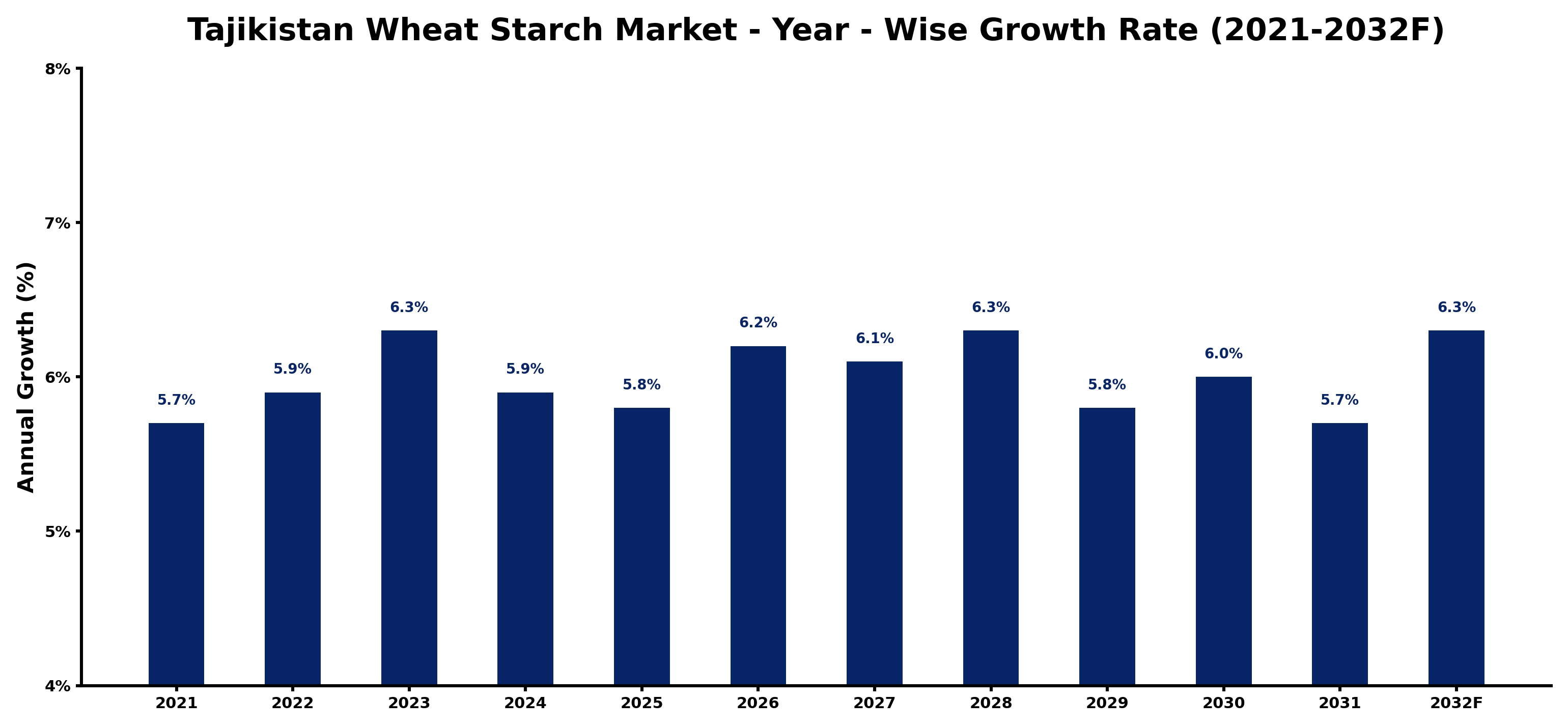
The table below presents the year‑wise growth rates along with the key drivers influencing the market
| Year | Growth Rate | Major Drivers |
| 2021 | 5.7% | Rising demand for gluten alternatives |
| 2022 | 5.9% | Increased consumer health awareness |
| 2023 | 6.3% | Food processing sector expansion |
| 2024 | 5.9% | Growing bakery product innovations |
| 2025 | 5.8% | Enhanced agricultural practices adopted |
| 2026 | 6.2% | Rising popularity of organic products |
| 2027 | 6.1% | Increased exports to neighboring countries |
| 2028 | 6.3% | Technological advancements in production |
| 2029 | 5.8% | Diverse applications in food industry |
| 2030 | 6.0% | Investment in local manufacturing facilities |
| 2031 | 5.7% | Emerging markets for specialty starches |
| 2032 | 6.3% | Sustainability trends driving innovation |
Note - Market size estimations and growth projections presented in this report are based on 6Wresearch's advanced forecasting approach, validated with industry datasets as of June 2026.
Tajikistan Wheat Starch Market Synopsis
The demand for wheat starch in Tajikistan is significantly bolstered by its versatile applications in the food industry, particularly in the production of convenience foods and snacks. As consumer preferences shift towards healthier options, the gluten-free properties of wheat starch have garnered attention, thereby widening its market appeal.
On the supply side, Tajikistan's robust agricultural sector plays a crucial role in providing the necessary raw materials for starch production. The government's initiative to promote local farming not only supports the wheat supply chain but also aims to reduce the reliance on imported starch products, contributing positively to market stability.
Tajikistan Wheat Starch Market Key Takeaways
- The market is projected to grow substantially due to rising health consciousness among consumers.
- Government initiatives are enhancing local production capabilities and infrastructure.
- Technological advancements in starch processing are improving product quality and efficiency.
- Investment opportunities in production and distribution networks are expanding.
- Awareness of the diverse applications of wheat starch is increasing across industries.
Evaluation of Restraints in Tajikistan Wheat Starch Market
Despite its potential, the Tajikistan Wheat Starch Market faces notable constraints. Fluctuations in wheat production, largely influenced by climate change, pose a threat to the stability of raw material supplies. Limited access to modern processing technologies further hampers efficiency and product quality. Additionally, the market struggles with inadequate distribution channels and competition from imported starches, which challenge local producers' market share and growth prospects. Addressing these barriers will be crucial for the market's long-term sustainability.
Tajikistan Wheat Starch Market Trends
A shift towards sustainable production methods is currently shaping the Tajikistan Wheat Starch Market. Manufacturers are increasingly focusing on environmentally friendly practices, aiming to minimize waste and energy consumption in their processes. Additionally, the adoption of innovative processing techniques is enhancing product quality, which, coupled with rising demand in pharmaceuticals and textiles, is driving further market expansion.
Tajikistan Wheat Starch Market Opportunities
The market presents various investment opportunities, particularly in the establishment of wheat starch production facilities. Given Tajikistan's strategic location along the Silk Road, there is potential for export to neighboring countries, enhancing market reach. Furthermore, investing in research and development to improve processing technologies can yield competitive advantages in quality and efficiency, thereby capturing a larger share of the market as demand grows.
Government Initiatives in the Tajikistan Wheat Starch Market
The Tajikistan government is actively implementing policies designed to bolster domestic production of wheat starch. These initiatives include financial support and subsidies for local wheat farmers, aimed at enhancing production levels. Moreover, the government is prioritizing infrastructure improvements and technological advancements in agriculture to elevate productivity and quality standards, ensuring that local products can compete effectively against imports. Such measures are critical for nurturing a sustainable and resilient wheat starch market.
Future Insights of the Tajikistan Wheat Starch Market
Looking ahead, the Tajikistan Wheat Starch Market is expected to maintain its upward trajectory between 2026 and 2032. Factors such as population growth, increasing disposable incomes, and the rise in demand for convenient food options will continue to drive market growth. Nevertheless, stakeholders should remain vigilant regarding potential fluctuations in wheat prices and competition from alternative starch sources. Overall, the market's capacity for innovation and diversification will be vital in catering to evolving consumer preferences.
Tajikistan Wheat Starch Market Latest Developments (May 2025 - June 2026)
Recent developments in the Tajikistan Wheat Starch Market indicate a growing emphasis on improving production techniques and sustainability. Manufacturers are increasingly investing in modern processing technologies to enhance the quality of wheat starch. Additionally, there are movements towards establishing stronger distribution networks to facilitate better market access for locally produced starch. Collaborative efforts among stakeholders are also being observed to promote the benefits of wheat starch in various applications.
Tajikistan Wheat Starch Market - Key Attractiveness of the Report
- 10 Years of Market Numbers
- Historical Data Starting from 2022 to 2025
- Base Year: 2025
- Forecast Data until 2032
- Key Performance Indicators Impacting the Market
- Major Upcoming Developments and Projects
Key Highlights of the Report:
- Tajikistan Wheat Starch Market Outlook
- Market Size of Tajikistan Wheat Starch Market, 2025
- Forecast of Tajikistan Wheat Starch Market, 2032
- Historical Data and Forecast of Tajikistan Wheat Starch Revenues & Volume for the Period 2022-2032F
- Tajikistan Wheat Starch Market Trend Evolution
- Tajikistan Wheat Starch Market Drivers and Challenges
- Tajikistan Wheat Starch Price Trends
- Tajikistan Wheat Starch Porter's Five Forces
- Tajikistan Wheat Starch Industry Life Cycle
- Historical Data and Forecast of Tajikistan Wheat Starch Market Revenues & Volume By Type for the Period 2022-2032F
- Historical Data and Forecast of Tajikistan Wheat Starch Market Revenues & Volume By Native Wheat Starch for the Period 2022-2032F
- Historical Data and Forecast of Tajikistan Wheat Starch Market Revenues & Volume By Modified Wheat Starch for the Period 2022-2032F
- Historical Data and Forecast of Tajikistan Wheat Starch Market Revenues & Volume By Grade for the Period 2022-2032F
- Historical Data and Forecast of Tajikistan Wheat Starch Market Revenues & Volume By Food Grade for the Period 2022-2032F
- Historical Data and Forecast of Tajikistan Wheat Starch Market Revenues & Volume By Industrial Grade for the Period 2022-2032F
- Historical Data and Forecast of Tajikistan Wheat Starch Market Revenues & Volume By End-Users Industry for the Period 2022-2032F
- Historical Data and Forecast of Tajikistan Wheat Starch Market Revenues & Volume By Food and Beverages for the Period 2022-2032F
- Historical Data and Forecast of Tajikistan Wheat Starch Market Revenues & Volume By Cosmetics for the Period 2022-2032F
- Historical Data and Forecast of Tajikistan Wheat Starch Market Revenues & Volume By Others for the Period 2022-2032F
- Tajikistan Wheat Starch Import Export Trade Statistics
- Market Opportunity Assessment By Type
- Market Opportunity Assessment By Grade
- Market Opportunity Assessment By End-Users Industry
- Tajikistan Wheat Starch Top Companies Market Share
- Tajikistan Wheat Starch Competitive Benchmarking By Technical and Operational Parameters
- Tajikistan Wheat Starch Company Profiles
- Tajikistan Wheat Starch Key Strategic Recommendations






































