Tajikistan Whiskey Market Size, Share & Growth Rate
The Tajikistan Whiskey Market was estimated at USD 492 Million in 2025 and is projected to reach USD 649 Million by 2032, growing at a CAGR of 4.0% from 2026 to 2032. This growth trajectory is predominantly fueled by increasing disposable incomes among the younger, urban population, who are increasingly drawn to premium spirits. Furthermore, the market is witnessing a gradual shift in consumer preferences towards high-quality whiskey, creating new opportunities for both local and international brands.
Tajikistan Whiskey Market Year-wise Growth Rate and Key Drivers
This graph highlights how the Tajikistan Whiskey Market has steadily grown over the years, supported by major growth factors.
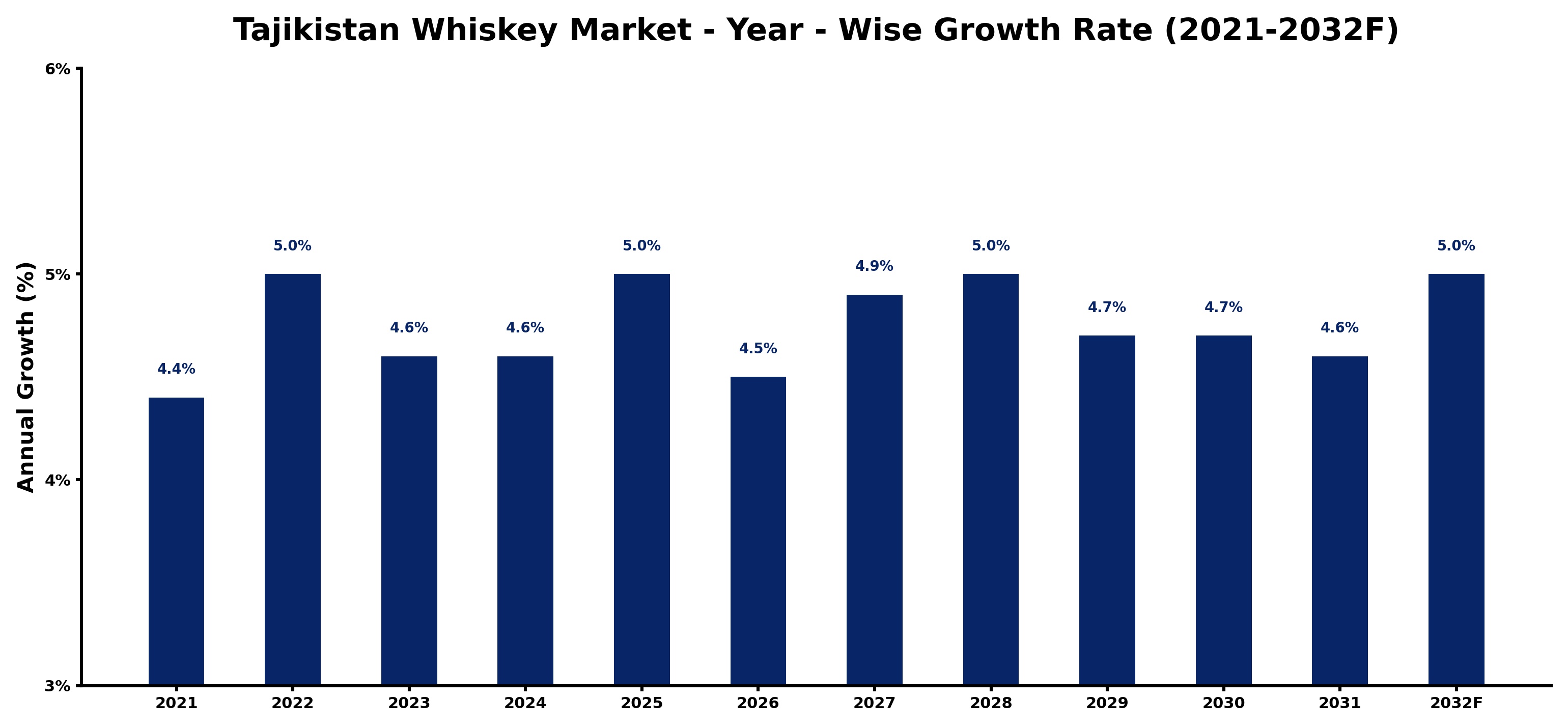
The table below presents the year‑wise growth rates along with the key drivers influencing the market
| Year | Growth Rate | Major Drivers |
| 2021 | 4.4% | Increased consumer interest in whiskey |
| 2022 | 5.0% | Emerging craft distilleries entered market |
| 2023 | 4.6% | Tourism growth enhanced whiskey sales |
| 2024 | 4.6% | Social media marketing expanded reach |
| 2025 | 5.0% | Whiskey tasting events gained popularity |
| 2026 | 4.5% | Local production improved product variety |
| 2027 | 4.9% | Collaborations with bars increased visibility |
| 2028 | 5.0% | Whiskey education programs attracted consumers |
| 2029 | 4.7% | International brands entered market space |
| 2030 | 4.7% | E-commerce platforms enhanced accessibility |
| 2031 | 4.6% | Cultural events promoted whiskey consumption |
| 2032 | 5.0% | Sustainability initiatives attracted new customers |
Note - Market size estimations and growth projections presented in this report are based on 6Wresearch’s advanced forecasting approach, validated with industry datasets as of June 2026.
Tajikistan Whiskey Market Synopsis
In recent years, whiskey has emerged as an intriguing alternative to traditional alcoholic beverages in Tajikistan, where vodka and brandy have long been favorites. Urban centers are witnessing a burgeoning interest in whiskey, particularly among young adults who seek sophisticated drinking experiences and unique flavors.
This evolving market landscape is characterized by an increasing number of whiskey tasting events and educational programs that further enhance consumer appreciation. As local distilleries begin to explore whiskey production, the market is set to diversify, aligning with global trends towards premium and artisanal spirits.
Tajikistan Whiskey Market Key Takeaways
- The market is witnessing a steady uptick in demand for premium and high-quality whiskey brands.
- Consumer preferences are shifting towards unique flavor profiles, with single malts and blended varieties gaining popularity.
- Challenges related to high import taxes and limited distribution networks remain significant obstacles for market growth.
- Urbanization and rising disposable incomes contribute to the expanding consumer base for whiskey in Tajikistan.
- The local distillation scene is starting to evolve, with more players attempting to enter the whiskey market.
Evaluation of Restraints in Tajikistan Whiskey Market
Despite the promising outlook for the Tajikistan whiskey market, several constraints hold it back from realizing its full potential. One major restraint is the traditional consumer preference for vodka and locally produced spirits, which dominate the cultural drinking landscape. Additionally, high import taxes on whiskey products can lead to elevated retail prices, making them less accessible to average consumers. The lack of robust distribution channels further complicates the availability of premium whiskey brands, limiting exposure and trial opportunities for potential buyers.
Tajikistan Whiskey Market Trends
The Tajikistan whiskey market is marked by a discernible trend towards premiumization, where consumers are increasingly gravitating towards higher quality offerings. Whiskey tasting events are on the rise, fostering a culture that values the nuances of flavor and craftsmanship. Moreover, social media and digital marketing play pivotal roles in shaping consumer perceptions and driving interest in imported brands. As a result, whiskey is becoming not just a drink, but a lifestyle choice among the younger demographic.
Tajikistan Whiskey Market Opportunities
Investment opportunities abound in the Tajikistan whiskey market, particularly for brands looking to penetrate an evolving consumer landscape. There is potential for developing branded whiskey bars and lounges in urban areas, targeting young professionals eager to experience premium spirits in a social setting. Additionally, strategic partnerships with local retailers can enhance market penetration and improve distribution efficiency, allowing international brands to establish a foothold.
Government Initiatives in the Tajikistan Whiskey Market
Government policies surrounding the Tajikistan whiskey market primarily focus on regulating the production, sale, and consumption of alcoholic beverages. The government has established strict licensing requirements to ensure quality control and consumer safety. Furthermore, regulations monitor marketing practices to promote responsible consumption. While these policies are designed to balance public health concerns with industry growth, they also create a structured environment for establishing local distilleries and enhancing consumer awareness.
Future Insights of the Tajikistan Whiskey Market
Looking ahead to 2026-2032, the Tajikistan whiskey market is poised for gradual expansion as economic conditions improve and consumer preferences evolve. The increasing trend of social gatherings and a burgeoning urban nightlife will likely further facilitate whiskey consumption. While challenges like high import costs and entrenched local preferences remain, the overall trajectory suggests that the market will continue to mature, offering substantial opportunities for brands that can effectively engage with the emerging consumer base.
Tajikistan Whiskey Market Latest Developments (May 2025 - June 2026)
Recent developments in the Tajikistan whiskey market indicate a growing enthusiasm for whiskey education among consumers, with multiple tasting events being hosted in urban centers. Local distilleries are starting to gain recognition for innovative whiskey varieties, indicating a shift in market dynamics. Additionally, international brands are beginning to adapt their marketing strategies to better resonate with local consumers, aiming to enhance brand visibility and consumer engagement.
Tajikistan Whiskey Market - Key Attractiveness of the Report
- 10 Years of Market Numbers
- Historical Data Starting from 2022 to 2025
- Base Year: 2025
- Forecast Data until 2032
- Key Performance Indicators Impacting the Market
- Major Upcoming Developments and Projects
Key Highlights of the Report:
- Tajikistan Whiskey Market Outlook
- Market Size of Tajikistan Whiskey Market, 2025
- Forecast of Tajikistan Whiskey Market, 2032
- Historical Data and Forecast of Tajikistan Whiskey Revenues & Volume for the Period 2022-2032F
- Tajikistan Whiskey Market Trend Evolution
- Tajikistan Whiskey Market Drivers and Challenges
- Tajikistan Whiskey Price Trends
- Tajikistan Whiskey Porter's Five Forces
- Tajikistan Whiskey Industry Life Cycle
- Historical Data and Forecast of Tajikistan Whiskey Market Revenues & Volume By Product Type for the Period 2022-2032F
- Historical Data and Forecast of Tajikistan Whiskey Market Revenues & Volume By American Whisky for the Period 2022-2032F
- Historical Data and Forecast of Tajikistan Whiskey Market Revenues & Volume By Irish Whisky for the Period 2022-2032F
- Historical Data and Forecast of Tajikistan Whiskey Market Revenues & Volume By Scotch Whisky for the Period 2022-2032F
- Historical Data and Forecast of Tajikistan Whiskey Market Revenues & Volume By Canadian Whisky for the Period 2022-2032F
- Historical Data and Forecast of Tajikistan Whiskey Market Revenues & Volume By Others for the Period 2022-2032F
- Historical Data and Forecast of Tajikistan Whiskey Market Revenues & Volume By Distribution Channel for the Period 2022-2032F
- Historical Data and Forecast of Tajikistan Whiskey Market Revenues & Volume By On-trade for the Period 2022-2032F
- Historical Data and Forecast of Tajikistan Whiskey Market Revenues & Volume By Off-trade for the Period 2022-2032F
- Tajikistan Whiskey Import Export Trade Statistics
- Market Opportunity Assessment By Product Type
- Market Opportunity Assessment By Distribution Channel
- Tajikistan Whiskey Top Companies Market Share
- Tajikistan Whiskey Competitive Benchmarking By Technical and Operational Parameters
- Tajikistan Whiskey Company Profiles
- Tajikistan Whiskey Key Strategic Recommendations






































